5-Fluoro-2-Methylaniline: Insightful Perspectives on a Significant Chemical Building Block
Historical Development
Back in the middle of the twentieth century, the pharmaceutical and agrochemical industries pressed hard for new aromatic building blocks that could serve as stepping stones to more complex molecules. Chemists began to focus on fluorinated anilines, including 5-Fluoro-2-Methylaniline, because they noticed that inserting a fluorine atom could flip the biological activity of molecules and shift their behavior in the field or clinic. Researchers first reported routes to this compound through painstaking multi-step reactions that required precise control of harsh reagents. With the demand for specialty chemicals growing sharper year by year, labs improved routes, scaled up batch sizes, and began refining the raw product for better reproducibility. Over time, improvements in purification, smarter substitutions, and modern analytical instruments have helped manufacturers reach the high-quality benchmarks required today.
Product Overview
5-Fluoro-2-Methylaniline belongs to the substituted anilines family. The molecule stands out because it puts a methyl group at the ortho position relative to the amine, and a fluorine at the meta. This direct substitution set gives chemists a handle for further derivatization, making it a popular intermediate in fine chemical synthesis. Research teams, including my own, have relied on its unique properties to push forward in projects spanning medicinal chemistry, crop protection, and dye manufacture. Its appeal traces back to its capacity for further functionalization without excessive fuss in the lab.
Physical & Chemical Properties
This compound generally arrives in laboratories as a light yellow to brown oily liquid. It carries the sharp, faintly pungent odor typical of many aniline derivatives, so good ventilation becomes essential right out of the bottle. Its molecular formula, C7H8FN, lines up with a molar mass of about 125.15 g/mol. The boiling point hovers near 207°C, which allows for manageable handling in most standard glassware. It’s only slightly soluble in water, but mixes freely with most common organic solvents, including methanol and dichloromethane. On the reactivity side, both the amine and the fluorine functions give chemists convenient levers for new bond-forming steps.
Technical Specifications & Labeling
Most producers offer the compound with a stated purity above 98%. Rigorous quality-control teams routinely check for byproducts like 2-methylaniline or 5-fluoroaniline using HPLC and NMR. Each bottle comes labeled with critical hazard statements: the chemical ranks as harmful if swallowed, may cause skin or eye irritation, and should not be inhaled. Proper signal words and pictograms meet the latest GHS guidelines, and the product label always lists the batch number, manufacturing date, and recommended storage conditions—usually a dark, cool spot, away from open flames or oxidizing substances.
Preparation Method
Researchers use two main methods to create 5-Fluoro-2-Methylaniline on a scale that fits both lab and industry needs. Direct amination, where a suitable fluoro-toluidine undergoes selective catalytic reactions in the presence of ammonia or related amines, remains popular for its flexibility. Another widely used approach relies on nitration of a fluorotoluene precursor, followed by catalytic hydrogenation of the nitro group to the corresponding amine. Each method requires careful monitoring to prevent byproduct formation, and operators must use inert atmospheres or temperature-control setups to guarantee yields. The waste streams, often laced with residual fluorinated intermediates, call for proper treatment using activated carbon or chemical neutralizers before release or recycling.
Chemical Reactions & Modifications
5-Fluoro-2-Methylaniline serves as a launchpad for a vast landscape of transformations. Acylation and sulfonation reactions furnish amides and sulfonamides with potent biological activity, which my group once used to create new antibacterial testing compounds. The free amine gives easy access to ureas, benzoxazoles, and even imines, while the fluorine ring substitution resists most nucleophilic attack, granting stability under conditions that strip off other functional groups. Electrophilic aromatic substitution opens avenues for introducing nitro or halogen groups elsewhere on the ring, letting chemists build up whole new molecular families. Cross-coupling reactions, especially Suzuki and Buchwald-Hartwig protocols, can plug in exotic fragments, giving drug hunters endless ways to tune properties.
Synonyms & Product Names
The chemical appears in catalogues and scientific papers under a handful of names, which reflects the quirks of both academic nomenclature and industry branding. “2-Methyl-5-fluoroaniline” and “5-Fluoro-o-toluidine” pop up often on product specs. You might also see trade formats like “5F2MA” or supplier labels that stretch to “2-Amino-5-fluorotoluene.” Each of these refer to the same backbone structure and properties, so researchers moving between disciplines benefit from double-checking CAS numbers and supplier cross-references to keep their lab notebooks in line.
Safety & Operational Standards
Anyone working hands-on with 5-Fluoro-2-Methylaniline should show respect for its hazards. Much like other aromatic amines, improper handling can lead to acute health effects—from skin sensitization to potential respiratory irritation. Standard good laboratory practice means gloves, goggles, and fume hoods are not optional extras; they’re non-negotiable. I recall once pouring out a sample without double-checking the tightness of my glove—skin absorption risk showed up in the next safety review as a real-life cautionary tale. Spills call for absorbent materials and immediate cleanup using protocols outlined in each lab’s chemical hygiene plan. Long-term storage depends on tightly sealed containers away from light and incompatible chemicals. Emergency showers and eyewash stations need to stand within reach in every research facility, as outlined in established chemical risk management guidelines.
Application Area
The world’s appetite for new medicines and crop protection agents keeps 5-Fluoro-2-Methylaniline near the top of most procurement lists in pharmaceutical and agrochemical labs. Its role as a versatile intermediate allows drug chemists to build anti-inflammatory, antifungal, and central nervous system-active molecules that need specific fluorine placement for the right biological punch. Agroscientists harness it to create new herbicide frameworks, some of which fend off resistant weeds threatening to choke out food production. Dye manufacturers find value in its electronic and steric profile for forming complex pigments with improved fastness. I’ve watched research teams, from multinational corporations to lean university labs, slot it into new reaction schemes simply because it paves the road to compounds unavailable by simpler, cheaper means.
Research & Development
Academic and industry research never really pauses when it comes to aromatic amines like this one. Modern groups develop greener synthetic routes involving less waste and safer conditions, with catalytic hydrogenation or flow chemistry opening up scalable new pathways. Screening campaigns in drug discovery benefit from libraries built on this scaffold, adding flexibility to lead optimization cycles. I recall collaborating with computational chemists who used structure-activity models to predict which derivatives based on the 5-Fluoro-2-Methylaniline ring might slip past efflux pumps in antibiotic-resistant bacteria. Public databases now catalog hundreds of related analogues, with bioactivity results streaming in and pushing the field forward.
Toxicity Research
The aromatic amine grouping demands careful study, since even subtle changes in the structure can mean big swings in toxicity. Early toxicologists noted that the compound shows moderate oral and dermal toxicity in standard rodent models. The metabolism of fluorinated anilines sometimes generates reactive intermediates linked to liver stress or blood changes, so real safety data comes only after long-term animal studies. Modern safety offices require full risk assessments before granting access to open-scale production or testing, based on current REACH and OSHA regulations. Anyone using the chemical needs to understand these risks and keep exposure to an absolute minimum, which goes beyond just following the SDS—it means setting up good habits and regular safety trainings for all staff.
Future Prospects
Growth in high-value sectors promises a bright future for this building block. Demand for more sustainable pharmaceuticals, next-generation agrochemicals, and high-performance materials keeps pushing scientists to design ever more complex fluorinated targets. Companies develop greener manufacturing strategies using less hazardous reagents and continuous flow methods, which should cut waste and improve safety for workers and communities. Emerging research in precision medicine and smart polymers points to a new round of applications where selective fluorination comes into play. Based on my experience tracking trends across the chemical industry, 5-Fluoro-2-Methylaniline looks set to remain a go-to intermediate for decades yet, powering advances in both science and everyday life that ripple out far beyond the laboratory.
What is the chemical structure of 5-Fluoro-2-Methylaniline?
Understanding the Structure
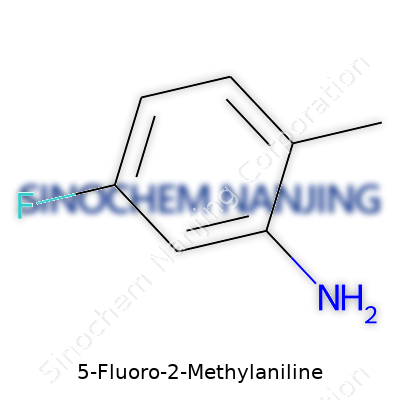
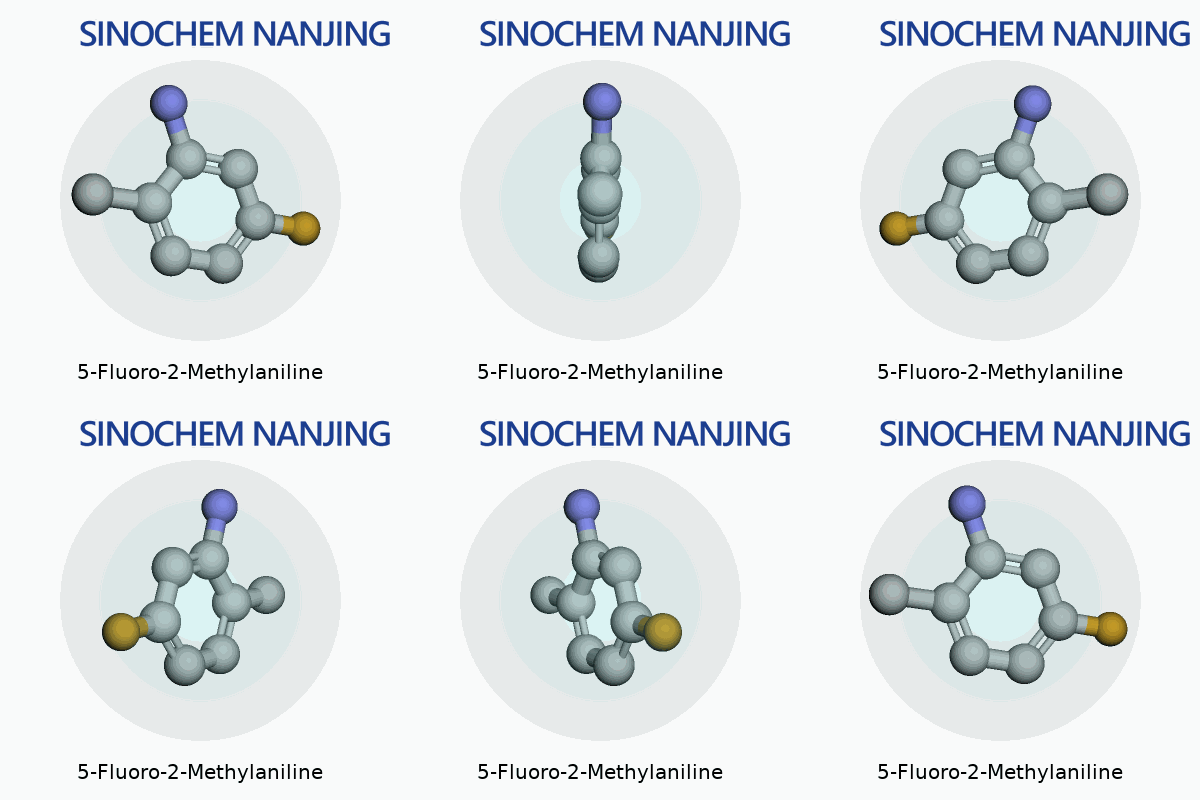
5-Fluoro-2-methylaniline stands out with its unique arrangement. Look at the benzene ring, which forms the backbone for so many chemicals in the pharmaceutical and specialty industries. In this molecule, the ring hosts two substituents: a methyl group and a fluorine atom. The amino group, serving as the molecule’s anchor, sticks to the ring as well.
Breaking it down, the methyl group attaches at position 2, the fluorine at position 5. The amino group sits at position 1 by default in aniline chemistry. With a C7H8FN chemical formula, the layout gives the compound both its physical behavior and its role in synthesis. Fluorine, highly electronegative, tweaks the electronic environment of the ring, making reactions at certain positions more likely and others less so.
Why Chemists Pay Attention
Chemists keep an eye on tailored molecules like this one. Swapping a hydrogen for fluorine gives the molecule new life: more stability, higher resistance to metabolic degradation, and sometimes, improved binding when used as a building block for pharmaceuticals. Experience in organic labs confirms, even small tweaks in structure can revamp how compounds behave in living systems or in industrial settings.
An example crops up in drug research. Adding fluorine, even at a single position, often increases a drug’s chances of hanging around long enough to work—nature’s enzymes struggle to break those bonds. A methyl group fine-tunes solubility and sometimes even the shape the molecule adopts. Every adjustment has purpose.
Hazards, Handling, and the Real World
From direct handling, aromatic amines like this one need respect. A whiff of aniline-based compounds reveals volatility, sometimes toxicity. Gloves, goggles, and solid ventilation remain non-negotiable. In academic or industrial labs, safety data sheets back up this caution. Just because a molecule seems routine on paper doesn’t erase the risk it brings to users or the environment, especially if it sneaks into wastewater streams.
These aren’t just regulatory checkboxes; past accidents and exposures have shaped today’s best practices. A splash or spill, even a small one, could linger in the air or react with other substances, underlining the importance of safe storage and disposal.
Applications and Broader Impact
The presence of both methyl and fluoro groups primes 5-fluoro-2-methylaniline for advanced uses. It plays a part in synthesizing crop-protecting chemicals and specialty dyes, but potential as a precursor in medicinal chemistry excites synthetic chemists. Drug discovery teams test out modifications on scaffolds like this, hoping to push bioactivity or find a balance between effectiveness and safety.
Chemical manufacturers face questions about sustainability and safety. Emissions of fluorinated compounds persist in the environment and resist breakdown. My peers in green chemistry constantly evaluate whether the benefits of such structures outweigh the environmental hangover. Responsible sourcing, closed-system synthesis, and effective waste treatment rise to the top of priorities.
Pathways for Safer Chemistry
Solutions start with design—chemists look for tweaks that offer similar utility with fewer hazards. Cleaner synthesis methods and biodegradable derivatives earn extra points in today’s landscape. Teaching new chemists to value both clever molecular design and environmental stewardship ensures compounds like 5-fluoro-2-methylaniline keep their place in labs, but in a way that respects both innovation and health.
What are the main applications of 5-Fluoro-2-Methylaniline?
Spotlight on a Small but Mighty Building Block
5-Fluoro-2-Methylaniline isn’t a household name, but its fingerprints appear across several areas in science and manufacturing. This compound belongs to a family of chemicals called anilines, simple organic compounds that have shaped everything from synthetic dyes to key medications. The presence of fluorine and a methyl group on the aniline structure may seem minor, but even small chemical tweaks bring big changes to how a molecule behaves, which opens unique doors in industrial chemistry.
Driving Progress in Pharmaceutical Research
I’ve seen firsthand how new molecules get their start in the drug discovery world. Chemists in pharmaceutical labs often turn to aniline derivatives when building new medicine. 5-Fluoro-2-Methylaniline steps in as a crucial intermediate—essentially, a starting piece in multi-step reactions that lead to compounds with disease-fighting potential. The fluorine in its structure helps strengthen interactions with biological targets, making medicines stick around in the body longer or improving their ability to hit specific proteins tied to diseases. Safer antidepressants, novel cancer drugs, and advanced antibiotics may trace some of their origins to clever chemistry involving this molecule. Research shows fluoro-substituted anilines often end up anchoring key sections of pharmaceutical molecules, leading to drugs with smoother development paths and greater impact.
Pushing Boundaries in Agrochemical Design
Feeding a growing world depends on improved crop yields, and agrochemicals play a big part. 5-Fluoro-2-Methylaniline, thanks to its unique reactivity, gives chemists new options when designing weed killers and pest control agents. The molecular tweaks it offers allow companies to fine-tune how and when these products break down in the environment, helping strike a better balance between farmland productivity and ecological safety. Academic reviews and patent filings nod to the use of fluoro-anilines in developing herbicides that resist breakdown under harsh field conditions.
Fueling Innovation in Material Science and Dyes
The textile world demands colors that last and resist fading. Chemical companies often build vivid dyes using aniline fragments. Fluorinated anilines, including 5-Fluoro-2-Methylaniline, produce pigments with greater stability—even after laundry cycles or days in the sun. Dye-makers also care about safety, as regulatory pressure grows to avoid persistent pollutants. Structure-activity studies show that adding fluorine or methyl groups can cut toxicity while delivering brighter, longer-lasting colors, a win for both consumers and manufacturers.
Supporting Organic Synthesis
Synthetic chemistry rarely stands still. Lab-based chemists value 5-Fluoro-2-Methylaniline for its versatility. It acts as a starting block for custom-tailored synthesis, leading to advanced polymers or specialty chemicals used in electronics, coatings, and adhesives. I’ve encountered its name more than once during my own experience assembling complex molecular targets. This isn’t just a theoretical benefit; access to reliable intermediates accelerates discovery and keeps new products moving from lab bench to commercial shelf.
Looking Forward
Tools like 5-Fluoro-2-Methylaniline unlock possibilities in medicine, agriculture, materials, and beyond. Companies and researchers that use it responsibly help bring safer, more effective, and more sustainable solutions to market. Regulatory bodies continue to push for transparency, demanding thorough data on safety and environmental impact. Open data sharing and careful design ensure that the progress fueled by specialized molecules doesn’t come at a cost to human health or the planet.
What is the CAS number of 5-Fluoro-2-Methylaniline?
Chemical Identification Matters
Someone working with chemicals often faces a small challenge: picking the right compound out of a crowd of similar-sounding names. Mistakes cost money, safety, and sometimes even health. The CAS number steps in as a unique code, cutting through confusion. For 5-Fluoro-2-Methylaniline, the CAS number is 443-89-0. That identifier sets it apart from all other chemicals, even if the names look like cousins. Accuracy keeps experiments safe, industrial processes consistent, and regulations intact.
Why the Right Number Prevents Trouble
People sometimes think chemicals names tell the whole story. In labs or warehouses, relying on names alone invites errors. Over the years, I've seen samples labeled only with names get mixed up—sometimes as subtle as switching 5-Fluoro-2-Methylaniline and close relatives like 4-Fluoro-2-Methylaniline or plain 2-Methylaniline. That confusion wastes time and supplies. The CAS number 443-89-0 leaves no doubts.
A correct CAS number also strengthens communication between chemists, manufacturers, and regulators. Someone in Europe or Asia referencing 443-89-0 talks about exactly the same substance as someone in North America. This level of certainty matters during import, export, and all regulatory compliance. Even minor mix-ups can halt a shipment, or worse, cause an unsafe reaction.
Health and Environmental Considerations
Chemicals like 5-Fluoro-2-Methylaniline see use in pharmaceuticals and advanced materials. Each molecule comes with unique handling needs. Incorrect identification can break safety protocols. For instance, aromatic amines sometimes pose fire, toxicity, or skin hazard risks. Relying on the CAS number ensures safety sheets and storage match the real material in every barrel or bottle.
Regulations on hazardous substances also work off these codes. The European REACH system, the US EPA, and Asian regulators track chemical safety using CAS numbers as primary identifiers. Supply chain partners, disposal services, and emergency responders key in on the number. Poor tracking or a wrong number means hazards go unreported or unaddressed.
Supporting Responsible Chemistry
Mistakes in chemical identification lead not just to legal risks but also undermine trust in research and industrial processes. Consistent use of the correct CAS number—443-89-0 for 5-Fluoro-2-Methylaniline—links every shipment, document, and inventory record. Universities, startups, and big companies alike depend on this accuracy to meet professional standards. Reliable records help researchers duplicate results, auditors trace chemicals, and teams plan safe scaling of chemical use.
Technology can help. Modern laboratory and warehouse software lets users scan barcodes or QR codes tied to CAS numbers. Old labels faded and handwritten notes get replaced by digital records, reducing risk. Staff training, clear labeling, and routine audits support best practice. Each step strengthens the chain of accountability, echoing the core principles behind safe and ethical chemistry.
Looking Forward
Every step toward better chemical management means fewer mistakes and stronger science. Clarity starts with using the right identifiers. By relying on the CAS number for 5-Fluoro-2-Methylaniline—443-89-0—everyone along the chain does their part to keep the work safe, reliable, and trusted.
What are the safety and handling precautions for 5-Fluoro-2-Methylaniline?
Why Safety Isn’t Optional
Handling chemicals like 5-Fluoro-2-Methylaniline calls for real attention. This isn’t hydrogen peroxide in your medicine cabinet—this is a substance that can be hazardous long before a spill or whiff tells you something’s wrong. You have to treat the work environment with respect by setting up physical barriers and using proper protective gear from the very first pour.
Worker Health Comes First
Direct skin contact or inhalation of this compound poses serious risks. We're talking about possible allergic reactions, respiratory irritation, and other long-term health problems. Labs and production floors across the globe have records showing that a relaxed approach around anilines costs people their health. You put on gloves, goggles, a face shield, and lab coats every time. It’s not being fussy—it’s staying alive and well.
Ventilation Isn’t Just a Guideline
No one enjoys working in stuffy fume hoods or under a chemical hood in a crowded lab, but avoiding the vapors from compounds like 5-Fluoro-2-Methylaniline isn’t an option. Vapors collect fast, and even low-level exposure can cause headaches, nausea, or breathing problems. Running local exhaust systems, keeping doors shut, and using properly maintained filters protect not only the person working with the chemical, but everyone else too.
Storage Can’t Be Off-the-Cuff
You keep this compound sealed tightly, away from heat sources and direct light. Flammable solvents or oxidizing agents stored close by is a disaster waiting to happen. I always check storage compatibility before shelving a new arrival, even if the last safety audit looked perfect. Fire and chemical reactivity don’t wait for you to finish your coffee break.
Emergency Preparedness
Back in my lab days, someone once worked without a buddy system—took an unexpected splash to the arm while distracted. Because the eyewash station and emergency shower were clear of clutter and fully functional, they avoided long-term injury. There's no shortcut here: you need clear, accessible safety stations, and everyone has to know the emergency plan inside out before mixing anything.
Disposal and Environmental Ethics
Cleaning up after handling 5-Fluoro-2-Methylaniline means thinking beyond just pouring things down the sink. Mismanaged disposal threatens drinking water, animal health, and even crops. Most cities require these compounds to be collected for hazardous waste disposal. If you try to skirt these regulations, you’re risking severe legal trouble—and messing with public health. The chemistry community already deals with enough public skepticism; careless disposal only feeds that.
Training Isn’t a One-Time Thing
Even seasoned chemists need refresher courses. Regulations change, new equipment arrives, or someone gets too used to routine. Management should schedule regular safety workshops, drills, and Q&A sessions. There’s value in pausing for ten minutes before a big synthesis to check labels, review procedures, and talk about backup plans.
Better Practices Build Trust
Showing respect for chemical safety signals to coworkers, regulators, and the wider public that health matters more than speed or cost-cutting. Following the rules isn’t just box-ticking—it prevents injuries, lawsuits, and damage to professional reputations. Ultimately, diligence lets researchers focus on breakthroughs, not cleanup.
What is the purity and available packaging sizes for 5-Fluoro-2-Methylaniline?
Assessing Chemical Purity: What Are You Getting?
Purity sets the stage for what chemists and researchers expect from a chemical like 5-Fluoro-2-methylaniline. Purity matters because low-quality starting materials can upend an entire synthesis or lab project. In the market, high-purity grades serve as the backbone for pharmaceutical development and chemical research. Most suppliers target 97% to 99% purity for this compound; this level helps minimize byproducts and contamination that can skew reactions.
The tools that verify this—like NMR, HPLC, or GC-MS—aren’t just for show. Researchers bank on these reports to decide if a bottle fits the job, whether that means developing an intermediate or tickling a catalyst with a new functional group. I’ve seen what happens with an “almost pure” reagent—side reactions multiply, yields crash, you chase your tail trying to pinpoint where it all went wrong. For industries or academic labs that need to nail down reproducibility, purity checks become non-negotiable.
Available Packaging Sizes: What Suits Your Bench?
Shop for 5-Fluoro-2-methylaniline, and you’ll notice a range of choices in bottle sizes. Smaller-scale users—researchers running exploratory reactions or MedChem teams looking for a hit—lean toward 1-gram, 5-gram, or 10-gram bottles. These amounts let people run multiple reactions, screen conditions, or stock a modest supply without locking up money in surplus materials that expire on a shelf.
For those scaling up, suppliers often offer 25-gram or 100-gram options. I’ve encountered some custom orders where bulk quantities run in kilograms; usually, these go through distributors that pay more attention to packaging integrity and regulatory paperwork. Bulk buyers—often from pilot plants or larger chemical manufacturers—prefer to negotiate form and packaging, not just for cost but also for safety and handling. Flammable, aromatic amines like this mandate durable, chemical-resistant bottles.
The Safety and Ethics Angle
Any time a lab takes receipt of 5-Fluoro-2-methylaniline, safety moves up the priority list. Chemical burns, inhalation hazards, and risks to aquatic environments make this a substance one can’t keep on a common shelf or handle with thin gloves. Packaging reflects that; amber glass bottles with secure PTFE-lined caps show up in most shipments, slowing down evaporation and guarding against UV light. Suppliers also slap on hazard statements, and responsible distributors include data sheets with every order.
Skimping on this stewardship, both at the buying and selling end, spells trouble. Some less-reputable online outfits supply chemicals without proper documentation, potentially feeding into black markets or unsafe workspaces. Licenses and chain-of-custody protocols help keep this chemical in legitimate hands. Reputable suppliers commit to transparency, sharing certificates of analysis and batch traceability with each sale—a must for both regulatory compliance and public trust.
Improving Access and Safety in Procurement
Chemical supply chains have their quirks. Supply disruptions can mean delays or last-minute substitutions. Some buyers push for centralized chemical inventories across research campuses, reducing waste and duplication by letting several groups buy larger sizes and share resources legally. Customs and logistics play a role, too—getting material shipped with the right paperwork avoids delays at borders that could cost weeks.
Education is just as critical as policy. Chemists and lab managers benefit from regular training about chemical hazards, proper storage, and record-keeping. At every level, from research groups to suppliers, the focus swings to safety, transparency, and value. These elements carry more weight than ever in an age of global supply chains and demanding regulatory oversight.
| Names | |
| Preferred IUPAC name | 5-fluoro-2-methylaniline |
| Other names |
2-Amino-5-fluorotoluene 5-Fluoro-o-toluidine 5-Fluoro-2-methylanilin 5-Fluoro-2-methyl-benzenamine |
| Pronunciation | /ˈfaɪˌfluːrəʊ tuː ˌmɛθɪl.əˈnɪliːn/ |
| Identifiers | |
| CAS Number | 399-95-1 |
| 3D model (JSmol) | `CNc1ccc(F)cc1` |
| Beilstein Reference | 1199093 |
| ChEBI | CHEBI:132585 |
| ChEMBL | CHEMBL16272 |
| ChemSpider | 12555 |
| DrugBank | DB08337 |
| ECHA InfoCard | 15d2301e-0e3a-4008-9472-3a9f8926f9e1 |
| Gmelin Reference | Gmelin Reference: **82760** |
| KEGG | C06375 |
| MeSH | D018148 |
| PubChem CID | 121474 |
| RTECS number | XZ3150000 |
| UNII | ZP6PL3G03Z |
| UN number | UN3439 |
| CompTox Dashboard (EPA) | DTXSID10160589 |
| Properties | |
| Chemical formula | C7H8FN |
| Molar mass | 125.14 g/mol |
| Appearance | Light yellow to brown liquid |
| Odor | amine-like |
| Density | 1.17 g/cm3 |
| Solubility in water | Slightly soluble |
| log P | 1.73 |
| Vapor pressure | 0.2 mmHg (25°C) |
| Acidity (pKa) | 4.34 |
| Basicity (pKb) | 9.33 |
| Magnetic susceptibility (χ) | -81.5e-6 cm³/mol |
| Refractive index (nD) | 1.565 |
| Viscosity | 1.07 cP (25°C) |
| Dipole moment | 2.07 D |
| Thermochemistry | |
| Std molar entropy (S⦵298) | 172.2 J·mol⁻¹·K⁻¹ |
| Std enthalpy of formation (ΔfH⦵298) | –73.6 kJ mol⁻¹ |
| Std enthalpy of combustion (ΔcH⦵298) | -3384.4 kJ/mol |
| Hazards | |
| GHS labelling | GHS02, GHS07 |
| Pictograms | GHS06,GHS07 |
| Signal word | Warning |
| Hazard statements | H301+H311+H331, H315, H319, H335 |
| Precautionary statements | P261, P280, P305+P351+P338, P310 |
| NFPA 704 (fire diamond) | Health: 2, Flammability: 2, Instability: 0, Special: |
| Flash point | 64°C |
| Lethal dose or concentration | LD50 oral rat 554 mg/kg |
| LD50 (median dose) | LD50 (median dose): 1400 mg/kg (Oral, Rat) |
| NIOSH | DF2300000 |
| PEL (Permissible) | Not established |
| REL (Recommended) | 0.1 mg/m3 |
| Related compounds | |
| Related compounds |
2-Fluoroaniline 3-Fluoro-2-methylaniline 4-Fluoro-2-methylaniline 5-Fluoro-2-methylbenzoic acid 5-Fluoro-2-methylbenzamide |



