2-Methoxyaniline: More Than Just a Chemical Name
Historical Development
2-Methoxyaniline’s story weaves through more than a century of chemical research and industrial progress. Synthetic chemists first encountered this compound back in the days when coal tar offered a fountain of new molecules. Early on, anilines quickly caught the eyes of dye manufacturers, and the version with a methoxy group at the ortho-position—now known as 2-methoxyaniline or o-anisidine—carved out a place in that bustling landscape. The old textbooks linked o-anisidine development closely to the golden age of azo dye chemistry, with factories across Europe chasing higher yields and brighter colors. Over time, the molecule’s reach stretched beyond dyes into pharmaceuticals, agricultural chemicals, and materials research, showing the unpredictable journey a single compound might take once unlocked by human curiosity.
Product Overview
2-Methoxyaniline comes from a family of aromatic amines featuring both a methoxy and an amino group attached to a benzene ring. The methoxy group, anchored at the ortho-position, makes this chemical distinct from its other siblings like para- or meta-variants. The usefulness rides on this subtle atomic juggling; place a single atom differently, and the properties, uses, and risks slide in new directions. Factories mostly produce this pale yellow liquid for downstream manufacturers crafting dyes and pigments, especially for textiles and inks. Folks in the lab know it as a versatile intermediate, nimble enough to serve as a stepping stone toward more complex molecules.
Physical & Chemical Properties
The senses catch o-anisidine right away: it shows up as a yellow to brown liquid, with a faint amine odor that’s hard to forget in a lab. At typical room temperature, it doesn’t vaporize quickly, but enough escapes to make good ventilation important. Its boiling point sits above 170°C, allowing reasonable thermal stability for most synthetic routes. Mix it with water, and it doesn’t blend all that well, but organic solvents like ether or alcohols handle it with no trouble. Chemically, the aromatic ring soaks up substitutions at activated positions, and the electron-donating methoxy group shapes its reactivity, steering reactions in ways pure aniline cannot manage. This combination of an amine and methoxy arm reinforces the core of its behavior—reactive, selective, and ready to undergo further transformations.
Technical Specifications & Labeling
Chemists value purity. Commercial 2-methoxyaniline often gets labeled according to its purity percentage, as tiny impurities sometimes prove disastrous for color consistency in dyes or reactivity in syntheses. Labels carry its CAS number—90-04-0—alerting handlers to any regulatory tracking. You spot other essentials like storage outlines, equipment safety notes, and concentration ranges tied directly to workplace safety limits. Strong labeling practice keeps dangerous guesswork out of high-pressure environments, where a mix-up might mean both economic and health costs. Labels also flag the chemical’s hazards and the need for gloves, goggles, and effective fume hoods.
Preparation Method
Preparing 2-methoxyaniline is a tale of controlled chemistry. Commercial plants often start with anisole, then walk through nitration and reduction steps. First, acid-catalyzed nitration slips a nitro group onto the ring, carefully balancing temperature and acid strength to get the ortho-product rather than a messy mix. This nitro compound then meets hydrogen under pressure with a catalyst—typically palladium or iron—transforming into the golden target molecule. Small-scale preparations in research labs may substitute milder conditions, but always require vigilance: overheating or careless handling can turn the process from productive to perilous.
Chemical Reactions & Modifications
This compound delivers a rich palette for organic chemists. Both functional groups—amino and methoxy—offer handles for further tinkering. The amino site often anchors azo couplings, a major source of synthetic dyes. The methoxy group shields the ortho position from certain attacks, but under the right conditions, strong acids or bases might pry it off, unlocking routes toward other substituted anilines. In newer synthetic schemes, researchers play with selective oxidation, cross-coupling, or ring closures, aiming for everything from pharmaceuticals to electronic materials. Tuning each step calls for local know-how, not just recipe-following: impurities, batch sizes, and solvent choices twist reaction outcomes in unexpected ways.
Synonyms & Product Names
Anyone seeking information on 2-methoxyaniline runs into a mess of names: o-anisidine, 1-amino-2-methoxybenzene, and ortho-anisidine—all point to the same compound. Trade circles may favor one name over another, but chemical catalogs or safety reports will most often highlight its CAS number or simply “o-anisidine.” Naming conventions have evolved with regulatory and industry demands, and the potential for confusion never fully goes away. That makes careful database checking a regular chore, not an afterthought.
Safety & Operational Standards
Handling o-anisidine comes with its share of risks. The International Agency for Research on Cancer lumps it into possible carcinogens, meaning long-term exposure brings upticks in certain cancer risks, especially among dye workers. Acute exposure produces immediate symptoms: headaches, dizziness, skin irritation, or respiratory distress. Facilities storing or handling the chemical enforce tough engineering controls—fume hoods, spill kits, protective clothing—since accidental contact brings both regulatory headaches and real health dangers. Training and regular medical checks ground these safety routines. Disposal can’t follow a casual route due to environmental persistence; incineration stands as the reliable choice, avoiding both groundwater contamination and regulatory fines.
Application Area
2-Methoxyaniline’s main stage remains industrial dye production. Textile plants rely on it for colors that stick to fibers, resist fading, and survive tough laundering routines. The molecule’s knack for participating in azo coupling reactions churns out a rainbow of colors used in everything from clothing and leather to printing inks. In pharmaceuticals, the compound occasionally plays supporting roles, serving as a building block for more complex drugs. Laboratories working on material science or agrochemical synthesis also pull it off the shelf for research projects. The breadth of uses reflects not only the molecule’s chemical potential but also the path-dependent quirks of research and market demand over decades.
Research & Development
Modern research views o-anisidine through both opportunity and caution. Green chemistry initiatives drive new routes for its synthesis—seeking methods that use less hazardous reagents, tame reaction waste, and keep operating temperatures safer for workers. Advances in catalysis let chemists perform reactions more selectively, cutting down on byproducts that gum up downstream purifications. Analytical chemists, meanwhile, invest in sensitive tests to spot trace contamination, especially since some metabolites of o-anisidine linger in the environment. New academic papers look for non-toxic analogues for dye chemistry, hoping to swap out risky intermediates without sacrificing performance. The field’s bottom line weighs environmental impacts as much as colorfastness or chemical efficiency.
Toxicity Research
Toxicologists bring a long perspective to o-anisidine. Decades of workplace epidemiology link exposure to bladder cancer, fueling ongoing restrictions and monitoring. Metabolism studies point to how the body handles the molecule, with the liver churning out reactive metabolites known to bind DNA and create mutagenic lesions. Regulatory bodies, informed by these findings, keep workplace limits low and restrict the compound’s direct use in consumer products. Environmental scientists track how spills or discharges persist and break down in soil or water, with the conclusion that careful treatment and disposal matters at every scale.
Future Prospects
2-Methoxyaniline’s future looks uncertain yet dynamic. Market shifts toward safer, sustainable dyes put pressure on traditional routes—companies seek molecules offering the same color range but with improved toxicity profiles. Regulatory tightening across the world means less tolerance for occupational exposures and environmental emissions. On the research side, innovations in biocatalysis or renewable feedstocks might rewrite old processes, turning hazardous chemical syntheses into more benign operations. For sectors still relying on robust azo dyes, the challenge lies in either taming this old workhorse’s risks or retiring it in favor of safer, greener alternatives. Each crossroad for 2-methoxyaniline tells a broader chemical industry story—a push and pull between utility, health, and accountability.
What are the main uses of 2-Methoxyaniline?
Understanding Where 2-Methoxyaniline Shows Up
2-Methoxyaniline, also known as o-Anisidine, plays a quiet but steady role in the world of industrial chemistry. The chemical carries a scent close to anise and shows up as a pale liquid, though you probably won't spot it outside a lab or a factory. My time researching organic compounds for textile printing opened my eyes to how certain chemicals keep supply chains ticking along, out of sight from most consumers. 2-Methoxyaniline is one of those behind-the-scenes chemicals that quietly fuel manufacturing.
Connecting the Dots: Where You’ll Find It in Daily Life
Textile and leather dye production keeps calling on 2-Methoxyaniline year after year. Factories use it as a building block for azo dyes — the same group that helps create deep reds, vivid violets, and other colors that make clothes look bright, leather goods look polished, and even carpets pop. Sometimes, the dye industry gets a bad rap for its impact on local waterways, and 2-Methoxyaniline is part of that ongoing debate about safety and sustainable chemistry.
As I learned on factory floors, chemists reach for 2-Methoxyaniline to create pigments that last through hundreds of washes. It lets them engineer colors with serious staying power. Anyone who has worked on production lines knows just how fast fashion shifts, and yet the key molecules hardly change.
Beyond Dyes: Pharmaceuticals and Agrochemicals
Another major zone for this compound lands in pharmaceutical labs. Synthetic chemists rely on it to build molecules for certain medicines. They use 2-Methoxyaniline as a starting material to piece together anti-inflammatory drugs, local anesthetics, and others. Every tablet or syrup takes a journey through dozens of reactions, and o-Anisidine often sets the path in motion for these products that ease pain or reduce fever.
Agriculture, too, leans on 2-Methoxyaniline for crop protection. When I interviewed a pesticide chemist last year, she explained how the molecule helps produce protective coatings for seeds and chemicals that defend plants from insects and fungi. The story isn’t just about defending crops — it’s about affordable food on grocery shelves. Growers and researchers keep trading ideas about balancing chemical use and environmental risk, and the story of o-Anisidine falls in that intersection.
Health, Safety, and the Path Forward
Handling 2-Methoxyaniline needs care. Regulatory agencies around the globe, including the EPA and ECHA, put strict guidelines around its use and disposal, warning about toxicity if handled the wrong way. Factory workers suit up with goggles, gloves, and proper ventilation. I’ve read studies linking long-term exposure to higher cancer risk, making safe practices and waste management central topics in chemical safety meetings. Smart local policy, strong community watchdogs, and honest reporting keep companies accountable for how they manage chemical risks.
Safer alternatives draw attention, and some manufacturers keep tweaking recipes to use less-hazardous substitutes. Transparent sourcing and regular workplace monitoring can shrink exposure. Real progress comes from both innovation and oversight: researchers creating dyes that need less risky chemistry, and communities weighing the risk-versus-reward behind every colorful product or powerful crop protector.
Looking at Solutions
Shifting away from hazardous compounds means supporting new technology, green chemistry, and worker training. Whenever a company invests in better filtration, or a university shares breakthroughs in safer syntheses, we inch closer to a world where the artistry of color and the tools of medicine come with less risk. Strong oversight, honest labeling, community science, and investment in alternatives push that progress along. In the meantime, knowing the story behind the molecules, like 2-Methoxyaniline, helps drive smarter choices in labs, factories, and on store shelves.
What is the chemical structure and formula of 2-Methoxyaniline?
Understanding the Basics of 2-Methoxyaniline
Walking through any university lab, the subject of aromatic amines pops up quickly if you talk chemistry long enough. 2-Methoxyaniline, known sometimes as o-anisidine, comes up often because it bridges basic chemical building blocks to commercial dyes, pharmaceutical precursors, and more. Its significance has a lot to do with both its structure and chemical reactivity. Seeing a small bottle labeled 2-Methoxyaniline often signals work involving colorants or exploration into organic synthesis routes.
Chemical Structure
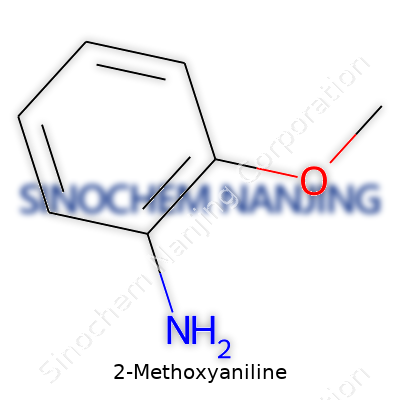
Every chemist notices the benzene ring first. In 2-Methoxyaniline, the benzene core carries two substituents: an amino group (-NH2) and a methoxy group (-OCH3). Placement matters a lot here. The “2-” in the name sets both groups next to each other—on adjacent carbons. Industry folks call this the “ortho” position. Formally, the structure goes like this:
- Benzene ring as the backbone
- Amino group attached to carbon 1
- Methoxy group attached to carbon 2
The full skeletal formula looks like this, drawn on paper: the benzene ring, one -NH2 immediately next to one -OCH3.
Molecular Formula
Looking at the atoms, you count eight carbons, nine hydrogens, one nitrogen, and one oxygen. Put together, the formula spells out as C7H9NO. This little arrangement means a lot, showing both aromaticity and the strong influence of electron-donating groups. The amino group increases the basic character of the molecule, and the methoxy group pushes more electrons into the benzene ring, making the structure more reactive than plain aniline or anisole alone.
Importance for Industry and Safety
Not every aromatic amine finds widespread use, but 2-Methoxyaniline shows up repeatedly in dye manufacture and specialty chemicals. It’s crucial to recognize that working with substances like this means respecting their potential health risks. The past has shown workers exposed to certain aromatic amines saw higher rates of bladder cancer. That’s why glove boxes, fume hoods, and strict safety training never stay optional. Anyone who’s ever handled aromatic amines, even with all the PPE, can tell you the faint sweet-ish odor lingers on gloves, stubborn and persistent. It reminds us how easily skin and lungs can take up these compounds.
Global regulations reflect those risks. Controls on workplace exposure have tightened over time, based on consistent findings about toxicity and persistence in the environment. While some see safety guidelines as a burden, those rules come directly out of real experience and long-term studies. Chemical synthesis work thrives best when all parties pay attention to both technical needs and personal health.
Better Practices and Solutions
With 2-Methoxyaniline still valuable for pigment and intermediate production, safer handling starts with education at all levels. More labs now use closed systems, improved air monitoring, and regular health checks for all staff handling aromatic amines. Industry associations share best practices, enabling safer processes to move between companies without competitive secrecy getting in the way.
Some companies develop stronger waste treatment options—oxidizing hazardous amines at the source before they reach water streams. Advances in green chemistry sometimes offer alternative reagents, though few match the efficiency of established aromatic amines for certain high-value reactions. Work continues, since safety and sustainability matter as much as production yield. Anyone mixing up a batch today relies just as much on solid science as they do on common sense and collective memory from those who came before.
Is 2-Methoxyaniline hazardous or toxic?
Recognizing the Risks
2-Methoxyaniline, also called o-anisidine, shows up in many chemical industry processes, from dyes to pigments, and sometimes in the lab. At first sight, it looks like another chemical compound with a long name and a short list of uses. The story takes a different turn once we look at its effects on health and how it travels through the environment. Anyone who has worked near chemical manufacturing, or who has read the small print on lab safety sheets, will recognize the red flags around o-anisidine.
What the Research Says
No sugarcoating here: major agencies like the International Agency for Research on Cancer (IARC) class this compound as possibly carcinogenic to humans. Scientists put 2-methoxyaniline under the microscope and saw enough cellular damage in animal studies to ring the alarm. Rats and mice exposed to o-anisidine developed tumors in their bladders. Animal testing often predicts the risks humans face on factory floors or during accidental spills.
A big part of its risk comes from the way the compound slips easily through the skin and airways. People working with the material might have headaches, nausea, skin irritation, or even symptoms pointing to anemia. Chronic exposure raises the stakes. Metabolites of o-anisidine can bind to hemoglobin, which sets off a chain reaction that messes with red blood cell function. Left-long enough, that process leads to bigger health problems.
Workplace and Community Exposure
In chemical plants, the biggest danger edges in during blending, packaging, and waste handling, especially where protective equipment falls short. I’ve talked with techs who trusted a basic pair of gloves, only to find rashes spreading across their arms just days later. Many small businesses still cut corners on fume hoods or ventilation, thinking that only heavy hitters like lead or asbestos deserve real attention. But compounds like 2-methoxyaniline don’t need high concentrations to do damage.
Years spent in a town next to a dye manufacturer helped me understand the larger pattern. Drains whooshing with colored water, faint chemical smells on windy days, and routine complaints about headaches and fatigue, especially among workers and neighbors. Residues seeped into local soil and water. State health officials showed up only after persistent complaints, but by then some effects lingered.
Protecting Health and Environment
Stronger regulation makes sense. OSHA puts limits on the compound's levels in the air, and Europe’s REACH regulations take an even stiffer line against workplace exposure. The rules help, but safety always starts at ground level. Good companies offer training, fresh protective gear, and invest in ventilation—even when nobody’s watching. Routine monitoring catches leaks and accidental spills before real harm strikes.
On the environmental front, treating wastewater on-site and keeping a careful handle on solid waste disposal prevents the spread beyond plant boundaries. Incineration at the right temperature breaks the compound down safely. It takes investment, sure, but cleanup after contamination costs more—economically and in the toll on people’s lives.
Safer Paths Forward
Some innovation targets safer dye alternatives and process adjustments. Academic studies keep pressure on manufacturers to do better, and worker’s rights advocates demand accountability. Everyone benefits from open information and honest assessments of risk. In the end, transparency, awareness, and strong habits hold the line between routine work and disaster.
How should 2-Methoxyaniline be stored and handled?
Meet 2-Methoxyaniline
I’ve spent enough hours around chemicals to know which ones need real attention, and 2-Methoxyaniline is on that list. It’s got a reputation in the organic chemistry world for all sorts of uses, especially in dyes, pharmaceuticals, and research. At first glance, it might look ordinary. But that shouldn’t fool anyone. Complacency can turn a productive day into a bad headline fast.
Real Risks, Not Guesswork
My early chemistry lessons drilled in respect for anything with “aniline” in the name. 2-Methoxyaniline is no exception. Direct contact can cause skin irritation, and its vapors can stir up headaches or worse if inhaled. Spills may seem manageable at first, but they creep into clothing and stick around. Over time, outdated storage or cracked containers lead to bigger problems — not just for the person handling it, but for everyone around. Ethically, no one wants to put coworkers at risk for short-term convenience.
Temperature Makes a Difference
Heat doesn’t treat chemicals kindly. Warm rooms or sunlight on a window ledge will speed up breakdown and sometimes release harmful byproducts. A climate-controlled cabinet, free from any sunlight, gives 2-Methoxyaniline more of a fighting chance for safe storage over time. I always look for locking cabinets that ventilate well, which stops fumes from pooling where people don’t expect them.
Why Labels and Logs Matter
People get sloppy when rushing, but every bottle should carry clear labels with accurate dates. That’s saved more than a few of us from grabbing the wrong thing or using something past its limelight. Chemical logs serve another purpose — they tell the next shift what’s inside, when it arrived, and when to toss it. I check those logs every morning, not because I have to, but because trust in a lab grows only with habits like this.
Solid PPE: A Prime Rule
Gloves, lab coats, and eye protection are the shield between trouble and safety. I’ve seen folks skip the apron “just for a minute” and learn the hard way. 2-Methoxyaniline doesn’t care that you’re confident; it’ll stain, burn, or irritate just the same. If a spill happens, access to showers or eyewash stations turns what could be a lasting injury into a shaky cautionary tale. Always keep those routes clear, and remind new team members to look for them.
Ventilation — Never an Afterthought
Fume hoods aren’t luxury add-ons. They keep the workspace clear of airborne nasties that never announce their presence until someone feels sick. I’ve made it a rule: anything involving 2-Methoxyaniline means working in a hood. I tell students and coworkers, “It costs nothing to flip that switch, but the price of a mistake is steep.”
Waste That Doesn’t Haunt the Place
After use, don’t even think about pouring leftovers into the sink. Waste containers, sturdy and labeled, keep future headaches at bay. Some places arrange for regular hazardous waste pickups, and that’s the only easy solution I trust. No one wants to leave a mess for the next generation of scientists, and a clean disposal habit does most of the heavy lifting in preventing long-term contamination.
Summing Up the Culture
Storing and handling 2-Methoxyaniline safely is more than just following rules. It’s about protecting people, respecting the risks, and building a culture where safety feels automatic. My years in lab coats tell me: the best workers aren’t fearless — they’re careful, stubborn about habits, and committed to going home safe every day.
What are the physical properties of 2-Methoxyaniline?
Introduction
2-Methoxyaniline shows up in research, industries, and even pops up in the lives of students and workers dealing with aromatic amines. From my days in the lab, a single whiff of this compound’s distinctive odor brings back memories of careful handling. Every detail in how it looks, feels, and behaves gives a clue to how best to store, use, and safeguard it.
Basic Appearance and Structure
Look at a vial of 2-Methoxyaniline, also called o-anisidine, and you'll see a pale yellow liquid. Some sources describe it as a yellowish or brownish oil. At colder room temperatures, it thickens, and fresh batches can give a bright, almost golden tint. Being a relatively simple organic compound, 2-Methoxyaniline owes its properties to both the amino group attached to the benzene ring and a methoxy group sitting next to it on the ring. These two groups shape the way the molecule interacts with water, other solvents, and the air.
Boiling and Melting Points
Think about storage. 2-Methoxyaniline has a boiling point around 243 to 245°C (469-473°F). That number means it’s not leaping off workbenches as vapor at room temperature, but it will eventually reach that point with enough heat. The melting point sits near -1°C (30°F), so you’re looking at a liquid under nearly all typical lab conditions.
Solubility and Odor
Solubility matters, especially for chemists. 2-Methoxyaniline dissolves in common organic solvents like ethanol, ether, and chloroform. In water, though, it barely stirs—only slightly soluble. This affects disposal plans and gives context to safety data, because runoff or spills don’t spread far in the usual lab rinses. You can’t ignore the strong, sweetish, amine-like odor, either. Even slight air exposure tickles the nose, underlining the need for good ventilation and awareness of potential inhalation risks.
Density and Refractive Index
The density comes in at about 1.09 g/cm³. This puts it close to water, so a spill doesn’t sink or float dramatically. Handling this liquid means remembering it can cling to surfaces just as easily as water, not running off or pooling in a way that’s easy to spot. The refractive index, a frequent tool for checking purity, falls at about 1.595, which is a handy confirmation for labs that check every incoming sample batch.
Stability and Reactivity
Anyone working with 2-Methoxyaniline knows not all samples age the same. Fresh samples pour bright and clear, but exposure to light and air leads to darker colors over time. This darkening hints at gradual oxidation—a headache for long-term storage. I always kept bottles tightly capped in amber glass to cut down on light and oxygen exposure. On the reactivity side, the amino group means this compound reacts quickly with strong oxidizers and acids. Spills matter, so materials like sand or vermiculite work for containment, and gloves are a must.
Potential Safety and Solutions
The physical properties make 2-Methoxyaniline valuable for dyes, pharmaceuticals, and research, but they also demand respect. Even at room temperature, enough vapor can gather to irritate eyes and respiratory systems. Mitigating that requires solid workplace habits: chemical fume hoods, good labeling, and proper training. Waste streams carrying 2-Methoxyaniline shouldn’t mix with general drains because it lingers and can’t break down easily in the environment. In my experience, regular refresher training and posted reminders help prevent incidents more than any manual ever did. Emergency spill kits close at hand and well-tuned ventilation systems tie everything together for safe everyday handling.
| Names | |
| Preferred IUPAC name | 2-methoxybenzenamine |
| Other names |
o-Anisidine 2-Aminophenyl methyl ether 2-Methoxybenzenamine |
| Pronunciation | /tuː mɛˈθɒksi ˈæn.ɪ.liːn/ |
| Identifiers | |
| CAS Number | 91-68-9 |
| Beilstein Reference | 1362466 |
| ChEBI | CHEBI:77514 |
| ChEMBL | CHEMBL15217 |
| ChemSpider | 12154 |
| DrugBank | DB04290 |
| ECHA InfoCard | 201-963-1 |
| EC Number | 205-504-7 |
| Gmelin Reference | 6047 |
| KEGG | C01423 |
| MeSH | D000590 |
| PubChem CID | 7039 |
| RTECS number | BY7378000 |
| UNII | H82105B248 |
| UN number | UN2014 |
| CompTox Dashboard (EPA) | 9308 |
| Properties | |
| Chemical formula | C7H9NO |
| Molar mass | 123.15 g/mol |
| Appearance | Colorless to yellow liquid |
| Odor | ammonia-like |
| Density | 1.09 g/cm³ |
| Solubility in water | soluble |
| log P | 1.02 |
| Vapor pressure | 0.24 mmHg (25°C) |
| Acidity (pKa) | 4.37 |
| Basicity (pKb) | 9.56 |
| Magnetic susceptibility (χ) | -54.0·10⁻⁶ cm³/mol |
| Refractive index (nD) | 1.615 |
| Viscosity | 1.184 cP (25°C) |
| Dipole moment | 1.36 D |
| Thermochemistry | |
| Std molar entropy (S⦵298) | 160.2 J·mol⁻¹·K⁻¹ |
| Std enthalpy of formation (ΔfH⦵298) | 48.6 kJ/mol |
| Std enthalpy of combustion (ΔcH⦵298) | -3592.0 kJ/mol |
| Pharmacology | |
| ATC code | D06BB01 |
| Hazards | |
| Main hazards | Harmful if swallowed, in contact with skin or if inhaled. Causes skin irritation. Causes serious eye irritation. Suspected of causing cancer. |
| GHS labelling | GHS02, GHS07, GHS08 |
| Pictograms | GHS07 |
| Signal word | Danger |
| Hazard statements | H302, H312, H332, H315, H319, H351, H410 |
| Precautionary statements | P261, P280, P302+P352, P304+P340, P312, P321, P330, P363, P405, P501 |
| NFPA 704 (fire diamond) | 2-2-0 Health:2 Flammability:2 Instability:0 |
| Flash point | 73°C |
| Autoignition temperature | 615°C |
| Explosive limits | 1.3–7% |
| Lethal dose or concentration | LD50 oral (rat) 930 mg/kg |
| LD50 (median dose) | LD50 (median dose): Rat oral 375 mg/kg |
| NIOSH | BZ8775000 |
| PEL (Permissible) | PEL (Permissible Exposure Limit) for 2-Methoxyaniline: 2 ppm (skin) |
| REL (Recommended) | 2 ppm |
| IDLH (Immediate danger) | 100 mg/m3 |
| Related compounds | |
| Related compounds |
Aniline p-Anisidine m-Anisidine o-Toluidine p-Toluidine m-Toluidine 2-Nitroanisole 2-Aminophenol |



