A Closer Look at 2-Hexene: Chemistry, Context, and Consequence
Historical Development
Walk back through the timeline of organic chemistry and you can find 2-hexene tucked among the lesser-known, yet crucial, actors in the story of alkenes. Laboratories in Europe and America ramped up hydrocarbon research in the 1800s, mapping the structures of alkenes far before the word “petrochemical” invaded every corner of industry. By the middle of the 20th century, knowledge about hexenes took a big leap thanks to improvements in separation and identification techniques. Chemists learned to distinguish between 1-hexene, 2-hexene, and other isomers based on where the double bond sits along the six-carbon chain. Now, whether someone is tinkering with polymers or fine-tuning synthesis for flavors and fragrances, understanding the behavior of 2-hexene matters much more than its relative obscurity suggests.
Product Overview
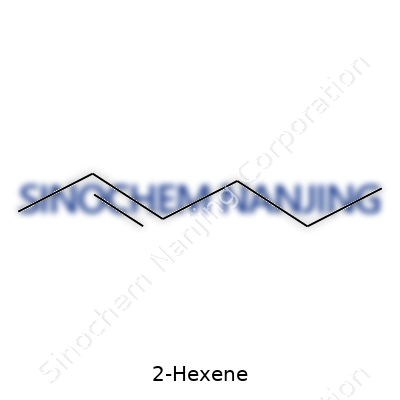
2-Hexene, with its six-carbon backbone and a double bond connecting carbon two to carbon three, fits into a huge range of chemical projects. It's a colorless liquid with a faint odor, cropping up in chemical catalogues, production plants, and university bench experiments. The compound appears as (E)-2-hexene and (Z)-2-hexene, which chemists sometimes call trans and cis forms. That little difference in geometry shapes everything from boiling point to reactivity. 2-Hexene doesn’t headline petrochemical streams the way ethylene or propylene do, but it plays an essential supporting role in both research and industry.
Physical & Chemical Properties
Look at the numbers and features, and 2-hexene falls right in line with other lower alkenes. Its boiling point, just above 62 degrees Celsius for the (E) isomer, can make it tricky to handle if you don’t have a well-ventilated lab or a chill condenser. The compound shows flammability, and like other alkenes, it mixes well with common organic solvents but stays clear of water. The double bond in the middle sets up opportunities for both addition and rearrangement reactions, which means you can build on it or break it apart with a toolbox of catalysts or reagents.
Technical Specifications & Labeling
Buy a bottle from a chemical supplier, and you might see something like 99 percent purity, with the specific isomeric ratio spelled out. Labels include hazard warnings, including flammability and the need for eye protection. Genuine scientific reputations rest on proper handling, so labels line up with globally recognized systems such as the Globally Harmonized System (GHS). Chemists trust that what’s in the bottle matches what’s on the label—no shortcuts. If a process relies on the (E) or (Z) form, the supplier must guarantee that level of detail. Quality control means more than paperwork; it means reproducibility and safety.
Preparation Method
2-Hexene doesn’t tumble out of oil wells ready to go. Most often it comes from dehydrohalogenation, taking 2-chlorohexane and stripping away hydrogen chloride with a base, yielding a clean double bond. In research settings, Elimination reactions fit the bill—mixing the right alkyl halides with a strong base under the right temperature. Another tactic uses catalytic cracking processes, breaking down larger hydrocarbons and sorting out the specific alkenes. Each approach brings trade-offs: economic cost, separation effort, waste generation, and the purity of the final product.
Chemical Reactions & Modifications
The real utility of 2-hexene comes from that double bond, wide open to all sorts of chemical adventure. Hydrogenation with a nickel or palladium catalyst tacks on hydrogen and turns 2-hexene into hexane. React it with halogens, and you have the recipe for dihalogenated compounds, which then can head in a dozen different directions. Work with hydroboration-oxidation, and you end up with alcohols. The position of the double bond means you control what new compounds spring up on either side of it, a key advantage for custom synthesis. The (E) and (Z) isomers each present a different face to chiral catalysts, which can matter a lot in pharmaceutical chemistry.
Synonyms & Product Names
Chemists tend to call things by many names, and 2-hexene is no exception. Sometimes catalogues list it as (E)-2-hexene or (Z)-2-hexene; older texts mention trans-2-hexene and cis-2-hexene. In European product registries, you may find 2-hexylene. These names all point to the same molecule, but awareness of the labeling makes life easier if you’re scanning databases or product listings. Anyone working across borders or industries learns these variants the hard way, one database entry at a time.
Safety & Operational Standards
Common sense and lab policy take the same side: 2-hexene deserves respect. The compound catches fire easily, so storage away from sparks and flames isn’t debatable. Prolonged exposure brings risks, including headaches and respiratory irritation, and skin contact should always prompt immediate washing and glove habits. Regulations spell out permissible exposure limits, and responsible labs have proper ventilation and spill containment defined before the first bottle gets opened. Emergency protocols should not only exist on paper but live in regular drills and staff knowledge. Too many headlines come from somewhere that trusted corner-cutting more than chemical safety.
Application Area
2-Hexene shows up in more applications than you might guess. Its role as an intermediate in organic synthesis means it’s often present in the background, helping form flavors, fragrances, specialty solvents, and fine chemicals. In polymer chemistry, particular isomers can act as co-monomers or as model substrates for catalyst testing. Few consumer products list 2-hexene on the label, but the compound helps form ingredients that comprise the daily goods people rely on, from clear plastics to food additives to coatings. Its value lies in chemical versatility; the double bond is a pivot point for building more complex molecules.
Research & Development
In university labs and industry R&D centers, 2-hexene opens paths to probe catalysis, test new green synthesis approaches, and develop next-generation materials. Academic journals regularly feature studies on its reactivity with novel catalysts, especially in asymmetric synthesis and polymerization. Competitive chemical companies look for ways to increase yield, reduce unwanted byproducts, and recycle process waste—sometimes using 2-hexene as a benchmark substrate. The compound also plays a subtle role in mechanistic studies, where scientists unravel how and why a catalyst takes one pathway and not another.
Toxicity Research
2-Hexene doesn’t carry the highest toxic profile of the alkenes, but responsible use still means understanding what even low levels can do. Inhalation and skin exposure risks are dose-dependent, with animal studies helping to fill in the safety picture. Regulatory agencies check the results of repeated-dose research for cancer and reproductive interference before approving large-scale production or use. Some studies suggest metabolites of simple alkenes have limited toxicity, but current recommendations hold to the conservative side, based on uncertainty and the costs of underestimating risk.
Future Prospects
Sustainability and efficiency are reshaping the market for simple alkenes like 2-hexene. Interest grows in biobased and waste-to-chemical processes, which could turn renewable feedstocks into 2-hexene instead of relying solely on fossil resources. Advances in catalysis push for milder, more selective transformations, especially as regulatory hurdles rise for everything from emissions to hazardous waste. As manufacturers aim for cleaner production, 2-hexene serves as a testing ground for new ideas that just might remake core parts of the chemical economy. Watching where this simple molecule turns up next is one way to follow the direction of the entire field.
What is 2-Hexene used for?
A Look at 2-Hexene and Its Role
2-Hexene might not get headline attention, but it helps build the backbones of materials a lot of people take for granted. Most folks don’t see clear liquids like 2-Hexene at work, but the stuff’s tucked deep in chemical plants and labs around the globe. Industry leans on it as a simple, reliable six-carbon alkene, which means a couple of things: it’s got a double bond and it’s ready to react. This molecule looks plain, but it helps generate the building blocks for products from plastics to specialty chemicals.
2-Hexene in Polypropylene and Polyethylene Production
Ask anyone who’s spent time in a plastics plant—they know 2-Hexene crops up as a comonomer for turning up the quality of polypropylene and polyethylene. Tossing in some 2-Hexene means the plastic doesn’t end up brittle. Take the pipes under your lawn, packaging wrap that doesn’t rip, or even the tough but flexible bottle caps that keep drinks sealed tight: 2-Hexene gets credit for the right blend of toughness and stretch.
People don’t always realize how much science goes into an ordinary bag or film. Without help from chemicals like 2-Hexene, a lot of these items would break early or be a pain to mold or recycle. Extra durability translates to less waste in landfills, which matters as we all think more about what we throw away.
2-Hexene: More than Just a Polymer Helper
This molecule does more than give plastics a hand. Scent manufacturers dip into it as a starting point to make fragrances and flavors. You’ll often find it cropping up in the path from raw material to something that smells like fresh fruit or spice. Chemists can tack on new atoms to that double bond, tweaking 2-Hexene until they get the notes they want in a perfume or a food additive.
There’s also demand from companies making solvents, coatings, and adhesives. The reason is simple: its double bond is a kind of invitation for chemical reactions. If manufacturers need a platform to build new chemicals for cleaning fluids or paints, 2-Hexene has the structure to get things rolling.
Safety and Environmental Points
From what I’ve seen—and from serious data—safety always comes up for compounds like 2-Hexene. Workers wear gloves and use sealed systems because direct skin or breathing contact can cause trouble. The liquid evaporates easily, which means fumes need proper handling. Nobody wants a spill in the groundwater, and plants have rules to keep it locked inside pipes and tanks.
The footprint from manufacturing and shipping can’t be ignored. Process managers keep looking for ways to tighten up systems, avoid leaks, and recycle byproducts. The world wants cleaner factories, and 2-Hexene use fits into the bigger push for greener chemistry. I’ve noticed that as the pressure grows to limit emissions, industry turns to better monitoring tech and process tweaks that keep people and the planet safer.
Stepping Toward Smarter Chemistry
Looking at the full life span, 2-Hexene’s role brings both rewards and risks. It gives products a longer shelf life, offers chemists a springboard for experiments, but still requires tough oversight. Smarter control, regular safety checks, and more research into alternatives help keep its uses in line with health and environmental goals.
What are the physical and chemical properties of 2-Hexene?
The Physical Side of 2-Hexene
2-Hexene comes as a colorless liquid, something clear and easy to spot in a clean lab bottle. It doesn’t stick to the bottle like syrup; it flows easily. It boils at about 68 degrees Celsius—meaning it won’t stick around if tossed into a hot pan. People won’t grab a gas mask for it, but the sharp smell isn’t hard to notice. That scent, familiar from other light alkenes, comes from its double bond.
This compound doesn’t mix well with water. Given its hydrocarbon roots, that’s no surprise; a drop will float, stubborn and slick. So, spills usually travel across the surface. Labs working with it have learned to contain it with absorbent pads and ventilation instead of relying on a mop.
Most folks in the lab world keep an eye on its low flash point—less than fourteen degrees Celsius. That’s cooler than a mild spring day, and it means the liquid can ignite quickly. Safety training drills this point home. Sparks and static electricity can set off more than just an alarm; they can cause a fire.
Chemical Properties of 2-Hexene
The double bond in 2-hexene brings reactivity to the table. Like other alkenes, it loves to react with halogens and acids. Toss some bromine at it, and you’ll see the reddish color fade, a quick old-school test for any alkene. Chemists use this spot-check all the time—nothing fancy, just a sharp eye.
In big tanks at chemical plants, that double bond isn’t ignored. Producers turn 2-hexene into 2-hexanol or hexane by adding water or hydrogen, respectively. These transformations are practical, feeding into the world’s supply of solvents, fuels, and plastics. On a smaller scale in the classroom, the same reactivity makes it a good teaching tool. Students watch it react, recording each fizz and bubble, connecting the dots to lessons on molecular structure.
Upsides abound, but 2-hexene brings risks. The reactivity that makes it helpful also means it doesn’t play well with strong oxidizers or acids. Accidents can trigger dangerous reactions—real hazards, not just textbook examples. Safety goggles and fume hoods aren’t for show; they’re essential. In my experience, even simple mistakes—pouring too fast, mixing with the wrong chemical—can create more than just a mess.
Why It Matters and What to Watch For
2-Hexene’s uses stretch beyond labs. Petrochemical plants use it as an intermediate in plastic and rubber production or to create synthetic flavors and fragrances. People rarely talk about the journey of simple hydrocarbons in daily life, but these unsung compounds shape everything from the soles of sneakers to the bottles of soda in the fridge.
With its low boiling point and flammability, 2-hexene calls for strict storage rules. Tanks need solid pressure systems and careful maintenance. My colleagues once dealt with a minor leak—luckily caught early—but the near miss stands as a reminder. Prevention beats cleanup every time. Training and well-labeled storage can stop most issues before they start.
Waste handling shows another side of the story. Improper disposal contaminates groundwater and soil, so following environmental rules stays top of mind. Facilities treating waste streams work in cycles, breaking down 2-hexene and ensuring it doesn’t sneak past safeguards. This protects more than just lab workers; it keeps communities safe.
Toward Safer and Smarter Use
Knowledge and respect for chemicals like 2-hexene help reduce mishaps. From proper use of fume hoods to investing in personal protective equipment, solutions come down to habits and checks. Digital records track storage dates and monitor use, lowering chances of unnoticed leaks. Education forms the first defense—everyone handling 2-hexene benefits from a clear-eyed look at both its promise and its risks.
Is 2-Hexene hazardous or toxic?
Looking Past the Chemical Formula
Most folks outside of a chemistry lab won’t run into 2-hexene often. This clear, oily liquid belongs to a family known as alkenes. You find them in everything from industrial solvents to the stuff fueling machines. I once spent a summer working alongside industrial safety inspectors at a plastics manufacturing plant. Just about every chemical around brought its own risks and headaches, and 2-hexene was no different.
Understanding the Health Risks
People see “hexene” and worry about immediate threats—burns, explosions, or sudden illness. The facts paint a more complicated picture. Pure 2-hexene tends to irritate skin or eyes on contact. Even small splashes left rashes on a co-worker’s hands in our old lab. Vapors become a concern in unventilated workspaces. Folks inhaling high concentrations talk about headaches, nausea, or dizziness. Nobody wants to work in a place with those kinds of problems swirling above their heads.
Some chemistry professionals have shared stories of cases where long-term exposure to certain alkenes contributed to central nervous system symptoms, though the evidence on 2-hexene specifically remains thin. You won’t see it listed among the big-name industrial carcinogens, but its close relatives—like 1,3-butadiene—do raise red flags for cancer with enough exposure.
Fire Hazards Lurking Nearby
Ask around any facility that handles 2-hexene and the fire department’s on speed dial. The stuff ignites almost as soon as a spark lands. Vapors settle low, creeping along floors in still air, making unseen dangers for workers who might think a space has aired out. Experience tells us never to underestimate this kind of risk. Following strict no-smoking rules and eliminating ignition sources saves lives. At my previous plant, alarms and ventilation systems didn't always run on schedule—another reason why hands-on vigilance trumps paperwork promises.
Safe Handling Is the Real Solution
Labeling 2-hexene as simply “hazardous” or “toxic” misses the point. Every tool or chemical in industry comes with a balance of risk and benefit. 2-Hexene isn’t as readily absorbed by the skin as some solvents, but nobody looking to protect themselves skips gloves or goggles. Proper training forms the backbone of safety. New hires I worked with learned not just to read the Material Safety Data Sheet, but to respect it. Ventilation transforms how tolerable a workspace feels. General exhaust fans make a difference, but targeted hoods catch vapors where they form. This kind of investment may look costly on paper, but it pays back every day by keeping workers healthy.
Accidents still happen. The response—eye wash stations, chemical showers, and first aid—cannot sit as afterthoughts. When a spill hits, knowing you’ve practiced the drill makes a world of difference. Fact-based protocols stem injuries and limit environmental messes. Supervisors who train every crew member, not just managers, build stronger teams. Reviews by third-party occupational specialists have caught more than one unsafe practice in facilities I’ve visited. Accountability must run deep, beyond the surface.
Responsible Choices Matter
Labeling a chemical for what it truly is—potentially hazardous, but manageable with the right steps—lets workers approach their jobs with confidence, not fear. Science says handle 2-hexene carefully and avoid inhalation or skin contact when possible. Common sense says respect the stuff, trust your training, and never cut corners. This approach, more than anything, keeps everyone safe on the job.
How should 2-Hexene be stored and handled?
What experience teaches about 2-Hexene
I’ve spent long days in storage warehouses, hands-on with chemicals ranging from basic solvents to moderately hazardous alkenes like 2-Hexene. Lab results and theory can show you risks, but it’s the practical details—smells, odd leaks, accidental splashes—that drive home what you can’t ignore. 2-Hexene comes off as ‘middle of the road’ in hazard, but don’t let down your guard. This liquid catches fire quickly, and inhaling its vapors can bring on headaches, confusion, or even loss of consciousness after long enough. Once, a small bottle cracked in storage. Even without a visible spill, the entire room stank for hours. This isn’t the kind of substance you treat like cooking oil.
Conditions make all the difference
It pays to keep 2-Hexene locked away in sealed, labeled containers, far from direct sunlight or heat. The stuff evaporates easily above room temperature. Pour a splash on concrete and you’ll smell it down the hallway within minutes. Just from that, it’s clear open shelving in a non-ventilated storeroom isn’t enough. My old department had to revamp a section, bringing in new ventilated cabinets and automatic fire suppression right after what could have been a close call—one summer, a heater got left on overnight, and a stored container swelled from the pressure. No one got hurt, but that’s luck you don’t want to count on.
Fire doesn’t take a day off
If there's one lesson to remember, anything flammable deserves storage in an area built for that risk. Steel cabinets with self-closing doors do the job. Stacking containers too close or next to acids just creates unnecessary danger. Some people try to cut corners by keeping hazardous chemicals near the fume hood to keep air moving, but if you’re not set up for flammables, that’s just building a problem. Proper grounding for any static-producing devices helps too, because a single spark is all it takes for 2-Hexene vapors to ignite.
Personal protection isn’t optional
I’ve seen colleagues rush through their handling routines just to save time. No gloves, no goggles—just planning to pour and run. All it takes is one slip for that ‘quick job’ to end in an emergency shower and days off for medical observation. Standard nitrile gloves, splash-resistant goggles, and a splash apron build a meaningful line of defense. If you’re decanting from a big drum, use the right pump and make sure you work under a fume hood or with strong local exhaust. There’s no excuse for shortcuts, and there’s a big difference between going home with a job done and heading to urgent care for a breathing treatment.
Systems build safe habits
Good habits start with an honest look at how people actually work. Posting safety data sheets (SDS) near storage, conducting quick refresher sessions, and encouraging double-checks before pouring—these steps do more than check boxes. At my workspace, regular audits and open conversation about near-misses helped us spot trouble before anything major developed. Safety isn’t just about one chemical or another. It’s a culture that keeps everybody going home at the end of the week, no matter what they’re handling.
What is the difference between cis-2-Hexene and trans-2-Hexene?
Getting to Know 2-Hexene
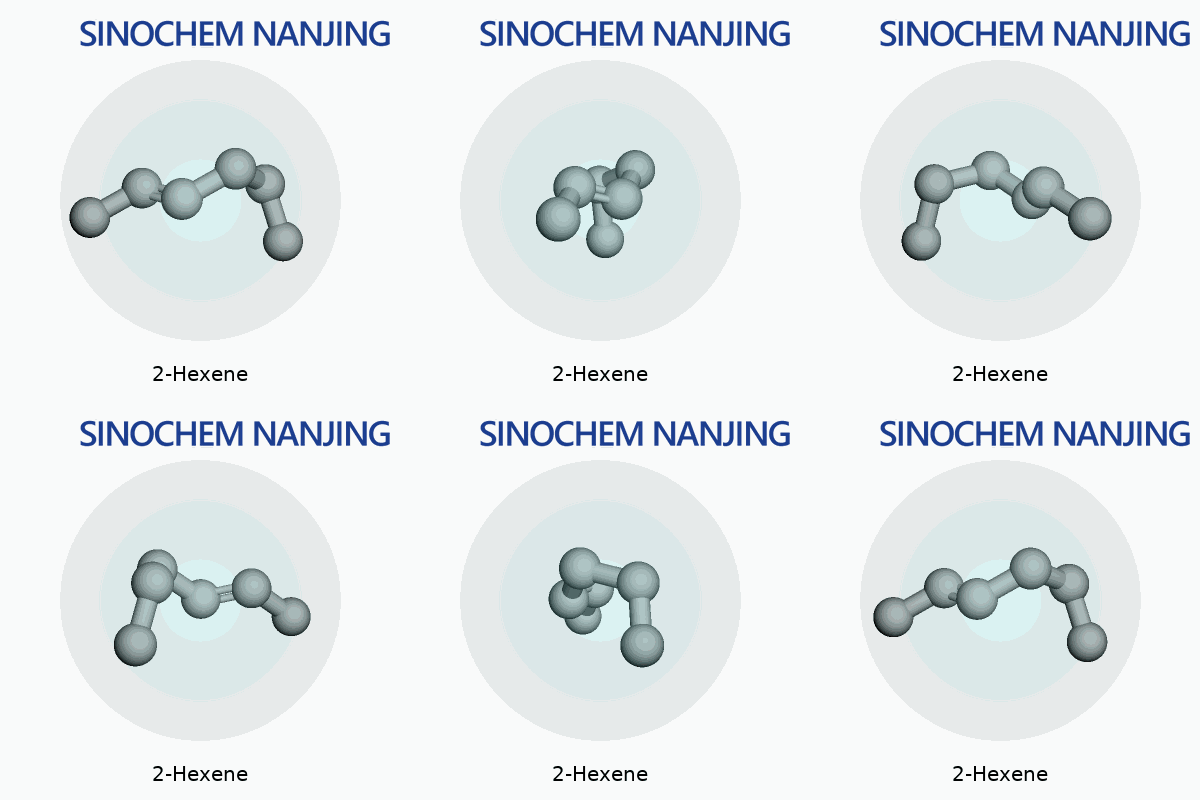
2-Hexene pops up in labs and classrooms as a simple molecule, but the story gets interesting when you look at its two forms: cis and trans. Both look almost identical on a drawing—six carbons in a row, double bond at the number two spot. But the arrangement around that double bond creates two different compounds. The words “cis” and “trans” say how the hydrogens and carbon chains sit near that double bond. Cis means the extra bits are on the same side; trans puts them across from each other. This small shift isn’t just textbook trivia. The way these molecules line up affects how they act and what you can do with them.
Why Shape Makes a Difference
Chemistry surprises you with how much shape matters. Think of cis-2-hexene as slightly bent—like a long twig with a kink in it. Trans-2-hexene stretches straighter. That kink changes more than just the drawing: it affects how tightly molecules pack together. In real life, this plays out in things like melting and boiling points. Trans-2-hexene lines up better, so it stacks more tightly, forming a solid more readily and boiling at a different point. Data backs this up: trans-2-hexene typically boils at around 68°C, with cis-2-hexene just a few degrees lower. That translates to real-world impacts, especially if you're designing products that rely on precise temperatures, like solvents, chemical intermediates, or fuels.
Chemical Properties and Uses
Every chemist remembers that functional groups and geometry can shift reactivity. The cis and trans forms prove that rule. The bent shape of cis-2-hexene puts atoms a bit closer together, so reactions involving bulky groups can run into more roadblocks. Trans keeps everything spaced out, sometimes making it a better choice for certain chemical syntheses. These unique properties ripple into industry: manufacturers may prefer one version over the other, depending on the outcome they’re chasing. Even small changes here can impact the efficiency of producing plastics, additives, or specialty chemicals.
Safety and Handling: The Human Side
Working with these isomers means paying attention not just to chemistry on paper, but to safety. Trans-2-hexene, packing more tightly and moving less, can feel different to handle in industrial settings. Flammability, volatility, and even how your safety gear reacts come into play. In the lab, mistakes in identifying cis or trans versions could lead to small but meaningful risks. I’ve seen spills escalate from minor to dangerous because the boiling point wasn’t what someone expected. Double-checking labels and keeping clear inventory records saves headaches and reduces risks.
Looking for Solutions in Practice
Sorting out cis from trans in a factory or lab doesn’t just fall on advanced machines. Teams use distillation, chromatography, or even simple chemical tests to spot and separate each form. This isn’t just a technical challenge. It’s a cost and quality puzzle. Investing in the right gear and training people to spot these differences helps avoid expensive product recalls or environmental mishaps later. My own experience tells me that clear communication between chemists, operators, and safety staff keeps everyone a bit safer and streamlines the whole process.
A Small Difference, a Big Impact
Plenty of new chemists shrug off the cis versus trans divide as book-learning. Years of working with both forms show it shapes everything from daily lab work to major industrial decisions. The difference in shape ripples through safety, reactivity, and even how efficiently products move from factory to shelf. Understanding the quirks of each isn’t just about passing chemistry class. It’s about building better products and safer workspaces—one small molecular detail at a time.
| Names | |
| Preferred IUPAC name | hex-2-ene |
| Other names |
(E)-2-Hexene (Z)-2-Hexene Hex-2-ene |
| Pronunciation | /ˈtuː ˈhɛksiːn/ |
| Identifiers | |
| CAS Number | 592-43-8 |
| Beilstein Reference | 1718734 |
| ChEBI | CHEBI:35920 |
| ChEMBL | CHEMBL21722 |
| ChemSpider | 65117 |
| DrugBank | DB04483 |
| ECHA InfoCard | ECHA InfoCard: 100.006.975 |
| EC Number | 203-915-3 |
| Gmelin Reference | 7297 |
| KEGG | C09796 |
| MeSH | D006543 |
| PubChem CID | 5283600 |
| RTECS number | MI8575000 |
| UNII | TDI74P5UWL |
| UN number | UN1208 |
| Properties | |
| Chemical formula | C6H12 |
| Molar mass | 84.16 g/mol |
| Appearance | Colorless liquid |
| Odor | mild odor |
| Density | 0.673 g/mL at 20 °C |
| Solubility in water | Insoluble |
| log P | 2.80 |
| Vapor pressure | 3.17E+04 mmHg at 25 °C |
| Acidity (pKa) | 15.68 |
| Basicity (pKb) | 15.1 |
| Magnetic susceptibility (χ) | -43.0 × 10⁻⁶ cm³/mol |
| Refractive index (nD) | 1.404 |
| Viscosity | 0.433 mPa·s (25°C) |
| Dipole moment | 0.39 D |
| Thermochemistry | |
| Std molar entropy (S⦵298) | 329.7 J·mol⁻¹·K⁻¹ |
| Std enthalpy of formation (ΔfH⦵298) | -7.9 kJ/mol |
| Std enthalpy of combustion (ΔcH⦵298) | -3917.6 kJ/mol |
| Hazards | |
| GHS labelling | GHS02, GHS07 |
| Pictograms | GHS02,GHS07 |
| Signal word | Danger |
| Hazard statements | H225, H315, H319, H335 |
| Precautionary statements | P202, P210, P261, P280, P301+P310, P304+P340, P312, P331, P370+P378, P403+P233, P501 |
| NFPA 704 (fire diamond) | 2-3-2 |
| Flash point | -7 °C (19 °F; 266 K) |
| Autoignition temperature | 498 °C |
| Explosive limits | Explosive limits: 1.2–7.4% |
| Lethal dose or concentration | LCLo (rat, inhalation): 4000 ppm/4H |
| LD50 (median dose) | LD50 (median dose): Oral-rat LD50: 6360 mg/kg |
| NIOSH | NIOSH: AZ9150000 |
| PEL (Permissible) | PEL (Permissible Exposure Limit) of 2-Hexene: "Not established |
| REL (Recommended) | 200 ppm |
| IDLH (Immediate danger) | IDLH: 800 ppm |
| Related compounds | |
| Related compounds |
Hexane 1-Hexene 3-Hexene 2-Methylpentane Cyclohexane |



