The Story and Science of 2-Butyne: An Editorial View
Tracing the Roots: How 2-Butyne Came Into Focus
Chemistry has a habit of introducing molecules with quiet beginnings and surprising potential. 2-Butyne, for many, doesn’t ring with the same recognition as acetylene or ethylene, but its story runs deep in the history of organic chemistry. Researchers first unraveled the mystery of simple alkynes back in the 19th century. During that time, new compounds were popping up in industrial chemistry, and 2-Butyne found a spot—thanks to its triple bond and four carbon backbone. Once lab techniques like fractional distillation improved, isolating alkyne isomers such as 2-Butyne became more practical, leading to a better understanding of its structure and reactivity. The journey from obscure hydrocarbon to a compound of interest has tracked alongside advances in chemical separation and synthesis. In many ways, its history highlights just how much patience and practice it takes for a simple molecule to earn its stripes in both academic research and real-world industry.
Product Picture: What is 2-Butyne, and Why It Matters
2-Butyne stands as a clear, volatile liquid under normal temperature and pressure—a straight-talking molecule with the formula C4H6. Its relatives, 1-butyne and acetylene, sometimes overshadow it, but chemists who work with alkynes likely recognize its potential, both as a building block and as a tool for creating new molecules in the lab. Its triple bond stretches between the second and third carbon atoms in the chain, lending it unique reactivity and applications. Unlike aromatic hydrocarbons, 2-Butyne doesn’t linger on the background of textbooks; it walks right into the laboratory because it can serve as a starting material for many organic syntheses. This compound doesn’t just exist in the chemist’s fridge, it can become part of manufacturing processes that reach further downstream—polymers, pharmaceuticals, specialty chemicals, and, in some cases, even electronics or advanced materials.
Physical and Chemical Properties: What Provides Its Edge
2-Butyne doesn’t masquerade as complex. It boils at a low temperature—about 27°C—and lights up with a flash point at -20°C, which makes safe handling a non-negotiable priority. It’s colorless and has a distinct, somewhat sweet odor, but you can’t judge its power on smell alone. The molecule dissolves easily in most organic solvents, carrying its triple bond everywhere it goes. Its chemical backbone resists attack from dilute acids due to that bond, but it quickly reacts with halogens, hydrogen, or ozone. Triple bonds in alkynes pull electron density between the two carbons involved, which makes those positions reactive in the face of an energetic reagent. This trait lets 2-Butyne participate in a raft of additions, reductions, and polymerizations. People working with it get to know the challenges: flammability, volatility, and a need for solid storage systems.
Technical Details and Labeling: Clarity is Crucial
Every time I’ve opened a bottle of 2-Butyne in the lab, front and center sits the hazard label—flammable, toxic by inhalation, and not meant for casual use. As regulations continue to tighten around chemical safety, labels must give details: purity, CAS number (503-17-3), warnings for health and fire risks. Technical specifications root themselves in purity requirements—sometimes as high as 98% or more for critical synthetic applications. Additives or stabilizers don’t typically show up, but any contaminants can shift how it behaves in a reaction. Every bottle speaks to modern concerns: barcodes for tracing, date of manufacture, sometimes even QR codes for MSDS access. Chemists rely on these details not just to avoid mistakes but to protect people and experiments alike.
Preparation Outlined: From Simple Feedstocks to Useful Reagent
Factories and labs use practical methods to prepare 2-Butyne, usually working from acetylene chemistry. One common approach runs through dimerizing acetylene in the presence of a catalyst, like copper salts, which clips the acetylene units together with surprising efficiency. Another route involves the elimination of hydrogen halides from butene-2 dihalide precursors, using strong bases such as potassium hydroxide. Both approaches demand control over temperature, pressure, and timing, since side reactions tend to eat into yields if anything goes off-balance. Over the years, process chemists have refined these routes to squeeze every mole out of raw materials, driven by economics and a desire to minimize waste. Research continues to look for greener methods, using less energy or more readily available feedstocks, because cost and sustainability never lose relevance.
Chemical Tricks: What 2-Butyne Can Do in a Reaction
No one mistakes 2-Butyne for a passive bystander. Add hydrogen and you’ll see it reduce to butene or even butane if taken all the way. Introduce halogens and watch the addition across the triple bond, with each halogen climbing onto the backbone. Oxidation with agents like potassium permanganate cracks the carbon chain in predictable fashion, a move useful for synthesis and analytical chemistry alike. Many chemists appreciate its role in cyclization and metal-catalyzed couplings. For example, 2-Butyne steps into the Favorskii reaction to yield oddball products otherwise hard to make. It’s served as a key intermediate when aiming at creating specialty chemicals, especially those that require functionalizing a triple bond. I’ve seen it help fashion ligands for catalysis and act as a synthon in the construction of natural product mimics.
Names and Faces: In the World of Synonyms
Chemistry textbooks don’t always agree on naming. You’ll see 2-Butyne also called Dimethylacetylene, Crotonylene, or 1,2-Butyne, though the last sometimes causes confusion with the more elusive isomer. Still, the name 2-Butyne finds most use in modern literature because it matches IUPAC guidelines and offers clarity in reaction mechanisms. These names are more than just trivia—they’re crucial for avoiding mix-ups in a world that often juggles multiple languages and naming systems. Synonyms also creep into patent literature, making due diligence important before starting a commercial synthesis.
Operational Safety: Rules Built from Experience
People who work around 2-Butyne treat its flash point with respect. Fume hoods, grounding cans, and explosion-proof storage have become basic protocol. Toxicity makes itself obvious if inhaled at high concentrations, leading to dizziness or worse. Many labs have swapped out old storage containers for bottles with venting caps to relieve pressure buildup, since this liquid evaporates fast and vapor has a knack for finding ignition sources. Regulatory bodies push for engineering controls, personal safety equipment, and clear signage. Safety data sheets stand as mandatory reading, not just for peace of mind but for legal compliance. Insurers and government inspectors don’t cut corners, either; every lab audit I’ve seen expects comprehensive logs and evidence of staff training. Industry-wide, incidents have driven home the need for proper ventilation and quick spill response—lessons often learned the hard way.
Where It Lands: Applications in Chemistry and Industry
2-Butyne finds its main life in chemical synthesis. Chemical manufacturers rely on it for creating specialty butadienes, far more reactive intermediates, and as a stepping stone in flavor and fragrance chemistry. Sometimes it turns up in the fine details of material science: certain polymers and advanced surfactants have required this molecule at the start. In the world of pharmaceuticals, research teams use it to fashion building blocks that will eventually become bioactive compounds. Academic labs treat it as a useful tool for developing new synthetic methods, probing reactivity, and teaching the next generation about the quirks of alkynes. That triple bond offers a different reactivity than alkenes or alkanes, a property leveraged in complex molecule construction.
Eyes on the Future: Research, Toxicity, and Prospects
Laboratory workers eye 2-Butyne with a mix of enthusiasm and caution. Research keeps probing how best to turn its triple bond into new chemical value: click chemistry, conjugate addition, or even functionalizing through photochemistry. Toxicity studies point to classic problems—excess exposure harms the nervous system, impacts mucosal tissues, and in worst cases, brings acute hazards. Studies on environmental impact show its volatility can lead to atmospheric releases if mishandled. Regulatory scrutiny grows each year, driven by lessons from chemical accidents and shifting public values around worker safety and environmental responsibility. Teams in green chemistry look for process improvements, cleaner preparations, and biodegradable derivatives. Tech-forward companies are working up ways to use 2-Butyne in the electronics sector, including as a potential precursor for certain conductive polymers. The future likely hinges on a mix of tighter safety rules and smarter, more sustainable synthetic applications, keeping chemistry innovative yet responsible.
What is 2-Butyne used for?
Not Just Another Chemical
You probably won’t find 2-butynes sitting on a shelf at your local hardware store, but in the world of industrial chemistry, this molecule does a lot of heavy lifting. Most days, few of us walk around thinking about synthetic chemicals lurking in pipes, research labs, or factories. My first run-in with butynes happened in a university chemistry lab—its strong odor left an impression. Since then, learning more about how such molecules fit into the bigger picture only helped me appreciate the chain reaction between basic science and real-world value.
Manufacturing and Synthesis Matter
Industrial processes thrive on building blocks that let other reactions happen. Picture 2-butyne as a skeletal frame for making other compounds. The triple bond in its backbone turns it into a skilled participant in chemical reactions, especially those that lead to larger, more valuable molecules. Petrochemical plants put 2-butyne into action as an intermediate, feeding it to reactors where it morphs into substances with more day-to-day impact, such as pharmaceuticals or specialty plastics. In places where high-octane performance counts, synthetic rubbers and various resins get a boost from compounds built with help from butyne.
Tools for Laboratory Innovation
Researchers lean on 2-butyne when mapping out new reaction chains. Its reactivity allows for testing new catalysts or reaction pathways, sometimes sparking discoveries leading to safer fuels or upgraded electronics. Some organic chemists call on it for “click” chemistry—the kind used to attach two fragments together quickly and reliably. If students ever tinker with organometallic coupling or other advanced topics, there’s a good chance 2-butyne appears in the lecture notes or on the lab bench.
Chasing Efficiency and Clean Technologies
In today’s world, there’s a rising push to squeeze more value from less. Chemical producers work to streamline reactions, lowering waste and slashing unnecessary energy use. 2-butyne steps in where specific selectivity is required, letting makers build molecules more cleanly. From experience, labs see that pure and well-managed syntheses leave less mess behind, and 2-butyne’s chemistry supports these goals.
Health, Safety, and Environmental Points
Working with 2-butyne isn’t as casual as pouring a cup of tea. It’s flammable and comes with health risks, which means anyone handling it wears goggles, gloves, and keeps sources of ignition away. Regulations force the issue—proper storage, tight containers, and clearly marked signs keep accidents at bay. This brings up the bigger topic of how chemicals shape both progress and responsibility. I’ve seen labs invest in strong training and detection monitors to stay ahead of incidents, setting a good example for industry handling.
What’s Next?
Companies and inventors continue searching for greener ways to make, use, and dispose of challenging compounds like 2-butyne. More renewable sources, better capture methods, and less wasteful side reactions stand at the center of this effort. That’s where skilled chemists, smart regulation, and thoughtful innovation play a part in guiding the next chapter.
What are the safety precautions when handling 2-Butyne?
Understanding the Risks
2-Butyne doesn’t carry the household familiarity of acetone or isopropyl alcohol, but its hazards demand real attention. You’ll find it in specialty chemical labs, sometimes in the prep work for making more complex compounds. The chemical itself is a colorless liquid with a distinctive odor, and like many small hydrocarbons, it raises concerns for flammability and health. Anyone who’s spent a few years around such chemicals learns to get cautious, not cavalier. A slip-up with a substance like this turns a regular workday into a scramble for emergency eyewash or the fire extinguisher.
Air and Fire Hazards
Flammable liquids behave unpredictably. 2-Butyne vapors linger close to the ground, mixing with air until even a tiny spark can start a fire. That means no open flames anywhere nearby. Avoid electrical switches that spark. I remember an incident in a university lab where a forgotten hotplate nearly set off a chain reaction. That memory keeps me double-checking my workspace.
Good ventilation does more than keep odors down; it prevents vapor buildup. Fume hoods save more than just your sense of smell. In confined rooms, fumes rise fast. If your eyes or lungs start protesting, don’t tough it out. Evacuate and let the air refresh.
Protective Equipment Matters
Hands, eyes, and lungs need thoughtful protection. Nitrile gloves stand up better than latex when working with solvents. Lab coats give an extra barrier, especially against splashes. Safety goggles block liquid squirts that could blind in seconds. In my own work, rushing to ‘just pour a bit’ without gloves has always ended with regret—sometimes a rash, sometimes a lecture from a more experienced chemist.
For bigger jobs, splash shields and face masks should be non-negotiable. If a spill happens, skin contact brings burns, irritation, or worse. Wash promptly with soap and water, and don’t hesitate to seek medical attention if anything seems off.
Storage and Handling
Storing 2-Butyne right keeps everyone out of trouble. Keep it in tightly sealed containers marked clearly. Store those away from direct sunlight, heat, or anything that radiates warmth. A dry, cool, well-ventilated cupboard or dedicated flammable cabinet does the trick. Never store it next to acids or oxidizing agents. Mixing the wrong chemicals creates dangerous conditions fast.
Transporting the chemical around the workspace demands focus. No rushing down tight corridors with open containers. Use secondary containment so even if a bottle breaks, the spill stays contained. These habits sound tedious at first, but after cleaning up one major spill, you learn respect for them.
Spills and Disposal
Any spill, even a few drops, needs immediate attention. Power down potential ignition sources. Ventilate the area. Absorb with inert material—no sawdust or rags—and collect the waste for hazardous disposal. Never dump it down a drain. Chemical waste bins exist for a reason.
Regular training helps everyone stay updated on spill control and emergency actions. I’ve seen how an informed team reacts faster and keeps panic low. Good labeling and shared knowledge go further than any printed manual stuffed in a back room.
Learning from Experience
Safety culture improves over time by listening to those with hands-on experience. Chemists and lab techs trade stories of burns, exposure, and near-misses so others avoid repeating them. If questions about a new chemical arise, don’t guess—read the SDS, ask a supervisor, and check with more seasoned coworkers. Knowledge, backed by proven habits, protects more than just paperwork; it keeps everyone heading home in one piece after a long day.
What is the chemical formula and structure of 2-Butyne?
Chemical Identity of 2-Butyne
2-Butyne shows up in the chemical world with the formula C4H6. It’s a hydrocarbon with four carbon atoms and two triple-bonded carbons right in the center of its chain. To visualize it, the molecule lays out like this: CH3–C≡C–CH3. Both ends have methyl groups (CH3), while the triple bond tugs those middle carbons (the second and third) tightly together. Many people miss this detail and confuse it with more common straight-chained hydrocarbons, but 2-Butyne’s structure stands out for its symmetry and rigidity.
Importance of Its Structure
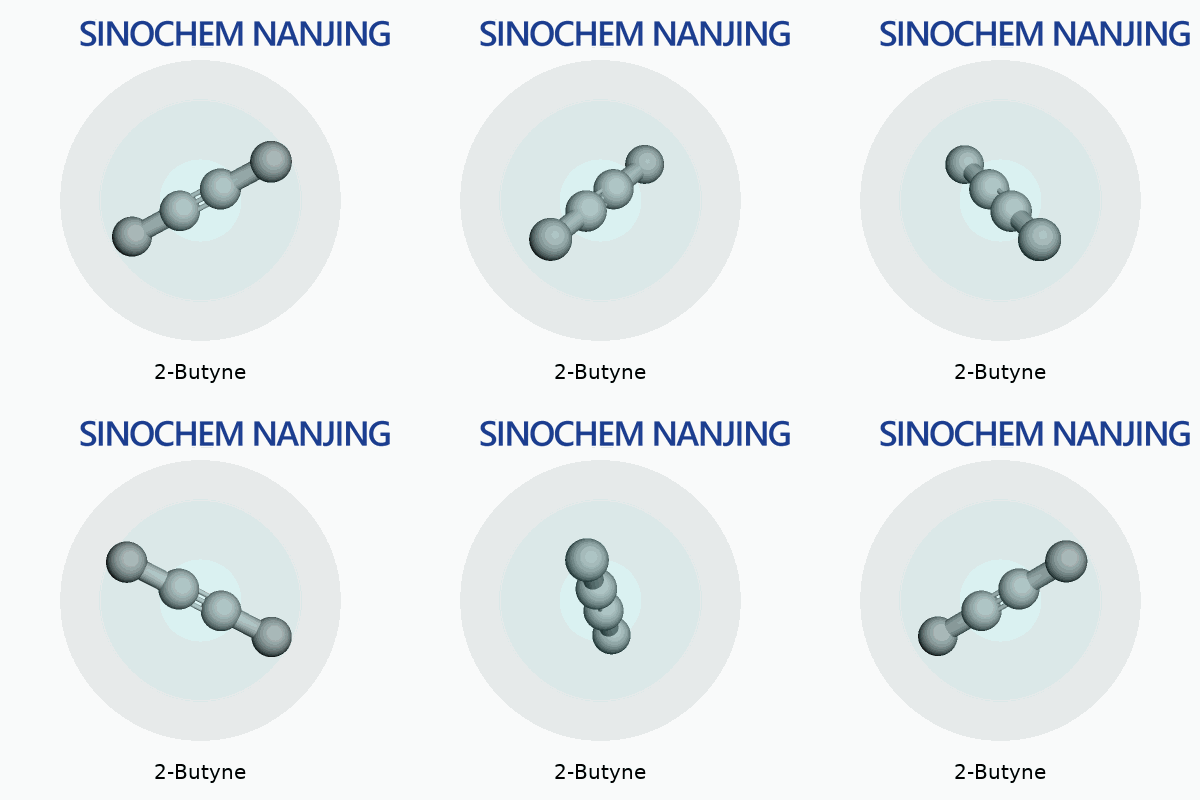
The most striking part of 2-Butyne’s skeleton centers on the carbon triple bond. You’ll find molecular geometry here is linear, not zig-zagged like saturated fats or simple alkanes. For those of us who’ve ever cracked open a can of spray paint or lighter fluid, you might have caught a whiff of a related compound. 2-Butyne’s structure puts it in the alkyne family, which means it behaves differently from alkenes and alkanes.
Alkynes, like this one, have fewer hydrogens compared to their alkene siblings. The triple bond is not just a line on paper. It introduces strain and unique reactivity to the molecule. This gives chemists an edge in creating more complex chemicals or designing reactions that require a high-energy, unsaturated bond.
2-Butyne in Everyday Contexts
People rarely talk about 2-Butyne in everyday life, but anyone who’s touched a university lab experiment may have met it. Students learn early on that this compound isn’t just an example in a textbook — it tells stories about volatility and hazards, echoing the reality that simple molecules can have big consequences.
Most of us hear more about acetylene, but 2-Butyne represents a different puzzle. Instead of terminating with hydrogen atoms, it sandwiches its triple bond between two methyl groups. This alters its physical properties — its boiling point, its solubility, and how easily it reacts. Chemists exploit these quirks in polymer formation, laboratory synthesis, and even in some niche industrial cleaner formulations. A molecule like this demonstrates the importance of nuance in structure; tiny changes in atomic connectivity produce huge differences in behavior, safety, and usefulness.
Learning from Structure to Learn Chemistry
Memorizing formulas doesn’t always help someone see the bigger picture. It wasn’t until college that I realized just how much a single bond or an extra methyl group can throw off predictions or plans for a reaction. Working with 2-Butyne in a standard organic chemistry lab taught me about handling volatiles and the unpredictability of unsaturated hydrocarbons. Safety goggles, fume hoods, and a healthy respect for “simple” molecules became standard practice.
Experience with this compound also drives home the need for detailed chemical education. Knowing the formulas, recognizing the line structures on a page, or understanding why the boiling point lands where it does – that all folds into effective science and safety. Every chemistry student could benefit from seeing what an unassuming hydrocarbon can actually do, both as a learning experience and a reminder of how quickly chemicals find their way into products, processes, and even hazards around us.
Moving Toward Better Understanding and Safer Practices
2-Butyne doesn’t strike headlines or command the same attention as compounds with more famous uses. Yet its chemical formula, CH3–C≡C–CH3, carries important lessons about structure dictating function. Researchers and industry professionals can encourage hands-on experience, stress molecular details, and never downplay the practical information each new hydrocarbon offers. In the end, the chemistry world needs both the slick theoretical knowledge and the gritty, informed day-to-day work that actually keeps labs and products running safely.
How should 2-Butyne be stored?
Understanding the Risks Involved
2-Butyne, known for its use in organic synthesis and specialty chemical manufacturing, packs quite a punch in its properties. Colorless, volatile, and highly flammable — these are not friendly traits if someone takes handling lightly. Many ignore the simple fact that 2-butyne develops dangerous peroxides if left in the open air for too long. Peroxides can turn a forgotten bottle into a bomb sitting in the back corner of a storage room. Laboratories running on autopilot end up as tomorrow’s cautionary tales if storage habits get sloppy.
Temperature and Ventilation
People tend to overlook the effect temperature has on volatile chemicals. I remember working in one lab — the difference between storing bottles in a sunlit storeroom and a cool, ventilated chemical safe made plenty of difference over a hot summer. Only an environment kept below 20°C prevents both unnecessary evaporation and the rising risk of runaway reactions. Any warm spot in a warehouse or a shelf exposed to sunlight could bring an unwelcome surprise. Proper ventilation stops the buildup of explosive vapors, especially if a bottle gets jostled or develops a slow leak. Relying on real airflow, rather than the hope that an old extractor fan still works, helps keep everything safer.
Avoiding Peroxides and Contamination
Chemists know that alkynes like 2-butyne don’t forgive carelessness. Pouring from one container to another, or leaving a bottle uncapped even for a few minutes, opens the door for slow peroxide formation. Glass containers with tight-sealing caps provide a simple solution, alongside regular inspection for cloudiness or crust on the rim — dead giveaways for peroxide risk. A coworker once argued that a drip of stabilizer can solve all problems, but no stabilizer replaces common sense: fresh containers, clear labeling, and scheduled replacement save both chemicals and headaches.
Labeling and Segregation
Sometimes, the small stuff slips by. A run of similar-looking bottles with fading labels leads to confusion and accidental mix-ups, especially during shift changes or in shared spaces. Using bold, standout labeling in chemical storage stops mistakes before they start. Flammable liquids, especially those prone to forming peroxides, stay best in their own locked cabinet — nowhere near acids or oxidizers. In the real world, people stack incompatible bottles together because space gets tight or they’re in a hurry, but clumsy shortcuts create long-term messes that someone eventually pays for.
Training, Inspections, and Community Responsibility
Training routines don’t just tick compliance boxes. Year after year, the labs that avoided disaster relied as much on routine visual inspections as they did on policy binders. Spotting a leaking cap or improper placement before lunch break matters more than catching it after hours. Teams that talk through what’s stored, who’s responsible, and how to respond in trouble transform storage from a chore into active protection for everyone. No chemical’s reputation matters more than the lives behind every bench or barrels stacked in a warehouse.
Moving Forward with Practical Solutions
Many forget that rules alone don’t make chemicals safer. Staying vigilant about temperature, ventilation, and proper sealing feels like overkill until bad luck catches up. Prioritizing group reminders, periodic evaluations, and encouraging open communication about near-misses helps safeguard more than property. In any place where 2-butyne lives, safety becomes community business — only daily effort keeps complacency from sneaking in.
Is 2-Butyne hazardous to health or the environment?
What Is 2-Butyne?
2-Butyne shows up in chemical plants, research labs, and specialty manufacturing. The molecule belongs to the alkyne group, and anyone who’s walked through an organic chemistry textbook has seen it pop up. It smells sweet, almost fruity, and evaporates easily in the air. Its most basic use: a building block for chemicals. The real questions start once that clear liquid leaves a lab and enters the air, soil, or water—even in small spills or leaky connections.
Health Risks
Breathing in 2-Butyne makes my airway prickle and head pound. This isn’t theory—I’ve been near it during undergrad chemistry. According to both the US National Institute for Occupational Safety and Health (NIOSH) and the European Chemical Agency (ECHA), 2-Butyne brings possible nerve effects, headaches, or dizziness. It can irritate the skin, eyes, and lungs. Exposure in small rooms can make people sick and, at higher levels, create much bigger emergencies.
Outside the lab, you won’t find this chemical hanging around grocery stores or office buildings, but plant workers or emergency responders may meet it in person. No one benefits from breathing it for long, and protective gear matters. The Material Safety Data Sheet (MSDS) says to remove the victim from the area, loosen their collar, and seek medical help. That level of attention tells me all I need to know about risk.
Environmental Hazards
People often ignore the H on the hazmat placard for 2-Butyne, but its flammability worries fire chiefs more. In air, even a trace can spark a fire or explosion. It floats up off asphalt, drifts into the sky, and wears out ozone a tiny bit. The chemical breaks down fairly quickly under sunlight, which stops it from accumulating like some persistent organics. Still, that ease of ignition—especially indoors or near older pipes—demands respect.
Leaks into water run a lower risk of long-term poisoning; the compound evaporates instead of sinking or holding on in the mud. That may sound safer, but what evaporates can still hit people or animals breathing nearby. Wildlife has it a bit easier, since rapid dissipation keeps it from concentrating on plants or in the food web. The trade-off sits in routine small leaks: nobody panics, but small exposures add up. In the wrong setting—chemical plants pressed up against neighborhoods or waterways—even a short-lived toxin raises trouble.
Why This Matters
Many chemicals seem harmless locked in steel tanks but shape-shift into hazards through mishandling. The world saw what happened in Bhopal with methyl isocyanate. That disaster came from underestimating risk and ignoring warning signs. 2-Butyne isn’t as tenacious or acute a threat, but it points to the same lesson: don’t let routine block out good sense.
Strong ventilation, good training, and up-to-date monitoring equipment make daily work with 2-Butyne safer. Checking pipes, labeling valves, and practicing spill drills save lives. Old habits put people at risk, especially in older facilities or ones cutting costs. Companies improve by running regular audits, listening to workers, and investing in automated leak detection.
Regulators can push for tighter limits, but community groups have power too—pressure brings transparency, and transparency brings accountability. Speaking from experience, a well-informed team reacts faster and prevents most accidents. Protecting people and the environment takes teamwork, attention, and a steady commitment to keeping short-term convenience from setting the agenda.
| Names | |
| Preferred IUPAC name | but-2-yne |
| Other names |
Dimethylacetylene Ethylideneacetylene |
| Pronunciation | /ˈtuːˌbjuːtaɪn/ |
| Identifiers | |
| CAS Number | 503-17-3 |
| Beilstein Reference | 1209227 |
| ChEBI | CHEBI:41993 |
| ChEMBL | CHEMBL16875 |
| ChemSpider | 53235 |
| DrugBank | DB02252 |
| ECHA InfoCard | ECHA InfoCard: 100.005.868 |
| EC Number | 209-524-7 |
| Gmelin Reference | 136097 |
| KEGG | C01984 |
| MeSH | D016420 |
| PubChem CID | 7847 |
| RTECS number | EL5425000 |
| UNII | V3C44E85GK |
| UN number | UN1161 |
| Properties | |
| Chemical formula | C4H6 |
| Molar mass | 54.09 g/mol |
| Appearance | Colorless liquid |
| Odor | sweet odor |
| Density | 0.689 g/cm³ |
| Solubility in water | slightly soluble |
| log P | 0.22 |
| Vapor pressure | 1430 mmHg (20 °C) |
| Acidity (pKa) | 25 |
| Basicity (pKb) | 25.0 |
| Magnetic susceptibility (χ) | -31.8·10⁻⁶ cm³/mol |
| Refractive index (nD) | 1.371 |
| Viscosity | 0.232 mPa·s (20 °C) |
| Dipole moment | 0.00 D |
| Thermochemistry | |
| Std molar entropy (S⦵298) | 228.5 J·mol⁻¹·K⁻¹ |
| Std enthalpy of formation (ΔfH⦵298) | +34.8 kJ/mol |
| Std enthalpy of combustion (ΔcH⦵298) | -1300.0 kJ/mol |
| Hazards | |
| GHS labelling | GHS02, GHS07 |
| Pictograms | GHS02,GHS07 |
| Signal word | Danger |
| Hazard statements | H225, H319, H335 |
| Precautionary statements | Keep away from heat, hot surfaces, sparks, open flames and other ignition sources. No smoking. Store in a well-ventilated place. Keep container tightly closed. Protect from sunlight. |
| NFPA 704 (fire diamond) | 2-1-2 |
| Flash point | Flash point: -32 °C |
| Autoignition temperature | 465 °C (869 °F; 738 K) |
| Explosive limits | Explosive limits: 1.7–12% |
| Lethal dose or concentration | LD50 (oral, rat): 3492 mg/kg |
| LD50 (median dose) | LD50 (median dose): rat oral 500 mg/kg |
| NIOSH | KW2975000 |
| PEL (Permissible) | Permissible Exposure Limit (PEL) for 2-Butyne: "40 ppm (120 mg/m3) TWA |
| REL (Recommended) | 0,2 ppm |
| IDLH (Immediate danger) | IDHL: 2000 ppm |



