Commentary on 2,5-Dimethylheptane: History, Science, and Possibilities
Looking Back: The Journey of 2,5-Dimethylheptane
Chemists first noticed the value of molecular variety in the early part of the twentieth century, and compounds like 2,5-Dimethylheptane came into the spotlight around that time. In the days before high-resolution chromatography, separating and analyzing hydrocarbons called for both patience and curiosity. This compound showed up among other alkanes when scientists started scrutinizing crude oil for its unique branched structures. Once analytical technology improved, people realized these branched alkanes had different boiling points and chemical stabilities compared to their straight-chain relatives. Researchers also started focusing not just on gasoline yields, but on combustion behavior. 2,5-Dimethylheptane, as one of these "isoalkanes," became a model for studying how hydrocarbons burn in engines. This interest has never quite faded, especially as efficiency and emissions keep drawing headlines.
Getting to Know 2,5-Dimethylheptane
Among the many molecules that make up fuels and solvents, 2,5-Dimethylheptane stands out for its tight symmetry and relatively low reactivity. It belongs to a family of saturated hydrocarbons with the formula C9H20, which means it contains just carbon and hydrogen, all bonded in single chains. The two methyl branches on the fifth and second carbon make this structure a bit more complex than a straight nonane, and this subtle difference changes how it behaves in mixtures or combustion. Branched alkanes like this tend to evaporate and ignite a bit differently, which became important when cleaner-burning fuels grew in demand.
Physical and Chemical Properties: An Insider’s Perspective
While studying hydrocarbon properties, it's clear that 2,5-Dimethylheptane brings together traits that are interesting for both lab work and industry. It's a clear, colorless liquid under room temperature, giving off a faint odor not far removed from lighter fluid. Its boiling point sits slightly below straight-chain nonane, reflecting how molecular shape nudges volatility. In terms of solubility, water rejects it, but it blends right into most organic solvents. Flammability remains a concern, something learned quickly in university labs with open flames and careless handling. From a chemical angle, this molecule resists attack under ordinary conditions; strong acids, bases, and oxidizing agents are needed to push it around. Its stability mirrors most branched alkanes, so shelf life or accidental breakdown rarely becomes a problem.
Labels and Technical Specs: Knowing What’s in the Bottle
Walk through any chemical storeroom, and labels tell as much of the story as the contents inside. Buying 2,5-Dimethylheptane, I notice it's usually labeled with its CAS number for clarity—identification is everything when shelves are lined with similar-looking containers. Common labels also call out its purity level. For precise applications, high-purity batches are expected, since trace impurities can upset test results. Flash point and boiling point data come printed in bold, since those handling the compound need instant reminders of safely stored and used volumes.
From Crude to Lab: How 2,5-Dimethylheptane Comes to Be
Years ago, refining techniques produced mainly long, straight-chain hydrocarbons, but it didn’t take long before chemists started devising routes to the more complicated branched structures. In commercial terms, catalytic isomerization runs at the heart of how structures like 2,5-Dimethylheptane are generated from straight-chain nonane. Careful control over temperature, catalyst composition, and feedstock unlocks just the right conditions for branching to occur at specific sites. For smaller quantities or more targeted syntheses, organic chemists sometimes build the molecule up step by step, piecing together carbon chains through reactions like alkylation. I've had the opportunity to run such reactions in the lab, watching liquid fractions separate on column chromatography until the desired branched alkane appears clean and ready.
Reactivity and Carbon Skeleton Transformations
Alkanes aren’t flashy on the bench, but in the presence of energy or reactive intermediates, transformations do occur. Combustion tops the list, and 2,5-Dimethylheptane burns hot and fast in air, a reminder of its value as a model fuel. Exposure to halogens, especially under light, can prompt substitution reactions, although controlling which hydrogen gets replaced isn’t trivial. On an industrial scale, cracking processes break down molecules like this into smaller, more useful fragments—but in the research setting, the molecule serves as a stand-in for broader hydrocarbon studies. Structural modifications, such as selective oxidation or catalytic reforming, often become parts of larger research projects rather than everyday work.
Name Game: Synonyms and Alternative Labels
Reading chemical literature, I’ve come across a small crowd of names referring to this molecule. The simplest shorthand is calling it 2,5-dimethylnonane, though that’s less accepted. Systematic names like Diisopropylbutane have also popped up, causing confusion for those not deeply versed in carbon-branching rules. Most agree that 2,5-Dimethylheptane stays true to IUPAC standards and appears most often in serious journals and catalogues.
Staying Safe and Working Smart
Safety standards matter just as much as technical details. Volatile organics pose risks not just from flames or sparks, but also through inhalation. Inhalation of concentrated vapors can lead to dizziness or headaches, even before people think about the hazards. Laboratory vent hoods, flame arrestors, and careful disposal routines make up daily practice. The chemical resists breaking down in the body, so while immediate toxicity remains low, chronic exposures cloud long-term effects. Regulatory compliance demands proper storage in tightly capped containers, stored away from oxidizers or strong sunlight. Every workplace review I've sat through reminds that familiarity never substitutes for solid habits: reading the MSDS, clear labeling, and never taking shortcuts with gloves or safety glasses.
Applications: Why 2,5-Dimethylheptane Still Matters
Fossil fuels and petrochemical research still lean heavily on model compounds like 2,5-Dimethylheptane. It doesn’t show up in mass-market products or household cleaners, but it does show up any time performance of fuels under different engine conditions gets tested. Engine knocking—a problem that dogged early gasoline cars—spurred a wave of research into how branching in hydrocarbons could dampen uncontrolled detonations. In bench chemistry, this molecule might serve as a standard or a comparative marker in chromatographic calibrations. Academic labs train young scientists with hydrocarbons like this, setting a foundation for later work on fuels, lubricants, or specialty solvents. Industrial R&D prioritizes molecules that can serve both as standards and as prototypes when looking for new ways to optimize energy yield or environmental compliance.
Raising Possibilities: R&D and the Search for Cleaner Energy
Research into 2,5-Dimethylheptane doesn’t halt at measuring how it burns. Scientists probe reactivity under controlled pressure and temperature, mapping out how branching affects energy content and byproduct formation. The molecule’s stability makes it a useful test subject for advanced catalysis, where converting hydrocarbons into higher-value or less polluting chemicals remains a top goal. Team projects aim to streamline how branched alkanes are synthesized, maximizing efficiency while slashing byproduct waste. Universities and energy companies alike keep reaching into their toolkits and returning to molecules like 2,5-Dimethylheptane for mechanistic insight.
Toxicity and Human Impact: Unpacking the Unknowns
People like to lump all hydrocarbons together in talks of pollution and health, but toxicity varies a lot within the group. For 2,5-Dimethylheptane, the data suggest low direct toxicity compared to oxygenates or aromatics, but long-term exposure raises different questions. Some animal studies note mild central nervous system depression at high vapor concentrations, which matches anecdotal reports from poorly ventilated workshops. Chronic inhalation remains an area with a lot of unexplored ground, especially concerning environmental build-up and persistence. Advances in monitoring technology may shed new light on whether traces of compounds like this play a role in occupational health.
Looking Forward: What’s Next for 2,5-Dimethylheptane?
Out of the thousands of hydrocarbons known today, few serve the dual role as both an industrial standard and a classroom teaching tool. 2,5-Dimethylheptane’s place may seem small, but as researchers dig deeper into sustainable energy solutions, every branch of the family tree gets a moment under the microscope. Advanced modeling uses its properties to design synthetic fuels, and its reactivity profile informs safer chemical manufacturing methods. Demand for lower emissions keeps pressure high on innovation, and even “old” molecules like this can spark new ideas. Anyone working at the crossroads of chemistry, engineering, and environmental science will probably cross paths with it, whether tuning a reaction, running a fuel test, or troubleshooting lab results. In the quest to understand and improve the materials shaping our daily lives, turning back to basics like 2,5-Dimethylheptane feels less like a step back and more like a reminder of how every detail matters.
What is 2,5-Dimethylheptane used for?
What’s Special About This Chemical?
2,5-Dimethylheptane doesn’t show up every day in conversation unless you’re tracking hydrocarbons or fuel chemistry. It’s part of the alkane family, made up of only carbon and hydrogen. People who follow petrochemical pathways know that its branched structure makes it distinctive compared to straight-chain cousins. It doesn’t just matter for a chart or textbook. There’s a practical angle that many overlook.
Where It Turns Up in Daily Life
You can find 2,5-Dimethylheptane mostly in gasoline and other fossil fuels. The energy sector values hydrocarbons with branching, such as this one, because they bring higher octane ratings. That higher octane helps engines resist knocking, giving smoother performance and reducing the risk of damage. As someone who’s worked on cars and spent plenty of time tuning engines, I’ve seen how big a difference this makes for everyday drivers. Octane ratings aren’t a marketing gimmick—they help prevent early ignition, so engines last longer and run with less trouble.
Why Does Octane Matter?
If you ever wondered why high-performance cars demand premium gas, the answer sits with molecules like 2,5-Dimethylheptane. Manufacturers aim for fuels with precisely balanced mixtures to fit modern engine designs. Tetraethyllead once did most of the heavy lifting for octane, but tightening regulations sent fuel chemists looking for clean alternatives. Branched alkanes like this one came to the rescue.
Beyond the Gas Pump
Refineries produce a range of hydrocarbons during crude oil processing. Many byproducts get blended into gasoline. Sometimes 2,5-Dimethylheptane goes into research labs, where chemists use it as a standard for calibrating instruments or studying reaction pathways. Its physical properties—high purity, well-known boiling point, and clear separation from other compounds—make it reliable for testing and comparison. Lab work needs dependable standards, and this one hits the mark.
Environmental and Health Issues
Any time a hydrocarbon enters the conversation, health or environmental risks deserve attention. 2,5-Dimethylheptane counts as a volatile organic compound, so it can evaporate and play a part in pollution. It’s not as infamous as benzene, but prolonged exposure still brings concerns. Employees at refineries and labs should treat it carefully, using ventilation and protective gear. The general public rarely deals with pure 2,5-Dimethylheptane, since it’s blended in fuel and burned off. Still, regulators have eyes on hydrocarbon emissions, driven by worries about smog and long-term health. Reducing releases from transportation and industry would cut risks tied to these compounds.
Room for Better Solutions
Striving for cleaner fuels stands out as an obvious priority. Bio-based gasoline alternatives and electric vehicles already attract attention, and 2,5-Dimethylheptane’s story shows why: improving combustion still leaves emissions. Policies pushing for next-generation engines, more renewable energy, and stricter monitoring of refinery outputs could all help in the quest for better air and safer work environments. From a practical angle, protecting people handling hydrocarbons starts with training, strong gear, and safety checks. Clean-burning fuels backed by smart regulation offer a real shot at keeping both engines and communities healthier.
What is the molecular formula and structure of 2,5-Dimethylheptane?
The Molecular Formula
2,5-Dimethylheptane carries the sleek molecular formula C9H20. Chemists see this formula and know it holds nine carbon atoms and twenty hydrogen atoms. Nothing too wild on paper, but the framework underneath gives the molecule its personality.
Molecular Structure Explained
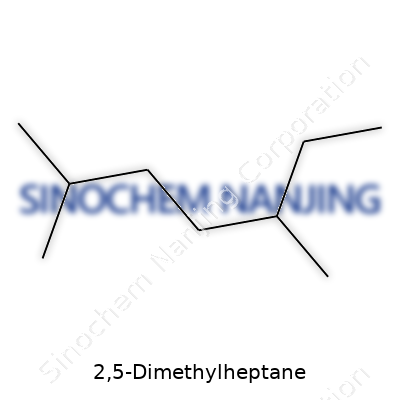
Drawing its backbone out, heptane means a straight, seven-carbon chain. Attach two methyl branches—one on carbon 2 and another on carbon 5—and the molecule changes. The branches hang like little arms, making the structure less linear and more branched. Here’s a clearer way to picture it:
- Main chain: A stretch of seven carbons, numbered from one end to the other.
- Methyl groups: On carbon 2 and carbon 5, each carries a one-carbon methyl branch.
Lay it out: Carbon 1 connects to carbon 2, then carbon 3, up to carbon 7 in a straight shot. On carbon 2, a –CH3 group (methyl) sticks out. Same story on carbon 5—another methyl group pokes out. This pattern avoids unnecessary complexity but pulls the heptane chain away from being completely straight.
Why Branching Matters in Alkanes
In my own experience working with organic compounds, branching—right down to tiny methyl groups—does more than change how the molecule looks. It affects real stuff: boiling points, reactivity, and how these compounds fit into larger chemical processes.
Take the boiling point. 2,5-Dimethylheptane, thanks to the methyl groups on each side, can’t pack together as tightly as straight-chain heptane. This loose stacking means it boils at a lower temperature. Industrial chemists and chemical engineers keep this in mind, because properties like boiling point play into things like fuel performance and distillation.
Real-World Relevance
2,5-Dimethylheptane pops up in discussions about fuel chemistry or hydrocarbon analysis, where precision makes a difference. Refineries separate alkanes by boiling point and structure so the unique layout of these molecules becomes a practical sorting tool. Branching gives this molecule a clear identity among isomers of nonane.
Complex hydrocarbons can create confusion—especially for students just starting organic chemistry. A mistake in drawing the branches or counting carbons lands you with an entirely different molecule. The IUPAC system makes the naming process practical, but learning to spot those branches on paper or in a model stands out as a key step. I remember getting that "aha" moment the first time I drew a branched alkane correctly.
Potential Solutions for Teaching and Industrial Use
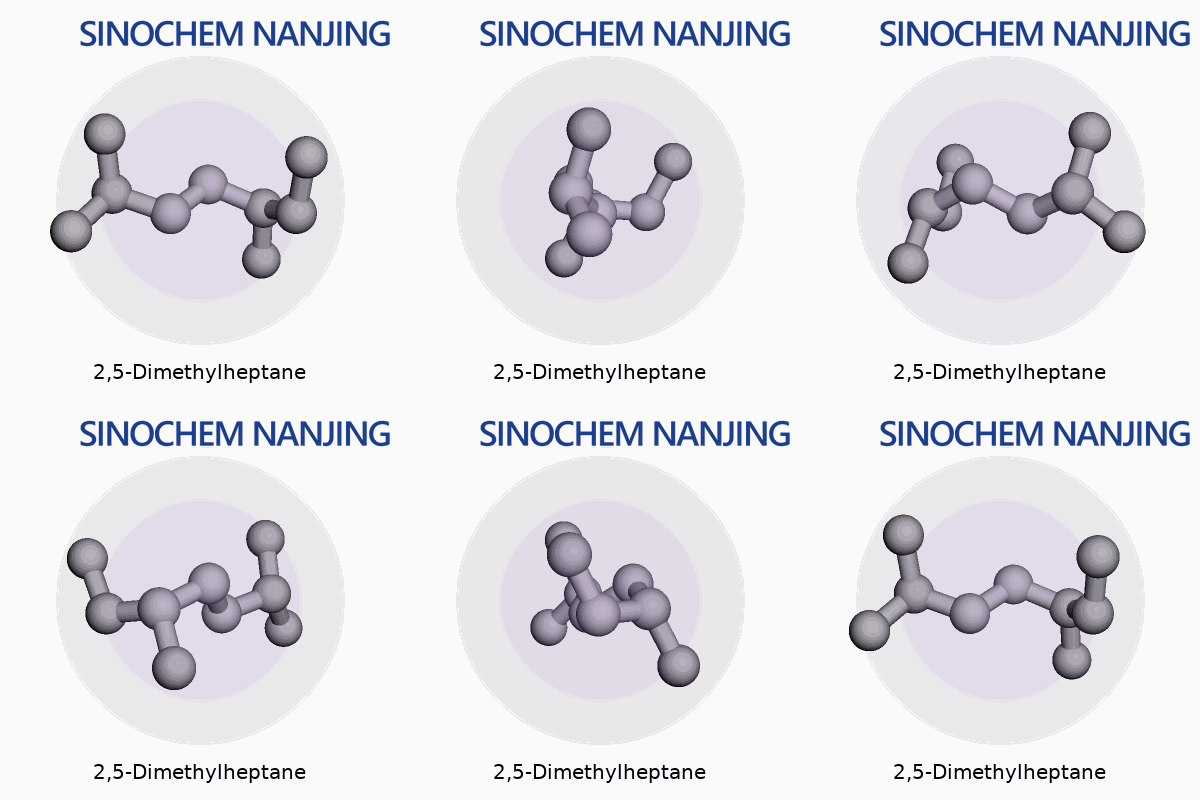
Educators who stick with physical models or 3D drawings help students understand branching without memorizing. Giving hands-on practice with molecular kits lets learners twist, turn, and really see the difference between straight and branched isomers.
In industry, better software tools and molecular modeling programs help researchers track properties tied to structure. Digital modeling lets people check structures faster, predict boiling points, and flag differences between similar-sounding compounds. With new AI-powered tools, mistakes from human error drop, and the process quickens.
2,5-Dimethylheptane offers a good example of how details in structure ripple out to properties and use. That C9H20 formula hints at a lot more than just atomic counts; it marks the starting line for real-world effects, from how the compound boils to how it ends up sorted and processed.
Is 2,5-Dimethylheptane hazardous or toxic?
Understanding 2,5-Dimethylheptane
2,5-Dimethylheptane lines up with other branched-chain alkanes in gasoline. Chemical industries use these compounds to boost octane, fine-tune engine performance, and tweak fuel blends. Most people outside chemistry never hear the name. Still, it flows through refinery pipes, tank trucks, and maybe even your car’s gas tank every day.
Does 2,5-Dimethylheptane Pose Health Risks?
A lot of folks wonder if leafing through safety data will turn up nightmares or peace of mind. Straight facts point out that 2,5-dimethylheptane shares traits with other hydrocarbons in the gasoline world. Inhaling high levels of these vapors knocks the nervous system around—headaches, dizziness, and even loss of coordination. Getting it on your skin won’t lead to fires, but irritation crops up quickly. This isn’t unique to 2,5-dimethylheptane; it’s common across the whole iso-alkane group.
The U.S. National Institute for Occupational Safety and Health (NIOSH) mentions that related low-molecular weight hydrocarbons cause drowsiness and lightheadedness in poorly ventilated spaces. This often happens in confined manufacturing locations or tank cleaning jobs, where basic ventilation gets forgotten. Swallowing isn’t likely in daily life, but accidental ingestion leads to vomiting or potential lung injury if someone inhales after swallowing. That’s the reality for most light hydrocarbons.
Environment and Fire Hazards
Environmental risks don’t fade away. Like other gasoline ingredients, 2,5-dimethylheptane evaporates easily. On a hot day, it can drift from a puddle or tank vent, heading skyward. If it finds a spark, it catches fire faster than many household chemicals. Refineries and fuel depots already know the rules—keep it contained, avoid static discharges, and check for leaks. That basic checklist matters, since the substance spreads quickly and leaves a flammable vapor trail.
Soil and water contamination can lead to headaches for cleanup crews. 2,5-dimethylheptane doesn’t hang around in water for long, breaking down or drifting off into the air. Still, a spill close to drinking water can stir up concern for communities and regulators. The Environmental Protection Agency (EPA) and similar groups require proper reporting and fast action if a major spill occurs.
Learning from Experience—Respecting the Risks
Working in industrial settings, I’ve seen safety training mark hydrocarbons as “handled with care” substances. No one scrambles around in rubber suits to avoid 2,5-dimethylheptane, but no one ignores a leaky drum either. Mechanical engineers, safety professionals, and plant workers all rely on clear labeling, sealed systems, and routine checks. Everyone learns to respect vapors and prevent open flames, even if the product itself seems harmless to the eye.
Public health groups have pressed for steady upgrades. Proper ventilation, personal protective equipment, and emergency eyewash stations cut down personal risk almost to zero. For the environment, training drivers and warehouse crews to stop, report, and isolate a spill has kept accidents rare and cleanup straightforward.
What’s the Path Forward?
Transparency from manufacturers makes a big difference. Clearer safety labels, regular public reporting, and updated education for employees help people share both responsibility and peace of mind. If gasoline blending ever phases in less toxic additives, the industry won’t miss a beat. In the meantime, mutual respect for the substance, practical safety routines, and honest communication keep danger at arm’s length.
How should 2,5-Dimethylheptane be stored?
Laying the Groundwork for Safe Storage
Anyone who has worked around chemicals knows how storing them right makes all the difference. 2,5-Dimethylheptane isn’t a household name, yet it falls in the crowd of volatile organic compounds. Its main issues are flammability and the risks from its vapors. So, ignoring storage basics would just be rolling dice for no good reason.
Why Ordinary Spaces Don’t Cut It
Most folks have seen what happens when gasoline gets near a hot surface or open flame. 2,5-Dimethylheptane fits in a similar category. Fumes catch fire easily, and containers heat up faster than you might expect. I’ve seen what can happen after only a careless moment with solvents; the cleanup, the fear, the regret—it lingers long after the smell fades. Nobody wants a chemical fire starting where people live or work, so taking shortcuts with storage puts lives and property on the line.
Ideal Setting for 2,5-Dimethylheptane
A metal cabinet built for flammables does the trick. Shelves hold containers securely, and the metal slows down flames in case of a nearby spark. These cabinets stay in cool, dry places—a basement corner won’t cut it unless ventilation keeps the air moving. A room with a window or exhaust fan clears out any lingering fumes. Keeping it away from sunlight and open heat sources is crucial. Even people who don’t handle much chemical stock keep to these basics at home or in the garage for paint thinners and gas cans, so the reasoning carries straight over.
Don’t Let Vapors Get the Best of You
Fumes from 2,5-Dimethylheptane build up quick if there’s a leak—one loose cap, or a seal that’s going bad, and you’re breathing in what you shouldn’t. Using containers with tight-fitting lids makes a difference. Old peanut butter jars or random plastic bottles only invite trouble. Only use containers with proper labels and materials rated for flammable liquids. Glass often shatters when dropped. Metal resists, as long as corrosion doesn’t creep in. High-density polyethylene works too, if the manufacturer says it’s built for such jobs.
Keeping It Out of the Wrong Hands
Years on oil rigs and in chemistry labs taught me that accidents happen most often when someone tries to help without training. Lock those cabinets. Post clear warnings on the front. Nobody should reach for a container unless they know what’s in it. Kids, stray animals, or even curious coworkers should never end up handling chemicals like this by accident.
Preparing for the Worst
Fires escalate in seconds. Always keep a working fire extinguisher nearby—type B for flammable liquids. I keep spill kits at arm’s reach in my own garage shop. For bigger storage, a sand bucket or absorbent pads can take care of leaks before they spread. Have local emergency numbers handy. Most people don’t believe a small amount could spark such trouble, but it only takes one unplanned reaction.
Final Thoughts on Why It Matters
Careless storage of 2,5-Dimethylheptane risks more than dollars lost to spilled liquid. It touches on local air quality and workplace safety laws. Trust in a community comes from handling dangerous goods responsibly. A few common-sense steps keep everybody safer, including the people who never see the inside of a chemical cabinet.
What are the physical properties of 2,5-Dimethylheptane (boiling point, melting point, density)?
Out on the Lab Bench: Boiling Point
2,5-Dimethylheptane draws interest among chemists looking for insight into the behavior of branched alkanes. This colorless liquid features a boiling point of about 140–142°C. Compared to straight-chain heptane, which boils at around 98°C, you might wonder why the boiling point rises for some branched cousins. Adding methyl groups at the 2 and 5 positions forces a tight configuration, cutting back on easy molecular stacking but also altering how molecules interact.
In my own experience working in organic research labs, a boiling point above 140°C usually steers this molecule away from volatility concerns in most ambient conditions. It doesn’t evaporate as fast as lighter alkanes. Ventilation remains vital, though, especially in larger-scale experiments, since volatile organic compounds can still impact air quality.
Feeling the Freeze: Melting Point
2,5-Dimethylheptane shows up as a liquid at room temperature, with a melting point hovering near -95°C. It remains pourable and workable in almost any typical laboratory or industrial setting. Those extra methyl groups block tight packing in the solid phase, dropping the melting point much lower than straight-chain alkanes with the same carbon count.
There was a time in winter, in a cold corner of the storage fridge, when I found straight-chain heptane frozen but 2,5-dimethylheptane still flowing smoothly. That moment crystallized, for me at least, how branching in hydrocarbons can reshape core behaviors in real-world settings beyond numbers on a chart.
Size and Mass: Density of 2,5-Dimethylheptane
Anyone who’s poured both water and an organic solvent from a flask will notice that most hydrocarbons float. 2,5-Dimethylheptane stays true to this pattern, with a density close to 0.70–0.72 g/cm3 at 20°C. That places it well below water. Density may seem like just a number, but for bench chemists, it means this compound will separate naturally in aqueous extractions, hanging up as the top layer.
I still remember losing precious milligrams in a separation funnel when I forgot which layer was the organic and which was the aqueous. Getting those details right matters when you’re handling solutions worth hours of your work. The low density of branched alkanes like 2,5-dimethylheptane almost always lands them at the top, so long as you haven’t loaded them up with foreign atoms.
Why the Physical Facts Matter
Chemists and process engineers want clear information about boiling and melting points because it shapes how they transport, store, and work with chemicals daily. Toxicology and flammability concerns often track closely to these numbers. In the case of 2,5-dimethylheptane, its boiling range allows safe heating on a lab hotplate or reflux rig, but it calls for care to avoid vapors. The low melting point and density mark it out as easy to handle down to frigid temperatures and simple to separate from water-based mixtures.
Real progress comes when labs use these details to build safer workspaces and fewer surprises in the separation funnel. Accurate labeling, thoughtful ventilation, and proper heating setups rely on facts like these. It’s about more than chemical trivia—these numbers shape daily decisions in labs around the world.
| Names | |
| Preferred IUPAC name | 2,5-Dimethylheptane |
| Other names |
sym-Dimethyln-heptane 2,5-Di-Methyl-heptane |
| Pronunciation | /tuː,faɪv-daɪˈmɛθɪlˈhɛpteɪn/ |
| Identifiers | |
| CAS Number | 2216-34-4 |
| Beilstein Reference | 1261484 |
| ChEBI | CHEBI:89070 |
| ChEMBL | CHEMBL16442 |
| ChemSpider | 121410 |
| DrugBank | DB14156 |
| ECHA InfoCard | 100.126.675 |
| EC Number | 203-622-1 |
| Gmelin Reference | 79059 |
| KEGG | C08267 |
| MeSH | D016695 |
| PubChem CID | 11592 |
| RTECS number | MA2625000 |
| UNII | PX1W1QL7VS |
| UN number | UN1165 |
| Properties | |
| Chemical formula | C9H20 |
| Molar mass | 128.255 g/mol |
| Appearance | Colorless liquid |
| Odor | Odorless |
| Density | 0.718 g/mL |
| Solubility in water | insoluble |
| log P | 4.8 |
| Vapor pressure | 1.23 mmHg (at 25 °C) |
| Magnetic susceptibility (χ) | -8.24e-6 |
| Refractive index (nD) | 1.398 |
| Viscosity | 0.69 mPa·s (25 °C) |
| Dipole moment | 0.00 D |
| Thermochemistry | |
| Std molar entropy (S⦵298) | 366.6 J·mol⁻¹·K⁻¹ |
| Std enthalpy of formation (ΔfH⦵298) | -205.0 kJ/mol |
| Std enthalpy of combustion (ΔcH⦵298) | -4883.7 kJ/mol |
| Hazards | |
| GHS labelling | GHS02, GHS07 |
| Pictograms | GHS02 |
| Signal word | Warning |
| Precautionary statements | P210, P233, P240, P241, P242, P243, P261, P271, P301+P310, P303+P361+P353, P304+P340, P305+P351+P338, P331, P370+P378, P403+P235, P405, P501 |
| NFPA 704 (fire diamond) | 1-1-0 |
| Flash point | 57 °C |
| Autoignition temperature | Autoignition temperature of 2,5-Dimethylheptane is 260 °C |
| Explosive limits | 1 - 6.5 % |
| NIOSH | UH9450000 |
| PEL (Permissible) | Not established |
| REL (Recommended) | 120 mg/m3 |
| Related compounds | |
| Related compounds |
2,2-Dimethylheptane 2,3-Dimethylheptane 2,4-Dimethylheptane 3,3-Dimethylheptane 3,4-Dimethylheptane 3-Ethylhexane Isooctane Heptane |



