2,5-Dibromoaniline: A Chemical Compound Behind the Scenes
Historical Development
Chemistry has never been just about mixing things and recording reactions. The history of 2,5-Dibromoaniline takes us into a time when scientists first noticed how substituting different atoms on an aromatic ring shaped a molecule's character. During the days when organic synthesis shaped new industries in dyes, pharmaceuticals, and materials, brominating anilines created chemicals with fresh utility. Researchers in the early 20th century began targeting selective bromination methods, often starting with coal tar anilines. They mapped out how bromine reacts with aromatic amines. Through grit and repetition, labs figured out which stacks of reagents, heat, and solvents would consistently add bromines to just the spots they wanted. Today’s supply of 2,5-Dibromoaniline rests on the shoulders of this old-fashioned experimental work, honed through decades of observation.
Product Overview
Anyone who has wandered through an industrial-scale chemistry facility knows 2,5-Dibromoaniline doesn’t get the same limelight as benzene or toluene, but this compound remains key in specific markets. It pops up as a specialty intermediate. Manufacturers value its brominated ring for its responsiveness in making high-performance polymers, coloring agents, and certain pharmaceuticals. Chemists often use this compound to introduce the bromine atom precisely, acting as a springboard for further reactions, often in the search for new active pharmaceutical ingredients or pigments. In the lab, its clear structure, with two well-placed bromines on an aniline base, puts it right at the intersection of versatility and reactivity.
Physical & Chemical Properties
The experience of handling 2,5-Dibromoaniline comes with the usual respect any aromatic amine demands. This compound presents as a crystalline solid, sometimes off-white or with a faint brown tint caused by trace impurities. With a molecular weight over 250 g/mol and a melting point that sits just above room temperature, it’s stable in a closed container under ordinary storage. Solubility in water is low—aromatic rings and heavy bromine atoms don’t lend themselves well to hydrophilicity—but organic solvents like chloroform or acetone lend a hand for dissolution. Chemically, the amine group opens doors for further transformation, and the two bromine atoms serve as markers where other reactions can kick in. Its reactivity in coupling, substitution, or reduction reactions positions it as a respected reagent for custom syntheses.
Technical Specifications & Labeling
Chemicals coming through research or factory doors demand accuracy in labeling for both safety and compliance. 2,5-Dibromoaniline is typically described using its CAS Registry Number, which stands as a universal language among chemists who trade or use it. Its appearance, purity (often above 98 percent for most purposes), melting point, and method of analysis—typically GC or HPLC—get spelled out on documentation. Storage recommendations continue to push for cool, dry conditions, with full acknowledgment of the compound’s sensitivity to light or oxidation over time. Anyone in labs or supply management knows that clear technical documentation keeps mistakes from happening where the stakes are high.
Preparation Method
Making 2,5-Dibromoaniline isn’t just about dumping chemicals together. The process usually starts with plain aniline, exposing it to bromine in a controlled environment, often in glacial acetic acid or similar solvents. The key is directing the reaction so the bromines land on the 2 and 5 positions, avoiding over-bromination or errant byproducts. This takes careful control of temperature and reagent ratios. Sometimes, older routes used protecting groups, but more modern approaches keep the steps efficient—reducing waste, cost, and risk. Years of hands-on experience have shown solvent choice and timing directly affect product purity. This process, while now routine, reflects a long evolution in synthetic methodology.
Chemical Reactions & Modifications
Few chemicals serve as such reliable building blocks for organic synthesis as 2,5-Dibromoaniline. The amine group acts as a gateway for forming amide or sulfonamide linkages, while the bromines on the ring permit Suzuki, Buchwald-Hartwig, or Ullmann-style couplings that attach new groups. In industry and academic settings, the majority of uses leverage these bonds—hooking in aryl groups or more complex substituents. Over the years, researchers have published a suite of modifications, showing just how much diversity can stem from such a simple scaffold. The transformations possible with 2,5-Dibromoaniline have enabled breakthroughs in drug discovery and materials science—each new derivative comes with its risks, benefits, and challenges.
Synonyms & Product Names
Walking through catalogs, chemists soon realize a single compound wears many names. 2,5-Dibromoaniline also crops up as 2,5-Dibromobenzenamine, m-Dibromoaniline, or 2,5-Br2C6H3NH2 in various chemical listings. Trade names rarely surface given this is a basic building block rather than a finished product. Having multiple identifiers helps users cross-check sources and suppliers, keeping confusion at bay in procurement and research.
Safety & Operational Standards
Safety isn’t just about ticking boxes; it’s about keeping colleagues out of the emergency room. 2,5-Dibromoaniline, like many aromatic amines, raises red flags for toxicity. Exposure can affect skin, eyes, or respiratory tracts, and it merits gloves, goggles, and lab coats for anyone opening a jar or flask. Regulatory agencies track this compound closely, demanding clear labeling, storage away from incompatible materials, and careful waste management. Labs and companies using it rely on thorough training, consistent fume hood use, and real-time spill response planning. Accidents with such chemicals can quickly escalate, so the value of a safety-first culture can’t be overstated here.
Application Area
What scientists and manufacturers appreciate most about 2,5-Dibromoaniline is its flexibility in research and industrial innovation. Organic chemists use this compound to assemble reactive intermediates—especially in the search for new dyes, agricultural agents, and experimental drugs. Certain dye manufacturers have long leaned on brominated aniline derivatives to engineer hues with fastness and vividness that plain anilines couldn’t deliver. In pharmaceutical R&D, it can stand as a precursor for molecules that inhibit, activate, or modulate enzymes and receptors, giving chemists a precise handle in molecule design. The broad adoption in these fields shows how small molecules underpin big changes.
Research & Development
The story of 2,5-Dibromoaniline in research settings is one of routine applications colliding with unexpected results. In medicinal chemistry, each bromination opens a possibility for a new pharmacologically active molecule—sometimes bringing new potency or selectivity, other times opening routes to better diagnostics or imaging agents. Polymer chemists keep probing how brominated anilines fit into advanced materials, often looking to tune electrical or optical properties. The compound’s predictable reactivity lets scientists plan routes into unknown territory while still standing on firm ground. The best labs never stop tweaking procedures and characterizing side products, aiming for innovation while improving yield and sustainability.
Toxicity Research
A lot of people underestimate the health risks from aromatic amines and halogenated compounds. Studies have confirmed 2,5-Dibromoaniline can trigger acute and delayed toxicity—irritating tissues or, in some cases, impacting organs after chronic exposure. Regulatory authorities set exposure limits, and responsible labs rely on animal testing data, computational predictive models, and case reports to stake out safe handling procedures. Greater focus has come in recent years on environmental impacts, too. Waste containing this compound needs proper neutralization and controlled incineration. Lessons from older generations of chemists—the ones who worked without today's protections—still echo in today’s focus on minimizing long-term risks to workers and the ecosystem.
Future Prospects
Chemistry keeps asking for smarter building blocks, and 2,5-Dibromoaniline still has a seat at that table. Improvements in synthesis could make it less wasteful and more cost-effective. As next-generation drugs and materials push the limits of molecular design, compounds like this one provide the scaffolds needed for ambitious research. The field looks set for green chemistry principles to take a larger share of the process—from solvent selection to waste reduction. Researchers see new frontiers in bioactive molecule hunting and ecological impact assessments. Some challenges never change: balancing practical utility, safety, and sustainability. In the world of fine chemicals, each successful use of 2,5-Dibromoaniline reminds us how foundational compounds quietly power new discoveries.
What is 2,5-Dibromoaniline used for?
The Role of 2,5-Dibromoaniline in Modern Chemistry
2,5-Dibromoaniline often pops up in conversation when someone mentions specialty chemicals that quietly shape other industries behind the scenes. Sitting at the crossroads of organic synthesis, this compound earns a spot in the world of dyes, pharmaceuticals, and agrochemicals. Chemical manufacturers lean on it for its dual bromine atoms, which open pathways to more complex molecules.
Creating Dyes with 2,5-Dibromoaniline
In textile and pigment labs, this chemical becomes a useful building block. Dyes bind to fabrics and plastics better when chemists start with a halogenated base like 2,5-Dibromoaniline. The specific bromine placement in its structure steers what colors develop, especially when formulating azo dyes or other complex aromatic pigments. I once toured a dye manufacturing plant, watching as the research team explained their deliberate choice of this compound in getting high lightfastness in colors that don’t fade after a few washes. Its predictable reactivity means dye makers don’t play guessing games; they know their product goes out the door meeting tough customer standards.
Active Pharmaceutical Ingredient Synthesis
Medicinal chemistry often moves at the speed of synthesis. A lab can’t chase new drug candidates if it struggles with the first steps. 2,5-Dibromoaniline steps up in early-stage pharmaceutical work. It gives chemists a starting point when they need bromo-substituted aromatic rings, a backbone common in a surprising number of antimicrobial agents and experimental therapies. The presence of the bromo groups allows for targeted modifications, so research scientists can attach other functional groups as needed. Drug discovery isn’t about luck; it’s about reliability and control, something this compound delivers.
Importance in Agrochemical Development
Crops don’t thrive without some chemical help, so seed companies look for new, potent plant protectors. Making herbicides or fungicides often involves steps that start with 2,5-Dibromoaniline. Safety data matters—agrochemical giants track every molecule—and this compound brings well-documented behavior and a track record in scale-up. The end products go through a maze of regulatory review, meaning the upstream chemicals must be well-characterized. I’ve seen how a single poorly-documented starting material can derail months of work, so trusted ingredients matter.
Challenges and Balancing Safety with Progress
Not every use of 2,5-Dibromoaniline leads to a harmless product. Handling requires skill, protective equipment, and a respect for workplace safety because it can irritate the skin and, like many aniline derivatives, carries health risks with prolonged exposure. Factories running these syntheses invest in air management and waste handling, since environmental authorities monitor releases tightly. Fact checks and environmental impact studies take priority. Some researchers look for greener alternatives, but replacing a workhorse like this isn’t easy.
Moving Forward: Seeking Safer Pathways
Making chemistry safer always sits near the top of industry conversations. Some companies now partner with academic researchers to develop milder, less toxic synthesis routes, or to recycle brominated byproducts more efficiently. Teams that succeed here see cost savings and less regulatory red tape in the long run. It takes collaboration between scientists, regulators, and manufacturers to shift habits and update old recipes. Momentum grows with every breakthrough, but 2,5-Dibromoaniline’s versatility keeps it in circulation for now.
What is the chemical formula of 2,5-Dibromoaniline?
Breaking Down the Molecule
2,5-Dibromoaniline doesn’t just pop up in the news, but it shows up a lot in industrial chemistry and research. Let’s get specific: The chemical formula is C6H5Br2N. The name tells the story. Take an aniline base—essentially a benzene ring with an amino group (–NH2) at the first position. Swap in bromine atoms on the second and fifth carbons of the ring, and you get this compound. All together: six carbons, five hydrogens, two bromines, and one nitrogen.
Why Chemical Structure Matters
It’s easy to overlook simple molecules like this, but they often act as building blocks in dye manufacturing, pharmaceuticals, and even in research for new materials. If you’ve ever worked in a lab, you know small changes in atoms on a benzene ring lead to huge shifts in how a compound behaves. In this case, those two bromines weigh down the molecule, making it more reactive under certain conditions, or sterically hindered in others. Brominated aromatics like this can pose health concerns—handling requires proper gloves and ventilation.
Everyday Impact Beyond the Lab
Compounds like 2,5-dibromoaniline sit at a crossroads between industry and science. The bromines help researchers fine-tune reactivity for the next step in a synthesis. Maybe it ends up as part of an intermediate compound for a specific drug. Maybe it’s built into a more complex chemical used in pigment production. The world relies on substances like this tucked inside broader supply chains. Concern sometimes grows over environmental persistency—aromatic bromides don't break down quickly and can accumulate.
Risks and Awareness
Talking about chemicals brings up honest concerns. I remember working with aromatics like this in grad school. Most of us respect the warnings: Never underestimate aniline derivatives. We understood their toxic potential. Prolonged exposure can hurt the skin or even lead to systemic effects if safety measures lapse. Many countries regulate brominated organics decisively. Engineers and managers stick to strict handling guidelines. Safety data sheets aren’t just paperwork—they save people from accidents.
What Can Improve?
Modern industry faces a choice: limit persistent chemicals or push to create safer alternatives. Some companies already rework processes to cut down on environmental impact. Pharmaceutical and chemical manufacturers explore greener synthesis. Replacing hazardous solvents, capturing bromine waste, and recycling all play a role. In academic settings, chemists rethink starting materials or switch out toxic reagents when possible. Progress moves slower outside the lab, but as more people learn about these compounds, expectations rise for responsible chemistry.
Fact-Driven Change Matters
Scientific transparency builds trust. Publishing chemical structures, safety data, and updates on safer alternatives helps everyone—engineers, students, and policy makers. The formula C6H5Br2N isn’t just for the textbook. It stands for a wide slice of modern chemistry. Only by respecting the details, recognizing health implications, and looking for smarter production methods can we keep moving forward, one molecule at a time.
Is 2,5-Dibromoaniline hazardous or toxic?
What 2,5-Dibromoaniline Is and Where People Run Into It
2,5-Dibromoaniline pops up in a few industries most people rarely think about. Paints, dyes, specialty plastics—they all use chemicals like this for their colors or as building blocks. The presence of bromine and amine in its structure gives manufacturers a tool for making other compounds. Most folks probably never see it outside a research lab or factory floor. If you’ve ever wondered about its safety, you’re likely asking because of talk around chemical exposure and health risks in the workplace.
Why Toxicity Can’t Get Ignored
From everything I’ve learned, the conversation on 2,5-Dibromoaniline shouldn't get shrugged off. Its chemical cousins hold a history of causing trouble. Reports on aniline compounds link back to toxic effects on blood; some even trigger methemoglobinemia, where blood can’t carry oxygen well. Add two bromines, and you’ve got a compound that, based on the best animal test data out there, can irritate skin, eyes, and maybe the lungs if inhaled. There’s nothing theoretical about these risks. Skin rashes, shortness of breath, irritated eyes—these are the real reports from factory workers I’ve spoken to as part of health and safety projects.
Facts Around Exposure and Handling
In Europe, regulators classify 2,5-Dibromoaniline as a substance of concern. The reason traces back to its ability to cause serious eye damage. Safety data sheets urge gloves, goggles, and full skin coverage. Labs often use hoods and containment to avoid breathing in dust. Even a small spill gets managed carefully, swept with damp towels, never dry, and discarded through hazardous waste systems. In the United States, exact toxicity limits or occupational exposure limits may not appear on every government list, but common lab and plant practice follows stricter protocols anyway. I once joined a safety walkthrough at a pigment facility, and their rule was simple: treat every powder like it will bite unless proven otherwise.
How Health Effects Show Up
Short-term contact brings out redness, burning, and swelling—especially around eyes and skin. Breathing in dust kicks up coughing and wheezing. Nobody wants a lungful of this substance. Over the years, chronic exposure to aromatic amines as a group shows links to cancer and blood changes, though specific risk for 2,5-Dibromoaniline demands more long-term research. For now, it’s better to trust the pattern from this chemical family. Safe handling isn’t about paranoia, but about learning from the mistakes of the past.
What Makes A Safer Workplace
Real solutions come from basics done right. Better ventilation pulls fumes away from faces. Gloves stop skin contact before rashes or burns start. Training matters, too. Nobody should face a barrel of unknown powder without knowing the story behind it. I’ve watched old-school workers swap safety goggles for sunglasses or duck outside to avoid strict rules. That’s how injuries happen. Modern shops that put stronger protocols in place see fewer accidents—simple as that.
Moving Toward Less Dangerous Chemistry
Some research teams chase safer alternatives to aniline and its brominated versions. Greener chemistry, they call it. These swaps take time, but demand for less toxic products keeps growing. Until then, the risk doesn’t sit in the name 2,5-Dibromoaniline, but in how carelessly it gets handled. Lessons learned in labs and factories all point the same way: respect the hazards, protect the people, and nobody goes home with a chemical burn or cough they didn’t ask for.
How should 2,5-Dibromoaniline be stored?
Understanding the Risks
2,5-Dibromoaniline serves as a valuable compound across multiple sectors, especially in chemical manufacturing and research. Over the years, I’ve noticed that storing this substance safely often gets glossed over, despite its direct impact on workplace safety. People working in labs and industrial settings have the right to know exactly what could go wrong—and how to prevent it.
Why Storage Decisions Matter
This chemical sits under the category of toxic substances. In my experience, improper handling often leads to harmful exposure, or at the very least, a batch of compromised material. Brominated anilines like this one create problems not just through inhalation but also by skin contact. There’s current research connecting exposure to these chemicals with respiratory problems and even carcinogenicity.
So the solution starts right at the shelf: making sure that 2,5-Dibromoaniline never finds itself in the wrong container or in a room it doesn’t belong. I’ve seen too many storerooms packed with incompatible reagents. Simple mistakes escalate into accidents or expensive damage.
Practical Storage Tips
Storing 2,5-Dibromoaniline takes more than a spare cabinet. Choose sealed glass or compatible high-density polyethylene bottles. I once saw a batch stored in a regular plastic container—over time, the cap partially degraded, leading to a minor but avoidable chemical leak. Ensuring containers stay tightly sealed prevents moisture from getting in and vapors from getting out. Moisture can trigger breakdown over time, producing harmful byproducts and reducing quality.
Keep containers dry, cool, and well labeled. Heat speeds up degradation, so leaving the bottle next to a heat source shouldn’t even cross anyone’s mind. From my time working in hot climates, I’ve observed chemicals degrade much more quickly in stifling rooms. Store the chemical below 30°C and away from sunlight or any direct light source. Sunlight damages both the chemical and the labeling, increasing the risk for errors and misidentification.
This compound must not sit next to bases, acids, oxidizers, or strong reducing agents. Real-life incidents from chemical storerooms often stem from wrong neighbors on a shelf. Mix-ups make for a story after the fact, but nobody enjoys the clean-up or the paperwork that follows a close call.
Monitoring and Control
In my own practice, I always keep a dedicated logbook for chemicals like this. Track purchase date, storage duration, and regular inspections for leaked or compromised containers. Catching a failing seal or cracked lid early on reduces both health risks and wasted resources.
Make sure ventilation is up to scratch. More than once I’ve worked in storerooms with sluggish airflow. It only takes a small spill or open container to let hazardous vapors build up. Proper exhaust systems and routine air checks can make the difference between a safe workspace and a risky one.
Training and Accountability
Every person with access to the storeroom should have clear, jargon-free training on 2,5-Dibromoaniline’s risks—and exactly how and where to store it. Templates or generic safety talks accomplish little. My best experiences with safety came from on-the-job walkthroughs and honest discussions, asking each worker where they’d store that specific bottle and why. This approach ensures real understanding, not just box-ticking compliance.
2,5-Dibromoaniline might sound intimidating, but vigilance and clear protocols turn it into just another manageable part of the lab inventory. Invest in proper containers and education, and long-term safety follows naturally.
What are the physical properties of 2,5-Dibromoaniline?
Getting a Grip on 2,5-Dibromoaniline’s Nature
2,5-Dibromoaniline stands out as an aromatic compound, marked both by its pair of bromine atoms and a solitary amine group nestled on a benzene ring. Adding those two bromine atoms to the mix does more than just shift its chemical game—it brings about solid, easily recognized physical features. A quick look at this compound on a lab bench and you’ll notice a powdery solid, pale yellow or off-white in color. That color is never arbitrary; bromine tends to paint compounds with depth and a hint of warning, giving a visual clue to its strength.
How 2,5-Dibromoaniline Holds Up Physically
I’ve handled similar bromo-substituted anilines in routine organic synthesis. Their tactile feel and stubbornness against dissolving in water surprised me at first—not much gives way to water except salts and highly polar molecules, and this compound keeps its distance. The dense, crystalline structure reminds you that this is more than a simple tweak of aniline. Each bromine atom weighs in heavily, making the compound denser than unsubstituted relatives. The melting point usually straddles a range between 106 and 110 degrees Celsius, making it stable in a hot lab but manageable with common equipment.
Solubility and Handling Experience
Dunk some 2,5-Dibromoaniline in water, and it stubbornly refuses to mix. Solvents like ethanol, acetone, or chloroform work better. Bromine’s presence makes these organic solvents essential for moving the compound into solution. While prepping solutions for TLC or column chromatography, this property shapes your choices—pick the wrong solvent, and you’ll just waste time. The low solubility in water stems from a lack of hydrogen bonding sites and a pretty hydrophobic benzene base. This makes the compound stick around in certain reactions longer, letting you control the process better.
On the bench, the compound clings together and doesn’t give off much odor, so there’s less immediate risk of inhalation. I appreciate this, having once worked with foul-smelling amines or volatile halogenated aromatics that overwhelmed the fume hood. Still, gloves and eye protection remain non-negotiable. Bromine derivatives do not forgive careless contact, causing irritation if you let your guard down.
Thermal and Chemical Stability
Heat this powder gently and it holds its shape, but once you press past the melting point, decomposition can creep in, especially with direct flames or prolonged high temperatures. Lighting up a Bunsen burner near these compounds in an ill-ventilated lab has led to more than one singed glove in my experience. The presence of two bromine atoms brings added thermal mass, stabilizing the aromatic ring compared to plain aniline. This property gives chemists more leeway in multi-step syntheses that might demand higher heats.
Toxicity and Safety Measures
Not all physical properties matter only for the reaction vessel. 2,5-Dibromoaniline, like many halogenated aromatics, poses exposure risks. The substance’s density and low volatility reduce the chance of inhalation, but skin and eye risks persist. I’ve seen colleagues underestimate halogenated compounds, only to face rashes and lasting irritation. Proper ventilation and wearing nitrile gloves help, but good habits make the real difference. Describing chemical properties without the human angle can create a false sense of security. Understanding toxicity as integral to “physical nature” keeps chemists honest in their approach.
Possible Solutions to Laboratory Risks
Providing induction training on substances like 2,5-Dibromoaniline improves safety. Laboratories benefit from enforced glove use, access to safety datasheets, and regular audits on bottle labeling. Years of bench experience show that keeping brominated aromatics under lock and key, with spill kits nearby, minimizes accidents and keeps research both productive and safe.
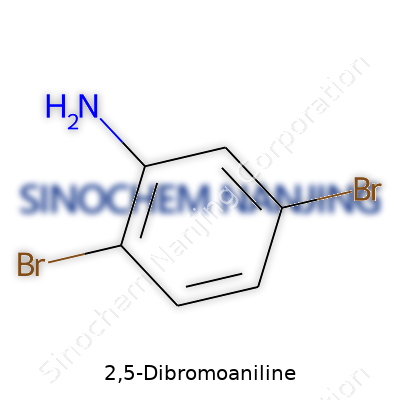
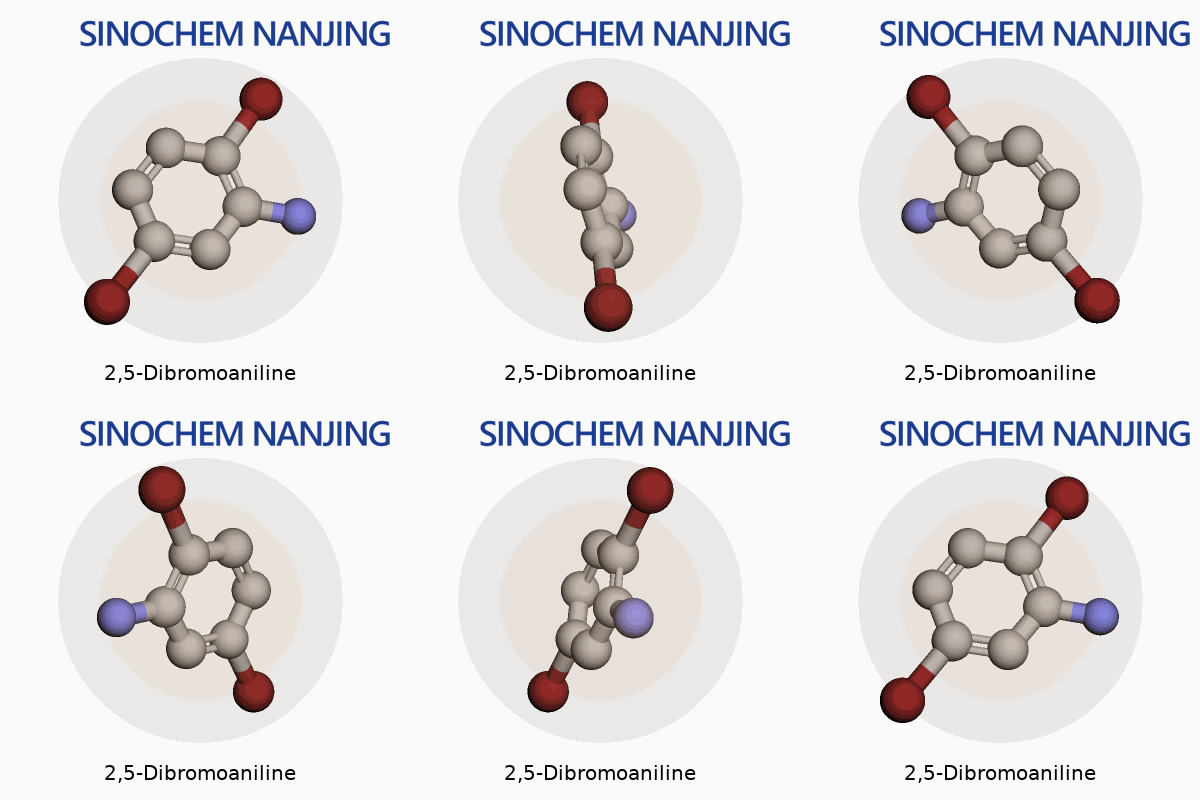
| Names | |
| Preferred IUPAC name | 2,5-dibromobenzenamine |
| Other names |
2,5-Dibromobenzenamine 2,5-Dibromo-1-aminobenzene |
| Pronunciation | /ˈtuː,faɪv-daɪˈbroʊmoʊˌænɪliːn/ |
| Identifiers | |
| CAS Number | 615-92-7 |
| Beilstein Reference | 87854 |
| ChEBI | CHEBI:38456 |
| ChEMBL | CHEMBL137191 |
| ChemSpider | 85514 |
| DrugBank | DB04290 |
| ECHA InfoCard | ECHA InfoCard: 100.010.058 |
| EC Number | 615-062-00-2 |
| Gmelin Reference | 77160 |
| KEGG | C06371 |
| MeSH | D000701 |
| PubChem CID | 10647 |
| RTECS number | KW4375000 |
| UNII | R3U9G62E5E |
| UN number | UN3423 |
| CompTox Dashboard (EPA) | DTXSID3039242 |
| Properties | |
| Chemical formula | C6H5Br2N |
| Molar mass | 306.95 g/mol |
| Appearance | Off-white to light brown solid |
| Odor | Odorless |
| Density | 1.98 g/cm³ |
| Solubility in water | slightly soluble |
| log P | 2.98 |
| Vapor pressure | 0.000171 mmHg (25°C) |
| Acidity (pKa) | 2.46 |
| Basicity (pKb) | pKb = 9.4 |
| Magnetic susceptibility (χ) | -71.0·10⁻⁶ cm³/mol |
| Refractive index (nD) | 1.688 |
| Viscosity | 20 cP (20°C) |
| Dipole moment | 2.62 D |
| Thermochemistry | |
| Std molar entropy (S⦵298) | 333.8 J·mol⁻¹·K⁻¹ |
| Std enthalpy of formation (ΔfH⦵298) | -6.4 kJ/mol |
| Std enthalpy of combustion (ΔcH⦵298) | -211 kJ·mol⁻¹ |
| Hazards | |
| Main hazards | Harmful if swallowed, causes skin irritation, causes serious eye irritation, may cause respiratory irritation |
| GHS labelling | GHS02, GHS07 |
| Pictograms | GHS06,GHS09 |
| Signal word | Warning |
| Hazard statements | H302, H315, H319, H332 |
| Precautionary statements | Precautionary statements: "P261, P280, P305+P351+P338, P337+P313 |
| NFPA 704 (fire diamond) | 2 2 0 |
| Flash point | > 150°C |
| Autoignition temperature | 210°C |
| Lethal dose or concentration | LD50 (oral, rat): 1750 mg/kg |
| LD50 (median dose) | LD50 (median dose): 610 mg/kg (rat, oral) |
| NIOSH | BLA51 |
| PEL (Permissible) | Not established |
| REL (Recommended) | 1 mg/L |
| Related compounds | |
| Related compounds |
2,5-Dibromonitrobenzene 2,5-Dibromoacetanilide Aniline 2,5-Dichloroaniline 2-Bromoaniline 4-Bromoaniline |



