2,4-Dinitrophenylhydrazine: A Closer Look at an Old Standby in Chemical Analysis
Historical Development of 2,4-Dinitrophenylhydrazine
Thinking back, the turning points in analytical chemistry rarely get the spotlight they deserve. The story of 2,4-Dinitrophenylhydrazine, known among chemists and undergraduates as DNPH, stretches back to the rising wave of organic analysis during the early twentieth century. At that time, a major hurdle existed: easy identification of aldehydes and ketones. Researchers needed a reliable, visual signal. DNPH stepped in as a dependable workhorse. Chemists noticed that mixing this compound with suspected carbonyls gave vividly colored solids — yellows, oranges, sometimes reds. This test, simple but powerful, saved time and guided crucial work. Its impact ran from college laboratories right into professional research. Today, many educators can still recall their first DNPH reaction — the excitement of watching a yellow precipitate form, connecting structure and color.
Product Overview: Where DNPH Fits In
In any lab, efficiency and reliability win loyalty. DNPH delivers on both for carbonyl detection. It comes as a yellow-orange powder and can slide smoothly into many analytical methods, like thin-layer or column chromatography. It’s not a glamorous item on the shelf, but its presence is constant. When laboratories check air quality for dangerous aldehydes, filter papers or cartridges coated with DNPH stand ready to trap and measure traces in the parts-per-billion range. That persistence, from counting molecules indoors to keeping tabs on chemical plants, gives DNPH more staying power than plenty of once-trendy reagents.
Physical and Chemical Properties
DNPH forms sharp crystals, usually an energetic yellow or orange. It has limited solubility in cold water but dissolves in alcohol, sparking instant reactions with carbonyl groups. The molecule itself shows a few quirks: two nitro groups draw electrons, amplifying the reactivity of its hydrazine core, and its relatively high melting point alerts anyone drying it on steam baths. It has a distinct, sharp odor — an unmistakable sign the jar’s open somewhere nearby. I’ve never managed to forget the gritty sight of it on a drafty balance, the color warning you to handle it with care.
Technical Specifications & Labeling
Quality and consistency matter, not just for big manufacturers but for every researcher running precise tests. Reputable suppliers supply DNPH with clear labeling — percent purity, batch record, expiration date. This is essential since small impurities can mask crucial signals. Labels also carry hazard symbols now, a vivid reminder of regulatory shifts over the decades. Long gone are the unmarked glass jars of pre-war laboratories; now, transparency and data go hand-in-hand with safety.
Preparation Method
Lab-scale preparation usually means nitration of phenylhydrazine. The process feels straightforward to a seasoned organic chemist: controlled addition, temperature management, careful washing of crystals. But here, practice trumps theory. Overheating invites runaway reactions; careless washing leaves contaminants behind. Researchers and students both know that the best yields come to those who pay attention, not to those rushing through the procedure with one eye on the clock. Small details during workup — filter speed, solvent temperature — often mark the difference between disappointment and a prize batch of strong yellow powder.
Chemical Reactions & Modifications
DNPH opens the door to sharp, insightful reactions. It latches onto aldehydes and ketones, swapping its hydrazine for the carbonyl’s oxygen and giving stable hydrazones in return. Color shifts signal success, allowing quick visual verification. But the chemistry doesn’t stop here. These hydrazone derivatives also hold value in structure determination, as solids suitable for melting point analysis — no need for gas chromatography or high-end detectors. Some creative minds have taken these reactions further: tweaking conditions, adding substituents, or anchoring DNPH onto solid supports for field use. The original test persists, but new forms push the limits — portable, fast, and sensitive.
Synonyms & Product Names
DNPH goes by many names. It appears as Brady’s reagent in old textbooks, named for the scientist behind those classic tests. Look through catalogs and researchers might see 2,4-DNPH or 2,4-dinitrophenylhydrazone. These aliases stick because they reflect a community’s long, collective experience. No matter the label, the value and function ring true across borders and decades.
Safety & Operational Standards
Anyone handling DNPH learns respect fast. The compound packs hazard warnings for a reason — dry powders can ignite, and the dust stings eyes and lungs on contact. Labs handling any real quantity now use containment, gloves, and fume hoods — protection comes first. Safety training covers both the chemistry and its hazards, stressing not only known risks but the unpredictable nature of chemical handling. Storage far from heat and sparks, careful disposal of contaminated materials, and rapid spill control make up the modern best practices. I’ve seen slips from overconfidence lead to neat little fires when the bottle cap wasn’t secured, so daily respect is earned in the trenches, not in safety lectures.
Application Area
DNPH earns its keep across multiple fields. Environmental scientists track trace amounts of toxic aldehydes in urban air, laying bare pollution levels and setting regulatory limits. Pharmaceutical teams use the test to confirm purity and process completeness, watching for rogue substances in final products. Food chemists depend on it to sniff out contamination and spoilage markers in everything from spirits to packaged goods. Academic labs, public health agencies, industrial groups all draw on this compound when the stakes involve consumer safety or environmental integrity. People may not realize it, but every clear glass of bottled water and every technical report on indoor air owes something to the day DNPH entered the scene.
Research & Development
Renewed focus on public health and tight regulation breathes new life into an old compound. Engineers are integrating DNPH into compact, automated detection arrays. Analytical chemists push for ever-lower detection limits, driving custom designs with higher reactivity and reduced interference from background impurities. Teams are also probing ways to recover or reuse spent reagents, slashing waste and lowering costs. Cross-disciplinary collaboration moves practical improvements from bench to deployment. Years ago, few would expect a mobile DNPH sensor mounted on a drone; now, engineers embrace this blend of tradition and innovation, capturing air samples across hazardous sites or disaster scenes.
Toxicity Research
Studies reveal the darker side of this compound. DNPH and its dust provoke respiratory irritation and skin sensitivity, with the potential for serious harm if ingested or inhaled in large amounts. Animal data supports cautious handling, and regulatory agencies call for strict controls. Environmental persistence presents another challenge — accidents or poor disposal methods can leave traces in soil and water. Toxicologists keep unearthing ways to improve worker safety, suggesting less volatile forms or robust containment methods. Consistent training, personal monitoring, and rigorous supervision improve safety records, but the job remains unfinished. Health and safety professionals call for more data, stronger labeling, and ongoing education.
Future Prospects
Refinement, safety, and sustainability guide the path ahead for DNPH. Researchers envision greener synthesis routes to limit hazardous byproducts and shrink the environmental footprint. Creative minds consider biodegradable or less hazardous analogues, hoping to match or exceed the sensitivity of DNPH without its risks. Automation, miniaturization, and smarter data analysis promise tools that capture airborne toxins in real-time, sending updates straight to smartphones or city-wide monitoring grids. The core value remains — a direct, reliable window into reactive carbonyls. Society’s needs have evolved, but confidence in DNPH’s promise anchors further advances. As public and private interests align for safer air, cleaner food, and smarter regulation, DNPH will keep adapting, staying vital to generations of chemists set on protecting human health and the environment.
What is 2,4-Dinitrophenylhydrazine used for?
A Reagent Every Chemist Knows
Walk into any college chemistry lab, and you'll see a collection of brown bottles with complicated names. Among them, 2,4-Dinitrophenylhydrazine—often known as DNPH—sticks out for its regular and direct use in experiments. My first memorable run-in with DNPH came during undergrad practicals. We weren’t trusted with open bottles at first; the teaching assistant handed everyone a test tube already prepped with the yellow-to-orange stuff. The purpose? To help us understand how chemists identify aldehydes and ketones, the building blocks in countless fragrances, plastics, and medicines.
The Heart of DNPH’s Use: Spotting Carbonyls
Organic chemistry classes can be dense, but DNPH made some concepts less abstract. Complex molecules often feature groups called carbonyls—these are important both for living cells and in industry. DNPH reacts with these groups, making a solid, colored compound known as a hydrazone. The color change happens right in front of your eyes. Aldehydes and ketones in a sample prompt the emergence of a yellow, orange, or sometimes red precipitate. In a world saturated with high-tech spectroscopy and chromatography, DNPH keeps things hands-on and visual.
This simple trick lets even beginner chemists separate out mixtures of unknowns, or check for impurities in solvents and pharmaceuticals. Hospitals and pharmaceutical firms use DNPH to make sure medications contain only what they should. Imagine a pain reliever tainted with an extra carbonyl-containing compound. DNPH can highlight that issue before pills ever reach a pharmacy shelf. The World Health Organization and the United States Pharmacopeia include this test as standard practice because of its speed and clarity.
Protecting People: From City Streets to the Lab
Growing up in a city meant plenty of days smelling exhaust and tracking smog alerts. What a lot of people don’t realize is that air pollution surveillance uses DNPH, too. Vehicles and factories push aldehydes, like formaldehyde and acetaldehyde, into the air. DNPH speeds up detection. Technicians collect air and treat it with DNPH, pulling out the dangerous molecules and making them trackable by simple color change, or more precise laboratory measuring. That data shapes air quality guidelines and drives cleaner-engine research, showing how a humble lab chemical can have a public health impact.
Risks, Real Talk, and Practical Steps
Nothing’s perfect. DNPH has a hazardous side. Its powders can explode dry, and contact means poisonous dust or liquid—definitely not something to treat lightly. I remember slipping up on gloves, wound up with the chemical on my fingertips. Unpleasant doesn’t begin to cover it: burning skin and a quick dash to the eye wash station. Industrial and educational settings answer these problems with wet storage, locked cabinets, and mandatory training. High school science fairs should never see DNPH without grown-up supervision, but it’s often the grown-ups who cut corners. More funding for periodic chemical safety classes can go a long way toward lowering the risk.
What’s Next for DNPH?
New analytical gadgets keep popping up, but DNPH holds its ground, especially where budgets pinch or a basic answer works best. Knowing how to handle and respect these time-tested reagents matters as much now as ever. DNPH gives early chemistry students a hands-on connection to molecular science, guides environmental testing, and helps keep factory output pure. Balancing its power and its risks remains a shared responsibility—for both the lab rookie and the seasoned chemist. That’s one lesson nobody should skip.
How should 2,4-Dinitrophenylhydrazine be stored?
Why Storage Matters for 2,4-Dinitrophenylhydrazine
2,4-Dinitrophenylhydrazine (DNPH) lands on the bench in many labs, but this stuff isn’t just another jar to toss on a shelf. I remember first learning about this compound in university—older lab techs told horror stories about bottles catching fire from careless storage. It made me realize, you don’t need to be in an industrial environment for danger to find you. DNPH comes with plenty of risk, mostly because it can explode if it dries out. As a chemist, the reality sits heavy: one mistake could lead to a fire, lost research, or even serious injury.
Understanding the Hazards
DNPH packs a punch when exposed to heat, friction, or shock, especially in a dry state. The risk makes proper storage as much about protecting people as protecting property. Even outside the lab, firefighters train to recognize the distinct yellow-orange crystals, always with respect. News from the National Institute for Occupational Safety and Health (NIOSH) and countless chemical safety boards serve as reminders: treat DNPH the right way, or you invite disaster.
Practical Storage Tips
DNPH isn’t like table salt or common lab acids. If it dries out, it can ignite from something as basic as screwing the cap back on. Best practice means always keeping it moist, often using water or dilute acid. Most suppliers ship the chemical wetted, which isn’t an accident—it’s a basic guardrail against disaster. At the bench, keep the original container sealed tight and stored in a cool, dry place far from heat sources, open flames, or direct sunlight. Never let the bottle dry out or open it near potential sources of ignition.
Storing DNPH in a well-ventilated chemical storage cabinet, ideally one that’s reserved for potentially explosive chemicals, keeps chances of a problem low. Lock the cabinet if possible, and make sure a clear label spells out the risks. My time in the lab showed me how easy it is for people to forget what's what, especially when bottles stack up. Even a simple sign can nudge everyone to slow down and check their surroundings.
What Goes Wrong—and How to Respond
Over the years, I’ve seen close calls. Someone left the cap loose, the crystals dried out in a warm room, and suddenly evacuation became the only option. Emergency services train for this, but prevention beats any fire alarm. If a DNPH container seems dry or crystals appear, don’t open it. Get an expert’s help right away. Developing a strong culture of safety proves more valuable than any piece of equipment. This means regular checks, up-to-date training, and honest conversations about risk.
Improving Safety Culture and Reducing Risks
Loose routines let bad habits creep in. Every time I train a new lab member, I tell them—DNPH deserves respect. Keeping a checklist for weekly visual inspections helps catch issues before they turn serious. Digital inventory systems make tracking easier, but old-fashioned logs work too. If an old bottle turns up during a lab cleanout, treat it like hazardous waste. Don’t take shortcuts; use professional disposal services.
Safety isn't just a rule; it’s a way to look out for one another. Sharing stories and lessons learned from incidents gives these protocols real weight. DNPH is a tool for chemistry, not a ticking time bomb. Treating it right means every researcher gets to walk out the door at the end of the day—no drama, no headlines.
What safety precautions should be taken when handling 2,4-Dinitrophenylhydrazine?
Why 2,4-Dinitrophenylhydrazine Raises Concern
Work in any chemistry lab long enough and you learn not every bottle on the shelf deserves the same respect. 2,4-Dinitrophenylhydrazine, known as DNPH by its fans and foes, claims a decidedly delicate spot on that scale. It reacts with aldehydes and ketones to form solid derivatives—a handy thing for analysis, but anyone familiar with its yellow-orange crystals also recognizes the risk they carry. As reliable as its chemistry seems, DNPH packs a double whammy: instability and toxicity. Tiny mistakes easily grow into big problems.
Understanding the Dangers
It’s tempting to brush off lab chemicals as just one more risk, but DNPH doesn’t tolerate carelessness. Its dry form explodes with surprising vigor when shocked, rubs up against a hard surface, or even just sits in a dried-out filter paper. Breathing dust or touching it with bare hands brings risks of poisoning. According to material safety datasheets, exposure can inflame the skin, eyes, or nose, and accidental ingestion triggers nausea, vomiting, and even bigger problems for the liver and kidneys. Anyone who’s ever cleaned up a DNPH spill remembers the sharp odor and rush to limit exposure.
Lab Culture: Building Habits That Protect
Chemistry wisdom often comes from stories. In graduate school, watching someone knock a bottle of DNPH off a bench drives home the need for safe storage. Keep it wet—typically under water or a dilute acid—because dry crystals mean danger. Instructors insist on sealed containers, chillers when possible, and keeping stocks small. These aren’t just textbook rules; they’re life lessons built on hard knocks.
Wear full PPE every time. Splash-proof goggles, gloves that resist not just liquid but powder, and a buttoned-up lab coat serve as minimum standards. I remember the red-faced embarrassment of early days, arriving without full gear and getting sent back out. No experiment run under pressure justifies skipping the safety checklist. With DNPH, the risk of cutting corners never pays off.
Managing Spills and Waste
If a spill happens, don’t panic, but don’t try to clean with your bare hands or ordinary paper towels. Baking soda and water helps neutralize the area, and scooping up with dedicated plastic tools prevents static sparks. Waste containers for DNPH demand clear labeling with hazard symbols, and the local fire marshal appreciates it when stock gets checked frequently for signs of drying. Disposal never goes down the drain; only designated hazardous waste handlers should touch that job.
Moving Forward with Smarter Practices
New students sometimes ask why labs don’t ditch DNPH altogether. The truth—its role in making carbonyl analysis reliable—means chemists keep it around, despite its drawbacks. Teaching smarter habits offers a better path. Safety training isn’t just a one-off video at the start of the year but an ongoing part of every lab meeting, every new experiment. Look up accident reports and you’ll find most problems trace back to ignored warnings or missed maintenance checks. Peer reminders, labelled shelves, and up-to-date spill kits stand between routine work and preventable disaster.
Lessons from Experience
Plenty of old-timers remember what happens when DNPH sits dry for months forgotten at the back of a drawer. Regular audits of chemical stocks, refreshers on safe handling, and real consequences for missed protocols all matter. Safety grows from habits, not just rules. DNPH reminds us that small details in daily lab life make the difference between learning and regret.
What are the hazards associated with 2,4-Dinitrophenylhydrazine?
Toxicity: A Risk Not to Take Lightly
In every lab I’ve worked in, handling 2,4-Dinitrophenylhydrazine (often called DNPH) never felt routine. It’s got a history: this orange crystalline powder reacts violently if you treat it carelessly. The moment it touches skin or wafts into the lungs, trouble follows. Those nitro groups on the molecule make it toxic to humans. Swallowing even a small amount brings nausea, headaches, and a racing heart. Its dust—and yes, it spreads easily—stings eyes, irritates airways, and inflames skin. Long-term exposure messes with blood cells; colleagues who ignored gloves or masks wound up regretting it.
Flammability and Explosive Potential
Many think of DNPH as just another reagent. That confidence disappears the first time a container dries out and pops—a real wake-up call. Dry DNPH doesn’t just burn; it detonates under friction or shock. Once, a bottle cracked and ignited in our waste hood because someone let the solvent evaporate. That fire moved faster than anyone could react, and clean-up took days. Static electricity or a jar set down too hard sets off the powder. Even a minor oversight can lead to blasts, serious burns, or chemical shrapnel.
Environmental Hazards and Disposal
Anything poured down the drain with DNPH in it creates problems far beyond the lab bench. Local rivers take the brunt—aquatic creatures get poisoned, and the water becomes unsafe. The stubborn molecule sticks around in soil and water, threatening more than just whoever wore the gloves. Some states fine labs hard for mishandling it, and for good reason. Poorly labeled waste or casual dumping led a university I worked with to pay penalties and overhaul training.
Mitigating the Hazards: Lessons from Experience
Care takes more than a warning label. Lab managers need real-world training, not just paperwork. We put in policies: always wear the right gloves and goggles, never open containers near ignition sources, and avoid storing DNPH without a stabilizing solvent like ethanol or water. Our team learned to keep quantities small and never let it dry out—fresh bottles only, no stockpiling. Spills mean pulling the fire alarm, not pretending nothing happened. Labs spent money on explosion-proof containers and locked cabinets, and every waste container has clear labeling with amounts and solvent content.
There’s also a need for backup—safety showers within a few steps, and proper respirators on hand. Neutralizing spill kits need to sit ready, and staff deserve regular drills. Everyone remembers the time a student skipped a step, and the spill turned a quiet morning frantic; you don’t forget how fast things go wrong.
Support, Oversight, and Continuing Vigilance
Institutions and regulators update best practices because incidents keep happening. Regular audits spot old containers or signs of drying. Community knowledge helps too—sharing close calls, updating protocols, listening when someone raises a concern. Labs linked with environmental safety offices track waste, log incidents, and close the loop from purchase to disposal.
Chemistry advances through careful work, not shortcuts. 2,4-Dinitrophenylhydrazine reminds every scientist that no routine task comes free of risk, and that shared accountability—a culture of safety—protects people, research, and neighborhoods.
How does 2,4-Dinitrophenylhydrazine react with carbonyl compounds?
Carbonyl Chemistry Hits the Classroom Bench
Every chemist—student or veteran—remembers the first time a bottle labeled “2,4-DNP” showed up in the lab. The stuff packs an unmistakable punch in smell and attitude. The first obvious reason for using 2,4-dinitrophenylhydrazine centers on identifying carbonyl groups, specifically in aldehydes and ketones. The reaction turns these colorless or barely-noticed chemicals into flaming orange or yellow solids. It’s a far cry from vague, invisible results.
Why This Reaction Matters
The practical impact hits home for anyone digging through a mixed bottle of unknowns. Say you’re unsure whether something’s an aldehyde, ketone, or something else entirely. Add 2,4-DNP to the mix, and a clear color change sweeps away the mystery. Confirmation gets immediate. Identifying these functional groups gives organic chemistry students a lifeline in exams and helps professionals in fields like pharmaceuticals or forensic science narrow down unknown samples in a day’s work.
Chemistry with a Splash of Color
You drop 2,4-DNP into a test tube with a carbonyl compound and see crystals start to form. It isn’t magic; it’s years of molecular design at play. 2,4-DNP latches onto the carbonyl carbon, kicking out a water molecule, and leaving behind a solid called a hydrazone. The color depends on the structure of the carbonyl—some come out as orange, others as yellow. Each color, each melting point adds to the archive of chemical fingerprints. That’s hard evidence, not just another number on a graph.
Reliability in Real Life
I’ve seen seasoned lab techs identify a solvent’s identity by glancing at the color of a 2,4-DNP test. In fields where speed matters, that saves time and money, and sometimes lives. During a summer internship in a small chemical plant, overworked analytical chemists relied on this test for quick checks before samples went for expensive spectrometry. They didn’t want to waste resources running every sample through machines if a common-sense test gave a good lead first.
Safety and Sustainability Concerns
Working with 2,4-DNP comes with risk. Many university labs keep it under lock and key because dry 2,4-DNP has a reputation for going off with a bang if mishandled. During crowded undergraduate labs, spills or inhalation accidents stress the point that handling chemicals safely isn’t just about memorizing rules. Education around safety gear, good lab technique, and up-to-date safety protocols must remain a priority. Some labs now look for greener alternatives, although few solutions compete with the simplicity and direct observation offered by 2,4-DNP.
Room for Smarter Science
Modern techniques like IR or NMR spectroscopy map out molecular structures with digital precision. Even so, the bold reaction between 2,4-DNP and carbonyl compounds bridges the physical world with the world of molecules, where sight and touch matter just as much as data. For educators, students, and working chemists, this reaction doesn’t just prove theories. It sharpens instincts, adds color to practice, and demands respect for both tradition and progress in the lab. If chemistry hopes to balance safety, sustainability, and clarity, the future rests on smart, practical tests—and a keen understanding of the chemistry behind them.
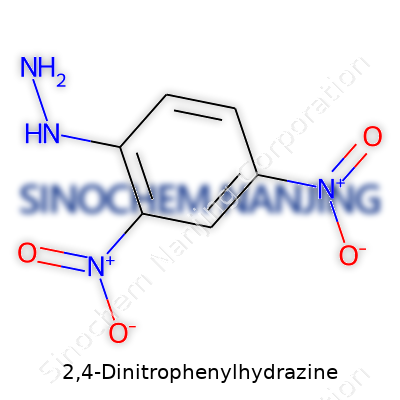
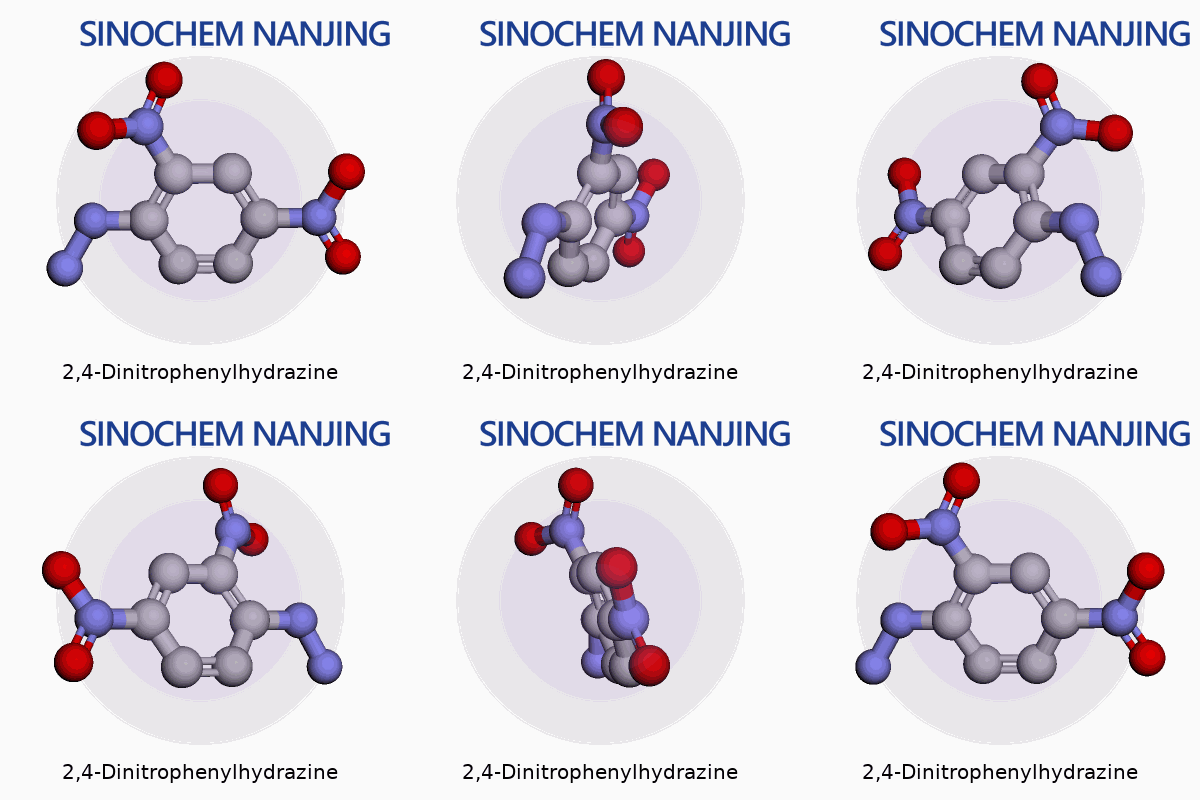
| Names | |
| Preferred IUPAC name | (2,4-dinitrophenyl)hydrazine |
| Other names |
DNPH 2,4-DNP hydrazine 2,4-Dinitrophenylhydrazone 2,4-dinitrophenylhydrazin 2,4-dinitrobenzenecarbohydrazide |
| Pronunciation | /ˌdaɪ.naɪ.trəʊ.fɪˌniːl.haɪˈdreɪn.iːn/ |
| Identifiers | |
| CAS Number | 119-26-6 |
| Beilstein Reference | 635876 |
| ChEBI | CHEBI:42470 |
| ChEMBL | CHEMBL1377 |
| ChemSpider | 2036 |
| DrugBank | DB09528 |
| ECHA InfoCard | 100.007.058 |
| EC Number | 2.4.2.23 |
| Gmelin Reference | 83311 |
| KEGG | C01744 |
| MeSH | D004244 |
| PubChem CID | 676303 |
| RTECS number | HT2450000 |
| UNII | C01C3G2Y4F |
| UN number | UN1320 |
| CompTox Dashboard (EPA) | `DTXSID7020636` |
| Properties | |
| Chemical formula | C6H6N4O4 |
| Molar mass | 198.14 g/mol |
| Appearance | Orange to orange-red crystalline powder |
| Odor | Odorless |
| Density | 1.683 g/cm³ |
| Solubility in water | slightly soluble |
| log P | 1.63 |
| Vapor pressure | 1 mm Hg (20 °C) |
| Acidity (pKa) | 3.70 |
| Basicity (pKb) | pKb = 11.86 |
| Magnetic susceptibility (χ) | -68.0·10⁻⁶ cm³/mol |
| Refractive index (nD) | 1.685 |
| Viscosity | Viscous liquid |
| Dipole moment | 2.67 D |
| Thermochemistry | |
| Std molar entropy (S⦵298) | 256.6 J·mol⁻¹·K⁻¹ |
| Std enthalpy of formation (ΔfH⦵298) | 146.6 kJ·mol⁻¹ |
| Std enthalpy of combustion (ΔcH⦵298) | -1654 kJ mol⁻¹ |
| Hazards | |
| GHS labelling | GHS02, GHS06, GHS08 |
| Pictograms | GHS02, GHS06, GHS07 |
| Signal word | Danger |
| Hazard statements | H315, H319, H335, H302, H351, H373 |
| Precautionary statements | P261, P280, P301+P312, P305+P351+P338, P308+P313, P337+P313 |
| NFPA 704 (fire diamond) | 2,4,0,W |
| Flash point | 113°C |
| Autoignition temperature | 410 °C |
| Explosive limits | Explosive limits: 0.4–2.0% |
| Lethal dose or concentration | LD50 (oral, rat): 420 mg/kg |
| LD50 (median dose) | LD50 500 mg/kg (oral, rat) |
| NIOSH | VP2275000 |
| PEL (Permissible) | PEL: 0.2 mg/m3 |
| REL (Recommended) | 0.3 mg/m3 |
| IDLH (Immediate danger) | 50 mg/m3 |
| Related compounds | |
| Related compounds |
Dinitrophenol Phenylhydrazine Nitrophenylhydrazine 2,4-Dinitroanisole 2,4-Dinitrochlorobenzene |



