2,4-Dimethylhexane: Not Just Another Hydrocarbon
Historical Development
2,4-Dimethylhexane didn’t leap to the top of any chemical hit list overnight. Laboratory benches saw its rough draft when early organic chemists tried to unravel the isomeric possibilities in the alkanes family. In those days, scientists split and recombined chains to study their behavior, chasing new fuels and looking to understand how slight tweaks in structure create big changes in function. Over time, folks noticed that out of the many branched isomers of octane, 2,4-dimethylhexane brought unique traits. Its appearance in gasoline research took off in the mid-20th century, as refining processes hunted for molecules that could boost octane ratings without needing lead or aromatic compounds. The slow but steady climb of this alkane from chemistry curiosity to something more industrial mirrors much of the hydrocarbon story—one part chance, one part persistence, always shaped by where demand and scientific interest meet.
Product Overview
On the outside, 2,4-dimethylhexane looks like most other colorless, clear hydrocarbons. It hides in plain sight, often surrounded by better-known cousins like iso-octane. Don’t let its humble appearance fool you. The molecule owns a unique spot among branched alkanes, mainly for its place in petroleum blending, solvent applications, and as a reference point for structure-property research. In labs and at fuel blending facilities, it often gets looked at as a building block, or a touchstone for comparing how branching influences knock resistance and vapor pressure. Its use stretches beyond just being poured into a tank; it’s part of a broader industrial vocabulary, the sort of compound that people who make and break fuels like to keep on hand.
Physical & Chemical Properties
2,4-dimethylhexane sports the usual hydrocarbon inertness—no fancy double bonds, no polarized functional groups. Its boiling point hangs in the typical range for branched octanes, hovering around 118°C. It isn’t eager to dissolve in water, thanks to its fully saturated, non-polar backbone. The molecular symmetry and just enough branching shave down its melting point and lend it decent volatility, making it a suitable candidate wherever lower vapor pressure is desirable. In the world of flammable liquids, it isn’t a heavyweight, but still makes its presence known thanks to a flash point below room temperature. Flammability stays up there with similar hydrocarbons, so proper storage keeps headaches away. Its density lands lower than water—standard stuff for an alkane—so spills float. In my own experience around labs, the sharp, gasoline-like smell tips you off to its identity almost as fast as any chemical test.
Technical Specifications & Labeling
You don’t see 2,4-dimethylhexane bottled up with a fancy branded label. Lab containers and shipping drums call it by its systematic name or a handful of registered synonyms. Specifications matter here: purity, absence of aromatic contaminants, and consistent physical properties all shape how it performs in a fuel blend or as a solvent. Typical labeling focuses on batch number, date of purification, and degree of purity—sometimes at 97% or higher for demanding analytical work. Users who care about trace impurities rely on gas chromatography profiles, not marketing slogans. Regulatory standards require hazard labels that underline its flammability—no sidestepping that fact. These practical labels and numbers help chemists, blending technicians, and researchers trust what's inside.
Preparation Method
Branched alkanes often demand some chemical creativity to synthesize. 2,4-dimethylhexane, with its double methyl branches, can be pulled out via sophisticated catalytic cracking or isomerization routes from petroleum feedstocks rich in octane isomers. Yet for purer samples, chemists sometimes build it from scratch, coupling short-chain alkyl halides—like methylation steps onto hexane frameworks—using catalysts like aluminum chloride. Most often, industrial players focus on separation rather than total synthesis, using fractionation and distillation under controlled conditions. If I’ve learned anything from watching a separation run, it’s that nailing the right cut depends on precision, not brute force. One slip, and purity tanks or you wind up with unwanted byproducts muddying the mixture.
Chemical Reactions & Modifications
Chemically, 2,4-dimethylhexane plays it cool. Saturated hydrocarbons don’t jump at the chance to react, especially without some tough conditions—high temperatures, strong oxidizers, or energetic radicals. Chlorination and bromination turn it into a stew of possible haloalkanes, useful if you want to explore functionalization. Combustion stands out as the most familiar reaction: you torch 2,4-dimethylhexane, you get carbon dioxide and water, along with heat. That’s why it matters so much for fuel research. Catalytic cracking could chop it further, but the energy and specificity needed run high. I’ve seen a few researchers tinker with nitration and sulfonation, but most often, these end up needing more work-up just to isolate something new.
Synonyms & Product Names
Names shuffle around depending on the context. In a research paper, you’ll spot “2,4-dimethylhexane” or “diisobutyl.” Chemical suppliers might go with the same term or spell out the IUPAC name for clarity. Trademarked brand names don’t usually pop up, as it lacks that kind of niche. What matters for most buyers is clarity: no mixups, and no confusion with other dimethylhexane isomers, which split into several forms based on where the methyl groups attach.
Safety & Operational Standards
Handling 2,4-dimethylhexane isn’t a job for careless hands. Any liquid that’s this flammable forces a bit of respect. Fume hoods stay busy for a reason—you don’t want vapors hanging around, especially with ignition sources nearby. Personal protective gear means solid chemistry practice, not just ticking a box—nitrile gloves, goggles, and flame-retardant coats make the difference between a good day and an emergency. OSHA and GHS regulations slap on clear warnings: no open flames, no sparks, proper bonding and grounding for transfer. What stands out from safety data isn’t the toxicity—the molecule doesn’t hit hard on that front—but the volatility and combustion risk. Fire suppression gear, spill containment, and airtight containers stay on deck in any lab worth its salt. Nobody likes an accident, especially not with volatile solvents.
Application Area
Fuel research draws the most attention to 2,4-dimethylhexane. As a branched hydrocarbon, it shows up in test blends for internal combustion engine studies, especially for studying knocking and optimizing engine performance. Refineries turn to it for tweaking gasoline octane ratings, lessening the need for old-school additives like tetraethyl lead. Its consistent physical behavior makes it a handy reference compound in chromatography or in calibration mixtures. While it doesn’t cross over to major consumer products, paint and coatings industries occasionally use it as a specialty solvent or carrier—its rapid evaporation and low residue play well in those settings. From my own work alongside analytical chemists, it’s clear the sharp distinctions between linear, branched, and cyclic hydrocarbons matter a lot more than non-chemists realize, especially in fields chasing fuel efficiency and lower emissions.
Research & Development
Academic and industrial labs poke and prod at 2,4-dimethylhexane for answers that stretch beyond routine analysis. New engine designs, especially those chasing every last bit of efficiency, rely on datasets describing dozens of hydrocarbon isomers’ combustion traits. Each subtle branch pattern holds clues about optimization. Environmental researchers keep an eye on how branched hydrocarbons break down in soil and water—those results guide clean-up strategies when spills happen. Spectroscopy and chromatography studies frequently feature it as a template molecule, showing how different detectors interpret saturated molecules versus unsaturates or aromatics. In my time around fuel additive studies, it struck me how even a small shift in hydrocarbon structure led to measurable shifts in octane number and emissions profile, often moving research in new directions.
Toxicity Research
Toxicologists haven’t found 2,4-dimethylhexane to be a heavy hitter when compared to aromatic or unsaturated hydrocarbons. Long-term studies on similar saturated branched alkanes suggest low acute toxicity, though inhalation of high doses, like with any hydrocarbon, brings central nervous system effects and chemical pneumonia risk. Biodegradation and environmental fate research point to moderate persistence, as microbes take their time with branched chains. Everything I’ve seen backs up the view that careful ventilation and strict avoidance of chronic inhalation prevent most health problems. You still find the odd study pressing for answers about trace metabolites or interactions with industrial catalysts, especially as environmental standards keep ticking upwards. None of this means anyone should drop their guard.
Future Prospects
Hydrocarbon chemistry isn’t going out of style anytime soon, though the spotlight keeps shifting toward renewables and sustainable blends. Research into 2,4-dimethylhexane’s role won’t dry up, thanks to engine designers who need reference isomers for optimized fuel performance. Clean fuel mandates and efforts to cut toxic additives mean branched alkanes stick around in the conversation. There’s more work ahead in understanding breakdown in natural environments and finding greener synthesis routes. Real-world demand may limit its spread beyond specialty applications, but it’s clear that lessons learned from this corner of alkane chemistry continue to ripple out to wider fields—from better fuels to smarter remediation efforts. The history of 2,4-dimethylhexane says as much about how we approach carbon chemistry as it does about the molecule itself.
What is 2,4-Dimethylhexane used for?
Understanding 2,4-Dimethylhexane
Most folks won’t find a bottle of 2,4-Dimethylhexane on the shelf at the local hardware store, but you do run into its impact almost every day. With its eight-carbon structure, this colorless, nearly odorless liquid plays a big role behind the scenes in modern life—especially every time you fill your vehicle or catch a whiff of gas at the pump.
A Key Piece in Fuel Chemistry
This compound pops up most in the world of gasoline. Refineries look for certain qualities in the hydrocarbons blended into motor fuel, and 2,4-Dimethylhexane fits the bill because it’s an isomer with a decent octane number. The octane rating matters for a simple reason: higher values keep engines running smoother and prevent knocking, which shortens both engine life and efficiency. So a hydrocarbon like this usually finds its way into premium blends, giving drivers a little extra assurance on the road.
How Refineries Use It
Refining crude oil creates a mix of straight and branched hydrocarbon chains. Chemists want to balance those out for cleaner combustion and better performance. Because 2,4-Dimethylhexane resists premature ignition, it deserves a spot in those premium gasoline cocktails. Refineries produce it, blend it, and send it to market, where its effects blend invisibly into everyday fuel. What sticks out is that fuel companies have to walk a tightrope: too many low-octane components, and you get poor performance; too much of the ‘high-octane’ stuff, and costs climb. This molecule hits that sweet spot between price and performance.
The Role It Plays In Research And Testing
Even outside refineries, chemists at universities and industrial labs lean on 2,4-Dimethylhexane. I remember a project during grad school focused on how different gasoline isoalkanes burned in test engines. Researchers picked this compound for benchmark testing—its stability under stress, its relatively simple synthesis, and how researchers could detect it in emissions data. Using it helped refine real-world predictions for engine performance under different loads and temperatures.
Questions About Health and Environment
Concerns about hydrocarbons trace right back to pollution and health. Burning these compounds leads to air pollutants, including volatile organic compounds (VOCs) and ozone-forming substances. Breathing in large amounts over time isn’t healthy—smog in big cities shows that in real time. Studies show that all branched hydrocarbons, this one included, can stick around in the environment a bit longer than their straight-chain cousins. Fuel companies have to balance performance and regulatory pressures to keep the air cleaner.
Moving Toward Solutions
Fuel makers run a tough game—reduce pollutants, keep engines running well, and meet new regulations. They tinker with additives and blend stocks to cut down on emissions. Some researchers focus on alternative fuels, aiming to make engines less dependent on traditional hydrocarbons. On a personal level, driving less, maintaining a car, and supporting cleaner fuel blends are steps everyone can take. Chemistry alone can’t solve the bigger pollution question, but tweaking the makeup of what goes into the tank—like using hydrocarbons such as 2,4-Dimethylhexane wisely—makes a difference over the long run.
What is the chemical formula of 2,4-Dimethylhexane?
Looking Closer at Molecular Structure
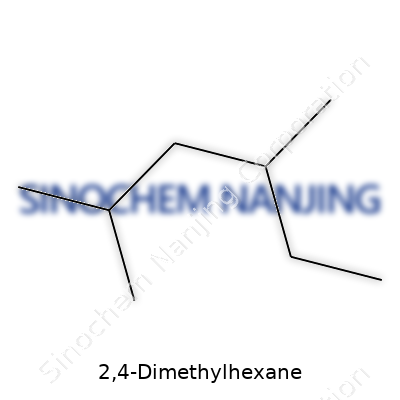
The world of organic chemistry has a long list of tongue-twisty names, but each name holds clues if you know the trick. 2,4-Dimethylhexane is one of those. Hexane on its own gives you a backbone of six carbon atoms—think of it as a simple chain. When someone adds the tag "2,4-dimethyl," the picture changes. Now, you’re dealing with two methyl groups, each one a -CH3 branch, hanging off the main hexane chain at carbons two and four.
Spelling It Out: The Chemical Formula
So what’s the actual chemical formula? That would be C8H18. Here’s how it adds up. Regular hexane has C6H14. Each methyl group brings another carbon and three hydrogens. Plug in two of those, and you top out at eight carbons and eighteen hydrogens. No extra oxygen, nitrogen, or oddball atoms.
Why This Structure Matters
I remember working in a small research lab as a student. The head chemist drilled into us: the way you read a chemical name changes how you design reactions, choose solvents, or picture how a molecule acts. Branches—like the ones in 2,4-dimethylhexane—make a big difference. The molecule gets bulkier. It flows and evaporates differently than straight-up hexane. In the lab, 2,4-dimethylhexane gets used as a model compound for fuel studies. Gasoline is full of branched alkanes like this, especially for boosting the octane rating.
Safety, Environment, and Uses
Here’s something people overlook: just because something is a hydrocarbon doesn’t mean it spills or burns the same. The extra methyl groups in 2,4-dimethylhexane push up the boiling point, so it doesn’t disappear as easily in the air as regular hexane. Getting exposed means a higher risk if you’re working in a poorly ventilated space. Old habits die hard in industry, but safety needs to keep up—more signage, proper extraction systems, and sensor checks would go a long way in smaller plants or research setups that still use these chemicals.
Branched alkanes like this don’t break down as fast as their straight-chain cousins, either. Their shape throws off some bugs and bacteria that chew up simpler hydrocarbons. Over time, this weakens the pace at which soil or groundwater recovers after spills. Stronger oversight on storage and clear labeling could help slow down environmental contamination.
Routes Toward Better Practice
Science classrooms and industry labs can both benefit from treating chemical structure as more than a set of numbers and letters. Tight labeling and staff briefings keep small mistakes from turning into big accidents. Front-line workers learn faster with real-life examples of what can go wrong with mishandling branched alkanes. Looking ahead, focusing on greener solvents might chip away at the need for these molecules in all but specialized roles.
2,4-dimethylhexane keeps popping up in studies and product specs. Each molecule carries more weight than its name suggests. Understanding its chemical formula isn’t just for passing a test, but for building safer labs, better fuels, and tougher environmental protections.
Is 2,4-Dimethylhexane hazardous or toxic?
Understanding What’s at Stake with 2,4-Dimethylhexane
Chemicals like 2,4-dimethylhexane rarely show up in daily conversations, but they do have a way of finding themselves on safety datasheets, industrial checklists, and environmental reports. Learning whether this chemical poses a danger takes asking tough questions, looking for honest data, and relying on practical experience.
What We Actually Know About 2,4-Dimethylhexane
2,4-dimethylhexane belongs to the group of alkanes — hydrocarbons commonly used in fuels and solvents. Its structure makes it similar to compounds in gasoline, kerosene, and some industrial cleaning agents. You won’t find much chatter about it in the news, but its family history raises enough flags to warrant a close look.
Diesel and gasoline fumes come loaded with branched alkanes much like this one. Plenty of studies connect long-term exposure to those fumes with headaches, dizziness, and sometimes reduced coordination. Some witnesses working in fuel depots and refineries talk about a persistent “chemical drowsiness” during marathon shifts. Evidence points toward hydrocarbon vapors — not some vague toxin, but real, breathing-level risk. The same playbook applies to 2,4-dimethylhexane.
Health Risks: Complications More Complex than “Just Toxicity”
Acute exposure to high levels of compounds like 2,4-dimethylhexane potentially irritates eyes, skin, or lungs. If someone accidentally swallows it, it could cause nausea or even trigger chemical pneumonia — especially if small amounts get into the airway. That’s textbook hydrocarbon behavior, and it puts workers who handle drums or clean up spills at greatest risk.
Chronic exposure raises other concerns. Laboratory testing finds many alkanes dissolve fats in the skin, stripping away protective oils. People who spend years around them sometimes report dermatitis or breathing problems. Safety protocols aren’t written in a vacuum — they’re written because technicians carried memories of sore throats and cracked hands home from work.
What Makes 2,4-Dimethylhexane Stick Out
Compared to heavy hitters like benzene or toluene, 2,4-dimethylhexane hasn’t earned the same level of regulatory scrutiny. Animal studies don’t suggest strong evidence for cancer risk or birth defects, but the data set stays thin. NIOSH, OSHA, and EPA don’t list it as a priority pollutant. That doesn’t bring much comfort to anyone watching open drums in a hot warehouse, because gaps in research don’t equal safety.
Its chemical properties matter. It evaporates faster when temperatures rise, filling air with fumes in confined spaces. This quirk means a simple splash can morph into a breathing hazard if ventilation slips. It doesn’t mix easily with water, so spills roll along floors or soak into porous materials, making clean-up slow and often frustrating.
Looking Toward Solutions
Personal protective equipment puts a barrier between people and the hazards: gloves that resist hydrocarbons, splash-proof goggles, and respirators in tight spaces. Ventilation matters just as much — fans, hoods, and open windows keep concentrated vapors from building up. Training workers to spot the signs of exposure means problems get caught fast rather than after someone’s already feeling woozy.
Spill kits stocked with absorbent pads stop small leaks from becoming emergencies. Regular safety audits and honest conversations between supervisors and staff catch risky behavior before accidents happen. Choosing well-ventilated workspaces and building a safety culture does more than any warning label ever could.
No chemical works in isolation. 2,4-dimethylhexane acts like many of the hydrocarbons used every day: not inherently evil, but best respected, handled with care, and never dismissed. Sitting down and getting honest about risks and solutions opens the path to a safer future in every lab, plant, and warehouse with its name on the inventory list.
What are the physical properties of 2,4-Dimethylhexane?
Getting Acquainted with the Compound
2,4-Dimethylhexane stands out as one of those hydrocarbons that quietly powers industrial routines and laboratory practices. At first glance, it looks like just another clear, colorless liquid, barely a ripple in a vial. But anyone who’s spent hours in a university chemistry lab or slogged through process plant shifts knows how much muscle sits behind a substance like this. It shows practically no color, pours easily, and—true to its molecular roots as an alkane—shows a strong resistance to water. I remember catching a whiff that reminded me of forever-open solvent bottles from undergrad research days, with a faint gasoline-like odor that never left the fume hood.
Key Physical Properties Up Close
Let’s talk numbers. 2,4-Dimethylhexane boils just shy of 120 degrees Celsius, making it more volatile than many heavier hydrocarbons. The melting point hugs negative territory at about -99°C—so it stays liquid in some of the world’s coldest labs. Pour this stuff out and you’ll notice it moves quickly; density hovers around 0.71 grams per cubic centimeter at room temperature, right below the density of water. Thanks to this low density, a spill won’t sink—it will ride across the top, a thin film spreading if dropped on a water bath. This behavior always meant cleanup needed attentiveness, because it likes to slip out of sight, not mix in.
As for solubility, it barely mingles with water and instead calls for organic solvents like ether or benzene for company. That hydrophobic trait isn’t just an academic tidbit. At one industrial internship, we relied on this property for separating mixtures quickly—water couldn’t touch it, so separation columns made quick work of complex distillation streams.
Real-World Uses and Safety Gaps
2,4-Dimethylhexane’s value mostly turns up in fuel blending and as a reference compound. It finds a place in both research and industry, not for the average home shelf but for labs that handle a complex dance of hydrocarbons. Gasoline owes a bit of its punch and volatility to components like this. In the classroom, chemistry instructors pull out its data sheet to teach students about structure-property relationships, because those methyl branches lower the boiling point compared to straight-chain octane cousins.
The same traits that make it useful present health and safety challenges. Volatility carries inhalation risks. Wrap your hands around a chemical safety manual, and you’ll see this compound flagged for its flammability and for the need to work in a ventilated space. One time, a spill in a poorly ventilated room led to headaches and a scramble for fresh air—these lessons sink in deep, much more than anything a textbook charts out. For most people handling hydrocarbons, routine can dull the senses, but the flash point of around -15°C makes this a material that demands respect.
Ways to Use It Responsibly
With every use, risk management becomes the name of the game. Proper labeling, storing away from heat sources, and using reliable containment strategies go a long way. Industry and research facilities have driven change by designing improved ventilation, employing spill trays, and automating handling to reduce mistakes. Training matters as much as technology—people who understand why those properties matter are far more likely to avoid incidents, keep records tight, and pass on safer habits. For anyone joining a chemical lab or industrial job, knowledge about everyday compounds like 2,4-Dimethylhexane often ends up mattering most at unexpected moments. Facts are useful, but experience and respect help build safer workplaces.
How should 2,4-Dimethylhexane be stored and handled?
Understanding What’s in the Drum
Anyone who’s worked with lab or industrial chemicals can tell you, don’t treat any material like it’s just another item on the shelf. 2,4-Dimethylhexane is a clear liquid that smells a bit like gasoline. It spreads through the air faster than you’d expect, so even a little spill can turn a storeroom into a hazard. Even if you’ve poured barrels your whole life, every substance asks for respect, and this one is no different.
Clear Steps for Storage
Nobody wants to pay for a fire or a spill cleanup. This compound burns easily, and it sends off vapors that can ignite with just a spark from static or a worn-out light switch. Keeping it cool matters more than most realize. Temperatures above room level boost vapor pressure, and that increases explosion risks. Place containers in shaded, well-ventilated rooms, far from sunlight or machines that get hot.
I once saw solvents stacked too close to a boiler, and it nearly led to disaster. Give this hydrocarbon a spot by itself, nowhere near oxidizers or acids. Stash it in tightly capped, labeled drums made from materials it won’t eat through. Don’t mix partial drums with other leftovers—one careless blend can release surprises that send everyone running.
Handling Without Worrying
You don’t need a PhD to follow simple protocols. Gloves, goggles, and long sleeves are non-negotiable. Thin nitrile gloves work well. Splashing a little on bare skin seems minor until irritation sets in. I learned the hard way and paid for it with a burning rash that stuck around for days. The fumes bring worse—headaches and dizziness can creep up, so always use a chemical fume hood when pouring or measuring.
Keep fire extinguishers handy, rated for flammable liquids. Static builds up fast when pouring between drums, so run a bonding wire between containers. A friend of mine once ignored the bonding step, and a single zap nearly blew the cap off a barrel. Take that risk once and you never forget.
If any gets loose, soak it up with sand or vermiculite, then scoop the waste into sealed bins for hazardous disposal. Forget about flushing it or tossing dirty rags in a regular trash bin—local rules call for special disposal, and getting fined is nobody’s idea of a good day.
Why It Matters and What to Improve
As chemical handlers, safety doesn’t get left to memory or guesswork. Storing and using 2,4-Dimethylhexane safely works best through teamwork and real training, not just posters on the wall. Regular drills keep habits sharp, and inspections catch leaking valves and rusty caps before they turn into problems.
Facilities can add gas detectors and alarms for peace of mind, especially in older buildings. Good records and regular inventories cut down on old stock that nobody remembers until it’s too late. Investing in basic protection and solid habits keeps everyone healthy and the business off the front page for the wrong reasons.
Don’t wait for an accident to happen before demanding better systems. Speak up if something’s off—without that, even the best chemical sits ready to cause trouble.
| Names | |
| Preferred IUPAC name | 2,4-dimethylhexane |
| Other names |
Diisopropylacetylene 2,4-Dimethylhexan |
| Pronunciation | /tuː,fɔːr-daɪˈmɛθ.əlˈhɛk.seɪn/ |
| Identifiers | |
| CAS Number | 589-43-5 |
| Beilstein Reference | 0219565 |
| ChEBI | CHEBI:132930 |
| ChEMBL | CHEMBL15426 |
| ChemSpider | 14206 |
| DrugBank | DB14074 |
| ECHA InfoCard | In that case, the ECHA InfoCard of product '2,4-Dimethylhexane' is: "031038777837-41-0000 |
| EC Number | 211-167-7 |
| Gmelin Reference | 61773 |
| KEGG | C08361 |
| MeSH | D000444 |
| PubChem CID | 11597 |
| RTECS number | SA8575000 |
| UNII | IZ0F8FEK3S |
| UN number | UN1208 |
| CompTox Dashboard (EPA) | DTXSID5053610 |
| Properties | |
| Chemical formula | C8H18 |
| Molar mass | 114.23 g/mol |
| Appearance | Colorless liquid |
| Odor | Odorless |
| Density | 0.673 g/cm3 |
| Solubility in water | insoluble |
| log P | 3.82 |
| Vapor pressure | 5.06 mmHg (at 25 °C) |
| Acidity (pKa) | pKa ≈ 50 |
| Basicity (pKb) | > 15.74 |
| Magnetic susceptibility (χ) | -68.8·10⁻⁶ cm³/mol |
| Refractive index (nD) | 1.388 |
| Viscosity | 0.661 mPa·s (at 20 °C) |
| Dipole moment | 0.00 D |
| Thermochemistry | |
| Std molar entropy (S⦵298) | 365.7 J·mol⁻¹·K⁻¹ |
| Std enthalpy of formation (ΔfH⦵298) | -216.9 kJ/mol |
| Std enthalpy of combustion (ΔcH⦵298) | –4722.9 kJ/mol |
| Hazards | |
| GHS labelling | GHS labelling: "No GHS label required |
| Pictograms | GHS02,GHS07 |
| Signal word | Warning |
| Precautionary statements | Precautionary statements of 2,4-Dimethylhexane are: "P210, P233, P240, P241, P242, P243, P261, P271, P301+P310, P303+P361+P353, P304+P340, P331, P370+P378, P403+P235, P405, P501 |
| NFPA 704 (fire diamond) | 1-1-0 |
| Flash point | 52 °C (126 °F; 325 K) (closed cup) |
| Autoignition temperature | 210 °C |
| Explosive limits | 1.0% - 6.0% |
| Lethal dose or concentration | Lethal dose or concentration for 2,4-Dimethylhexane: "LD50 (oral, rat) > 5000 mg/kg |
| LD50 (median dose) | 5.0 g/kg (rat, oral) |
| NIOSH | NIOSH: MN9275000 |
| PEL (Permissible) | Not established |
| REL (Recommended) | 100 ppm |
| Related compounds | |
| Related compounds |
Hexane 2-Methylhexane 3-Methylhexane 2,3-Dimethylhexane 3,4-Dimethylhexane 2,5-Dimethylhexane |



