2,4-Dichlorobenzoic Acid: Looking Beyond the Basics
Historical Development
Digging into the story of 2,4-Dichlorobenzoic acid takes us back to the evolving days of organic synthesis in the early twentieth century. Scientists at the time, aiming to enhance herbicidal properties, ventured into modifying benzoic acid structures. Chlorination landed them at a molecule both robust and versatile. Early work, especially in the 1940s and 1950s, charted out a pathway that industrial chemists still respect. If you ever tour through chemical manufacturing archives, you’ll find the names and signatures of trailblazers who experimented with various ring substitutions, eventually focusing their lens on what two chlorines at the 2 and 4 positions could deliver. The first patent filings and process designs came from pharma and agrochemical companies seeking selective weed control or intermediates for future drugs. Technical communities kept widening the roles of this compound, showing the exploratory power of applied organic chemistry.
Product Overview
Producers market 2,4-Dichlorobenzoic acid as a specialty chemical, often keeping purity levels above 98% for most uses. If you glance across catalogs, you’ll see it available as a white to off-white crystalline powder, stored in moisture-resistant packaging to preserve its stability. This acid falls under the substituted benzoic acids family, packing reliability for both research and manufacturing. From lab scale bottles to industrial drums, each package ships with batch data and sourcing details. Its function as a building block or intermediate holds value not just for the factories making herbicides, but also for fine chemical labs shaping pharmaceutical agents or advanced materials. As a staple in the toolkit of synthetic chemists, it sits on the same shelf as its better-known cousins, supporting creative leaps in molecule design.
Physical & Chemical Properties
Solid at room temperature, this chemical boasts a melting point near 165°C and moderate solubility in hot water. Tossing it into common organic solvents such as ethanol or acetone stirs up high solubility, which chemists appreciate. Characteristically, it gives off a faint, medicinal scent. Structurally, two chlorine atoms at the 2 and 4 positions change its electron density, tweaking reactivity compared to unsubstituted benzoic acid. Its acid dissociation constant sits a bit lower, so the molecule loses its proton more easily in alkaline conditions. Density lingers near 1.6 g/cm³, with a molecular weight sitting at 191.01 g/mol. Having handled this crystalline solid, you quickly see why researchers love its clean, stable nature during reactions and storage.
Technical Specifications & Labeling
Labels don’t just tell you about the contents—they spell out essential handling and hazard symbols, offer global harmonized system (GHS) compliance statements, and often link to a Certificate of Analysis. Packaging reflects uses: lab-scale vials receive batch numbers, expiration dates, and proper chemical identifiers, while bulk containers ship with shipping codes and hazard warnings. Suppliers usually provide spectral data for QA processes, so users can verify material identity by NMR or IR scans. For those in regulated industries, traceability rules drive strict recordkeeping from synthesis to final use. Regulatory agencies worldwide, including the US EPA and the EU’s REACH initiative, expect companies to supply up-to-date labeling and composition data.
Preparation Method
Most producers craft 2,4-Dichlorobenzoic acid using a direct chlorination route. Starting from benzoic acid, they introduce chlorine gas under controlled temperature and pressure with ferric chloride as a catalyst, triggering selective substitution at the 2 and 4 positions. Careful adjustment of reaction times and concentrations avoids polychlorination or off-target byproducts. After the reaction, the mixture undergoes aqueous workup, neutralization, filtration, and recrystallization. Each stage takes precision, especially during purification, to reach high-grade product suited for pharmaceutical or analytical applications. Some labs experiment with para-chlorobenzoic acid as a stepping stone, though the classic method keeps its crown for yield and scalability.
Chemical Reactions & Modifications
Chemists tap into 2,4-Dichlorobenzoic acid as both a starting point and reactant. Carboxylic acid groups allow for standard transformations: esterification crafts esters used in flavor or fragrance development, while amidation brings it closer to pharmaceutical analogs. The two chlorine substituents open doors for nucleophilic aromatic substitution, amenable to tailored syntheses in agrochemical pipelines. Add a reducing agent and you can move toward 2,4-dichlorobenzyl alcohol; with oxidation, the compound journeys toward complex chlorinated aromatic acids. One benefit lies in its robust aromatic ring—the molecule withstands moderately harsh reaction conditions, supporting experimentation in drug discovery or material science. In academic circles, this behavior sparks interest for preparing ligands or templates for advanced coordination compounds.
Synonyms & Product Names
Trade names and synonyms abound in industry and reference materials for 2,4-Dichlorobenzoic acid. Common alternatives include Benzoic acid, 2,4-dichloro-; 2,4-DCBA; and NSC 8939. Some suppliers abbreviate as DCB Acid or use systematics such as o,p-Dichlorobenzoic Acid. Researchers and purchasers should always check product codes for consistency, particularly with international sources where translation can tweak nomenclature. Publications reference this molecule under both IUPAC and common names, so cross-referencing between databases and patents pays off, cutting confusion during requisition or literature review.
Safety & Operational Standards
Safety during production, handling, and disposal sets the benchmark for responsible use of 2,4-Dichlorobenzoic acid. Exposure limits prompt operators to keep skin and eye protection on hand along with fume hoods or exhaust fans for dust or vapor. Standard operating procedures outline steps for spills, including use of absorbent materials and rapid containment. Waste companies recommend collection in designated hazardous material containers, sending all residues to certified incinerators rather than municipal disposal routes. Training goes beyond posters—management brings in trainers to outline both acute and chronic exposure risks based on latest toxicology data. Laboratories regularly check storage rooms for proper temperature and humidity to maintain chemical integrity, and they post emergency protocols at every corner for staff clarity. Auditors from regulatory bodies make spot checks, demanding up-to-date documentation.
Application Area
Industrial and research sectors use 2,4-Dichlorobenzoic acid for very different goals. In agriculture, it finds a second life as an intermediate in crafting selective herbicides. Big manufacturers blend it into larger molecular structures, adjusting weed-killing effectiveness and crop safety. In pharmaceuticals, development chemists slot this acid into projects seeking new antimicrobials, anti-inflammatories, or metabolic tracers. It occasionally surfaces as a preservative, especially for fungal protection, though that area keeps shrinking as natural alternatives enter the market. Academic research deploys it in studying structure-activity relationships or as a model compound for halogen bonding phenomena. Environmental monitoring programs sometimes use it as a marker to trace water pollution or chemical run-off patterns, aiding policy advocacy for safer practices.
Research & Development
Laboratories continue to experiment with the reactivity profile and synthetic versatility of 2,4-Dichlorobenzoic acid. Chemists develop greener chlorination methods using electrochemical or catalytic systems to cut emissions and strengthen process sustainability. Formulation specialists explore salt and ester derivatives for solubility tweaks or slower release in field applications. Pharmaceutical projects dig into the molecule’s core structure, searching for antimicrobial or anti-cancer leads through modification of its carboxyl and aromatic regions. Computational chemists and modellers simulate how chlorination patterns shift activity in target organisms or biological pathways. Each wave of innovation brings new forms or functionalities, encouraging partnerships between academic researchers and commercial teams. Patent filings reflect shifting priorities—less toxicity, smarter delivery systems, and better environmental profiles.
Toxicity Research
Extensive testing reveals moderate acute toxicity and limited chronic effects for 2,4-Dichlorobenzoic acid under controlled use. Animal studies flag the danger of high doses, showing potential for irritation of mucous membranes and temporary liver stress, but regulatory guidelines set clear benchmarks for safe exposure. Aquatic toxicity presents a bigger concern—runoff reaching water bodies can harm sensitive species, prompting calls for improved containment and breakdown systems. Continuous monitoring in workplaces, combined with routine health checks for exposed staff, underscores how safety culture makes a difference. Toxicologists and public health researchers keep adding data, updating risk assessments as new forms or byproducts enter the supply chain. Companies adapt, phasing in automated dosing, closed systems, and stricter waste protocols that shrink exposure windows.
Future Prospects
Looking forward, the footprint of 2,4-Dichlorobenzoic acid in industry and labs will shift in response to mounting regulatory, environmental, and commercial pressures. Companies with a track record in process intensification move to minimize waste, developing recycling or catalytic ring substitution techniques. Trends in green chemistry prompt R&D budgets to cover life-cycle analysis and pollutant abatement as new value drivers. Pharmaceutical developers dig deeper into benzoic acid derivatives, seeking leads for rare disease targets or antibiotic-resistant pathogens, where slight modifications of core structures offer fresh solutions. As sustainable chemistry sweeps across the sector, the traditional chlorination route may give way to electro-organic methods that limit hazardous byproducts. These transitions highlight how ongoing education and open reporting serve the dual goals of safety and progress.
What is 2,4-Dichlorobenzoic Acid used for?
The Nuts and Bolts of 2,4-Dichlorobenzoic Acid
Anyone who's ever worked in a lab, handled agricultural products, or read the fine print on a chemical label has probably come across names like 2,4-Dichlorobenzoic acid. To a lot of folks, it sounds like another tongue-twisting ingredient you’d expect to sit forgotten in a storeroom. The reality is much less abstract. I remember opening a shipment at a job—rows of containers all marked with this name. Back then, I didn’t know much about what it actually did, but I’ve learned a thing or two since then.
Real Uses in Everyday Life
This chemical comes from the family of chlorinated benzoic acids, and its uses go well beyond the stereotypical “lab experiment” image. One of the main places you’ll find 2,4-Dichlorobenzoic acid is in the manufacture of herbicides. In fact, it has played a key part in the synthesis of 2,4-Dichlorophenoxyacetic acid, better known as 2,4-D. Farmers and groundskeepers across the world use 2,4-D to keep broadleaf weeds in check. Without these herbicides, fields would look very different, and the fight against invasive species gets a whole lot tougher.
That’s just agriculture. This compound also serves as a building block for several pharmaceutical ingredients. Chemists use it to create drugs that treat infections or manage pain. Years ago, I worked with a team testing antibiotics based on benzoic acid derivatives. The presence of molecules like 2,4-Dichlorobenzoic acid helped shape the medicines in ways that simple benzoic acid could not. Medicines reach people faster, and with fewer complications, because of how well these compounds work during synthesis.
Why People Should Care
The real question for many remains: why pay attention to something with such a technical name? For starters, food production and public health lean heavily on agriculture and medicine. If farmers can’t manage weeds, food prices go up and harvests shrink. If drug companies had fewer chemical options, fewer treatments would make it through development, and infections could spread in hospitals with less control. These ripple effects reach everyone.
At the same time, there’s another side that can’t be ignored. Chemical runoff from herbicides has potential impacts on water and soil. I’ve seen local waterways near big farms where algae growth changed overnight—it wasn’t only about nutrients but traces of agricultural chemicals washing downstream. Researchers have measured these levels and spotted changes in fish and plant life. That’s not just a lab story—it’s a community issue.
Looking at What Comes Next
Sustaining the benefits without harming the environment means more than banning this or that chemical. When businesses invest in better containment and more efficient usage, risks shrink. Rotating crops and using integrated pest management methods cut the overall load of herbicides needed, reducing waste. Support for responsible disposal and tighter controls on chemical sales gives regulators an edge. On the medical front, teams can keep searching for alternatives that work under more controlled conditions or break down more easily in nature.
Products like 2,4-Dichlorobenzoic acid aren’t going to vanish from supply chains anytime soon, but how people use and manage these substances will decide how much good or harm gets done. That shaped a lot of my own views about working with chemicals: respect their benefits, and never ignore the risks.
What is the chemical formula of 2,4-Dichlorobenzoic Acid?
Understanding the Basics
2,4-Dichlorobenzoic acid comes up a lot in industrial labs and college chemistry classes. Its formula, C7H4Cl2O2, might look intimidating at first, but it tells a straightforward story. Seven carbon atoms, four hydrogens, two chlorines, and two oxygens. Simple numbers, big implications.
Why This Formula Matters
I remember my first organic chemistry exam, staring at a lineup of benzoic acid derivatives, each with a dizzying pattern of substituents. The “2,4-dichloro” part points right to the two spots on the benzene ring where chlorine jumps in. Small differences in formula bring big changes in reactivity, toxicity, and practical use. This isn’t just classroom trivia. Mistakes in chemical formulas can tank an experiment, throw off a manufacturing process, or worse, trigger a dangerous scenario in a real-world lab.
Real-World Uses and Importance
2,4-Dichlorobenzoic acid sits in the middle of key industries. It pops up as an intermediate in agrochemical manufacturing, especially for certain herbicides. Shuffle a few elements, and you have a building block for medicines or plant treatments. With its chlorine atoms locking onto that benzene ring, the molecule powers a range of reactions that help feed and heal millions. Down at the practical level, checking and double-checking the formula during synthesis means fewer costly recalls and safer workplaces.
Getting Chemical Formulas Right
One oversight in a formula can ripple throughout production. Pharmaceutical companies watch these details closely, aiming for both compliance and reputation. Regulators expect raw ingredients, like 2,4-Dichlorobenzoic acid, to match the paperwork exactly. Incorrect labeling stalls shipments at borders, ties up cash flows, and could even lead to legal issues. There’s a reason auditors spend hours cross-referencing batch certificates with test results.
Supporting Safety and Environmental Responsibility
Handling halogenated compounds demands a different mindset. Chlorinated benzoic acids can persist in soil and water if disposal isn’t managed well. The two chlorine atoms make this molecule more resistant to breaking down, raising alarms for environmental chemists. Responsible use starts with recognizing what the formula means for stability, toxicity, and how waste will be treated or recycled. Skipping these steps can land a company in the middle of a cleanup effort with global regulators watching. It pays to bring chemists and environmental specialists together early in the process.
Working Toward Solutions
Some companies have turned to digital tools that flag formula errors as soon as someone logs them. Others build extra training sessions around the risk of mislabeling or misidentifying reagents. In academic settings, professors push students to draw out formulas by hand, so muscle memory reinforces accuracy. On my own teams, pairing newer chemists with more experienced colleagues always delivered better outcomes—the human double-check rarely fails.
The Bigger Picture
Accuracy in chemical formulas is not just a technical point. It fuels trust, protects health, and backs up the reputation of scientists and companies alike. C7H4Cl2O2 stands for more than its atoms, reminding us that behind every formula lies a chain of responsibility stretching from lab bench to boardroom to field and riverbank. The science, and the stakes, are real.
Is 2,4-Dichlorobenzoic Acid hazardous or toxic?
Staying Safe with Chemical Compounds
I've spent years digging into the nitty-gritty details of chemical compounds, and one thing never changes—people underestimate the importance of handling these substances with care. 2,4-Dichlorobenzoic Acid doesn't make front-page news, but those who work with chemicals in labs or factories need to understand what they're dealing with.
Potential Risks to Health
2,4-Dichlorobenzoic Acid shows up in manufacturing, research, and sometimes in the herbicide world. Some technical reports link this compound to skin and eye irritation. Breathing in the dust or vapors can trigger problems in sensitive people—think coughing, burning sensations, sometimes headaches. These aren’t rare complaints, and OSHA regulations lay out clear exposure limits for good reason. Even if it doesn’t stack up to the most infamous toxic chemicals, repeated exposure can take a toll. In real-world labs, I’ve seen coworkers battle red, sore hands after spending a rushed afternoon without gloves.
The Material Safety Data Sheet makes some things obvious: don’t eat it, don’t let it touch your eyes, and always work with plenty of ventilation. Long-term research on chronic effects stays limited, but there’s enough data hinting at liver and kidney strain after high doses in animal studies. That doesn’t mean instant danger, but it suggests a need for regular monitoring, especially for anyone exposed over many years.
Environmental and Handling Concerns
Tossing these compounds into the drain? That practice spells trouble. 2,4-Dichlorobenzoic Acid breaks down slowly in the environment. Fish and aquatic insects take a hit in contaminated waterways. Local EPA guidelines recommend controlled disposal—usually through certified hazardous waste handlers. Anyone working in agriculture or involved in chemical disposal has seen how a little neglect can build up over decades, turning streams sluggish and poisoned.
Proper storage means dry, well-ventilated areas, away from open flames and strong oxidizing agents. Spilled powder gets swept up quickly and placed in sealed containers. Even at room temperature, strong chemical smells mean a need for effective fume hoods.
Building a Safer Routine
There’s a big gap between what’s written in rulebooks and what happens on the ground. Gloves, face shields, and eye protection may look like overkill, but skipping them shortens careers. I remember a young lab tech who learned hard lessons about splash hazards after a flask broke—five minutes of carelessness led to weeks of recovery. Most labs run tight on budgets, but cutting corners on personal protection never pays off.
Training makes a difference. Teams that rehearse spill response and good ventilation practices see far fewer injuries. Some factories automate handling so fewer people get exposed. Every time employers push for better training, accident rates drop and everyone breathes easier.
Smart Solutions for Health and the Environment
Innovation opens doors to safer alternatives. Some producers switch to less persistent chemicals, reducing environmental cleanup later. Regulators continue to flag questionable disposal methods and keep the pressure on industries to plan ahead. Community education extends beyond labs and plants—anyone living near chemical sites deserves updates on what’s being stored or released nearby.
Every compound calls for respect, no matter how ordinary it seems. People, not just procedures, keep workplaces and neighborhoods safe. Making safety a daily habit changes lives, one careful step at a time.
How should 2,4-Dichlorobenzoic Acid be stored?
Why Proper Storage Makes a Difference
Keeping chemicals safe at work or in the lab often comes down to simple habits. I’ve seen what happens when people get casual about storing things like 2,4-Dichlorobenzoic Acid. Corroded shelves, ruined packaging, and even weird smells in storage rooms all point back to shortcuts and bad routines.
2,4-Dichlorobenzoic Acid isn’t some everyday kitchen supply. This compound serves as a starting point for synthesizing herbicides, pharmaceuticals, and dyes. Most folks with experience in research or industry know it poses a low-level, chronic risk if not treated right. Touch or inhale enough of it, and you’ll see skin sensitivity or throat irritation. Written warnings on every drum serve as a daily reminder about why safety habits matter.
Picking the Right Spot
Think about your own garage or basement—would you stash paint thinner next to canned tomatoes? Safe storage starts with separation. 2,4-Dichlorobenzoic Acid belongs away from food, water, or anywhere people might accidentally mix up containers. I’ve watched coworkers grab the wrong bottle off a cluttered shelf more than once. One quick way to head off confusion is dedicating a chemical storage cabinet just for acids and labeling everything with date and content.
Moisture and light both create headaches. Even slow leaks or a little extra sunlight can break this acid down into nastier stuff, or just weaken the packaging till powders or fumes start to escape. In my labs, climate control never felt like a luxury—a well-ventilated, cool, and dry area keeps chemical changes and pressure build-up at bay. If you check the SDS from major suppliers, they all call for storage below 30°C and a relative humidity under 50%. Stores that ignore these limits wind up with clumped, yellowing powder and more frequent cleanups.
Choosing the Best Container
A chemical doesn’t stay fresh on the shelf by accident. Containers made from high-density polyethylene or glass have always been my preferred pick—both stand up to acid’s slow corrosion and stop vapor leaks. Metal drums invite rust and reaction. Seal the lid tightly after every use, even if you plan to return soon. I keep a box of disposable gloves near chemical storage because residue on hands spreads onto every surface. One misplaced spoon or funnel, used for two chemicals, can trigger a reaction—dedicated tools and written cleaning logs cut that risk to practically zero.
Safety Practices that Go the Distance
Storing acids seems routine until a spill or cloud of dust fills the air. In every place I’ve worked, managers installed visible spill kits and trained people to use them. Take it from someone who’s made that call: nothing beats being prepared. Emergency showers, eyewash stations, and a posted list of emergency contacts all set the tone that this isn’t just “business as usual.”
Fact is, when storage works, nobody notices. But forgotten corners, poor ventilation, or slipshod labels eventually surface. Regular inspections, a simple logbook of opening and closing dates, and re-training sessions once or twice a year save money and health.
Storing 2,4-Dichlorobenzoic Acid responsibly isn’t some burdensome chore. It’s an everyday choice, backed by science and shaped by lived experience. For anyone serious about safety, these habits last longer than any printed warning.
What are the physical and chemical properties of 2,4-Dichlorobenzoic Acid?
What Science Reveals About Its Physical Nature
Experiencing a laboratory packed with jars of powders and crystals often gives me a direct window into what chemicals quietly promise or threaten. Take 2,4-dichlorobenzoic acid. If you hold a vial of its white, crystalline powder, you’ll notice the grains don’t merge in humidity; this powder stays dry and clumpy. That signals its low solubility in water—fewer than 0.1 grams dissolve per 100 milliliters at room temperature. It carries a faint odor, slightly reminiscent of medicinal antiseptics, something you might recognize from extended time among chemical bottles.
Melting starts around 175°C, and by 280°C, you find it breaking down, sending harsh fumes. In most lab settings, storage outside of direct sunlight at room temperature keeps it stable for years. While its crystals may look innocent, anyone handling this chemical soon learns gloves are not optional—skin can grow irritated, and dust should never go airborne into your face.
Chemical Reactions Worth Noting
Anyone with a few years of chemistry behind them learns that structure dictates function. Here, two chlorine atoms hang on the benzene ring at positions 2 and 4, squeezing next to a carboxylic acid group. Those chlorines do more than just change the name; they shift the acidity, dropping the pKa to about 2.9. That’s sharper than regular benzoic acid, which shows up in medicine and food as a preservative. The chlorines also make this molecule stubborn in reactions—many reagents bounce off unless you bring in heat or catalysts.
Mixing 2,4-dichlorobenzoic acid with mineral bases, like sodium hydroxide, creates soluble salts. Yet, throw in strong oxidizers or reducing agents, and you risk uncontrolled reactions; some can even produce toxic chlorinated byproducts. For chemists working in industry or environmental labs, these properties matter for more than academic curiosity. In soil or wastewater, this chemical hangs around longer than simpler acids.
Some of its reactivity fuels the synthesis of herbicides or pharmaceuticals, where strong resistance to breakdown can help weedkillers last in rainwashed fields. That’s useful for farmers but burdensome for people working on cleanup.
Health, Environmental Impact, and Why They Matter
Decades of chemical manufacturing have left patches of our world contaminated with compounds like 2,4-dichlorobenzoic acid. Given its taste for longevity, groundwater and soil become storage banks unless careful measures are used. Scientists studying toxicity found that exposure can irritate eyes, lungs, and skin. Even small runoff in waterways affects aquatic life. Not as notorious as dioxins, still it can add up, especially where local regulation skips strict monitoring.
Solutions need hands-on science: better detection in industrial waste, real enforcement of safe handling, and more push for cleaner synthesis methods in the lab. Companies and local governments can work together to switch to processes that generate less hazardous waste. Investment into treatment methods, like activated carbon filtration or advanced oxidation, converts stubborn residues into less harmful materials. That’s not futuristic thinking—it’s protection for people who work with chemicals and the communities downstream.
Direct experience around chemicals like 2,4-dichlorobenzoic acid sparks clear respect: knowing what it can do shapes how we use, store, and clean up after it. Understanding its properties turns a curious white powder into a story about practical safety, everyday health, and doing right by the environment.
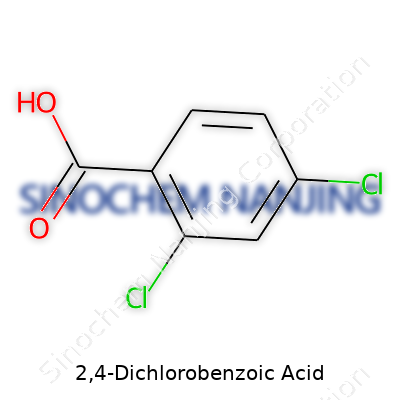
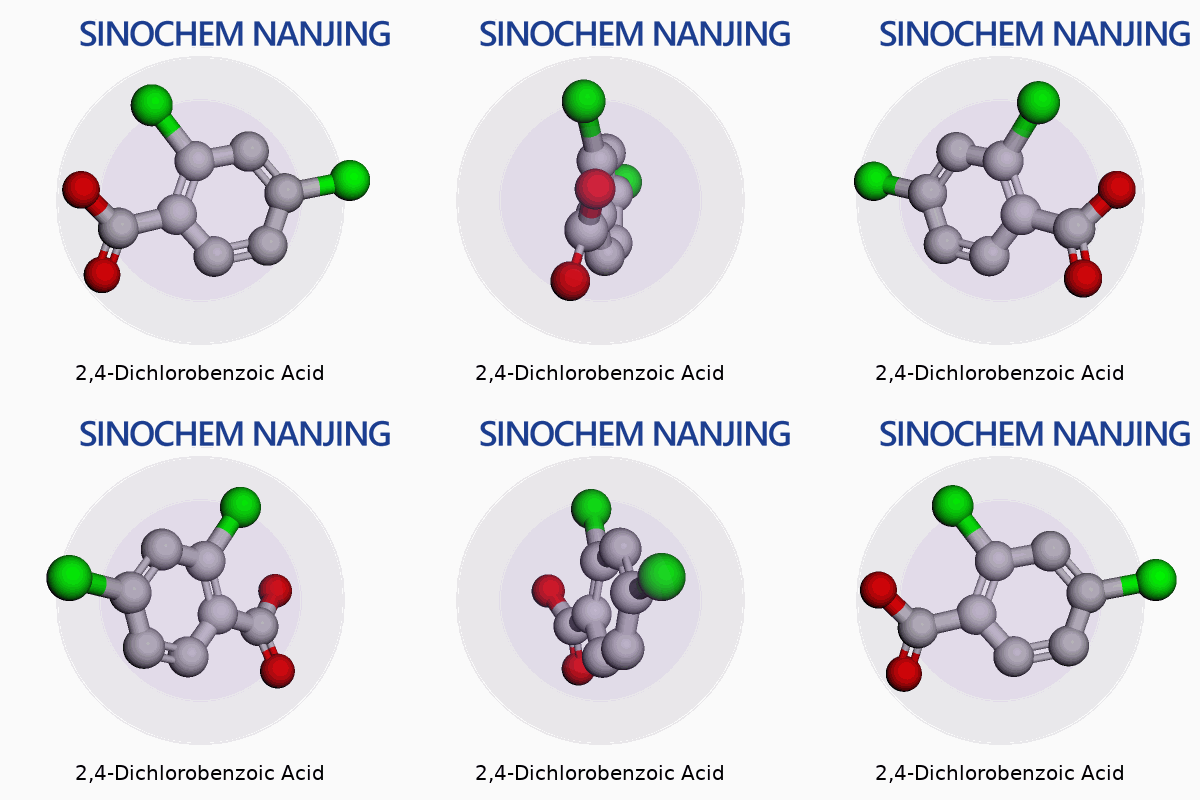
| Names | |
| Preferred IUPAC name | 2,4-dichlorobenzoic acid |
| Other names |
2,4-DCBA 2,4-Dichlorobenzoate Benzoic acid, 2,4-dichloro- 2,4-Dichlorbenzoesäure NSC 8695 |
| Pronunciation | /ˈtuː fɔːr daɪˌklɔːrəʊˈbɛnzoʊ.ɪk ˈæsɪd/ |
| Identifiers | |
| CAS Number | 50-84-0 |
| Beilstein Reference | 1207934 |
| ChEBI | CHEBI:2817 |
| ChEMBL | CHEMBL1089 |
| ChemSpider | 10480 |
| DrugBank | DB08694 |
| ECHA InfoCard | 100.007.726 |
| EC Number | 209-932-1 |
| Gmelin Reference | 2911 |
| KEGG | C06587 |
| MeSH | D003639 |
| PubChem CID | 7026 |
| RTECS number | DG9625000 |
| UNII | 871Y94M2FW |
| UN number | UN3077 |
| CompTox Dashboard (EPA) | DTXSID1022516 |
| Properties | |
| Chemical formula | C7H4Cl2O2 |
| Molar mass | 186.01 g/mol |
| Appearance | White to beige crystalline powder |
| Odor | Odorless |
| Density | 1.57 g/cm³ |
| Solubility in water | slightly soluble |
| log P | 2.7 |
| Vapor pressure | 4.8 x 10^-5 mmHg (25°C) |
| Acidity (pKa) | 3.0 |
| Basicity (pKb) | pKb = 10.28 |
| Magnetic susceptibility (χ) | -71.6·10⁻⁶ cm³/mol |
| Refractive index (nD) | 1.621 |
| Viscosity | 1.15e-2 Pa·s (25°C) |
| Dipole moment | 1.73 D |
| Thermochemistry | |
| Std molar entropy (S⦵298) | 218.6 J·mol⁻¹·K⁻¹ |
| Std enthalpy of formation (ΔfH⦵298) | -323.7 kJ·mol⁻¹ |
| Std enthalpy of combustion (ΔcH⦵298) | -3232.2 kJ/mol |
| Pharmacology | |
| ATC code | D06BX03 |
| Hazards | |
| Main hazards | Harmful if swallowed, causes skin and eye irritation, may cause respiratory irritation. |
| GHS labelling | GHS07, GHS05 |
| Pictograms | GHS05,GHS07 |
| Signal word | Warning |
| Hazard statements | H302, H315, H319, H335 |
| Precautionary statements | P261, P264, P270, P272, P301+P312, P330, P501 |
| Flash point | 163°C |
| Autoignition temperature | 250 °C |
| Lethal dose or concentration | LD50 oral rat 1878 mg/kg |
| LD50 (median dose) | LD50 (median dose): Rat oral 1877 mg/kg |
| NIOSH | SN1575000 |
| PEL (Permissible) | Not established |
| REL (Recommended) | REL (Recommended): 0.5 mg/m³ |
| Related compounds | |
| Related compounds |
Benzoic acid 4-Chlorobenzoic acid 2,6-Dichlorobenzoic acid 2,4,6-Trichlorobenzoic acid 2,5-Dichlorobenzoic acid 2-Chlorobenzoic acid 3,4-Dichlorobenzoic acid |



