1-Pentyne: History, Properties, and Applications Explored
Tracing the Roots of 1-Pentyne
Organic chemists started paying attention to simple alkynes like 1-pentyne back in the 19th century, a time when basic molecular structures were first getting untangled. Early laboratory experiments laid the foundation, turning curiosity into a clear understanding of how compounds with triple bonds behave. Many tried isolating various alkynes by tweaking distillation processes or choice of reagents, finding new compounds along the way. 1-Pentyne made its mark as an easily recognizable five-carbon alkyne, unique thanks to that terminal triple bond. As researchers mapped out reactions and physical details, 1-pentyne slowly moved from lab curiosity to chemical staple, especially for those studying the fascinating world of unsaturated hydrocarbons.
Overview of the Product Itself
1-Pentyne, also catalogued as C5H8, shows up as a clear, colorless liquid that catches the eye for its faint but distinct scent. Chemists recognize its structure right away — a five-carbon straight chain featuring a triple bond at the alpha position. It doesn’t appear on grocery store shelves, but it’s easier to run into in chemical supply catalogs. Suppliers keep it in glass or steel containers, ready for custom synthesis or mechanistic projects. Its main draw comes from how the triple bond at the carbon-1 position opens doors for other molecules to attach or react, making 1-pentyne a familiar starting point or intermediate in countless chemical stories.
Physical and Chemical Properties
Not many everyday substances move from liquid to vapor as quickly as 1-pentyne does. Chemists measure its boiling point around 40°C (104°F), and it freezes below −100°C (−148°F), which beats out many other five-carbon compounds for volatility. On the density scale it checks in at roughly 0.7 grams per cubic centimeter—floating on water, much like lighter gasoline fractions. Water hardly dissolves it, but aromatic and aliphatic organic solvents handle it just fine. Flammability stands out, with vapor-air mixtures catching fire easily in open air or low-ventilation labs, which means strict controls at the bench. The triple bond also adds an extra layer of chemical character. This bond makes the molecule less reactive than alkenes when it comes to addition reactions, but strong enough to take on electrophiles, metals, or catalysts head-on.
Technical Specifications and Labeling
Commercial sales focus on clarity. Labels spell out the purity percentage, often 98% or higher for research or specialty synthesis work. Bottles arrive stamped with CAS number 627-19-0, molecular formula, structural diagram, and batch number for tracking. Flammable warning symbols leave zero room for confusion, and storage notes demand dry, cool, and well-ventilated environments. Labs use hazmat signage near stored containers, making sure nobody forgets the risks. Some catalogs go a step further, breaking down isomeric composition and the absence of water, stabilizers, or acidic impurities. Each bottle includes a certificate of analysis, helping synthetic chemists judge compatibility with possible downstream reactions.
Preparation and Synthesis Strategies
Labs usually prepare 1-pentyne by eliminating hydrogen halide from 1,1-dihalopentane using a strong base. This route taps into the E2 elimination mechanism, which kicks off the bromide or chloride and leaves behind the triple bond. An older approach involves treating 1-pentene with bromine and then using sodium amide to force out the dihaloalkane, ending up with 1-pentyne through a double elimination step. Smaller operations sometimes generate it by dehydrating pentanols or modifying alkynyl precursors imported from other chemical processes. Key here: avoid water during synthesis, since even minimal moisture can stall or contaminate these reactions. Certifications and trace analysis step in for validation, particularly in large-scale operations.
Reactions and Chemical Modification
Chemists treat 1-pentyne as a reliable source of terminal alkynes for chain extension and cyclization reactions. Reaction with alkali metals forms a pentynyl anion, a powerful nucleophile that builds carbon frameworks in new ways. Hydrogenation over Lindlar’s catalyst gently converts 1-pentyne to cis-2-pentene, a process prized for its partial reduction control. Halogenation or hydrohalogenation across the triple bond offers pathways to dihaloalkanes or haloalkenes. Hydration in sulfuric acid introduces a carbonyl group, serving up 2-pentanone through tautomerization. For the bold, oxidative cleavage opens the skeleton up completely, generating smaller carboxylic acids. This suite of reactivity underlines why 1-pentyne often plays the backbone in multi-step synthetic sequences in academic and industrial labs alike.
Alternative Names and Synonyms
Chemists often call 1-pentyne by other names in the lab. Classic texts list it as ethylacetylene, thanks to the ethyl group tacked to the acetylene core. Some catalogs use 1-pentine, though the correct IUPAC spelling remains 1-pentyne. Synonyms echo in research papers and synthesis manuals, so familiarity with all these names helps in literature reviews or ordering supplies. On labels, both ethylacetylene and 1-pentyne show up interchangeably, easily resolved by matching the molecular formula and structure.
Safety Practices and Operational Policy
Few chemicals demand as much respect in a confined space as 1-pentyne. Labs rely on spark-proof hoods, explosion-proof storage, and proper grounding of equipment. Handling calls for flame-resistant gloves, eye shields, and lab coats. No open flames or static near dispensing areas. Regulatory agencies classify it as a highly flammable liquid—OSHA and EPA regulations both have a say. Air monitoring equipment tracks ambient concentrations during large-scale use. Safety data sheets, reviewed in training sessions, stress the rapid onset of symptoms like headaches, dizziness, or drowsiness from vapor inhalation. Draining systems route away from ignition sources. Clean-up instructions require using inert absorbents and immediate sealing in hazardous waste containers. Modern setups even fit gas detection alarms in workspaces where 1-pentyne sees routine use.
Main Areas for Application
Applied chemists and process engineers lean on 1-pentyne as a linchpin for several specialty syntheses. In pharmaceutical research, it sets the stage for coupling reactions or functions as a masked group to insert length into molecular scaffolds. Polymer synthesis teams use it as a monomer or temporary cap to guide chain length. Fine-chemical manufacturing values it for introducing alkynyl groups that become handles for click chemistry or further transformations. Universities incorporate its unique reactivity into advanced undergraduate lab courses. Commercially, fragrance ingredient developers, agricultural science labs, and material technologists carve out new avenues by building on the reactive triple bond.
Innovation: Research and Development
Exploratory teams investigate new catalysts that render 1-pentyne transformations more selective or greener, reducing waste and energy demands. Organic methodologists work out tricks for enantioselective additions, aiming for more efficient ways to build chiral centers. Analysts chase after trace-level detection protocols, helpful for environmental monitoring or quality assurance in pharmaceutical workflows. Instrument manufacturers roll out new sensors capable of spotting alkyne vapors at ever-lower thresholds, supporting occupational health. Multidisciplinary collaborations dig deeper, using 1-pentyne as a starting point for advanced materials, turning its unique geometry into features for electronic devices and sensors.
Toxicity and Exposure Research
Toxicologists point out that, like many light volatile organics, 1-pentyne poses both acute and chronic risks. Short spells of exposure above a few hundred parts per million can leave workers dizzy or disoriented, with more serious effects possible if concentrations climb. Rodent studies reveal signs of mild central nervous system depression, but no evidence suggests long-term carcinogenicity at typical lab or industrial exposure levels. Most animal inhalation results demonstrate full recovery after short-term, low-level exposures. Occupational guidelines, including those from NIOSH and ACGIH, specify exposure ceilings well below odor thresholds, prioritizing preventive action. Research into breakdown and metabolism suggests that 1-pentyne clears rapidly from mammalian systems, breaking down via oxidative pathways with minimal bioaccumulation. Combined, these data reinforce the need for tight handling protocols, routine air quality checks, and rapid response in spill situations.
Looking Ahead: Prospects and Future Uses
1-Pentyne continues to draw attention for its adaptability in organic transformations. As interest in click chemistry and next-generation pharmaceuticals rises, chemists dig deeper into its capacity to serve as a springboard for connecting molecular fragments under mild, scalable conditions. Greener synthesis pathways, renewable feedstocks, and new asymmetric reactions may soon push its role beyond where even the early pioneers might have guessed. Automation and digital process control spell new precision in scale-up, opening routes to niche applications in materials science and smart sensors. As synthetic chemistry explores smaller, faster, cleaner transformations, the five-carbon alkyne keeps proving its worth in every corner of the modern lab.
What is 1-Pentyne and how is it used?
Digging Into Its Chemistry
1-Pentyne belongs to a group of compounds called alkynes, which carry a triple bond between two carbon atoms. In this case, that triple bond lands right at the end of the five-carbon chain. In classrooms, 1-pentyne stands out as a simple, straightforward example of an alkyne for chemistry students. Its formula, C5H8, looks basic, but underneath, that extra bond gives the molecule different properties from things like alkanes or alkenes.
Use in Organic Synthesis
Labs use 1-pentyne as a building block. If you picture synthetic chemistry sort of like a set of Lego bricks, certain basic chemicals give scientists a base to click new pieces together. 1-Pentyne fits that role—its triple bond opens up a path for attaching groups in specific spots. The molecule lets researchers create new medicines, plastics, or even flavors and fragrances. For example, that triple bond takes part in coupling reactions—a cornerstone of making more complicated chemical structures. When students first handle alkynes like 1-pentyne in college, that reactivity clicks and makes the material come alive.
In real-world manufacturing, these sorts of reactions eventually lead to specialty chemicals. Some of them end up in products we use every day, even though most folks won’t ever see 1-pentyne itself. The backbone it brings to the mix—thanks to its straight chain and reactive triple bond—shows up in the final product.
Handling and Safety Concerns
Anyone who works with 1-pentyne knows to use care. With a relatively low boiling point, it can vaporize at room temperature and its vapors can catch fire easily. People handling it keep it away from open flames, wear gloves, and use proper ventilation. That’s not just a rule on the wall—burned chemicals and fumes can do real damage quickly. Before I ever pipetted a liquid like this, older lab techs hammered home that no shortcut justifies a rushed job with flammable material. Proper handling habits help keep the work safe.
Environmental Impact and Control
Chemicals like 1-pentyne rarely get released directly into the environment if handled right. But spills can happen, and leaks lead to pollution risks. In college, my class went over how fast these compounds evaporate and how easily they could create smog if they escape into the air. Vent systems and sealed containers slow down that chance, but accidents remind people about the importance of strict storage protocols.
Potential for New Discoveries
As green chemistry moves forward, researchers keep looking for safer, cleaner ways to build on molecules like 1-pentyne without producing large amounts of hazardous waste. Synthetic chemists hunt for milder reaction conditions or less toxic substances that deliver the same value. I’ve seen university projects explore catalysts that can push reactions to happen faster and cleaner, with less byproduct, and these approaches will keep gaining ground as science keeps moving.
Bringing Knowledge Forward
Understanding a simple molecule like 1-pentyne helps students and industry professionals see deeper into how chemistry shapes the world. Knowledge sparks innovation, improves safety measures, and helps the field adapt to the needs of people and the planet.
What are the physical and chemical properties of 1-Pentyne?
Physical Properties That Catch Attention
1-Pentyne shows up as a colorless liquid with a sharp, gasoline-like smell. Sometimes people describe it as pungent. Its molecular formula, C5H8, puts it in the alkyne family, known for that carbon-carbon triple bond. Pour it into a beaker, and you’ll see a boiling point around 40°C to 41°C (about 104°F to 106°F). It feels light, since its density checks in at roughly 0.69 grams per cubic centimeter at room temperature. That’s less than water, so it floats up fast if there’s a spill.
It mixes well with most organic solvents. That makes it easy to use in a lab, but it also means 1-pentyne spreads fast in the environment. It barely dissolves in water— just trace amounts— which is typical for small alkynes. This weak relationship with water matters in transport and storage. Leaks can travel through soil, or evaporate into the air, rather than dissolving away in stormwater runoff.
Chemical Properties: That Triple Bond Tells the Story
What jumps out about 1-pentyne is the triple bond on the end of its carbon chain. That makes it part of the terminal alkynes, giving the molecule extra energy and reactivity. That triple bond opens the door for chemical reactions like addition or polymerization. Compared to alkanes and alkenes, alkynes like this one become much more willing to react, especially with halogens and acids. Scientists apply this property to build bigger, more complex molecules.
1-Pentyne can catch fire quite easily. Its flash point sits well below room temperature, which calls for real caution during handling. The vapor forms an explosive mix with air, so igniting it only takes a stray spark. Fire departments list 1-pentyne as a dangerous fire risk in chemical storage.
What Does This Mean in Real Life?
The properties pack a punch. Having worked in a college lab, I learned early on what happens if someone ignores the volatility of 1-pentyne. We used it to create specialty compounds for research, and a few drops on a glove made my hand itch and sting until I washed it off. Stories like this stick with you: it’s not a chemical you treat lightly.
On the industrial side, chemists rely on that triple bond to build things—pesticides, drugs, plastic additives. The reactivity cuts down the number of steps needed to make more useful products. Handling the substance, though, means following strict procedures. Labs rarely leave 1-pentyne sitting out after experiments. Proper venting, tight seals, and protective gear become non-negotiables. Storage always happens in flame-proof cabinets, away from direct sunlight or static electricity.
Handling Concerns—and Some Solutions
Safety comes down to training and engineering controls. Chemical fume hoods put a barrier between workers and harmful vapors. Using glass syringes (not rubber) avoids unwanted side reactions, since the triple bond can attack weak spots in some materials. In larger settings, vapor detectors and emergency ventilation make a big difference. On the environmental side, collecting spills with absorbent pads and disposing of waste in sealed, labeled containers cuts down on pollution.
Clear labeling and attention to detail, even when everyone seems confident, create a safer workspace. Proper respect for chemicals like 1-pentyne matters for anyone from undergrads to process engineers. Learning the details—boiling point, flammability, chemical reactivity—arms users with knowledge to protect themselves and others.
What are the safety and handling precautions for 1-Pentyne?
Understanding the Risks Before Grabbing That Bottle
1-Pentyne belongs to a family called alkynes. It looks simple on paper—five carbons, one triple bond—but the way it acts in the real world demands respect. Found in research labs and sometimes in advanced chemical manufacturing, 1-Pentyne comes with hazards that go beyond a basic splash in the eye or a bad smell.
Flammability: The Flash Point Problem
1-Pentyne catches fire easily. Pools of vapor can hang low to the ground, mixing with air and waiting for a spark. I remember a lesson during my time in a college organic chemistry lab: one tiny open flame, and alkynes can snap from liquid to fireball. Government agencies such as OSHA and the National Fire Protection Association both rank chemicals with these properties at the top for explosion risk. Using 1-Pentyne in a room with Bunsen burners, hot plates, or even faulty electrical equipment can spell disaster in seconds.
Short- and Long-Term Exposure Risks
Let’s talk about what it does to people. Breathing in 1-Pentyne vapor makes your eyes water and nose burn. If you touch it, redness and irritation appear quickly. Spend enough time around the fumes, and headaches, dizziness, and in heavier cases, impaired breathing can start. Alkynes reach deeper into the lungs than some other solvents, so anyone with asthma or weak lungs feels the effects fast. Studies have shown that repeated exposure, even at low levels, can impact the nervous system. For anyone who takes chemical safety seriously, this isn’t a bottle you leave uncapped.
Personal Protective Equipment (PPE): Not an Afterthought
A full splash-resistant lab coat, chemical goggles, and nitrile gloves serve as baseline protection for 1-Pentyne. I’ve seen gloves eaten through by other alkynes—don’t bank on thin latex. Anyone handling this liquid needs a fume hood, not just an open window. Airborne concentrations above a few hundred parts per million can trigger alarms on industrial gas detectors.
Storage Rules Keep Emergencies Away
Keep 1-Pentyne tanks locked away from heat and sunlight, preferably in a safety cabinet rated for flammable materials. Static discharge can ignite residual vapors during transfers. Chemical manufacturers recommend grounding all containers and using spark-proof tools. You won’t see this in every university lab, but every industrial shop worth its salt stores alkynes in separate rooms from oxidizers and acids. Having a class ABC fire extinguisher and spill kit in the vicinity isn’t just good practice; it could save lives and thousands of dollars in damages.
Waste and Emergency Response Practices
Disposing of 1-Pentyne means collecting waste in clearly labeled, sealed containers. Dumping down the drain isn’t just illegal—it’s reckless. Local fire departments and hazardous waste services get frequent calls about improperly managed alkynes. Immediate steps for accidental spills include evacuating the area, letting only trained personnel handle cleanup, and using inert absorbents. Ventilation cannot fix a serious spill.
Moving Forward: Building a Safety Culture
Chemicals like 1-Pentyne teach you to respect every step in the process. That includes reading safety data sheets every time, refreshing on emergency drill procedures, and reporting leaky bottles before small problems become emergencies. As a lab worker, I learned that small shortcuts could turn into real injuries or lost research. Honest conversations and routine checks give people the confidence to speak up about risks, and that habit saves more than just skin.
How is 1-Pentyne synthesized or produced?
What 1-Pentyne Really Is
1-Pentyne stands among the simplest alkyne hydrocarbons, holding five carbons and a triple bond at one end. Laboratories and chemical plants often look to make this compound because it works as a building block for other chemicals. People use it in making pharmaceuticals, research reagents, and various organic transformations. Although it doesn’t make headlines the way household chemicals do, 1-pentyne’s method of creation actually reflects broader ideas about responsible chemical production and education.
Classroom Chemistry and the Power of Hands-On Learning
I remember watching a professor using glassware and a hood to turn haloalkanes into alkynes with sodium amide. That simple scene sticks with me not just for the science but for the sense of precision and safety. Making 1-pentyne usually starts with 1-pentene, which itself comes from cracking longer-chain hydrocarbons. Chemists add a strong base such as sodium amide, which then pulls two hydrogens off the pentene, forcing those carbons to form a triple bond. The reaction works well, but it also reinforces lessons from chemistry class about controlling side reactions and safely handling caustic chemicals. If you want to teach students about organic synthesis and laboratory safety, few reactions do better than an alkyne preparation like this.
Industrial Routes and Environmental Questions
Factories make 1-pentyne in bigger batches, introducing questions that stretch beyond the classroom. Most large-scale producers rely on dehydrohalogenation, starting with 1,1-dihalopentane or similar molecules. They’ll treat these with sodium amide or potassium tert-butoxide, both strong bases, to kick out a halide and force a triple bond into shape. The efficiencies these days impress, but the waste side-products bring challenges. Spent bases and salts need to be collected and treated. Regulators and chemists have pushed for “greener” methods, sometimes looking at routes using biocatalysts or recyclable solvents. That work shows up in academic journals and conferences, but scaling it to industry hasn’t always come easy.
Safety Lessons Matter for Everyone, Not Just Chemists
I’ve seen well-meaning folks underestimate the risk in handling alkynes. 1-pentyne’s triple bond makes it more reactive than an alkane or alkene, raising risks of fire or reactions with common chemicals in the air. Strong bases and reactive intermediates can cause burns, explosions, or toxic vapors if not given proper respect. Anyone planning to make the compound, whether an undergraduate or a chemical engineer, has to take mandatory precautions—fume hoods, eye protection, and proper disposal protocols. Unfortunately, chemical accidents don’t distinguish between experts and amateurs.
Where Modern Solutions Come In
Improvements rarely come from a single breakthrough. Over the years, access to greener chemistry textbooks, open-access journals, and safety campaigns have helped more people learn safer and cleaner methods. Encouraging open training, sharing lessons from accidents, and designing reactions that cut waste and hazards can all push synthesis forward. For a routine reaction like making 1-pentyne, there’s no reason to settle for outdated methods when modern science keeps improving both yields and safety standards.
Beyond the Lab: Why It Matters
Most people walk past chemistry labs without giving a thought to what happens inside, but small molecules like 1-pentyne end up in medicine, materials, and technology. Watching the field pay more attention to clean and responsible methods gives me hope for a time where fewer accidents and less waste become the norm, not the exception.
What are the storage requirements for 1-Pentyne?
Getting Real About Chemical Safety
Working with chemicals isn’t just for big factories or research labs. Anyone who handles 1-pentyne, even in small batches, needs to show some respect for what it can do. I’ve seen more than a few stories of garages or classrooms turned into emergency clean-ups just because the right guidelines got skipped. These lessons stick with you, and 1-pentyne, being a flammable alkyne, doesn’t offer many second chances.
Fire Risks Aren’t Hypothetical
It only takes a spark for things to go sideways with something like 1-pentyne. Its flash point hovers around minus 38 degrees Celsius, which puts it among substances that can catch fire in ways most folks can’t imagine. Vapors hang out low to the ground, pooling where you’d least expect them. That means any source of ignition—from a light switch to a stray static charge—can turn a quiet shelf into the site of a disaster. You want to keep things cool, definitely below room temperature, and absolutely far from anything that could spark.
Containers Matter
Old habits die hard: I’ve seen makeshift containers pressed into service for a lot of dangerous substances. That doesn’t fly with 1-pentyne. Proper storage calls for tightly sealed, chemically compatible cylinders or bottles, typically made from steel or certain grades of glass. Any leak not only wastes material but turns the storage space into a potential bomb. Pressure can build up even at modest temperature shifts, so you don’t just want any lid—you want the right pressure-tested cap and a label that spells out exactly what’s inside.
Ventilation and Segregation
Nobody wants to breathe 1-pentyne fumes. Proper ventilation does more than keep the space comfortable. It dilutes accidental releases so that even if something goes wrong, the risk for explosions or poisoning drops. I remember cases where poor airflow led to headaches and dizziness—those aren’t minor symptoms. Storing this compound alongside acids, strong oxidizers, or halogens invites reactions that will make any clean-up crew earn their pay. Separation isn’t bureaucracy; it’s what keeps things calm when you aren’t watching.
Security and Monitoring
A locked cabinet under constant watch, whether by camera or a simple inspection log, acts as the first line of defense. Small thefts or unintended use often come from simple neglect. Tracking how much you have, how often you open the container, and who’s supposed to have access goes a long way. It also keeps regulators and safety inspectors off your back, and nobody’s nostalgic for a surprise visit from the fire marshal.
Personal Protection & Training
Goggles, gloves, chemical-resistant aprons—these aren’t for show. A splash or whiff of 1-pentyne can do a lot more than cause irritation. Anyone handling it even briefly should learn the symptoms of overexposure, from lightheadedness to respiratory distress. Training sessions are worth the effort here. Well before a crisis, everyone should know how to use the safety shower, where the nearest fire blanket sits, and how to call for help.
Disposal and Emergency Readiness
Leftover 1-pentyne doesn’t just disappear. Plan for proper chemical waste management. Contact local authorities for hazardous waste pickup; pouring it down the drain is a shortcut to fines or worse. On top of that, spill kits designed for flammable organics should always remain within reach. Emergency drills help cement good habits for real scenarios, making safe storage not just a checklist but part of the daily routine.
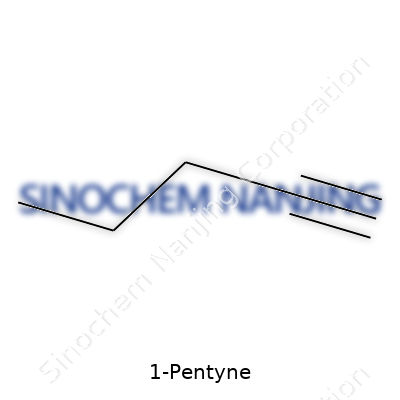
| Names | |
| Preferred IUPAC name | Pentyne |
| Other names |
Ethylacetylene 1-Ethylacetylene |
| Pronunciation | /paɪnˈtaɪn/ |
| Identifiers | |
| CAS Number | 627-19-0 |
| Beilstein Reference | 1209221 |
| ChEBI | CHEBI:36939 |
| ChEMBL | CHEMBL136839 |
| ChemSpider | 55709 |
| DrugBank | DB01975 |
| ECHA InfoCard | ECHA InfoCard: 100.007.958 |
| EC Number | 207-760-0 |
| Gmelin Reference | 508344 |
| KEGG | C01837 |
| MeSH | C043382 |
| PubChem CID | 7903 |
| RTECS number | RN0175000 |
| UNII | 0C12L6F5RC |
| UN number | UN1867 |
| Properties | |
| Chemical formula | C5H8 |
| Molar mass | 68.12 g/mol |
| Appearance | Colorless liquid |
| Odor | unpleasant |
| Density | D:0.694 g/mL at 25 °C(lit.) |
| Solubility in water | slightly soluble |
| log P | 1.88 |
| Vapor pressure | 19.6 kPa (at 20 °C) |
| Acidity (pKa) | 18.7 |
| Basicity (pKb) | 25 |
| Magnetic susceptibility (χ) | -25.2×10⁻⁶ cm³/mol |
| Refractive index (nD) | 1.369 |
| Viscosity | 0.408 mPa·s (25 °C) |
| Dipole moment | 0.77 D |
| Thermochemistry | |
| Std molar entropy (S⦵298) | 344.0 J·mol⁻¹·K⁻¹ |
| Std enthalpy of formation (ΔfH⦵298) | +154 kJ·mol⁻¹ |
| Std enthalpy of combustion (ΔcH⦵298) | -3082 kJ/mol |
| Hazards | |
| GHS labelling | GHS02, GHS07 |
| Pictograms | GHS02, GHS07 |
| Signal word | Danger |
| Hazard statements | H225, H319, H336 |
| Precautionary statements | H225, H319, H336 |
| NFPA 704 (fire diamond) | Health: 2, Flammability: 4, Instability: 1, Special: – |
| Flash point | -38 °C |
| Autoignition temperature | Autoignition temperature of 1-Pentyne is "318°C |
| Explosive limits | 1.4-8.4% |
| Lethal dose or concentration | LD50 Oral Rat 3600 mg/kg |
| LD50 (median dose) | LD50 (median dose) of 1-Pentyne: **3500 mg/kg (rat, oral)** |
| NIOSH | KN5600000 |
| PEL (Permissible) | OSHA PEL: Hexane, all isomers 500 ppm (1800 mg/m³) TWA |
| REL (Recommended) | Room temperature |
| IDLH (Immediate danger) | IDLH: 1,500 ppm |
| Related compounds | |
| Related compounds |
1-Butyne 2-Pentyne 1-Hexyne 2-Butyne |



