1-Octyne: A Closer Look at Its Journey, Character, and Impact
Historical Development
People have been exploring alkyne chemistry since the 19th century, drawn by the reactivity of triple bonds and the vast landscape they offer for synthesis. 1-Octyne, an eight-carbon terminal alkyne, first drew attention in the context of expanding organic building blocks beyond cheap acetylene and smaller monoalkynes. By the twentieth century, chemists reached out for longer chains like 1-Octyne for their potential in making advanced molecules and polymers. Over the decades, refinements in purification and production led to higher-purity 1-Octyne, and its use expanded from pure academic curiosity into more practical sectors like specialty chemistry, pharmaceuticals, and certain niche materials. Old patents show how chemical industries sought ways to scale up its manufacture for intermediates in surfactants, flavor compounds, or additives.
Product Overview
1-Octyne stands out as a clear, colorless liquid. Its crisp smell shares much with boosted hydrocarbons. Curious lab newcomers often notice the rapid evaporation and the sharp feel. For a terminal alkyne, it’s less volatile than those with fewer carbon atoms, which means containers store it with a little less worry about vapor loss. Its molecular formula, C8H14, comes loaded with a triple bond at the end of a straight chain, and those carbons and hydrogens pretty much set the stage for how this chemical behaves and how it gets handled. Producers offer it in tight drums or specialized bottles, certified for a certain percent assay—usually 98% or higher. Chemists, engineers, students: many see 1-Octyne’s name on inventory lists, whether for research, pilot scale-up, or novel applications.
Physical & Chemical Properties
Digging into its physical features: 1-Octyne’s boiling point hovers around 138 °C, high enough to limit loss under room conditions but low enough to vaporize in standard lab glassware. Its density clocks in at about 0.74 g/cm³. Insoluble in water, yet it easily dissolves in organic solvents like ether and chloroform. The triple bond anchors its reactivity, sapping a bit of electron density from the rest of the molecule, making it ripe for a range of additions and transformations. The terminal hydrogen can be swapped out with a good base. This property gives rise to alkynylation–chemists use it to tack new carbon chains onto other molecules. Its flash point sits near 31°C, a reminder that open flames spell hazard. The pure compound avoids color and odor taints—provided it’s handled and stored in dry, tight vessels far from strong acids or bases. Over time, exposure to oxygen can lead to the gradual formation of peroxides, so established labs keep stabilizers or monitor age and storage carefully.
Technical Specifications & Labeling
Bottles of 1-Octyne typically bear a CAS number—629-05-0—along with lot numbers for traceability. Content by assay runs above 98 percent for many suppliers, with some grades marked for analytical or synthesis standards only. Technical sheets usually cite acid value, moisture limit, and GC purity as core indicators. Transportation follows UN codes for flammable liquids; hazard labels clearly note fire risk and necessary precautionary statements. Chemists and handlers need the right gloves, goggles, and ventilation, due to its vapor effects and skin penetration. Desk-level standards call for storage below 25°C in dark, dry cabinets, away from sources of static or open flame. Proper labeling resolves accident risk and signals regulatory compliance.
Preparation Method
The lab route for 1-Octyne starts with reactions that build the carbon backbone step by step. Many organic chemists use a coupling between a smaller alkyne and a haloalkane through methods like the Corey–Fuchs reaction or Sonogashira coupling. At a larger scale, processes draw on catalytic dehydrohalogenation of octyl halides—using strong bases and sometimes copper or palladium catalysts. Crude products go through distillation to isolate the target compound from byproducts. Careful attention to dryness and oxygen presence keeps unwanted side reactions at bay, so dryness agents and inert atmospheres prove handy. Over the past years, continuous improvements in catalyst selection and process engineering dropped batch times and increased yields, answering the demands of specialty chemical makers.
Chemical Reactions & Modifications
Chemists enjoy working with 1-Octyne as a starting point for chain extensions or function additions. Its triple bond invites hydrogenation to give octene or octane; even partial hydrogenation (using Lindlar’s catalyst) yields cis-octene. Treatment with halogens or halides allows substitution at various points, and the triple bond’s pi electrons open the door for acetylide formation, which can act as nucleophiles in cross-coupling. Labs often rely on 1-Octyne in click chemistry, particularly azide–alkyne cycloaddition, producing triazoles that matter to pharmaceuticals and materials alike. Sometimes 1-Octyne’s chain undergoes oxidation to form acids, alcohols, or ketones—useful building blocks themselves. With the right metals, the terminal hydrogen swaps for more complex organic groups, bridging synthesis routes for even larger, more intricate molecules.
Synonyms & Product Names
Those searching for 1-Octyne may also see it called 1-Octine, Oct-1-yne, or n-Octyne in catalogs. Several chemical suppliers list it under proprietary blend names as part of reaction kits, derivatization sets, or custom bulk orders. These names show up in published research as well as patent filings, reflecting its adoption across chemical subdisciplines. Newcomers in a lab might miss the similarities when labels only show alternative names. Consistent safety training and stockroom cross-checks make sure no confusion slips through, keeping experiments clean and inventories up-to-date.
Safety & Operational Standards
Working with 1-Octyne demands respect in the lab or factory. As a flammable liquid, it quickly ignites from open flames, sparks, or static discharge, so labs install explosion-proof fans and mandate non-sparking tools. Personnel use nitrile gloves, lab coats, and wraparound goggles since the liquid irritates skin and the fumes can lead to headaches or dizziness. Good ventilation ranks top priority, and spills require immediate cleanup with absorbents, double-bagging, and safe disposal. Drums and bottles store behind locked, ventilated doors, and regular inspections sniff out leaks or degradation. Regulatory guidelines from OSHA, GHS, and the CDC shape documentation, labeling, and handling routines. Waste management plans line up with local requirements, ensuring no 1-Octyne finds its way into groundwater or air outside facility limits.
Application Area
1-Octyne supports a roster of industries and research fields. Chemical manufacturers use it to build longer, more complex molecules in surfactant, flavor, and fragrance synthesis. Polymer chemists find its triple bond handy for cross-linking or functionalizing new materials, unlocking properties old monomers can't reach. Pharmaceutical developers look for compounds with strong triple bonds to set the stage for selective reactions or to introduce new carbon–carbon connections. Specialty coatings and adhesives pick up value from 1-Octyne-derived intermediates, driving innovation in hard-wearing or weatherproof surfaces. Academic labs keep it in stock for method development, reaction discovery, and mechanistic studies, sometimes inspiring breakthroughs that later filter into industry scale.
Research & Development
Researchers have never stopped pushing 1-Octyne into new corners of chemistry. New catalysts, from transition metals to green enzymatic systems, make some reactions milder, faster, and more selective than classic protocols. Modern analytics trace impurities down to the parts-per-million range, supporting its role in fine chemical and drug synthesis. Teams develop methods that use less solvent, scale up safely, and reduce risks backed by strong process engineering. These efforts unlock new reaction partners for 1-Octyne, creating access to derivatives important for bioactive compounds, smart materials, and sustainable polymers. Partnerships between academia and industry often put 1-Octyne at the heart of grant calls and collaborative publications, spinning off new know-how into patents and products.
Toxicity Research
Work on 1-Octyne’s health effects pulls together fields from toxicology to environmental monitoring. Studies point out that prolonged exposure to vapors can irritate the respiratory tract, and contact with skin leads to irritation or redness. Animal tests highlight moderate acute toxicity, though much lower than for smaller alkynes or aromatic solvents. Metabolism in mammals shows slow breakdown, giving the body time to excrete most of it unchanged. Chronic exposure risks remain less mapped, pressing occupational health authorities to keep their exposure limits under constant review. Environmental research explores 1-Octyne’s breakdown by soil microbes, verifying that, under normal use patterns, accidental release doesn’t stick around to harm water or wildlife populations.
Future Prospects
The actionable future of 1-Octyne stretches with every leap in synthesis, green chemistry, and materials science. As demand grows for biodegradable surfactants and sustainable polymers, C8 alkynes present attractive starting points. Advanced catalysis, maybe using earth-abundant metals or bio-catalysts, opens routes with less waste and greater energy efficiency. Researchers keep an eye on its potential for click chemistry in drug discovery, marking possibilities for tailored medicines and diagnostics. Efforts to improve process safety and reduce emission rates position the compound to play a part in clean-chemistry manufacturing. Ongoing toxicity reviews and environmental monitoring will keep the compound in line with health and ecological goals, setting benchmarks for responsible growth. In the end, 1-Octyne’s story intertwines with how resourceful, creative, and responsible its handlers and developers become in the next scientific advances.
What is 1-Octyne used for?
A Closer Look at This Niche Chemical
1-Octyne sounds like something you’d only meet in a chemistry textbook, but it actually plays a quiet role in fields ranging from research labs to plastics, and even the flavors in your favorite foods. I’ve spent time in small startup labs and watched researchers order odd chemicals like 1-Octyne to plug into new projects or chase after elusive results. This colorless liquid, defined by its triple carbon bond near the end of its eight-carbon chain, offers more than just a chemical oddity — it’s a workhorse for synthesis and a subtle enabler tucked deep into modern manufacturing.
Chemical Building Block for Industry
1-Octyne behaves a lot like a Lego piece in organic chemistry. Thanks to the triple bond, it reacts quickly under the right conditions and opens the door to building all sorts of complex molecules. If you ever tried to piece together a model kit only to find the right connector is missing, you’ll understand the fierce demand for such chemicals. Chemists grab 1-Octyne for the “alkynylation” reactions that add new bits onto molecules. This trick feeds into pharmaceuticals, agrochemicals, and specialty polymers.
If you look at the world of materials science, plenty of new coatings and plastics owe a debt to niche ingredients like this. Researchers have turned to 1-Octyne to create surfactants — the molecules that let soap clean oily grime or help paints stick better. These surfactants often need a specific carbon chain length, and the structure of 1-Octyne makes it a perfect backbone.
Flavor and Fragrance Applications
Walk through a candy factory or a perfume lab, and you’d struggle to spot 1-Octyne directly. But its derivatives sneak their way into all sorts of flavor compounds. Many artificial flavors stem from these small building blocks, tweaked into fruity, floral, or citrusy notes by expert chemists. It’s a reminder that even stuff with a scientific-sounding name sometimes ends up making the world taste and smell better.
Enabling Drug Discovery
Drug developers use every tool they can get. In small-scale pharma research, I’ve seen teams employ 1-Octyne as a “tag” or a precursor, linking it to create new medicinal candidates. Its triple bond reacts predictably, letting chemists build compounds step by step without triggering side reactions that could spoil weeks of work. The urge to find new antibiotics or more selective cancer drugs pushes scientists to use chemicals that let them cut, paste, and shuffle tiny carbon atoms. 1-Octyne turns up in a toolbox that helps speed progress and innovation.
Balancing Benefits and Risks
Working with 1-Octyne, like any reactive chemical, isn’t risk-free. It evaporates easily and demands good ventilation and personal protective equipment. This may sound mundane, but people’s safety depends on tight storage practices and clear labeling, especially in busy labs where mistakes can have real consequences. Regulations call for training and proper waste disposal because keeping workers safe and the environment unpolluted can't get lost amid the focus on discovery.
Pushing Toward Greener Chemistry
Watching the rise in “green chemistry,” I’ve seen more companies seek alternatives or use 1-Octyne with greater care. Developing processes that minimize leftover waste, recycle solvents, or source from renewable feedstocks will matter as regulations tighten. Plus, customers ask tougher questions about what ends up in their homes, their food, or their water. Transparency and a drive for safer practices shape how labs and factories use specialty chemicals like 1-Octyne.
1-Octyne won’t ever grab headlines, but its fingerprints turn up across surprising corners of research and products. Knowledge of safe handling, smarter synthesis, and a push for responsibility go hand in hand with real progress — in science and in the lab next door.
What is the chemical formula of 1-Octyne?
The Backbone of Chemistry—Molecular Formulas
Every single step in chemistry depends on getting the basics right. The chemical formula stands as that foundation. For 1-Octyne, the formula is C8H14. Seems like a few letters and numbers, but in truth, it captures everything you need to know about its atomic makeup.
Working with hydrocarbons over the years, I’ve seen how one wrong digit in a formula can put an entire process off course. Picture preparation for organic synthesis: lab staff can’t just guess and hope for the best. Each carbon and hydrogen count has a purpose, especially with functional groups like alkynes, which carry a triple bond. For 1-Octyne, that triple bond sits at the first carbon in the chain, and this arrangement is not just academic — it influences how the molecule behaves in real reactions.
The Structure Behind the Symbols
1-Octyne may sound exotic, but it’s a straight-chain hydrocarbon with eight carbons. Putting the triple bond at the front end makes it more reactive in some settings, especially when you add catalysts. You wouldn’t use it the same way as an internal alkyne. Practical use always starts with knowing what’s on the table. The formula for an alkyne usually follows CnH2n-2. For 1-Octyne, that means eight carbons, and twice as many hydrogens minus two: 8 and 14. It’s a pattern that gives students and lab workers a quick check before moving forward.
Why It Matters Beyond the Lab
I’ve watched plant technicians double-check these formulas during quality checks. Skip that step, and a batch can go sideways, which means wasted raw materials and money down the drain. These details matter when compounds go into petrol additives or pharmaceuticals. One slight change can mean a completely different compound, altered toxicity, or reactivity—sometimes with serious consequences.
One famous misstep happened with a misunderstanding on a hydrocarbon feedstock order. A difference between 1-Octyne and its isomers triggered downstream equipment issues that cost days of downtime. This mistake boiled down to not confirming the formula at the procurement stage.
Solutions for Keeping Chemistry on Track
A few steps help keep everyone on point. I’ve worked in labs where peer review of formulas before requests or reactions made all the difference. Double-entry checks in inventory systems stopped many headaches. For classrooms or new chemists, clear visuals and hands-on practice with counting carbons and hydrogens build confidence and knowledge that serves for years. Regular upskilling around formula interpretation also keeps teams sharp, reducing human error in fast-paced environments.
Knowledge sharing between research, procurement, and production teams doesn’t just boost efficiency — it cultivates safety. Posting a simple chart with alkynes formulas on the wall in workspaces creates a reference point. It may seem basic, but small steps like this prevent big—and sometimes costly—mistakes.
At its core, something like the formula of 1-Octyne, C8H14, isn’t just a textbook fact. It’s the key to safety, efficiency, and productivity in chemical work.
What are the safety precautions for handling 1-Octyne?
Recognizing the Risks
1-Octyne belongs to the family of alkynes—compounds known for being reactive and, sometimes, unpredictable. In the lab, it can release flammable vapors and react with air or strong oxidizers. The liquid can irritate skin, eyes, and lungs. I learned pretty quickly in my early research days that simply reading the safety sheet doesn’t cover it all; you need to respect the material and what even a small spill can trigger.
Personal Protective Equipment (PPE)
No shortcuts with gear. Lab coats, splash goggles, and chemically resistant gloves stand as the basics. Working with 1-Octyne taught me to double-check for glove compatibility—nitrile offers solid protection here. My old lab partner once skipped goggles for a “quick transfer.” A single splash left him with irritated eyes for hours. Don’t risk exposed skin, hands, or eyes.
Ventilation and Storage
Vapor control is serious business. I always work with volatile organics such as 1-Octyne inside a certified fume hood. Ventilation shields you from fumes, which can build up fast and cause dizziness or headaches. Store 1-Octyne in a cool, fireproof cabinet, away from oxidizers and direct sunlight—heat ramps up vapor release and flammability. Keeping the cap tight and labeling containers clearly has saved me trouble more than once, especially during busy projects.
Handling and Spill Response
Pour and measure liquids like this slowly and deliberately. Even a small splash outside the container adds extra clean-up and exposes you to vapors. I keep absorbent pads and a neutralizer kit on the bench, just in case. If a spill happens—and, trust me, someday it will—lock down the area, turn off ignition sources, and go straight to containment. Let nobody re-enter until you’ve dealt with the fumes and waste.
Fire Prevention
Nothing ramps up tension in a lab like flammable liquids. Static discharge, Bunsen burners, even a spark from a loose wire can mean disaster with 1-Octyne around. I grew up watching old-timers in the workshop double-check for flame sources and electrical faults. No cell phone charging, hot plates, or open flames in the same area. Grounding containers during transfer limits static risks. It might feel redundant, but walking away for a cup of coffee without checking your setup is all it takes for an accident.
First Aid and Emergency Planning
Low-level exposure doesn’t excuse inaction. If you get vapors in your lungs or material on your skin, leave the area and rinse thoroughly with water. My own lesson came from fumbling a glove removal and feeling the burn on my wrist. I learned the hard way to keep the eyewash station and safety shower uncluttered and test them every week. Training your team, not just the supervisor, on spill and fire procedures builds confidence and quick response.
What Works and What Needs Improvement
Experience, not just the manual, improves outcomes. Labs with daily safety briefings and real stories see fewer mistakes. Manufacturers update their handling protocols, but they don’t always cover real-world lab chaos. Hands-on training, not just checklists, keeps a team sharp. Digital tracking of chemical stocks helps flag expired or forgotten bottles before they pose risks.
Building a Safer Routine
Stay vigilant. Take the time to suit up, keep a tidy bench, and keep your senses sharp for leaks and smells you might otherwise tune out. My own background taught me to respect not just the rules but the reasons behind them. Small lapses with compounds like 1-Octyne sometimes snowball into emergency calls or ruined projects. Real respect for the hazards makes each day in the lab safer and, frankly, keeps the work a lot more enjoyable.
What is the boiling point of 1-Octyne?
Why Boiling Points Matter Outside the Lab
Plenty of people remember learning about boiling points back in school, but those numbers start to matter much more when work involves chemistry on a daily basis. Ask anyone who’s spent time in a lab and they’ll tell you: knowing the boiling point keeps you safe, saves your project, and helps plan out reactions and separations without nasty surprises. With 1-octyne, a molecule featuring a triple bond and eight carbons, the boiling point isn’t just trivia—it shapes how, where, and even if you use it.
Getting Specific: The Boiling Point of 1-Octyne
1-Octyne’s boiling point hovers at 121°C, based on trusted sources like the CRC Handbook of Chemistry and Physics. You won’t see puddles of it outside in summer, but inside a heated flask, things change fast. That number tells researchers exactly when it will move from a liquid into a vapor. Some might expect it to evaporate sooner, but few molecules with eight carbons and an alkyne bond boil any lower. For comparison, n-octane, which doesn’t have the triple bond, boils at 126°C; so with 1-octyne, you see a slightly lower point, thanks to the structural difference. This kind of detail might look small, though in a busy synthesis process, it can mean hundreds or thousands of dollars difference in costs or equipment choices.
Straight Talk on Handling and Safety
The temperature tells more than just how hot to get the heating mantle. 1-Octyne, like many alkynes, can form peroxides if left in contact with air for a long time, which creates additional hazards—especially near its boiling range. The moment conditions approach that 121°C mark, expect increased volatility and vapor pressure. Practices like using a fume hood, grounding glassware, and keeping ignition sources away aren’t just rules—they come from years of accidents, lots of them preventable, all linked to people not respecting the boiling point or the volatility of unsaturated hydrocarbons.
Why Real Data Beats Guesswork
Some databases and chemical supply companies might show the boiling point within a few degrees of 121°C—don’t take wild guesses, especially if purity or accuracy matters. Even with all the technology around, more than a few people have found themselves pausing experiments when things start bubbling much sooner than expected. Labs working with 1-octyne usually keep a copy of safety data sheets on hand, ensuring everyone knows the correct boiling point and the atmospheres it should be stored under. Guesswork only has a place in science when there’s nothing left to measure—real data sticks around because it keeps people from wasting time and risking their jobs or health.
How Reliable Information Shapes the Industry
Boiling points seem simple, but slip-ups can shut down whole processes, delay R&D teams, or lead to expensive cleanups. Getting information right comes from researchers with experience, peer-reviewed journals, or suppliers with rigorous quality standards. Nobody wants to repeat experiments or face workplace injuries over numbers listed wrong on a label. Practical details about properties like boiling points support safe scale-ups, storage, and shipping decisions in every chemical plant and research facility.
Working Toward Safer and Smarter Labs
There’s always room for better communication and training about basic physical properties. From my own years in academic labs, fresh graduates rarely question the numbers in front of them—until something goes wrong. Sharing knowledge in clear language and highlighting concrete details, like the boiling point of 1-octyne at 121°C, turns a by-the-book operation into a safer, more informed workplace. That’s how mistakes shrink, productivity rises, and everyone gets home safely each day.
How should 1-Octyne be stored?
Storage Risks and Real-Life Consequences
1-Octyne appears on materials safety data sheets with several hazard flags. It’s flammable and gives off fumes that make you cough or worse if there’s poor ventilation. I once witnessed an accident at a research lab where someone left a loosely capped bottle of a similar alkene. Later, a spark from static electricity fed a quick flare-up. Everyone panicked, the fume hood’s alarms blared, and it became an expensive mistake once fire response got involved. That moment illustrated why storing volatile organics like 1-Octyne safely is non-negotiable, not just a box to check on a compliance list.
Flammability and Fire Prevention
This liquid catches fire near any ignition source, even something as simple as a flicked light switch or a zip-up sweater shedding static in the winter. Because of this fact, only flame-proof storage cabinets should hold 1-Octyne. I’ve worked in facilities that tried to skip these cabinets in favor of regular shelves, thinking it’d be fine for just a day or two. Within hours, the sharp, faintly sweet smell became obvious, and people started getting headaches near that workbench. Shortcuts always catch up. Flammable materials rules exist because the risk isn’t theoretical.
Container Choice and Chemical Stability
Glass bottles with airtight, chemical-resistant seals give the best protection. Some plastics break down or let vapor escape. It’s tempting to use plastic, but after a couple of years in the lab, I don’t gamble with that. Aluminum and other metals introduce their own risks as some alkyne compounds react with metals, especially over time or at high temperatures. Using the right materials for chemical containers isn’t just about following SOPs but about preventing leaks and unpredictable reactions. Nobody wants to mop up a luminescent puddle from a cracked bottle at midnight.
Temperature, Light, and Humidity
Storing 1-Octyne at room temperature out of direct sun keeps its pressure and composition stable. Too much heat boosts vapor production, and all it takes is a warm day or a lab fridge door left cracked open to change those conditions. Once, colleagues stashed reactive organics in a sunlit part of storage, thinking the glass cabinet blocked all UV – it didn’t. Spiking temperatures inside the bottles warped the seals and meant disposal before the seal failed completely. Even small storage errors waste money and time. Also, desiccants can help when humidity creeps in, reducing the odds of water finding its way into bottles and triggering slow chemical changes.
Labeling, Separation, and Safety Habits
Routine mixing of incompatible chemicals in shared cabinets nearly always ends in spilled reagents, ruined experiments, or accidental exposure. 1-Octyne belongs apart from acids, bases, oxidizers, or anything reactive. Honestly, one speedy search for “lab accident mixing oxidizer and organic solvent” gives a clear incentive to keep chemicals separated. Dating the bottles, checking for leaks, and logging who accessed what and when — these practical habits stop most close calls before they start. Reading the SDS seems tedious, but it’s saved more than a few students’ hands in high-pressure situations. New staff and students absorb safety habits best if they see them modeled by others, not just read about them in a manual.
Improving Storage Culture
In any workplace with 1-Octyne — whether a teaching lab or a chemical plant — safe storage and handling mean more than ticking boxes on inspection forms. Regular audits by trained staff, clear signage, and an environment where anyone can speak up about unsafe practices go a long way. Building a culture where employees feel responsible for one another pays dividends in both morale and safety. Every flammable or toxic substance deserves the respect and vigilance that only hands-on experience and consistent practice can deliver.
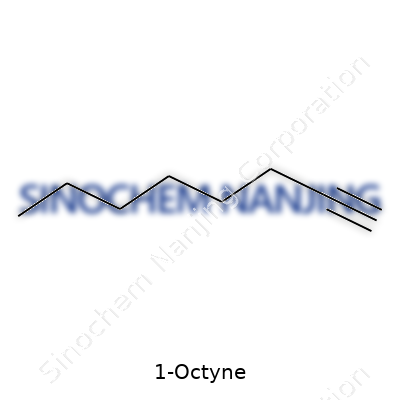
| Names | |
| Preferred IUPAC name | oct-1-yne |
| Other names |
1-Octyne Oct-1-yne |
| Pronunciation | /ˈwʌn.ˈɒk.taɪn/ |
| Identifiers | |
| CAS Number | 629-05-0 |
| Beilstein Reference | 1209242 |
| ChEBI | CHEBI:38794 |
| ChEMBL | CHEMBL160198 |
| ChemSpider | 61481 |
| DrugBank | DB01810 |
| ECHA InfoCard | 100.007.994 |
| EC Number | 211-017-7 |
| Gmelin Reference | 68273 |
| KEGG | C02571 |
| MeSH | D017912 |
| PubChem CID | 7844 |
| RTECS number | RN0340000 |
| UNII | Y5K47QQ8P1 |
| UN number | UN1166 |
| Properties | |
| Chemical formula | C8H14 |
| Molar mass | Molar mass of 1-Octyne is 110.19 g/mol |
| Appearance | Colorless liquid |
| Odor | Aromatic |
| Density | D = 0.759 g/mL at 25 °C |
| Solubility in water | Insoluble |
| log P | 1.99 |
| Vapor pressure | 3.62 mmHg (at 25 °C) |
| Acidity (pKa) | 25.0 |
| Basicity (pKb) | 25.0 |
| Magnetic susceptibility (χ) | -23.0·10⁻⁶ cm³/mol |
| Refractive index (nD) | 1.411 |
| Viscosity | 2.60 mPa·s (20 °C) |
| Dipole moment | 0.44 D |
| Thermochemistry | |
| Std molar entropy (S⦵298) | 322.5 J·mol⁻¹·K⁻¹ |
| Std enthalpy of formation (ΔfH⦵298) | ΔfH⦵298 = 185.8 kJ/mol |
| Std enthalpy of combustion (ΔcH⦵298) | -5111.7 kJ/mol |
| Hazards | |
| GHS labelling | GHS02, GHS07 |
| Pictograms | GHS02,GHS07 |
| Signal word | Warning |
| Hazard statements | H226, H315, H319, H335 |
| Precautionary statements | P210, P233, P240, P241, P242, P243, P261, P264, P271, P280, P303+P361+P353, P304+P340, P305+P351+P338, P312, P337+P313, P370+P378, P403+P235, P405, P501 |
| NFPA 704 (fire diamond) | 2-3-2-✔ |
| Flash point | 36 °C (97 °F; 309 K) |
| Autoignition temperature | 579 °C |
| Explosive limits | 1.5–11% |
| Lethal dose or concentration | Lethal dose or concentration (LD50/LC50) of 1-Octyne: "LD50 (oral, rat) > 5000 mg/kg |
| LD50 (median dose) | LD50 (median dose): Oral rat LD50 > 5 g/kg |
| NIOSH | NIOSH: RS6190000 |
| PEL (Permissible) | PEL (Permissible Exposure Limit) for 1-Octyne: Not established |
| REL (Recommended) | 5 ppm |
| IDLH (Immediate danger) | IDLH: 300 ppm |
| Related compounds | |
| Related compounds |
1-Heptyne 1-Nonyne 2-Octyne Octene Octane |



