1-Octanethiol: From Discovery to Future Applications
Historical Development
Chemists first isolated 1-Octanethiol in laboratories focused on expanding the catalog of aliphatic thiols during the early twentieth century. Before the digital age, research relied on meticulous distillations and basic chromatography, which meant discovering specific properties took time and patience. The rise of organic synthesis, especially during and after World War II, carved space for thiol derivatives, both in academia and industrial settings. Chemists chasing after better catalysts, lubricants, and surfactants soon realized that tweaking carbon chains around a sulfur atom could bring about unique physical and chemical properties. Over time, 1-Octanethiol moved from a lab curiosity to a staple in specialized research and production, representing the shift from empirical experimentation to targeted molecular engineering.
Product Overview
1-Octanethiol, also known as n-octyl mercaptan, shows up as a clear to yellowish liquid with a sharp, often unpleasant odor characteristic of organic sulfur compounds. This molecule, C8H18S, combines an eight-carbon straight chain with a terminal thiol group, making it distinct in both reactivity and application compared to shorter-chain thiols or its alcohol analogs. General storage recommendations focus on airtight, amber glass bottles to limit oxidation and odor leakage, lending practical insights for those handling the substance for the first time. For buyers, its catalog listing often lies near chemical standards for physical-organic labs, surfactant solution providers, and functional material developers.
Physical & Chemical Properties
As a colorless liquid, 1-octanethiol carries a molar mass of 146.3 g/mol. Its boiling point hovers around 206°C, indicating sufficient thermal stability for slow distillation procedures. The melting point lies close to -52°C, a nod to its flexibility for storage and reaction setups below room temperature. A density of 0.84 g/cm³ anchors it as lighter than water, and a vapor pressure on the lower side preserves shelf life but doesn't eliminate odor risks. Its low solubility in water, attributed to the nonpolar octyl chain, suggests that hexane, ether, or other organic solvents work best for dilution. The thiol group, chemically more nucleophilic than corresponding alcohols, drives substitution and addition reactions, a keystone for specialty material synthesis.
Technical Specifications & Labeling
Suppliers usually label 1-octanethiol according to both purity and intended use. Laboratory-grade batches advertise purities above 98%, ideal for surface science and nanomaterial research where trace contaminants influence outcomes. Storage warnings emphasize caution for light sensitivity and volatile sulfur odor, supporting both workplace comfort and long-term product stability. Manufacturers display CAS number 111-88-6, UN number 3336 for transport, and hazard pictograms indicating flammability and acute toxicity. Proper GHS labeling spells out the risk of skin and eye irritation as well as hazardous vapor inhalation, giving technicians clear guidance for safe handling.
Preparation Method
Industrial synthesis of 1-octanethiol frequently involves nucleophilic substitution reactions between 1-chlorooctane and sodium hydrosulfide solution. The reaction efficiently replaces the terminal chlorine with a thiol group under mild conditions. Subsequent purification relies on vacuum distillation, separating unreacted starting materials and side products from the desired thiol. Some specialty labs opt for reduction of octyl disulfide for particularly sensitive uses, although this pathway adds both expense and steps. Either way, air and moisture exclusion remain vital throughout synthesis, as side oxidation can yield disulfides or sulfonic acids, both undesirable for most applications.
Chemical Reactions & Modifications
Chemists value 1-octanethiol’s reactive sulfur-hydrogen bond. The thiol group forms strong bonds with noble metals, especially gold, making it popular for constructing self-assembled monolayers on nanoscale surfaces. Alkylation of the sulfur atom yields thioethers, expanding the molecule’s compatibility in organic synthesis. Oxidizing agents transform the thiol into either the disulfide or sulfonic acid, processes critical in both environmental monitoring and chemical manufacturing. Nucleophilic addition to electrophilic double bonds, as found in Michael additions, brings further depth to its utility in polymer chemistry and bioconjugation.
Synonyms & Product Names
1-Octanethiol goes by names including n-octyl mercaptan, 1-mercaptooctane, and octane-1-thiol. Such synonyms pop up across chemical catalogs, laboratory records, and regulatory databases. Product labels both in research and industry settings register the IUPAC name alongside the established CAS identifier for reliable ordering and inventory management.
Safety & Operational Standards
Handling 1-octanethiol requires rigorous safety protocols due to its strong odor, potential toxicity, and flammability. Labs use well-ventilated fume hoods, nitrile gloves, safety glasses, and flameproof storage lockers as standard practice. Spills pose both a persistent odor challenge and an inhalation hazard, so spill kits with absorbents and activated charcoal often stand at the ready. Regulatory safety data sheets direct users to avoid open flames, hot surfaces, and oxidizers, and advise on procedures for decontamination and waste disposal, usually incineration under controlled conditions. Chronic exposure can irritate skin and respiratory tissues, echoing the importance of established occupational exposure limits and routine air monitoring.
Application Area
Surface scientists reach for 1-octanethiol in forming self-assembled monolayers on gold or silver, enabling fine control of surface chemistry for sensors, electronics, and anti-fouling coatings. In organic synthesis, this molecule acts as a versatile intermediate for creating more complex thiol-containing compounds, surfactants, or even specialty lubricants. Petrochemical labs experiment with it as a sulfur source for lubricant additive formulations. Biochemistry teams tap its affinity for gold surfaces to anchor biomolecules in diagnostic assays and nanotechnology. Niche uses extend to odorant development, offering model compounds for understanding sulfur smell perception at remarkably low concentrations.
Research & Development
Emerging studies follow 1-octanethiol’s role in nanoparticle surface functionalization, which links directly to advances in medical imaging, targeted drug delivery, and electronic device miniaturization. Research groups continually test modified versions to tweak hydrophobicity and reactivity for custom-designed interfaces. Investigations into greener synthesis pathways, such as biocatalytic reductions or solvent-free conditions, build value by reducing environmental footprint. Patent filings track innovations in monolayer durability and resistance to environmental degradation, with industry and government labs collaborating to refine application-specific formulations.
Toxicity Research
Toxicologists have established that low-dose vapor exposure leads to headaches, nausea, and temporary irritation, with higher doses presenting risks of chemical burns and central nervous system depression. Animal models show liver and kidney impacts after repeated exposure, shaping current workplace limits. Environmental studies point out odor complaints even at concentrations below most analytical detection limits, pushing regulators to update permissible exposure levels and monitoring requirements. For accidental spills, recommendations stress immediate evacuation, respiratory protection, and medical follow-up, especially for individuals reporting dizziness or breathing difficulties.
Future Prospects
Scientists expect demand for 1-octanethiol to grow alongside nanotechnology and sensor development. As companies strive for more sensitive biosensors or advanced coatings for wearable devices, monolayer assembly using this thiol opens new performance windows. Ongoing research seeks to minimize associated health and environmental risks by improving containment, reducing vapor pressures through formulation, and developing effective neutralizers for spills and emissions. In materials science, bioconjugation and supramolecular chemistry present fresh challenges that drive inventive applications. Teams working at the interface of biotechnology and microfabrication draw from the cumulative knowledge of its handling and reactivity, envisioning smarter materials for diagnostics, drug delivery, and energy harvesting.
What is 1-Octanethiol used for?
A Closer Look at 1-Octanethiol
1-Octanethiol doesn’t pop up in regular conversation, but it plays a big part in specialized industries. This sulfur-containing organic molecule looks harmless at a glance; what stands out instead is its sharp, pungent scent. That tells you right away: caution counts. In the lab, even the smallest spill lingers on your skin and in the air longer than you’d like. My first encounter with it came during a simple exercise in organic synthesis, and I still remember how the smell hung on my gloves after cleanup. 1-Octanethiol demands respect and careful handling, yet chemists keep it close for good reason.
Building Blocks in Organic Synthesis
For chemists, 1-octanethiol shows real practical value as a starting material and a chain extender. Its sulfur atom forms strong bonds with metals, which helps in crafting self-assembled monolayers—thin films that cover and modify surfaces on the atomic scale. Much of today’s sensor and microchip engineering needs molecular building blocks like this. In my own research, the process seemed almost magical: apply a dilute solution to a gold surface, rinse off the excess, and you end up with a layer one molecule thick, changing the way that metal behaves. Those slick layers determine how water, organic compounds, or even living cells stick and interact.
Application in Nanotechnology and Electronics
1-Octanethiol steps up in nanotechnology, where gold nanoparticles wore its molecular “coat” in biosensor projects. This coating helps researchers control how nanoparticles move and interact, which can alter everything from their stability in a solution to how they recognize target molecules. Laboratories push this further by developing chemical sensors or microelectronic switches, often experimenting with different thiols to get the feature set just right. In a world that keeps shrinking technology to smaller and smaller scales, molecules like 1-octanethiol hold the key to unlocking new designs.
Role in the Chemical Industry
Beyond nanotech, 1-octanethiol shows up in chemistry labs as a reagent for making more complex molecules. It helps add sulfur-containing groups to various chemicals, giving those products a range of uses from fragrance formulation to corrosion inhibition. Some of these finished goods end up in everyday materials, though few people realize the supply chain began with a vial labelled “1-octanethiol.” Its strong smell rules it out as a perfume in itself, but its chemistry opens the door for more pleasant scents with greater stability or unique performance in different products.
Safety, Environmental Impact, and Future Solutions
Sulfur compounds call for special respect, and 1-octanethiol is no different. You learn pretty quickly that skin contact should be avoided, and that good ventilation in the lab is non-negotiable. The chemical’s intense aroma serves as an early warning, but safe storage and proper disposal stop its spread into the air and water. Environmental agencies keep a close eye because thiols, when mishandled, can harm water quality and wildlife. In the industry, the push continues for greener handling procedures and biodegradable alternatives that offer the benefits without the baggage. Training, engineering control, and research into new surface chemistry tools all help limit the downside that comes with these strong-smelling, powerful molecules.
What is the chemical formula of 1-Octanethiol?
Breaking Down 1-Octanethiol
1-Octanethiol’s chemical formula is C8H18S. This compound belongs to the group known as thiols, which look like alcohols at first glance, but swap out an oxygen atom for a sulfur atom. Chemists spot this swap right away: thiols have a -SH group, where the sulfur attaches to a hydrogen. With 1-octanethiol, the -SH group hooks onto the end of an eight-carbon chain, setting the stage for how it behaves.
Where You’ll Find It and What It Does
If you’ve ever caught a whiff of something distinctly “skunky” or “garlicky,” there’s a strong chance a thiol was part of that experience. 1-Octanethiol produces a bold, often unpleasant scent that you can’t ignore. It pops up in industrial settings, research labs, and sometimes in nature. Oil refineries and chemical manufacturers use thiols for their sulfur chemistry. I remember seeing lab technicians—gloved and cautious—preparing solutions sparingly, their faces scrunched up at the smallest escape of vapor.
The formula C8H18S helps lab workers measure it precisely, not just for safe handling but to make sure reactions go as planned. Thiols often function as chain transfer agents in polymer chemistry. They can stop runaway reactions and help control plastic properties, which means they play a direct role in what keeps countless modern materials reliable.
Handling Comes with Responsibility
Never underestimate a thiol. Its potent smell isn’t just a nuisance; it signals a need for strong ventilation and tight protocols. Safety sheets, which usually accompany bottles in the lab, highlight its flammability and the risk of skin irritation. One spill in a closed room will clear the place out fast. Workers carry out regular air checks with sniffers built for volatile chemicals, confirming that nothing exceeds exposure limits. Even small leaks demand immediate attention, both for comfort and for health. Over the years, standards have improved, but no one in a lab grows careless with the stuff.
Laboratory regulators hold strict controls: access to the chemical calls for approval, and disposal procedures get monitored closely. The sulfur content in 1-octanethiol can wreak havoc on the environment if released unchecked. That’s why collection and chemical treatment systems stand ready wherever thiols pass through.
Keeping Safety and Innovation in Balance
Some might wonder why chemists stick with smelly reagents like 1-octanethiol when alternatives often exist. It comes down to results. Thiols bring specific chemical reactivity—often impossible with alcohols or other options—making them necessary for certain applications. This reliance puts more pressure on labs and industries to improve engineering controls, train staff, and look for green chemistry alternatives that don’t sacrifice performance.
Teams keep pushing for safer handling and better substitutes. Meanwhile, accurate chemical formulas like C8H18S let those of us reading a label know exactly what sits inside a bottle, which is more than a detail—it’s the key to science that works and workplaces that protect people.
What are the safety precautions for handling 1-Octanethiol?
Personal Experience Shapes My Approach
Years back in a university lab, the sharp, pungent odor of a thiol lingered in the air for hours after a carelessly opened bottle. We spent nearly half a day airing out the space. It taught me plenty about how quickly things can go wrong with strong-smelling, volatile chemicals like 1-Octanethiol. The lessons stick with me today: respect for both the substance and the possible effects from simple mistakes.
Understanding the Hazards
1-Octanethiol brings a sharp scent that is hard to ignore, but its risks extend far beyond unpleasant smells. Contact with skin or inhalation can irritate skin, eyes, and the respiratory tract. Inhaling the vapors or getting the liquid on your skin for too long actually puts more than your nose at risk—there’s a real toxic effect. The chemical is flammable and reacts strongly with oxidizing agents, pumping up the stakes in any workspace.
Straightforward Steps: Personal Protective Equipment
Most mistakes hinge on skipping the basics. Gloves made of nitrile or neoprene, lab coats that cover arms, and safety goggles cut down the risk of actual exposure. Anyone who has scrambled to flush eyes after a splash doesn’t soon forget how that feels, and investing in the right protective gear means dodging drama in the first place. Even regular glasses won’t cut it—a full splash guard matters too much to skip.
Ventilation Takes Priority
Strong ventilation counts as a non-negotiable in my book. 1-Octanethiol loves to spread its vapor and odor. Fume hoods and exhaust fans catch the vapors before they bother anyone. Keeping the workspace scrubbed free of clutter cuts down the chance of spills, a point overlooked until an accident actually happens.
Storage Demands Respect
Storing this compound away from heat sources and oxidizing chemicals matters. Most labs keep thiols sealed tightly in flammable cabinets. Proper labels help everyone in the room spot the danger even if the container gets moved around. I’ve seen people in shared spaces grab the wrong bottle more than once, multiplying risk exponentially.
Spill Response Lines Up Before Any Mistakes
Any seasoned hand in the lab knows the importance of preparing for spills. Absorbent pads, sand, and special disposal bins need a home right near where the chemical opens. Notification systems mean everyone in the area can move fast to handle evacuations if vapors spread too much. No one wants to get caught hunting for instructions or gear in the middle of an incident.
Health Monitoring and Education
Comfort with procedures only matters if the training sticks. Regular refreshers about toxic effects, emergency showers, eyewash stations, and first-aid responses help keep the knowledge fresh. Encouraging team members to report headaches, dizziness, or any rashes that pop up soon after exposure could make a real difference to early intervention and long-term health.
Room for Solutions and Improvements
Working with 1-Octanethiol always proves that safety doesn’t happen by chance. Lab managers create checklists and signage to reinforce expectations. Making reporting easy and rewarding—rather than punishing—means more people speak up before small oversights grow into big ones. In my own labs, encouraging an open attitude about mistakes and close calls has stopped more than one incident before it begins.
Relying on good ventilation, sharp PPE habits, safe storage, and ongoing education means working with 1-Octanethiol can remain routine, not risky.
What is the purity specification for 1-Octanethiol?
Looking Past the Label—What “Purity” Means in Real Work
Anyone who has set foot in a chemistry lab knows how little room there is for uncertainty. The bottle says “1-Octanethiol,” yet what scientists count on is that number stamped on the side—purity, normally listed as something greater than 97% or 98%. That number’s not there for show. A student in my old organic synthesis class found out the hard way when a side reaction ruined an entire batch, thanks to a reagent with “unaccounted for” impurities. It taught everyone the stakes tied to chemical purity.
Why Not Just Use “High Enough” Quality?
Let’s look closer—1-Octanethiol, or CH3(CH2)7SH, gets used for building self-assembled monolayers (SAMs), certain flavors of organic synthesis, and in some neat corrosion inhibitor recipes. If a surface coating needs clean, uniform behavior on gold or a catalyst only works properly with well-behaved reagents, overlooked impurities cause headaches. Small differences in purity—99% vs. 97%—sound trivial, but that remaining 1-3% can trigger chain reactions, literally and figuratively. One sulfur contaminant can ruin a year’s delicate nanotech research.
This isn’t just perfectionism in action. Analytical data from suppliers like Sigma-Aldrich, Thermo Fisher, and TCI point toward “assay, by GC, ≥97%” as the standard specification offered for most lab and pilot-scale applications. Some industries demand ≥98% or even higher for ultra-critical surface chemistry, but cost and convenience keep the 97-98% range common in daily research.
Meeting the Standard: Who Sets the Bar?
Regulatory and industry bodies keep an eye on such details. Chemical supplier certificates of analysis (COAs) give the full rundown: not just the assay, but also color, water content (often capped at 0.5% or less), and presence of secondary thiols or oxygenated impurities. The American Chemical Society (ACS) sets minimums for “reagent grade” chemicals at ≥97%. This grade covers most teaching and industrial labs.
Going into manufacturing or pharmaceutical work brings even tighter grades. Trace metal analysis, ultraviolet and IR spectra, residual solvents—regulatory compliance brings layers of paperwork, traceability, and record keeping. The U.S. Pharmacopeia, ISO standards, and local governing bodies set their own cut-offs and methods. Labs pay extra for documentation, batch tracking, and validated synthetic sources.
Impact of Purity Missteps: Money, Safety, and Discovery
Forgetting about purity brings more than technical glitches. A 2020 report in the Journal of Organic Chemistry showed that low-purity batches of 1-Octanethiol led to unpredictable yields in palladium-catalyzed couplings. One contaminated drum at a coatings maker can mean weeks of lost production. Nobody wants to explain to management—or, worse, to reviewing agencies—how a seemingly “minor” impurity spoiled a new product.
A chemist who skips the certificate wastes not only time but safety. Some thiol byproducts can raise toxicity. Researchers with allergies get exposed to unexpected compounds.
Better Solutions: Testing and Trust
Double-checking supplier reputations, running GC or HPLC in-house, and reviewing every COA line by line keeps projects—and people—safe. Buying only from reputable vendors, or distilling in-house for super-sensitive work, reduces risk. Colleagues who do surface science sometimes set aside an hour to test every fresh batch before a big experiment, comparing new bottles with a trusted standard. In my own lab work, this habit saved us more than once when a new shipment from overseas arrived with a slip in color and odor—an early warning sign of trouble.
How should 1-Octanethiol be stored?
Why Storage Matters for 1-Octanethiol
1-Octanethiol, a chemical with a strong odor and reactive sulfur group, brings clear safety concerns to any laboratory or industrial setting. Over the years, I’ve seen the problems that crop up when basic storage steps get skipped. A poorly sealed bottle in a humid storeroom quickly fills the air with that unmistakable smell. Worse, it puts staff at risk. Health agencies like OSHA and NIOSH flag thiols as skin and respiratory irritants, so proper containment isn’t just regulatory red tape—it protects real people from accidental exposure.
Understanding Compatibility and Reactivity
Storing 1-Octanethiol next to acids, oxidizers, or strong bases creates a disaster waiting to happen. The chemical reacts vigorously with strong oxidizers. I recall one instance at my old research lab where someone left a bottle of dilute nitric acid near a thiol; local safety officers had to clear the wing for hours. A little awareness in storage can make sure chemicals with a history of dangerous interaction never meet.
Suitable Containers
For long-term storage, high-density polyethylene bottles with tight-fitting lids work well. Glass can serve, too, but I’ve seen plastic win out whenever accidental drops or bumps occur. 1-Octanethiol can corrode metals and some rubber, so using containers recommended by the chemical supplier helps prevent leakage and breakdown. Always check the seal after handling—chemicals with high vapor pressure or strong odors have a way of finding the tiniest cracks.
Location, Temperature, and Ventilation
Heat accelerates decomposition and evaporation, so I keep 1-Octanethiol well away from furnaces and sunlight. Most safety data sheets suggest cool, dry storage—ideally at room temperature, below 25°C. Some labs use dedicated flammable material cabinets, which also keep unauthorized users out. If storage near a drain or water source ever seems convenient, think again. Water can spread contamination or help the chemical infiltrate the environment.
As for air quality, good ventilation goes a long way. Many labs use chemical fume hoods or well-ventilated cabinets. One whiff of thiol vapor lingers for ages, and too much in the air can overwhelm even seasoned chemists. Regular air changes and odor alarms can catch leaks before they become problems.
Labeling and Record-Keeping
Accurate labeling reduces confusion, especially during emergencies. My habit is to write the date opened, initials, and hazard symbols right on the bottle. Inventory logs in a central database help team members track what’s on hand. Small investments in labeling and record-keeping pay off if a spill or fire ever breaks out.
Personal Protective Equipment and Training
Storing 1-Octanethiol safely doesn’t end once the bottle hits the shelf. Anyone handling it should suit up in gloves (nitrile works best), goggles, and a lab coat. Ventilated gloves and splash-resistant aprons can help during transfers. It’s not only about following procedures—real safety comes from reminding each person why those steps matter. I’ve seen seasoned researchers skip gloves “just for a second,” only to regret it later as persistent odors cling.
Improving Storage Practices
Some improvements can make a major difference. Installing small spill trays contains leaks before they turn into crises. Sharing real stories from labs—about avoidable accidents and close calls—keeps the team alert. Regular drills and refresher courses fill the gaps left by formal training. Making safety part of daily conversation, not an afterthought, creates a workplace where staff watch out for each other and every container gets the respect it deserves.
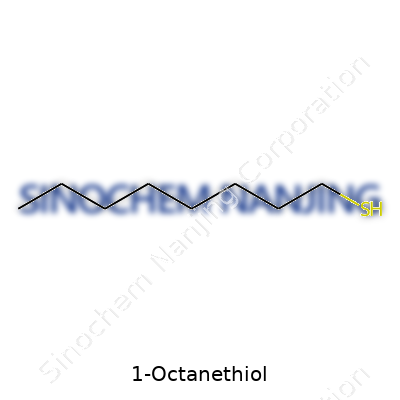
| Names | |
| Preferred IUPAC name | Octane-1-thiol |
| Other names |
1-Octyl mercaptan n-Octyl mercaptan n-Octanethiol Octyl mercaptan |
| Pronunciation | /ˈoʊk.teɪn.θaɪ.ɒl/ |
| Identifiers | |
| CAS Number | 111-88-6 |
| Beilstein Reference | 1821373 |
| ChEBI | CHEBI:38697 |
| ChEMBL | CHEMBL135334 |
| ChemSpider | 20442 |
| DrugBank | DB13888 |
| ECHA InfoCard | 100.009.436 |
| EC Number | 220-260-2 |
| Gmelin Reference | 70473 |
| KEGG | C12124 |
| MeSH | D008519 |
| PubChem CID | 8128 |
| RTECS number | RG2275000 |
| UNII | C389D41O1D |
| UN number | UN2371 |
| Properties | |
| Chemical formula | C8H18S |
| Molar mass | 146.28 g/mol |
| Appearance | Colorless to yellow liquid |
| Odor | Unpleasant, garlic-like |
| Density | 0.845 g/mL at 25 °C(lit.) |
| Solubility in water | Insoluble |
| log P | 4.39 |
| Vapor pressure | 0.045 mmHg (25°C) |
| Acidity (pKa) | 10.5 |
| Basicity (pKb) | pKb = 3.38 |
| Magnetic susceptibility (χ) | -73.0e-6 cm³/mol |
| Refractive index (nD) | nD 1.439 |
| Viscosity | 2.03 mPa·s (20 °C) |
| Dipole moment | 1.516 D |
| Thermochemistry | |
| Std molar entropy (S⦵298) | 481.9 J·mol⁻¹·K⁻¹ |
| Std enthalpy of formation (ΔfH⦵298) | -114.0 kJ/mol |
| Std enthalpy of combustion (ΔcH⦵298) | -5131.5 kJ/mol |
| Hazards | |
| GHS labelling | GHS02, GHS05, GHS06, GHS07, GHS09 |
| Pictograms | GHS06,GHS09 |
| Signal word | Warning |
| Hazard statements | H226, H302, H311, H314, H331, H410 |
| Precautionary statements | P210, P233, P240, P241, P242, P243, P261, P264, P271, P273, P280, P301+P310, P302+P352, P304+P340, P305+P351+P338, P312, P321, P330, P337+P313, P362+P364, P370+P378, P391, P403+P235, P405, P501 |
| Flash point | 97 °C |
| Autoignition temperature | 210 °C |
| Explosive limits | Explosive limits: 0.9–6.5% |
| Lethal dose or concentration | LD50 oral rat 2080 mg/kg |
| LD50 (median dose) | LD50 (median dose): Oral rat LD50 = 820 mg/kg |
| NIOSH | SN 84 |
| PEL (Permissible) | PEL: 0.5 ppm (Skin) |
| REL (Recommended) | 0.5 ppm |
| IDLH (Immediate danger) | IDLH: 100 ppm |
| Related compounds | |
| Related compounds |
1-Butanethiol 1-Hexanethiol 1-Decanethiol 1-Dodecanethiol Octanol |



