1-Nitronaphthalene: Exploring Its Journey, Properties, and Role in Modern Chemistry
Historical Development
Walking through the history of synthetic dyes, explosives, and certain pesticides, you often run into 1-nitronaphthalene. Chemists in the late 1800s started isolating nitro derivatives of naphthalene, mostly by accident when they pushed beyond benzene. These early discoveries found quick use—dyemakers and explosives researchers latched onto the chemical’s keen ability to supply active nitro groups. Factories in Europe began producing it on more than a lab scale well before the First World War, and its role just grew from there. Industrial syntheses grew cleaner during the twentieth century as companies looked for ways to cut costs and reduce dangerous byproducts. As industries shifted their focus to safety and cleaner processes, 1-nitronaphthalene continued to hold relevance both in research and production, keeping scientists busy looking for improved synthesis and modifications that would keep it competitive and sustainable.
Product Overview
1-Nitronaphthalene falls into a category many organic chemists know well: stable enough to ship, reactive enough for lots of downstream chemistry. Its signature pale-yellow appearance is common to many nitroaromatics, giving a visible cue to its presence in a working lab. It is favored for making intermediates found in dyes, certain agricultural chemicals, and even pharmaceutical scaffolds. Labs value its reliability; each batch is expected to deliver consistent performance, especially for more sensitive downstream reactions.
Physical & Chemical Properties
Known for its crystalline solid form, 1-nitronaphthalene brings a melting point hovering around 61°C and a boiling point reaching close to 304°C. It shows poor solubility in water, but proves much friendlier in solvents like ethanol, ether, and most hydrocarbons. The compound’s density rests at about 1.34 g/cm³. The molecule carries a nitro group at the first position of naphthalene, which pushes strong electron withdrawing character and makes a visible mark on its reactivity. Its intense yellow color and mild aromatic odor offer quick confirmation of purity or identify contaminants. In storage, it remains stable at room temperature, losing none of its punch even over several months unless exposed to intense light or heat, which can start to decompose it and release toxic fumes.
Technical Specifications & Labeling
Good labeling practices matter more for 1-nitronaphthalene than for plain old sodium chloride. Each bottle must list its purity—typically above 98% for research use—batch number, and verified absence of obvious nitro impurities that would interfere with intended syntheses. Safety data must be thorough. Labels often warn about respiratory risks, eye contact, and flammability, with globes, flames, and exclamation marks plastered in standardized ways. Even before you open a shipment, you should see hazard pictograms and first aid advice, a detail honed by decades of accidents and new safety requirements. Researchers and chemical handlers notice lot-to-lot consistency and use certificates of analysis to catch any problems before new batches hit the bench.
Preparation Method
You start with naphthalene and concentrated nitric acid, sometimes with sulfuric acid tossed in as a dehydrating agent. Keeping everything cool avoids runaway side reactions. Workers use batch or continuous reactors, controlling the exotherm with chillers and adding acid slowly. The mixture separates into organic and acid layers; 1-nitronaphthalene mostly sits in the organic fraction. Washing, neutralizing, and careful temperature management keep purity up and yield losses down. Recrystallization from alcohol or another suitable solvent finishes the job. On an industrial scale, every bit of heat, acid, and waste needs careful handling—closed systems, vent scrubbers, and redundant controls show up in any modern operation. Waste streams have to pass tough environmental controls, making real-world manufacture a balancing act between efficiency, safety, and compliance.
Chemical Reactions & Modifications
1-Nitronaphthalene’s reactivity grows out of that nitro group. You can reduce it straight to 1-aminonaphthalene with iron and acid or catalytic hydrogenation, and the amino version serves as a key dye intermediate. Nucleophilic substitutions work well on the ring, especially in the ortho or para spots relative to the nitro. People push further, making cyanoderivatives, sulfonic acids, or even fancier ring expansions when the project calls for originality. In the presence of strong bases or nucleophiles, the aromatic ring plays host to substitutions not always open in benzene analogs. Photochemical reduction can trigger more complex transformations, sparking new research ideas or practical synthetic routes for targeted products. Chemists still pore over its behavior for tweaks that might open pathways to green chemistry or higher-yield industrial syntheses.
Synonyms & Product Names
Industry professionals and catalogues have given 1-nitronaphthalene a long list of names through the years. Besides the main entry, “alpha-nitronaphthalene” and “1-nitro-naphthalene” both show up, especially in older texts. Some suppliers simply list it by its registry number or by trade names manipulated for branding. Scientists and workers call it out by whatever rolls off the tongue or whatever the project SOP dictates, but clear chemical identification always helps keep orders, inventory, and regulatory compliance in line. Mistaking this compound for others isn’t just a clerical problem; it can bring serious safety or legal headaches, especially in complex or multi-chemical workflows.
Safety & Operational Standards
Safety begins before the bottle ever reaches the bench. Beyond standard goggles and gloves, working with 1-nitronaphthalene often demands fume hoods, full-body coats, and respiratory protection when powder weighs get underway. Inhalation or skin contact brings proven risks—nosebleeds, respiratory trouble, and even methemoglobinemia if workplace controls break down. Modern safety protocols demand proper ventilation, spill control materials, and standardized first aid training. Storage out of heat, light, and oxidizers cuts risk. Workers learn routes of exposure, watch for early symptoms, and report any accidental splashes, which tend to get logged and investigated to prevent recurrence. All waste needs careful segregation and proper destruction, since regulators count this aromatic nitro compound as hazardous both to workers and to the environment. There are benchmarks for permissible exposure and disposal set by agencies like OSHA, REACH, and local equivalents, and companies perform regular audits and drills to keep on top of them.
Application Area
People seek 1-nitronaphthalene for its precision as a building block in dye synthesis, giving bright, stable colors that resist fading in sunlight or cleaning. Agricultural chemical synthesis pulls on this compound for specialty fungicides and pest-management tools. Pharmaceutical researchers appreciate its ability to serve as a launching pad for more elaborate multi-ring systems—antimalarials and certain experimental anticancer agents begin with naphthalene derivatives. Explosives chemists use the material as a precursor or additive, valuing its controlled reactivity for energetic materials with tailored detonation properties. Environmental scientists find it in legacy contaminated soils, giving new insights into persistence and transformation, and driving new approaches to soil and water remediation. Analytical chemists at regulatory agencies test for trace levels of 1-nitronaphthalene in consumer goods, industrial waste, and ambient environments to safeguard health and regulatory compliance.
Research & Development
Research on 1-nitronaphthalene pulls from both synthetic innovation and environmental stewardship. Scientists develop new catalysts to lower activation barriers, use greener solvents, chase cleaner yields, and shrink the environmental impact of each synthesis. Biotechnologists dip into microbial degradation, looking for ways to break the aromatic ring under mild conditions instead of harsh acids or bases. Analytical chemists refine faster, more sensitive detection methods in soil, water, and air. Universities use this compound as a case study for teaching fundamental aromatic chemistry, allowing students to explore classic nitro reductions, oxidations, and substitutions. Pharmaceutical startups explore derivatives for novel therapeutic use, pressing deeper into biological screening and structure-activity relationships. The push for sustainability nudges the field—calls grow louder for full life-cycle assessments and engineering tweaks to cut waste, energy use, and exposure risk while delivering essential materials to downstream industries.
Toxicity Research
Workplace and environmental exposures to 1-nitronaphthalene sparked decades of research into its toxicity. Animal studies found links to irritated respiratory tracts, blood disorders, and even modest liver or kidney stresses under chronic exposure; researchers saw methemoglobinemia appear—a classic sign of nitro aromatic absorption—especially in workers without proper controls. Short-term inhalation or ingestion at high levels can cause dizziness, headaches, nausea, or, for unlucky individuals, more serious systemic effects. Regulatory bodies set strict limits on air, water, and contact concentrations, as well as guidance for emergency responders and risk management teams. Ongoing studies track breakdown products, worry about persistence in soil and sediment, and prompt stricter reporting and mitigation rules. Research also explores genetic impacts, testing in vitro models for mutagenicity and other long-term effects since environmental persistence can turn even low-level exposures into chronic risks.
Future Prospects
Organizations continue to seek safer, cleaner synthetic routes not only for 1-nitronaphthalene itself but for its downstream use in dyes, pharmaceuticals, and crop treatments. Demand will keep shifting as industries pivot toward sustainability and regulatory change. Biodegradability and non-toxic breakdown products have become priorities, driving research from basic modification through green manufacturing pilot plants. The chemical’s predictable reactivity anchors it as a starting point for more advanced, tailored molecules needed for modern therapeutics or specialty materials, so basic research budgets keep the study of nitronaphthalene relevant. Widespread calls for transparency and product stewardship push companies to disclose more data, test alternatives, and emphasize circular chemistries. Real improvements will likely stem from advances in catalysis, new purification approaches, and breakthroughs in toxicological screening. Opportunities will favor chemists and engineers who keep environmental health and process innovation at the center of their work, building on the stable but reactive backbone that 1-nitronaphthalene presents.
What is 1-Nitronaphthalene used for?
What is 1-Nitronaphthalene?
1-Nitronaphthalene isn’t the sort of thing you come across while running everyday errands, but it’s been part of the industrial landscape for a long stretch. Chemically, it’s a bright yellow crystalline solid that comes from treating naphthalene with nitric acid. The roots trace back through the history of dye making and the chemical industry. The stuff signals both opportunity and caution at the same time.
Why Bother with 1-Nitronaphthalene?
One place 1-nitronaphthalene really stands out is in making dyes and pigments. Textile factories rely on all sorts of chemicals, but aromatic nitro compounds like this one supply the backbone for several synthetic colors. Many azo dyes—the sorts found in clothing, plastics, and sometimes in printing inks—start off from aromatic nitro compounds. I remember watching technicians at a plant handle the stuff with steady hands, turning raw chemical into batches of striking yellow, red, or orange colorants.
Beyond dyes, you find 1-nitronaphthalene acting as a building block for more advanced chemicals. The pharmaceutical industry leans on intermediates like this. Think about painkillers, fever reducers, or antihistamines—often, their creation involves reactions set off from simple nitroaromatics. It’s less flashy than the bright dyes but just as crucial behind the scenes.
Some Real Risks
Take a closer look at the safety sheets and the picture stops looking rosy. 1-Nitronaphthalene carries a reputation for being hazardous. Skin contact or inhaling dust can cause irritation. It’s even more serious if larger amounts enter the body, causing damage to blood cells and affecting the liver. I grew up around family members who worked in plants handling aromatic chemicals. They always talked about the importance of regular health checks and strict routines—showering before coming home, separate work clothes, gloves, masks. Not everyone in industry follows these habits, so health risks remain very real.
Environmental protection adds another layer. Wastewater from plants where nitroaromatics are produced or processed sometimes carries traces of these chemicals. Contamination concerns push stricter regulation. Local rivers and soil have sometimes borne the brunt in the past. Many companies invest heavily now in treatment systems, monitoring, and recycling to avoid repeating old mistakes.
Looking Ahead
Chemistry keeps moving, and research into safer alternatives grows every year. Green chemistry tries to shift focus onto fewer toxic or biodegradable compounds. At some factories, automation helps limit direct contact by workers, and newer containment methods keep leaks to a minimum. But as long as demand for synthetic dyes and certain medicines stays strong, facilities can’t fully step away from 1-nitronaphthalene yet.
Overall, 1-nitronaphthalene shows up where vivid color and specialized drugs begin their journey. That track record brings both achievement and responsibility. It matters that manufacturers put workers’ health and the environment on even footing with profits. The hope is that the next chapter of this chemical’s story cuts down the downside and keeps the useful parts shining bright.
What are the safety precautions when handling 1-Nitronaphthalene?
Why Pay Attention with 1-Nitronaphthalene?
1-Nitronaphthalene shows up in labs and industries for research, dye production, and chemical synthesis. Most folks won’t bump into it outside those environments, but if your job involves this chemical, keeping safe practices front-and-center isn’t optional. Inhaling its dust, getting it on your skin, or letting it splash in your eyes brings real health risks. Reports link it to skin irritation and likely organ damage with longer exposure. Once, during a lab training, I watched a colleague ignore basic glove checks and pay the price—skin redness and a trip to the health office. Even smart people can slip up when pressed for time.
Personal Gear and Clothing Make the Difference
Every time you face work with 1-nitronaphthalene, covering up is your first move. Proper chemical-resistant gloves—nitrile or neoprene work well—add a barrier between hands and anything leaking. Tight-fitting goggles save your eyes, while a good lab coat and long pants cover the rest. That reminder on shoe covers isn’t overkill. Open-toe shoes on the lab floor tend to lead to accidents.
Work in a Controlled Environment
Ventilation can’t be an afterthought. Prepping or transferring 1-nitronaphthalene inside a fume hood quickly reduces the chance you’ll breathe dust or vapors. Years ago, I ran a small experiment with poor ventilation, dismissing early warnings of slight odor. Days later, I learned about my mistake after developing a persistent cough. A well-functioning fume hood proves the biggest single layer of protection.
Mindful Handling Reduces Mistakes
No lab sprint goes smoothly. Most spills, splashes, or cloud formation comes from rushing or skimping on process. Scooping out fine powders should run slow and steady, with eyes level to the bench. Label every container clearly. I once witnessed a supervisor snag the wrong jar—labels faded and a chemical mix-up turned into a headache. Swapping out aged or faded labels every few months prevents painful confusion down the line.
Clean-Up and Storage Keep Hazards Contained
Immediate cleanup after use saves everyone future problems. Disposable towels, double-bagging waste, and wiping down benches keep residue in check. Store leftovers in tightly sealed, chemical-resistant bottles, stowed on low shelves away from strong acids or other reactives. More than one seasoned tech will share stories about accidental reactions from shelving neglect—what looks harmless can turn hazardous with the wrong neighbor on the shelf.
Emergency Steps: Better Prepared than Caught Off-Guard
Spills are rare with discipline, but not impossible. No one forgets the first time a bottle tips over. Emergency eyewash stations and showers should be clear, easy to reach, and kept working. Every workplace should regularly drill everyone on spill response. Knowing how to use spill control powder or how to don a respirator cuts panic and injury. Have contacts for local poison control and company health officers saved and visible. Quick thinking only works with quick access.
Continuous Training Sets the Standard
Lab safety doesn’t end with orientation. Upskilling and reminders, like annual safety courses or toolbox talks, push good habits into muscle memory. Sharing stories, even the embarrassing ones, turns written rules into actions people remember. Mistakes can teach sharp lessons, but regular practice and respect for chemicals like 1-nitronaphthalene keep everyone working, learning, and heading home safe every day.
What is the chemical formula of 1-Nitronaphthalene?
Understanding the Basics
1-Nitronaphthalene carries the chemical formula C10H7NO2. That’s one naphthalene ring holding onto a single nitro group. You’ve probably seen naphthalene show up in mothballs or as the backbone in dyes and other chemicals, so when that nitro group steps in, it changes the game. This little tweak turns it from a wardrobe anti-moth hero to an industrial player.
Real-World Applications Build Value
Chemists need precision, not confusion. Getting a formula right—C10H7NO2—can make or break a synthesis run. 1-Nitronaphthalene doesn’t just look good in a text book; it lands in labs and factories where dye intermediates and pesticides start their story. The accuracy of its formula keeps reactions predictable.
Safety and Environment: More Than Just Numbers
Knowing what you’ve got in your beaker is crucial. 1-Nitronaphthalene brings nitroaromatic chemistry to the table. That nitro group isn’t just for show—it packs energy, posing some risk if handled carelessly. Reports from the National Institute for Occupational Safety and Health (NIOSH) highlight respiratory and skin hazards, including risks of methemoglobinemia. I’ve worked around similar chemicals, and there’s no room for shortcuts with labeling or PPE. This detail matters—precision prevents accidents.
Connecting the Dots: Industry and Public Health
Big manufacturing setups rely on bulk chemicals like this one. The Environmental Protection Agency (EPA) keeps a watchful eye on 1-nitronaphthalene because of its persistence. Once it lands in soil or water, breakdown happens slow. This means folks beyond the factory gates want accountability.
Kids play outside, communities garden, and nobody wants hazardous leftovers sticking around. Years ago, living close to a chemical plant, I learned that people always remember the name of a spill—even if they can’t pronounce it. Responsible stewardship starts with correct information, from chemical formula to waste plans.
Supporting Facts and Lessons Learned
In 1989, the International Agency for Research on Cancer (IARC) listed 1-nitronaphthalene as not classifiable regarding carcinogenicity, but that doesn’t invite carelessness. Peer-reviewed journals describe how it metabolizes into reactive species. This provides another reminder: science stays in motion, and what’s ignored today might cause tomorrow’s problem.
Ways Forward
If industry wants trust, transparency helps. Clear labeling, updated safety data sheets, and strong community partnerships protect lives and reputations. Modern technology offers green chemistry pathways, cutting toxic byproducts before they exist. Companies carrying forward best practices on chemical handling lead by example, and that ripples far—workers take those habits home too.
At the end of the day, knowing the chemical formula, C10H7NO2, isn’t just a quiz answer. It’s a building block for progress, safety, and trust in the spaces where chemistry and community cross paths. The chemical world stays grounded when it keeps people and science on the same page.
How should 1-Nitronaphthalene be stored?
Looking At Risks Straight On
Walking into any chemistry lab, the sharp awareness of chemical storage never goes away. 1-Nitronaphthalene isn’t a chemical you leave on a shelf near open sunlight or a crowded supply closet. With its yellow, crystalline appearance, it may look harmless, but looks can mislead. This chemical packs toxic punch if mishandled, and exposure can sneak up through skin or inhalation. Add in its flammability, and the stakes rise even higher, both for lab workers and the greater environment.
Lessons From Experience: Containers and Temperature
I remember once in a university lab, someone tried storing a bottle of 1-nitronaphthalene with a cracked cap. What followed was a sharp, unpleasant odor spreading across the shelves, revealing the container’s slow leak. The lesson imprinted right away: use airtight, sturdy glass or HDPE containers, and check the seals twice. The wrong choice in caps, even a minor crack, creates headaches—literally. Keeping things sealed offers the simplest protection against both inhalation and environmental loss.
Heat speeds up decomposition and increases the risk of accident. I’ve seen thermometers in hazardous cabinets reading a few degrees too high after a hard summer, and the anxiety was noticeable until someone fixed the ventilation. Direct sun or warm rooms bring danger. A chemical like 1-nitronaphthalene wants cool temperatures, well below 30°C. Place it direct in a flammable-materials safety cabinet with a self-closing door. These cabinets aren’t optional add-ons; they separate disaster from daily work.
Weighing Out Incompatibilities
Forget about mixing this chemical with strong acids, oxidizers, or alkalis. Crossing those lines means risking violent reactions. Mixing chemicals is a rookie mistake that can ignite fires or release dangerous fumes. I keep a chart of chemical incompatibilities taped inside the cabinet for quick double-checks–that paper has prevented more than one close call over the years. Keeping 1-nitronaphthalene out of reach of incompatible substances isn’t a ceremonial guideline; it’s a survival habit.
Access Control Still Matters
Who gets access, who replaces labels, and who tracks bottle integrity? These questions eat up time, but every lapse can lead to dangerous exposure. Training matters as much as tech: staff should check labels with every use. If something looks off, that bottle gets quarantined, no questions asked. In one memorable case, a label faded until nobody could recognize the contents anymore. We disposed of it by the book instead of taking a chance.
Ventilation and Spills
A forgotten lesson crops up in many workplaces: never store 1-nitronaphthalene anywhere stuffy or crowded. Bottles live best in ventilated, fire-rated cabinets away from common traffic. One day, a minor bottle slip created a small spill, showing why absorbent pads, gloves, and ready-to-use containers should stay at arm’s reach. Cleaning becomes far less risky when supplies are close and protocols have been practiced, not merely learned from binders.
Building A Safer Routine
Every time I work near 1-nitronaphthalene, basic routines save the day: checking labels, using proper PPE, and keeping the storage space clean. Regular inspections catch the little things that might snowball into major trouble later on. Everyone—new hires or seasoned chemists—should pitch in, because safety with this chemical comes from a culture of constant, practical vigilance.
What are the potential health hazards of 1-Nitronaphthalene exposure?
Understanding 1-Nitronaphthalene
1-Nitronaphthalene turns up in the production of dyes and pigments. Industrial processes use it for chemical synthesis, and its presence in environmental samples often traces back to manufacturers using naphthalene as a raw material. People working around such chemicals tend to become aware of the risks through formal safety training, but regular news coverage rarely picks up stories about health effects tied to it.
Health Risks That Matter
Breathing in dust, fumes, or vapors from 1-nitronaphthalene causes a person’s eyes and throat to get irritated. Speaking from experience around older manufacturing facilities, that burning pinch in the eyes caught my attention long before reading any hazard sheet about the chemical. Workers exposed at high concentrations have reported nausea, headaches, and fatigue.
Long-term exposure creates problems deeper than a sore throat. Research published by the U.S. National Institute for Occupational Safety and Health links nitronaphthalene exposure to damaged red blood cells and potential organ effects, such as damage to the liver or kidneys. Studies using rodents, such as those from the National Toxicology Program, found an increase in tumors, which placed the compound under suspicion for cancer risk. Many lab techs I’ve spoken with constantly keep tabs on air monitoring results, trying to spot unsafe situations before they get worse.
Impact on Communities and Workers
People living near industrial plants may worry about chemical leaks, and 1-nitronaphthalene can drift into air or settle in soil. Regular environmental testing in communities near chemical plants has found traces in neighborhood soil and water. Once it enters the ecosystem, it can linger for months. Young kids, pregnant women, and older folks have the most to lose from continual exposure. Among former colleagues who lived close to plants, coughing fits and skin rashes often made them nervous about long-term health. These worries often get dismissed until the numbers start showing up in public health data.
Preventing and Reducing Hazards
Protective equipment like respirators, gloves, and goggles shield workers, but none of it replaces good ventilation or up-to-date engineering controls. Some manufacturers have installed closed-loop systems, making it harder for gas or vapor to escape. Plants with strong union oversight tend to invest more in automated handling and real-time exposure monitoring. Simple steps like washing hands and changing clothes after every shift work better than most warning signs hung in a break room.
For nearby residents, regular public reporting and honest disclosure matter a great deal. Community air quality programs, run independently from plant management, can spot issues before they become health emergencies. Local doctors, if trained to recognize chemical exposure symptoms, can help individuals get treatment faster. Information-sharing between factories and local health boards helps build trust, and when both sides speak honestly, more practical solutions surface.
Moving Forward
Learning from older industrial towns, it's clear that the strongest defense always mixes education, strict handling rules, and clear right-to-know policies. Advocates push for lower workplace exposure limits and investment in safer chemicals, while employers who respond quickly to community concerns end up with fewer sick days and lawsuits. As technology improves, monitoring gets easier, letting both management and workers find dangers before they turn serious. In the end, protecting people from 1-nitronaphthalene calls for practical steps and everyday vigilance—something that depends as much on workplace culture as on regulatory fines.
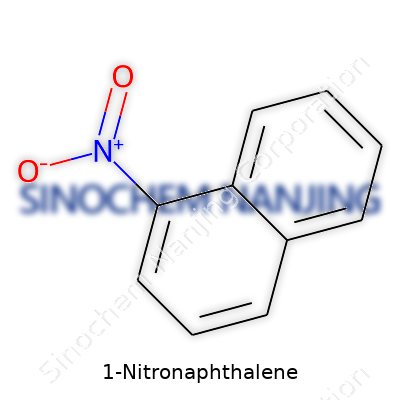
| Names | |
| Preferred IUPAC name | naphthalen-1-yl nitrite |
| Other names |
1-Naphthylnitrene 1-Nitronaphthalin alpha-Nitronaphthalene |
| Pronunciation | /waɪtˌroʊ.næfˈθæliːn/ |
| Identifiers | |
| CAS Number | 86-57-7 |
| Beilstein Reference | 805593 |
| ChEBI | CHEBI:16408 |
| ChEMBL | CHEMBL14161 |
| ChemSpider | 21106251 |
| DrugBank | DB01775 |
| ECHA InfoCard | 100.010.119 |
| EC Number | 202-713-4 |
| Gmelin Reference | 4078 |
| KEGG | C06580 |
| MeSH | D009652 |
| PubChem CID | 997 |
| RTECS number | QJ0525000 |
| UNII | 4332V8A2TI |
| UN number | 1665 |
| Properties | |
| Chemical formula | C10H7NO2 |
| Molar mass | 173.16 g/mol |
| Appearance | Yellow crystalline solid |
| Odor | aromatic |
| Density | 1.204 g/cm³ |
| Solubility in water | Insoluble |
| log P | 2.7 |
| Vapor pressure | 0.002 mmHg (25°C) |
| Acidity (pKa) | 15.80 |
| Basicity (pKb) | pKb = 10.65 |
| Magnetic susceptibility (χ) | -60.4·10⁻⁶ cm³/mol |
| Refractive index (nD) | 1.669 |
| Viscosity | 2.52 mPa·s (25 °C) |
| Dipole moment | 2.98 D |
| Thermochemistry | |
| Std molar entropy (S⦵298) | 181.6 J·mol⁻¹·K⁻¹ |
| Std enthalpy of formation (ΔfH⦵298) | 122.6 kJ/mol |
| Std enthalpy of combustion (ΔcH⦵298) | -5193 kJ/mol |
| Hazards | |
| Main hazards | Harmful if swallowed; causes skin and eye irritation; may cause respiratory irritation; suspected of causing genetic defects. |
| GHS labelling | GHS02, GHS07, GHS08 |
| Pictograms | GHS07 |
| Signal word | Danger |
| Hazard statements | H302, H315, H319, H335, H410 |
| Precautionary statements | P264, P270, P273, P280, P301+P312, P302+P352, P305+P351+P338, P308+P313, P501 |
| NFPA 704 (fire diamond) | 2-2-0 |
| Flash point | 104°C |
| Autoignition temperature | 464 °C |
| Explosive limits | 0.8–5.0% |
| Lethal dose or concentration | LD50 oral rat 470 mg/kg |
| LD50 (median dose) | LD50 (median dose): 470 mg/kg (oral, rat) |
| NIOSH | RN36700 |
| PEL (Permissible) | PEL = 1 ppm (parts per million) |
| REL (Recommended) | 0.05 |
| IDLH (Immediate danger) | 100 ppm |
| Related compounds | |
| Related compounds |
2-Nitronaphthalene Naphthalene Nitrobenzene |



