Understanding 1-Iodopropane: Past, Present, and Prospects
Historical Development
People who work in chemistry have often looked to simple building blocks for tools that open up new reactions and possibilities. The story of 1-iodopropane started over a century ago when scientists set out to modify molecules in a straightforward, reliable way. Early halogenated organics gave researchers handy reagents that let them shuffle around carbon skeletons or swap specific groups cleanly. Methods for making alkyl iodides, including 1-iodopropane, got a big boost in the late nineteenth and early twentieth centuries as lab glassware improved and chemical supply chains matured. These early chemists knew the value of an accessible alkyl halide, and years of tinkering cemented 1-iodopropane’s role as a practical intermediate. Today, scientists still lean on this compound to drive reactions that would be tough or tedious without a slick, reactive handle like iodine’s.
Product Overview
1-Iodopropane looks simple on paper: a three-carbon chain with an iodine atom at one end. It’s a colorless to pale yellow liquid with a smell that hints at both its organic roots and the distinctive presence of iodine. Companies offer it mainly as a lab reagent, sold from milliliter vials to industrial drums. The widespread availability and clear labeling make it a familiar face in university storerooms and chemical research labs alike. Having it on hand gives chemists a head start for any application needing a reactive alkyl source.
Physical & Chemical Properties
A bottle of 1-iodopropane sits in the cold, dense class of heavier alkyl halides. The iodine atom pulls significant weight, both literally and chemically. That makes the compound heavier than its chloro- and bromo-propane relatives, with a boiling point around 102-103°C and a density that feels almost syrupy in the hand. It mixes poorly with water but blends nicely into most organic solvents, from ether to benzene. The key feature comes down to the reactivity of the carbon-iodine bond. Iodine doesn’t just make the molecule heavy; it turns the propyl group into a willing partner for nucleophiles, acids, and other chemical guests, opening up the sort of transformations synthetic chemists count on. Stability isn’t a giveaway. Light and air can push 1-iodopropane into slow degradation, so sealed dark bottles always beat clear glass on open shelves.
Technical Specifications & Labeling
Quality control and trustworthy labeling matter a lot with chemicals like 1-iodopropane. Impurities can mess up delicate lab reactions or introduce risk. Reliable suppliers highlight purity levels, most often above 98%, and flag any stabilizers or additives in plain language. A good label will state the CAS number, show the structural formula, and spell out basic hazards—flammability, health effects, and what gear protects best. Labels count for more than compliance. Anyone reaching for the bottle should grasp both what’s inside and how best to handle it without surprises. That sort of attention to documentation and real-world risk follows the E-E-A-T principles that guide strong operational practice: experience, expertise, authority, and trust shine brightest in details like these.
Preparation Method
Tradition and practicality shape how labs make 1-iodopropane. Classic routes include heating 1-propanol with red phosphorus and iodine, or running a Finkelstein reaction where 1-bromopropane meets sodium iodide in acetone. Lab veterans respect these reactions for their directness and predictability. These approaches deliver a clean product with basic glassware and reagents, provided care is taken to keep water away and control heat. The reaction often gives a telltale aroma and heavy, oily product layer. More modern process tweaks focus on greening up the steps, reducing phosphorus waste or swapping out harsh solvents while keeping yields high enough for commercial viability.
Chemical Reactions & Modifications
Anyone who’s studied a semester of organic chemistry sees 1-iodopropane as more than a bottle on the shelf—it’s an invitation to rearrange, swap, or graft on new groups. That labile iodine atom turns 1-iodopropane into a potent alkylating agent, supporting nucleophilic substitution (SN2) reactions that swap out iodine for amines, thiols, cyanides, and more. Cross-coupling opens even more doors: with a bit of catalytic palladium and the right ligands, it can join aryls or alkynes to build up complex scaffolds for pharmaceuticals or advanced materials. Reductive elimination, elimination to alkenes, and displacement for chain extensions all enter the workflow with this molecule on hand. Beyond textbook transformations, 1-iodopropane fits real research when a chemist wants to introduce a straight-chain propyl group with minimal fuss.
Synonyms & Product Names
Over the years, chemists have juggled a handful of names for this compound. The label might read n-propyl iodide, 1-propyl iodide, or even just propyl iodide in older texts. The systematic name, 1-iodopropane, cuts through confusion and clarifies that iodine sits at the primary carbon. Most suppliers stick with straightforward terminology and highlight unique identifiers like the CAS registration, cutting down the mix-up risk in busy storerooms or crowded order lists.
Safety & Operational Standards
Handling 1-iodopropane means facing both acute risks and longer-term hazards. It doesn’t ignite as easily as some solvents but vapors still catch flame with enough spark. Breathing, skin contact, or spills introduce toxicity concerns that have been catalogued in regulatory reviews and lab safety manuals. Good lab stewardship means eye protection, gloves (nitrile holds up best), and working with solid ventilation or closed systems to keep fumes out of personal breathing space. Storage calls for sealed, dark bottles in a flammables cabinet. Disposal rarely gets casual: professionals collect and process halogenated waste under category-specific guidelines because iodine can be particularly challenging for municipal wastewater systems. Staff who work with such chemicals rely on well-run training programs, up-to-date safety data sheets, and routine checks on storage and labeling. These habits don’t happen by accident; they come from a culture built on consistency, accountability, and respect for both molecule and human life.
Application Area
Research chemists value 1-iodopropane for the way it speeds up synthesis. It’s a workhorse in alkylation, helping to build pharmaceuticals, dyes, custom polymers, and surface modifiers. Medicinal chemists introduce propyl groups to change drug properties like absorption and solubility. Material scientists graft it onto surfaces to adjust wetting, adhesion, or catalytic activity. In tracer studies, radioactive iodine versions let researchers follow reaction paths or target tissues in imaging applications. The diversity reflects a simple truth: a well-behaved alkyl iodide opens doors from bench chemistry to industry, wherever chemists need reliable carbon chain extensions.
Research & Development
Academic groups and corporate labs keep finding creative ways to use and improve 1-iodopropane. Green chemistry stands out as a driving force, with teams working to swap out hazardous solvents and make the iodine swap with safer, recyclable materials. Pharma and agrochemical research leans on the simplicity of its reactivity, building new libraries of molecules for testing and patenting. On the educational side, students get early hands-on experience in nucleophilic substitution using 1-iodopropane, learning not just a reaction, but broader lessons about lab practice, error prevention, and the subtle risks that come with each step. Peer-reviewed studies in the last decade have also investigated alternative iodine sources and routes, keeping the chemistry efficient and reducing waste, heat input, and environmental load. Curiosity and regulatory pushback motivate much of this research. The best advances have shown that a small molecule can keep evolving through smarter applications and sharper ethical focus.
Toxicity Research
Data on the risks of 1-iodopropane continues to grow. Short-term exposure usually brings out respiratory and skin irritation. Chronic exposure can lead to thyroid effects, as organic iodides alter iodine balance in the body. Inhalation or ingestion, even small-scale, is best avoided because iodine’s heavy atom makes metabolism tough on the liver and kidneys. Studies in animals point out neurotoxicity risks at higher doses, and many lab handbooks stress double-checking protective protocols before each use. Regulators note that although acute harm is rare with careful use, exposures that stack up across weeks or months raise legitimate concerns. All this evidence comes down to a shared principle: handle it with respect, and use established engineering controls and PPE as part of a routine, not as backup after a near-miss. Open dialogue around incidents brings more accountability and smooths out safety blind spots before anyone gets hurt.
Future Prospects
The chemistry community keeps pushing toward cleaner, safer, and more efficient processes without giving up on proven building blocks like 1-iodopropane. As industries face tighter environmental rules around emissions and halogenated waste, synthetic chemists look for new catalysts or alternate iodine suppliers that slash the environmental burden. Startups explore flow chemistry and automation to scale up reactions while keeping human exposure and waste down. Some research groups are publishing results on closed-loop iodine recovery, reducing both cost and risk of raw material shortages. On the educational side, more training puts safety and green alternatives front and center, seeding a culture change in the next cohort of lab workers. All these changes point to a future where useful yet hazardous compounds find their place in a thoughtful, conscious laboratory. Progress depends on not just new discoveries, but clear-eyed recognition of both opportunity and risk, balanced by experience, teamwork, and a willingness to adapt as science and society shift.
What is 1-Iodopropane used for?
A Key Ingredient in Organic Chemistry
1-Iodopropane often plays a role in the lab that many overlook. This clear, colorless liquid isn’t exactly a household name, but in scientific circles, it has real value. If you think back to that one chemistry set, packed with vials and mysterious powders, 1-iodopropane isn’t far removed. It steps in as a building block, helping to create more complex molecules.
I’ve seen it show up in college labs and research settings, particularly in organic synthesis. Researchers use it for what’s called alkylation. Imagine wanting to swap out part of a molecule to make something entirely fresh. 1-Iodopropane shares its iodine atom, allowing the molecule to morph into something new. This leads to making drugs, agrochemicals, and dyes — fields that touch our daily lives, whether in medicine, food production, or the clothes we wear.
The Role in Pharmaceuticals and Research
The pharmaceutical world leans heavily on compounds like this. In the search for new medicines, researchers constantly need chemical tools to connect atoms in a precise way. 1-Iodopropane offers a handy handle for scientists to grab onto. Its reactivity lets teams design molecules with targeted functions, critical in drug discovery.
In research, it also works as a reference or standard. Many analytical techniques rely on something consistent to calibrate their instruments, and 1-iodopropane can fill that need. Consistency matters, especially when accuracy creates the difference between a failed and a groundbreaking experiment.
Behind-the-Scenes in Agrochemicals and Dyes
Chemistry forms the backbone of how modern agriculture and textile manufacturing evolve. Farmers use pesticides developed through the help of reagents like 1-iodopropane. Plant protection depends on molecules that can withstand sunlight, rain, and pests. Scientists often reach for 1-iodopropane during the multi-step process involved in making these molecules tough yet safe for the environment.
Dye manufacturing also relies on organic chemistry basics. Developing colors that last on fabrics or resist washing out in sunlight requires innovative chemistry. 1-Iodopropane often gets involved in building the color molecules that make your favorite blue jeans stay blue, or your sports jersey look sharp season after season.
Handling and Health Considerations
Like with many potent reagents, careful handling makes a difference. I remember learning how to use a fume hood for volatile organoiodine compounds, and that lesson stuck. 1-Iodopropane can irritate skin, eyes, and the respiratory system, and long-term exposure brings its own worries. Anyone using it must know how to store and dispose of it safely, with gloves and goggles as standard gear.
Possible Solutions and Looking Ahead
One challenge today involves minimizing potential health and environmental risks while still taking advantage of what 1-iodopropane enables in the lab. Green chemistry approaches look for alternatives that work just as well but pose fewer hazards. Some teams now use milder reagents or design processes that use less toxic solvents. Training makes a difference; the more that lab workers know about handling these chemicals safely, the better the outcomes for both science and health.
1-Iodopropane isn’t likely to land on a grocery store shelf, but it underpins advances that matter across medicine, agriculture, and industry. It reminds me how something almost invisible to the public can quietly help shape breakthroughs we all depend on.
What are the safety precautions for handling 1-Iodopropane?
Why Proper Handling Matters
I’ve spent most of my lab time around organic solvents, and 1-iodopropane stands out for a few reasons. It doesn’t show up in your high school chemistry class, but it plays a serious role in research, manufacturing, and analytical chemistry. With its strong smell and volatility, this compound grabs your attention right away. Those who ignore the warning signs usually learn pretty fast—some messes leave stains, but poor safety practices here can leave damage that’s harder to fix.
Ventilation Sets the Tone
I learned early on that skipping a fume hood is a rookie mistake. 1-Iodopropane evaporates fast, filling the air with vapors that irritate eyes, nose, and lungs. Even brief exposure makes you wish you hadn’t been so casual. Studies show repeated vapor contact can trigger headaches and sore throats, and prolonged exposure increases risks for more serious health issues. Lab-grade ventilation is the way to go. Open windows won’t give enough air flow or dilution for these vapors. I always check the fume hood sash and airflow gauge before uncapping the bottle, so I don’t turn a routine procedure into a medical event.
Choosing the Right Personal Gear
Nitrile gloves are my top pick, since latex tends to let halides slip through. Face shields or snug goggles stop splashes from hitting sensitive spots—a single drop in the eye hurts more than you’d think. I wear a lab coat with tight cuffs so sleeves don’t creep up, and long pants tucked into shoes without mesh. These basics block most direct skin contact, which is essential since 1-iodopropane burns and causes dermatitis after even short exposure.
Reducing Spills and Splash Risks
One thing I’ve come to respect is planning the workflow before popping the cap. This means securing containers right on the work surface—no balancing chemical flasks on a stack of paper towels. Pouring slowly and using a pipette for small volumes avoids splashing. If something spills, absorbent pads and sodium thiosulfate solution help with cleanup, neutralizing small spots before they spread. Bigger spills call for calling in safety teams rather than heroics; nobody should try to fix a large mess alone with shop towels and hope.
Storing Away from Heat and Light
Simple habits save more hassles than any fancy gadget. I keep 1-iodopropane stored in a tight, labeled container, stashed in a flammables cabinet with other halogenated reagents. High heat speeds up vapors, so I never keep these bottles near hot plates, radiators, or direct sun. Exposure to light also breaks down the compound, adding extra risks both to purity and personal safety. Shelves should be low to the ground; high storage means one accidental slip could send a bottle crashing straight down and making a mess impossible to forget.
Disposal Shouldn’t Be an Afterthought
Pouring leftovers down the drain causes more trouble than people realize. 1-Iodopropane doesn’t just disappear; it builds up in sewage, damaging pipes and turning up as hazardous waste. Proper disposal means collecting waste in marked bottles, handing them over to chemical management for incineration. This reduces both personal risks and keeps water systems clear of contamination. I always double check regulations, since laws can shift, but environmental safety rarely follows shortcuts.
A Few Steps Go a Long Way
No matter how familiar any chemist gets with these chemicals, treating 1-iodopropane with anything less than full attention only brings regret. I keep my safety glasses close, double check my workspace, and go through the steps calmly and carefully. Safety isn’t about fear; it’s about making sure every project ends as well as it starts—for health, data, and peace of mind.
What is the chemical formula of 1-Iodopropane?
Getting to Know 1-Iodopropane
Chemistry isn’t just about formulas on a chalkboard. Every compound on the shelf tells its own story. Take 1-iodopropane, for example. You’ll see its formula written as C3H7I. That translates to three carbon atoms, seven hydrogens, and one iodine atom coming together in a lineup that turns heads in a lab. For people working in organic chemistry, recognizing that cluster of atoms isn’t just a trivia point, it can mean the difference between a successful reaction and a wasted afternoon.
Why C3H7I Matters in the Lab
Back in college, I spent hours watching clear liquids change to oily layers just from swapping a bromine for an iodine. Alkyl halides like this one carry their own set of quirks. The bigger, heavier iodine attached to the carbon chain in 1-iodopropane turns it into a precision tool for organic synthesis. That bulky iodine isn’t shy—it leaves easily during reactions and makes the compound a go-to choice in substitution work. For anyone building carbon-carbon bonds, that trait saves time, resources, and frustration.
Sourcing and Safety in the Real World
C3H7I might not turn up on kitchen shelves, but it shows up where controlled reactions demand a reliable starting material. Industries and research labs rely on its consistency and high reactivity. The story changes fast if someone skips the gloves or ventilation, though. Iodine compounds bring toxic risks, which is why careful storage and solid training matter. Teams emphasize handling protocols to prevent skin and lung irritation that can land someone in the ER.
Beyond the Lab Bench
Tech and pharma companies can’t afford to cut corners with their reagents. For one, keeping up with safety regulations means tracking every gram of C3H7I. Colleagues of mine in manufacturing keep detailed logs. A missed entry can cost more than money—it can stall a drug trial or raise flags with regulators. Such oversight keeps dangerous spills and exposures off the news.
Exploring Greener Alternatives
Some research groups try to swap out compounds like 1-iodopropane for greener or less hazardous alternatives. The challenge isn’t just about replacing iodine; it’s about finding another molecule that reacts as predictably. Early experiments with milder or bio-based alkylating agents often fall short. Progress takes solid funding and plenty of trial and error, but the potential pay-off is big. Less toxic waste, safer workspaces, and cleaner production pipelines all start with the search for new chemistry.
Reliable Data Builds Trust
From textbooks to trade magazines, you’ll see C3H7I listed as the formula for 1-iodopropane. This isn’t just book knowledge—regulatory bodies, chemical suppliers, and researchers cross-check it before placing million-dollar orders. Good data leads to strong science, and that ripples out to medicine, energy, and green tech. Sharing accurate chemical info lets everyone from classroom students to industry leaders speak the same language and build on proven ground.
How should 1-Iodopropane be stored?
Getting Real about Chemical Storage
Working in a lab, you start to realize the everyday details that matter most. Take 1-Iodopropane, for instance. Some folks might think it’s just another bottle sitting on the shelf, but anyone who's worked around halides will tell you: mistakes can cost you your health or your project. This compound, with its halogen tag, carries risks that go beyond minor irritation or a bad smell.
Recognizing the Hazards
1-Iodopropane isn't water or kitchen vinegar. This liquid is flammable and releases vapors that hurt eyes, skin, and your lungs. Small leaks in storage or sloppy habits can easily spiral into big problems. Inhalation causes dizziness or headaches, spills chew up gloves if you don’t choose the right kind, and contact with air or moisture might cause degradation. Knowing those realities, I treat each step with care, not paranoia, just respect for the facts.
Thinking Through Container Choices
For storage, I skip plastics that can break down; 1-Iodopropane sees right through weak barriers. Amber glass bottles with a solid, non-reactive cap–that’s my go-to. The color isn’t just for style. It shields the liquid from light, which the chemical doesn’t appreciate. Too much light or heat, and you may end up with a mess you didn’t intend, or worse, a container ready to pop. Sealing the bottle tightly counts too. Those vapors are persistent; a loose cap won’t just stink up the place, it invites contamination, which throws off experiments.
Location Sets the Tone
Shoving the bottle into a random cabinet invites disaster. I place my 1-Iodopropane in a cool, dry, and shady spot, well away from doorways or sunlight. Refrigeration isn’t always mandatory, but room temperature spikes above 25°C shouldn’t be ignored if stability matters. Avoid chemical neighbors that like to ignite or spark; strong acids, bases, or oxidizers can trigger trouble if bottles leak.
Ventilation: Breathing Room for Chemicals and People
Anyone who’s worked in a badly ventilated room knows the feeling—nausea comes on quick. I always keep 1-Iodopropane in a fume hood or in a flammable chemical storage cabinet with built-in venting. Even with labeling, you catch whiffs if storage lapses. Poor airflow risks not just your comfort but chronic exposure harm.
Labeling and Accountability
Sloppy handwriting or faded labels create confusion. I use clear, typed labels, marked with contents, date received, and any hazard symbols. If the storage area is shared, a visible inventory chart helps avoid double storage or misplacement. That kind of transparency cuts down on wasted time and frantic searches.
Solving Persistent Problems
No system stays perfect. If I notice grit or color change in the bottle, I don’t ignore it–I bring it to a supervisor. Hazardous waste routines matter; pouring leftovers down a drain is lazy, not efficient. Following the lab’s disposal process keeps colleagues and the environment safe.
What Works: Experience Matters
I’ve seen some wild storage habits, but careful work pays off. Companies like Sigma-Aldrich, and data from the National Institute for Occupational Safety and Health, spell out similar steps. They don’t just make up rules; it comes from incidents and lessons learned. Safe storage of 1-Iodopropane isn’t a bonus feature, but a basic responsibility. In my experience, when a routine is easy to follow, folks stick with it and accidents become rare stories, not daily reality.
What are the physical properties of 1-Iodopropane?
Understanding a Common Organic Compound
1-Iodopropane pops up in labs and classrooms where folks deal with organic chemistry. It forms part of the alkyl halide family, meaning it carries an iodine atom attached to a straight-chain hydrocarbon. People call it n-propyl iodide too, especially in older textbooks.
Appearance and State
The first thing anyone notices about pure 1-iodopropane is its clear, colorless to slightly yellowish liquid look. Its hue may darken over time, especially if someone leaves the bottle uncapped in a bright room. This isn’t just a head-scratcher for curious students—real changes hint at decomposing or oxidizing processes, which matter in chemical storage.
Boiling and Melting Points
Watch the thermometer during distillation, and you see 1-iodopropane boil at about 102 degrees Celsius under standard pressure. Compared to its cousin, 1-chloropropane, it boils at a much lower temperature due to the lighter atom (chlorine versus iodine). The melting point sits near -101 degrees Celsius, making it hard to find the stuff in solid form unless you’ve got a serious lab freezer.
Density and Molecular Weight
A small flask filled with 1-iodopropane comes out heavier than you might expect. I’ve seen technicians nearly spill samples because the density tricks you. The value hovers around 1.744 grams per cubic centimeter at room temperature. The molecular weight—about 169 grams per mole—means anyone handling it gets a sense of working with a molecule where a big, heavy atom dominates.
Solubility and Odor
Try mixing it with water, and you get that familiar separation of oil and water. It doesn’t dissolve in water, but it blends well with organic solvents like ethanol, ether, and chloroform. The odor is sharp and might remind folks of related alkyl halides—almost a sweet, chemical note that sticks in your nose if you linger over an open bottle.
Reactivity and Storage
Anyone who’s worked with this chemical knows it doesn’t just sit quietly on a shelf. It reacts strongly with nucleophiles, making it popular in laboratory reactions that swap out the iodine for something else. That reactivity stems from the weak carbon-iodine bond, which breaks apart more easily than in similar compounds with fluorine or chlorine. To keep 1-iodopropane from turning into something you didn’t ask for, dark glass bottles and a cool, dry cupboard work best.
Safety Points
Folks in the shop or the classroom can’t ignore safety. 1-Iodopropane can irritate skin and lungs if spilled or vaporized, so gloves and goggles become a habit. Good ventilation cuts the risk of breathing in the fumes. I’ve seen even seasoned chemists step back after catching a whiff.
Significance in Research and Industry
Why do scientists and manufacturers keep bottles of 1-iodopropane? It takes part in making pharmaceuticals, pesticides, and specialty chemicals through nucleophilic substitution reactions. It shows up on the bench often enough that understanding its properties feels like basic chemistry literacy.
Improving Handling Experiences
Teaching proper storage—low temperatures, opaque bottles, clear labeling—makes a difference. Encouraging regular checks for discoloration or leaky caps helps avoid waste and keeps everyone safer. Simple habits like double-checking the odor and keeping detailed records mean fewer surprises down the road.
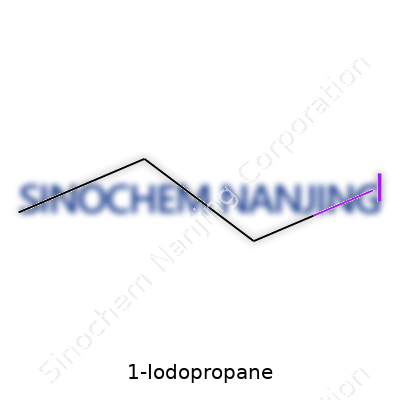
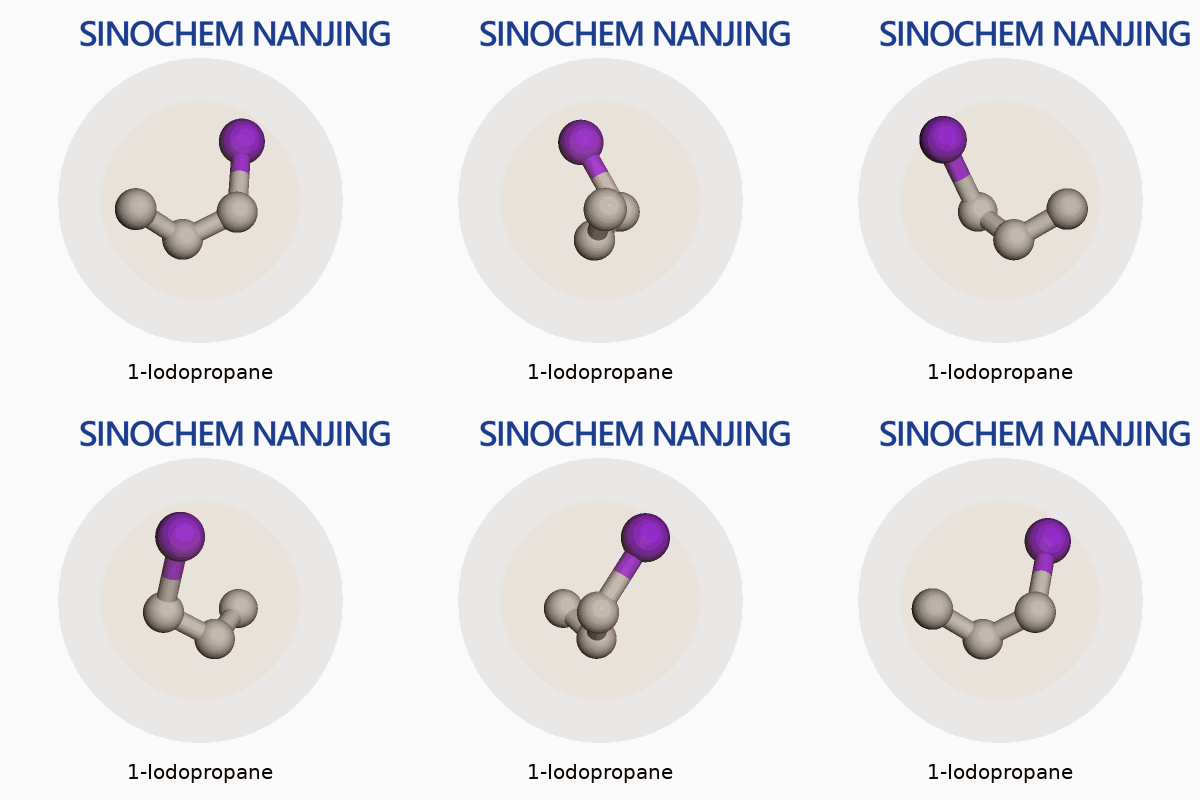
| Names | |
| Preferred IUPAC name | 1-iodopropane |
| Other names |
n-Propyl iodide 1-Propyl iodide 1-Iodopropane Propyl iodide |
| Pronunciation | /ˌwʌn.aɪˌoʊdəˈproʊpeɪn/ |
| Identifiers | |
| CAS Number | 107-08-4 |
| Beilstein Reference | 3580675 |
| ChEBI | CHEBI:35906 |
| ChEMBL | CHEMBL15441 |
| ChemSpider | 15700 |
| DrugBank | DB11137 |
| ECHA InfoCard | DTXSID0036474 |
| EC Number | 603-027-00-5 |
| Gmelin Reference | 8226 |
| KEGG | C08319 |
| MeSH | D017547 |
| PubChem CID | 6366 |
| RTECS number | UJ1050000 |
| UNII | TYL03F7KA4 |
| UN number | UN1272 |
| Properties | |
| Chemical formula | C3H7I |
| Molar mass | 184.02 g/mol |
| Appearance | Colorless to pale yellow liquid |
| Odor | Sweet odor |
| Density | 1.747 g/mL at 25 °C |
| Solubility in water | slightly soluble |
| log P | 2.3 |
| Vapor pressure | 3.3 mmHg (20 °C) |
| Acidity (pKa) | **16.0** |
| Basicity (pKb) | pKb: 13.6 |
| Magnetic susceptibility (χ) | -69.0e-6 cm³/mol |
| Refractive index (nD) | 1.439 |
| Viscosity | 2.38 mPa·s (25 °C) |
| Dipole moment | 2.05 D |
| Thermochemistry | |
| Std molar entropy (S⦵298) | 322.6 J·mol⁻¹·K⁻¹ |
| Std enthalpy of formation (ΔfH⦵298) | −23.5 kJ·mol⁻¹ |
| Std enthalpy of combustion (ΔcH⦵298) | –2113 kJ·mol⁻¹ |
| Hazards | |
| GHS labelling | GHS02, GHS07 |
| Pictograms | GHS02,GHS07 |
| Signal word | Danger |
| Hazard statements | H225, H302, H312, H315, H319, H332 |
| Precautionary statements | P210, P280, P301+P312, P305+P351+P338, P337+P313 |
| NFPA 704 (fire diamond) | 1-1-0-W |
| Flash point | 56 °F |
| Autoignition temperature | 465 °C |
| Explosive limits | Explosive limits: 2–10% |
| Lethal dose or concentration | LD50 (oral, rat): 1800 mg/kg |
| LD50 (median dose) | LD50 (median dose): Oral rat LD50 2,000 mg/kg |
| NIOSH | RX8575000 |
| PEL (Permissible) | PEL (Permissible Exposure Limit) of 1-Iodopropane: "Not established |
| IDLH (Immediate danger) | No IDLH established. |
| Related compounds | |
| Related compounds |
1-Bromopropane 1-Chloropropane 1-Fluoropropane 2-Iodopropane Iodopropane Propyl iodide |



