1-Iodopentane: More Than Just a Halide
Historical Development
Chemists have been tinkering with haloalkanes like 1-iodopentane since the early days of organic synthesis. The basic idea isn’t complicated: swap a hydrogen atom on a simple alkane for an iodine atom, and suddenly the molecule plays by a whole new set of rules. I remember flipping through textbooks from the twentieth century, where researchers stared down this colorless, oily liquid, surprised at how easily the iodine atom could be switched for all sorts of other chemical groups. As laboratories scaled up synthesis through the industrial boom, new techniques made 1-iodopentane more accessible. Early work relied on tricky, sometimes dangerous methods with phosphorus triiodide, but things got a bit more practical with the use of safer, more selective reagents. In a sense, the story of 1-iodopentane runs right alongside the story of organic chemistry itself: a march from clunky glassware and trial-and-error to carefully tuned modern procedures that deliver high purity and reliable yields.
Product Overview
1-Iodopentane might look unassuming to the untrained eye, but it's one of those chemicals that shows up in many corners of the lab. Once you’ve seen it in action, you realize it’s a kind of Swiss Army knife for synthetic organic chemistry. If I walk through any lab focused on pharmaceutical or agrochemical research, chances are good there’s a bottle of this compound tucked away on the reagent shelf. Its value comes from being a straight-chain primary alkyl iodide, which makes it much more reactive in substitution reactions than the more common bromides and chlorides. I’ve fixed my share of stubborn chemical syntheses by swapping a less reactive halide for 1-iodopentane and watched transformations that just wouldn't budge suddenly take off with hardly any fuss.
Physical & Chemical Properties
This chemical comes as a clear, oily liquid with a mild odor that reminds you of the sea. It boils at about 157-158 degrees Celsius and clocks in at a density just above 1.5 grams per cubic centimeter at room temperature. Iodine, being a heavy atom, gives it real heft in the flask. It doesn’t mix well with water, but throw it in with most organic solvents and it dissolves right in. If you run NMR or mass spec on it, the signals practically jump out at you thanks to that big iodine atom. Chemically, it’s quite reactive—exactly what you want for building carbon chains or swapping out the iodine for more exotic groups. That reactivity means lab techs keep the bottles tightly capped and stored away from heat or sunlight, since the compound can slowly degrade, releasing iodine over time and turning yellow.
Technical Specifications & Labeling
Labeling needs to be clear and direct. The CAS number most researchers quote runs as a kind of shorthand: anyone searching catalogs or scientific databases uses it to avoid mistakes. Purity usually lands above 98 percent for serious synthetic work, since side impurities can mess up downstream reactions. Bottles typically include hazard pictograms, warning about the compound’s irritant properties and proper storage instructions—dark, cool cabinets far from direct sunlight. I have seen accidents where sloppy labeling led to mix-ups, so keeping everything crystal clear not only meets regulations, it prevents headaches and lost time trying to sort out contaminated batches.
Preparation Method
Making 1-iodopentane doesn’t call for fancy tricks, but a steady hand and respect for chemistry’s unpredictable side. Most routes take 1-pentanol and hit it with a source of iodide—often using red phosphorus and iodine, which together generate phosphorus triiodide on the fly, or switching to newer methods that reduce the danger by swapping phosphorus for milder catalysts. The reaction is exothermic, so it’s smart to plan plenty of cooling and gentle stirring. After the reaction, chemists separate the organic phase and run it through careful distillation. Purification cuts down on residual starting material, unreacted iodine, or side-products. Every synthetic chemist's nightmare is finding traces of phosphorus impurities at a late stage, but modern purification techniques like flash chromatography or washing with sodium thiosulfate handle that risk well enough.
Chemical Reactions & Modifications
1-Iodopentane plays a starring role in "nucleophilic substitution," a classic classroom demonstration that also drives high-value industrial reactions. The iodine atom doesn't hang on tightly to the carbon chain, so it practically begs for strong nucleophiles—think azide, cyanide, or alkoxide ions—to swoop in and swap places. I’ve seen colleagues use it to prep amines, thioethers, or nitriles in just a couple of straightforward steps. Grignard reagents form easily when magnesium metal meets 1-iodopentane in dry ether, generating a powerful carbon nucleophile ready for all sorts of transformations. This flexibility means organic chemists can construct long, complex molecules from simple building blocks, and the straightforward substitution chemistry has turned 1-iodopentane into a foundation for countless synthetic routes.
Synonyms & Product Names
I’ve come across several names for this compound in literature and catalogs. Sometimes it’s called n-pentyl iodide, pentyl iodide, or just straight 1-IP among chemists in a rush. Each name points back to the same simple structure—a five-carbon chain ending in iodine. This tangled naming system can frustrate new students, but learning the synonyms helps avoid costly mix-ups, especially when searching through multinational databases or ordering chemicals from distributors around the world.
Safety & Operational Standards
No use pretending: 1-iodopentane calls for basic but important safety steps. Its volatility means well-ventilated hoods are a must, since inhaling the fumes over long periods can irritate sensitive airways. Gloves hold up well against casual splashes, but the oily residue lingers—so frequent changes and good hand-washing habits keep contamination in check. Like many iodides, it can stain skin and clothing, and accidental spills can spread the smell of iodine throughout the lab. Waste gets collected separately and sent to specialist disposal companies under guidelines set out by regulatory bodies in the US, Europe, and Asia. Reviewing local chemical hygiene plans before use prevents surprises.
Application Area
Anyone making new molecules in a research setting knows the value of 1-iodopentane for straightforward carbon–carbon bond formation. Medicinal chemists turn to it for quickly building side chains in drug development programs, where time and flexibility matter. Agrochemical testing facilities rely on it for attaching functional groups that tweak physical properties or soil mobility. Some polymer chemists dip into the supply for adding chain-terminating groups with predictable reactivity. Even the world of materials science takes advantage by tacking it onto larger frameworks, adjusting solubility or reactivity with a single chemical transformation. I’ve seen it pop up in bespoke synthetic routes, where off-the-shelf chemicals can’t quite do the job and the customizable iodine anchor offers a way forward.
Research & Development
Researchers spend countless hours looking for better, safer, or more environmentally friendly methods to prepare and use 1-iodopentane. Over the years, new catalytic approaches and greener iodide sources have chipped away at waste streams, boosting atom economy and easing purification headaches. High-throughput experimentation relies on reliable starting compounds like this for quickly testing synthetic pathways. I've watched a colleague automate a reaction screen involving dozens of alkyl iodides, showing how accessibility and reactivity of 1-iodopentane open up data-driven optimization that would have been unthinkable in earlier decades. Making greener synthetic protocols remains at the front of the conversation because waste from heavy halides and hazardous phosphorus reagents adds up quickly. Finding ways to use water as a solvent, cut down on by-products, or recover starting materials all get tackled in academic and corporate research programs every year.
Toxicity Research
Studies on the health effects of 1-iodopentane point to acute irritation as the main concern for laboratory use. Prolonged exposure—especially through skin or inhalation—has caused concern about effects on thyroid function, given iodine’s central role in hormone regulation. Animal studies suggest moderate toxicity if ingested, and the compound remains on watch lists for strict handling procedures. Mutagenicity and carcinogenicity have not been conclusively associated with this compound in the concentrations typically used in research, but every safety data sheet stresses the need for gloves, goggles, and good fume hood practices. Avoiding unnecessary contact makes sense, especially for researchers working with radioactive iodine, which adds a heightened level of risk in medical tracer experiments.
Future Prospects
Sustainable chemistry will drive the future of 1-iodopentane. As demand rises for cleaner, smarter molecular building blocks, chemists look for production methods that avoid harsh reagents or minimize hazardous waste. The role of automation, reaction miniaturization, and digital monitoring should keep growing, letting researchers work safely while cutting down on error rates. Advances in continuous-flow technology could mean safer, more scalable manufacturing, and better recycling of iodine promises a smaller environmental footprint. As synthetic methods evolve, 1-iodopentane will probably show up in applications that reach beyond small-molecule drug discovery—stretching into fields like advanced materials, smart polymers, and even renewable energy devices that need molecular-level customization. Watching a simple compound like this stay relevant across decades of change shows the staying power of classic organic chemistry tools when paired with fresh thinking and new technology.
What is 1-Iodopentane used for?
Chemical Synthesis: A Subtle Backbone
Walk into any active research lab, and somewhere on the shelves, you’ll spot bottles labeled with scary-sounding names. 1-Iodopentane is one that might not get much attention from outsiders, but plenty of chemists know it’s no stranger to making reactions work. This compound shows up as a handy building block in organic chemistry, with its iodine atom sitting attached to a five-carbon chain, ready to swap out and make connections.
Making carbon-carbon bonds gets a boost from these sorts of molecules. In the lab, 1-Iodopentane often kicks off Grignard reactions and forms the groundwork for more complex structures. This sort of work lays the path for medicines, flavors, dyes, and even advanced plastics. Take the example of drug development: sometimes an intermediate step can spell the difference between a working medicine and a failed experiment. 1-Iodopentane jumps in, giving researchers a dependable tool for crafting new compounds by passing its carbon chain into the hands of other reactants.
Pharmaceutical Development: Building More Than Just Molecules
Formulating medicines demands a web of different chemical transformations. 1-Iodopentane doesn’t just sit around collecting dust, it’s often drafted for synthesizing ingredients or fragments that end up in active drug molecules. Research teams rely on its reactivity, especially its ability to create straight-chain molecules and swap in new functional groups. This helps in fine-tuning properties like absorption and metabolic stability — details that matter most when a pill needs to do its job inside the body.
A good example comes from the world of antivirals and cancer research. Scientists have tested long chains like those found in 1-Iodopentane for modifying lead compounds, eventually working out routes for new clinical candidates. Patents sometimes mention halogenated pentanes as key intermediates. These aren’t solutions that make headlines, but their behind-the-scenes role shapes the drugs patients rely on today.
Learning and Skill-Building in Academic Labs
Teachers guiding students through organic labs find 1-Iodopentane familiar territory. It’s a prime choice for showing how nucleophilic substitution reactions work. Students get a tangible sense of real-world chemistry by watching the iodine group leave while something else sneaks in — like seeing a baton pass in a relay race. This kind of hands-on experience is crucial for sparking understanding and building the confidence needed to design syntheses later on.
Safety always forms part of these lessons. Iodinated compounds aren’t toys, so lab safety rules keep everyone prepared. Careful handling and proper ventilation, along with thoughtful disposal, play as big a role as the chemistry itself.
Challenges and Smarter Solutions
1-Iodopentane comes with baggage. Iodine isn’t cheap, and using lots of halogenated chemicals creates waste that's tough to recycle. Green chemistry has been pushing for the smarter use of raw materials, seeking alternatives or improved recycling. Some groups look for ways to swap in less toxic halides or renewably sourced reagents. Switching over takes work, but younger chemists often put sustainability high on their lists. Questioning routine practices drives this chemical world to evolve.
Getting greener means more than swapping one chemical for another. It calls for working with partners across supply chains, engineering better reaction setups, and staying vigilant about handling and waste management. The hope is that future generations keep finding smarter paths, cutting down risks without losing the reliable reactivity that makes compounds like 1-Iodopentane valuable.
What is the chemical formula of 1-Iodopentane?
Digging Deeper Into 1-Iodopentane
1-Iodopentane holds the chemical formula C5H11I. At first glance, it looks like just another halogenated organic compound—one iodine atom sticking out from a straight, five-carbon chain. To folks in organic chemistry or pharmaceutical fields, this molecule delivers more than meets the eye. Pulling up this formula takes me back to days hunched over a lab bench, hoping reactions produce exactly the compound the recipe calls for. There’s no mystery here: the layout matches the textbook definition for a five-carbon alkane with an iodine atom taking the place of a hydrogen on the end carbon.
What Sets C5H11I Apart
1-Iodopentane comes packed with practical uses. This kind of molecule doesn't just show up for trivia night. Chemists lean on compounds like this when building larger, more complex molecules. The iodine attached to the carbon chain makes it a go-to for substitution reactions, where swapping out the iodine for another group lets you customize the molecule’s function. That’s one big reason labs keep bottles of it within reach. During my own graduate work, simple halides including 1-iodopentane stepped in as starting points for testing out new reaction conditions. You get a feel early on for how much subtle changes in chain length and halogen type can shake up an experiment’s success rate.
Understanding the Health and Environmental Side
Plenty of folks see chemical names and think danger, but every substance has context. 1-Iodopentane is flammable and gives off iodine vapor; breathing it in or letting it touch skin can irritate the body, which means responsible labs place personal safety and ventilation first. Plenty of chemists—me included—read safety data sheets carefully before that cap comes off. That’s not just job protocol. It shows respect for both the chemical’s power and your own well-being. In a world looking for cleaner, safer methods, handling halogenated solvents like 1-iodopentane gets reviewed regularly. Regulatory agencies keep tabs on storage and disposal, so waste doesn’t end up where it doesn’t belong.
Problem-Solving and Safer Chemistry
Modern research keeps chipping away at the hurdles. In teaching labs and industry sites, people lean on green chemistry. They look for less hazardous substitutes or tweak the process to use fewer harmful reagents. Sometimes, using less reactive halides or recycling spent solvents can cut down on both risk and cost. I watched students come up with creative workarounds—choosing milder conditions, swapping in less toxic chemicals, and using better personal protective gear. Those concrete actions tackle bigger problems bit by bit.
Building Trust Through Transparency
There’s something honest about owning up to what goes into your work—even if it’s just the formula of a simple organic molecule. Scientists have a duty to share details about the chemicals they use and the precautions they take. Pulling back the curtain lets people see that safety and quality don’t take a back seat. Explaining the formula, risk factors, and best-use cases for C5H11I doesn’t just fill a requirement. It builds trust, and that foundation matters more than any reaction yield or product purity metric ever will.
How should 1-Iodopentane be stored?
Understanding the Chemical
Working in a lab forces you to pay attention to everything around you, especially the containers on your shelves. 1-Iodopentane isn’t the kind of stuff you leave out like salt on the kitchen counter. Sitting through a chemical safety course drives that point home—iodoalkanes usually show up on the list of volatile and sometimes reactive folks that need close oversight. I learned early on, nobody takes shortcuts with storage if they want to keep accidents at bay.
This chemical packs a decent punch in terms of toxicity. It gives off irritating vapors and, on top of that, iodine-containing compounds may break down and release vapors you don’t want mixing with your lungs or those of your coworkers. The liquid can do a number on plastic and certain rubbers, too.
The Storage Rules You Don’t Ignore
I still remember the morning a coworker spilled some on the benchtop, thanks to a cracked cap—he spent half the day scrubbing things down and apologizing to the safety officer. That scene really made me look at the storage basics hard. Store 1-Iodopentane in a tightly sealed glass container. Avoid plastics, since halides sometimes eat through them. Keep the bottle upright and steady, not tossed in with random flasks or left propped against something by the fume hood. A solid, stable shelf in a dedicated chemical cabinet works well enough.
Temperature control matters more than many realize. This chemical boils at around 130°C, but that doesn’t mean you can leave it on a window ledge in August. Direct sunlight makes glass hot and vapor pressure jumps fast. Always keep it in a cool and dry spot, far from heaters or sunlight. If the room gets warm or humid, vapors build up and that spikes both fire and health risks.
Avoiding Bad Reactions
Mixing iodine-based organics with the wrong chemicals often leads to trouble. In my experience, keeping oxidizers and reducing agents in the same cabinet or storage zone invites reactions. For 1-Iodopentane, stash it away from strong acids, bases, and any bleach-containing supplies. It makes sense to group it with others in the same hazard class, ideally with clear labeling. Tracking bottle inventory in a log or spreadsheet adds an extra layer of safety, especially if you work in a shared space.
Ventilation, Spills, and Emergency Steps
Chemical cabinets with built-in ventilation earn their keep, especially for volatile or unpleasant compounds. Don’t keep containers of 1-Iodopentane in crowded corners or near open flames. If you can smell it, you’re probably getting exposed to more than you bargained for. Labs I’ve worked in always expect spills. Keep absorbent material and a bottle of sodium thiosulfate handy. Quick cleanup protects people and stops the chemical from eating into workspace surfaces.
Final Take: People Rely on Protocols
Good storage habits aren’t busywork. People’s jobs and health sit on the line. Write the storage date on every bottle and use the oldest first. Check for leaks during monthly inventory. These steps don’t only meet safety rules—they catch issues before anyone suffers, and that beats paperwork and accidents every time.
What are the safety precautions for handling 1-Iodopentane?
What Makes 1-Iodopentane Tricky
1-Iodopentane isn’t a chemical you grab without thinking. The stuff packs a punch when it comes to risks. It's easy to inhale, spill, or splash if you don't pay attention. The heavy iodine atom gives it more weight than it looks, and that comes with a sharper smell and stronger reaction if it touches your skin or eyes. Breathing it in irritates the airway quick. Over time, even a small exposure builds up. That alone should make anyone slow down and double-check their habits around it.
You don’t need a disaster for harm to start. Simple mistakes compound. A stray drop on your finger feels tingly, and the impact piles up after repeated contact. Folk knowledge says you “just rinse it off,” but chemistry teaches the opposite—minute quantities over a year mean higher risk to health, and you can’t see those effects on day one. Cancer risk lingers on most organoiodines, especially with chronic exposure.
The Right Gear Isn’t Optional
Gloves are the line between safety and regret. Nitrile lasts longer than latex here, and double-gloving holds up if the bottle leaks or glass breaks. I used to skip eye protection at my first lab job, thinking face shields looked overkill, then a spill led to a co-worker twisting on the floor. Safety goggles and a real lab coat became my armor after that. Don’t wear shorts or sandals in this line of work—skin needs coverage from the ankles up.
Fume hoods make all the difference. I remember one winter lab session—windows closed, ventilation reduced, one person thinking the flask would be fine on the bench. Air started to smell off, and we all picked up headaches. The right air flow clears the vapors before they reach your lungs. To me, good labs mean strong ventilation, fans running, and sash windows always pulled as low as they’ll go.
Smart Storage Makes Fewer Accidents
The bottle sits tight while away from heat or sunlight. Stash the stuff in a flammables cabinet and you sidestep the risk of chemical fires. Some students stack things close together to save space, and that’s a mistake. 1-Iodopentane hates moisture and reacts with some metals, so sealed lids matter as much as location. I mark my containers with clear labels—no faded ink or vague tape. Mixing up compounds leads straight to confusion or, worse, a bad reaction at the wrong moment.
Simple Habits Lower Big Risks
I always keep emergency numbers and eye-wash stations close by. There’s no heroism in waiting to treat exposure. My rule is to train every new lab member on spill cleanup, because review saves you precious seconds. Spills mean granular absorbents for small drops, and the proper kit for bigger events. Regular checks on storage dates make sure nothing outlives its shelf life.
Precise note-taking helps track exposure, even if it sounds tedious. If someone starts coughing or feels nauseous on a Tuesday, the log will help trace exposure back to a specific moment—no guessing games. Sharing stories in the lab, like the time the hood failed and we nearly got a big hit of fumes, drives home the point more than any poster or written instruction.
Better Training Means Fewer Incidents
In most workplaces, hands-on training beats a lecture. No one forgets their first safety drill gone right or wrong. A seasoned mentor, willing to answer odd questions, accelerates learning. I push for teams to discuss near-misses openly because this builds awareness beyond the textbook and cuts repetition of mistakes.
Good practice with 1-iodopentane isn’t about overreacting. It’s about small steps—gear, habits, storing it right, and speaking up—that together turn risk into another routine day in the lab.
What is the boiling point of 1-Iodopentane?
Digging Into 1-Iodopentane’s Place in the Lab
People outside of chemistry circles rarely pay attention to names like 1-iodopentane. Still, within a research setting or a factory where pharmaceuticals get built from the ground up, small details about these compounds make a huge difference. 1-Iodopentane’s boiling point, coming in at 156 °C (312.8 °F), isn’t just a number you memorize before a big test. It changes how you handle, store, and transform this liquid. If you’ve tried distilling anything with a similar halogen-based structure, that temperature stands out. You can’t just throw this into a flask and walk away—the heat needs monitoring, and good ventilation helps dodge nasty fumes.
Understanding Why Boiling Point Isn’t Just Academic
Boiling point tells you about the molecule’s behavior long before you even touch the stuff. A halogen like iodine offers heft and a lot of drama. Add it to a straight-chain hydrocarbon like pentane, and its presence sends the boiling point way up compared to ordinary pentane or even bromopentane. I learned this firsthand in undergrad, hands sticky from leaky joints and my hood billowing with unpleasant smells because I underestimated just how much energy these molecules hold onto. Clean-up isn’t fun, and nobody wants that sticky residue on glassware.
Your approach to 1-iodopentane ties directly to boiling point. Solvent selection, separation steps, or even the lines for waste disposal—every stage forces you to respect that 156 °C. Glassware needs to match; not every flask can handle repeated cycles at that heat. In a high school lab, you tend to get away with shortcuts. Step into a more advanced lab, and you learn quickly that boiling point influences planning as much as pricing from a supplier.
Why Safety Talking Points Need Real Examples
A boiling point north of 150 °C means you need gloves, goggles, and respect. If you’ve worked with lighter halides, they vaporize at lower temperatures, so you catch leaks faster from the sharp aroma. With 1-iodopentane, the vapors may sneak up on you. Its heavier molecules settle, and inhaling that vapor isn’t something you want repeated. I once missed a tiny crack in glassware while running an alkylation and ended up with a stubborn odor in my workspace for days. The risk isn’t just a ruined experiment, but exposure to chemicals that pack real health risks.
Good Choices Start With Accurate Information
Before you heat any compound, the boiling point acts as your guide. A boiling point that high pushes you to double-check connections, use fresh seals, and maybe even set up extra cooling on your distillation column. If there’s a lesson to share, it’s this: every successful reaction comes from respecting your materials—and that starts with small facts like the temperature where your chemical tips from liquid to vapor. Better safety, smooth reactions, and happy lab partners all start there.
For anyone making substitutions or seeking greener alternatives, iodine’s high boiling point in molecules like 1-iodopentane makes it less volatile than many smaller halogenated organics. Choosing compounds responsibly means weighing safety, effectiveness, and impact on people and the environment. Data pulled from trusted resources like the NIST Chemistry WebBook and peer-reviewed journals keeps decision-making strong and accurate.
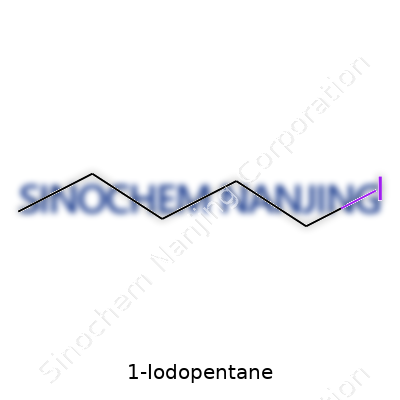
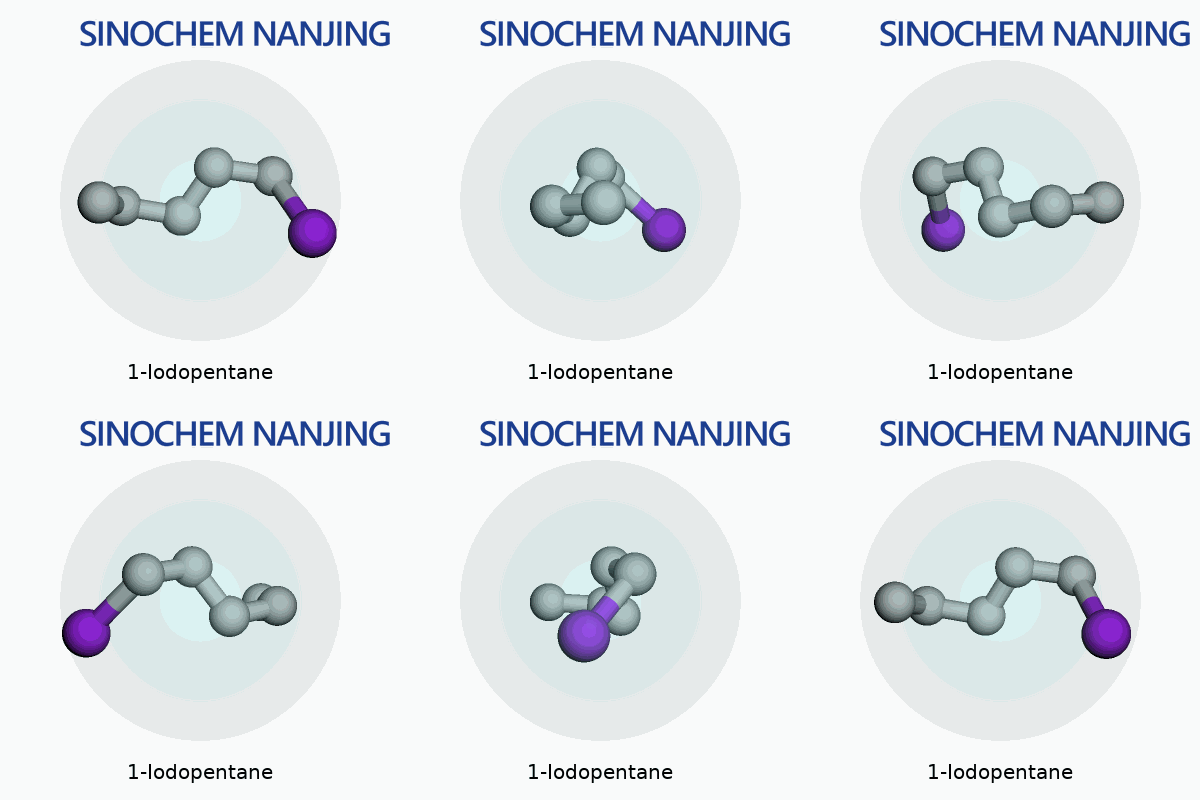
| Names | |
| Preferred IUPAC name | 1-iodopentane |
| Other names |
1-Iodopentane n-Pentyl iodide n-Amyl iodide Pentyl iodide Amyl iodide |
| Pronunciation | /ˈaɪ.oʊ.doʊ.pɛnˌteɪn/ |
| Identifiers | |
| CAS Number | Iodopentane" CAS Number is "638-45-9 |
| Beilstein Reference | 1718737 |
| ChEBI | CHEBI:51435 |
| ChEMBL | CHEMBL15373 |
| ChemSpider | 62032 |
| DrugBank | DB02361 |
| ECHA InfoCard | ECHA InfoCard: 100.005.327 |
| EC Number | 203-910-4 |
| Gmelin Reference | 7782 |
| KEGG | C08354 |
| MeSH | D017355 |
| PubChem CID | 80596 |
| RTECS number | RN0489600 |
| UNII | 1OL88A5C3R |
| UN number | UN1993 |
| Properties | |
| Chemical formula | C5H11I |
| Molar mass | 212.05 g/mol |
| Appearance | Colorless to pale yellow liquid |
| Odor | sweet odor |
| Density | 1.616 g/mL at 25 °C (lit.) |
| Solubility in water | Insoluble |
| log P | 2.91 |
| Vapor pressure | 0.923 mmHg (at 25 °C) |
| Acidity (pKa) | 16.0 |
| Basicity (pKb) | pKb = -3.18 |
| Magnetic susceptibility (χ) | -72.0·10⁻⁶ cm³/mol |
| Refractive index (nD) | 1.483 |
| Viscosity | 2.42 mPa·s (20 °C) |
| Dipole moment | 1.60 D |
| Thermochemistry | |
| Std molar entropy (S⦵298) | 232.6 J·mol⁻¹·K⁻¹ |
| Std enthalpy of formation (ΔfH⦵298) | −15.5 kJ/mol |
| Std enthalpy of combustion (ΔcH⦵298) | -2496.7 kJ/mol |
| Hazards | |
| GHS labelling | GHS02, GHS07 |
| Pictograms | GHS02,GHS07 |
| Signal word | Warning |
| Hazard statements | H302 + H312 + H332: Harmful if swallowed, in contact with skin or if inhaled. |
| Precautionary statements | P210, P280, P301+P312, P305+P351+P338, P337+P313 |
| NFPA 704 (fire diamond) | 2-2-0 |
| Flash point | 59 °C |
| Autoignition temperature | 215 °C |
| Explosive limits | Explosive limits: 1-7% |
| Lethal dose or concentration | Rat oral LD50: 2,100 mg/kg |
| LD50 (median dose) | LD50 (median dose) of 1-Iodopentane: **820 mg/kg (rat, oral)** |
| NIOSH | SN 197 |
| PEL (Permissible) | Not established |
| REL (Recommended) | 200-800 mg/day |
| IDLH (Immediate danger) | No IDLH established |
| Related compounds | |
| Related compounds |
1-Bromopentane 1-Chloropentane 1-Fluoropentane Pentanol Pentanal |



