1-Hexene: The Backbone of Modern Industry
Historical Development
Long before high-tech plastics and advanced materials filled our world, chemists had eyes on simple hydrocarbons, searching for compounds that could shape tomorrow's technology. In the post-war decades, people in laboratories began recognizing the untapped potential of alkenes like 1-hexene. Early industrial methods leaned on cracking techniques to squeeze needed chemicals out of heavier oils, and as demand for tougher, more versatile plastics grew, innovation pushed toward more selective synthetic processes. Shell’s work in the 1950s and Phillips’ discoveries on Ziegler catalysts turned the story of 1-hexene into something much larger. The rise of olefin-based plastics and linear low-density polyethylene marked an inflection point. Investment in better separation and purification methods grew because even slight impurities affect how these materials perform. Through the 1980s, production climbed steadily, keeping pace with global growth in consumer goods and packaging. Today, chemical engineers learn about 1-hexene not just as a building block but as a key moment in industrial evolution.
Product Overview
1-Hexene falls in the family of alpha-olefins, known for their terminal double bond, which gives them a reactive edge compared to their saturated cousins. Its formula, C6H12, seems simple on paper, but the chemistry packs a lot of value. Factories across the globe churn it out mainly as a co-monomer, blending it into polyethylene to dial in the right mix of strength, flexibility, and processability. Certain specialty chemicals and niche lubricants also stem from this molecule. When handling bulk shipments, many suppliers focus on purity because this shapes end-use performance in resins and specialty applications. Over the past decade, 1-hexene has cropped up in automotive compounds and modern packaging materials. The ability to tune a finished product with small amounts of this molecule often means the difference between cracking plastic or a tough, flexible film.
Physical & Chemical Properties
Looking at 1-hexene, you find a clear, colorless liquid at room temperature. The slight sweet odor gives away its hydrocarbon roots. Volatility stands out on the shop floor — the boiling point gets up near 63 degrees Celsius, nothing you’d mistake for water, so safe handling becomes crucial. Few people enjoy talking about flammability, but with a flash point dipping down around -26°C, nobody ignores the risk. The solubility leans away from water and toward organic solvents, making cleanup and containment a careful business. The double bond at the end of the chain gives the molecule a handle for other reactions, which manufacturers use to tack on new groups or build bigger molecules. Chemists see a molecule like 1-hexene and recognize its willingness to participate in addition and polymerization, making it much more than just another chemical drum in a warehouse.
Technical Specifications & Labeling
Every drum shows labels for content, purity level, hazard warnings, and handling requirements. Purity wins attention from buyers, usually running above 99%. Lower contamination supports better yields in polymerization – no room for sulfur, oxygenates, or other sticky by-products. Color indicators also matter, although a good batch runs water-clear. Technical bulletins highlight boiling and freezing points, vapor pressure, and recommended storage temperatures. This helps users avoid mistakes during blending and transport. The regulatory landscape adds another layer, with marking for flammability, and health hazard symbols in line with global standards. Whether material sits in a storage tank or runs through pipelines, every operator checks the documentation before turning valves.
Preparation Method
The petrochemical industry leans heavily on methods like ethylene oligomerization for 1-hexene production. Large reactors link simple ethylene molecules together under heat and pressure, then use specialized catalysts to favor the six-carbon chain with the terminal double bond in just the right spot. This catalytic process marks a leap from older thermal cracking, where controlling product mix felt like playing roulette. Modern plants aim for higher selectivity, which cuts waste and shapes a more sustainable business model. Fractional distillation steps in to pull 1-hexene from other alpha-olefins in the mix, so at the end you wind up with a stream that meets strict specifications. With crude oil supplies in flux, some research groups look to alternative sources, including bio-based ethylene, hoping to green the process for the future.
Chemical Reactions & Modifications
1-Hexene rarely sits idle on the shelf. Chemists use the double bond for hydroformylation, turning it into heptanal and other aldehydes that spawn surfactants and plasticizers. Halogenation, oxidation, and related reactions turn this simple alkene into a toolkit for many industries. The molecule can polymerize, acting as a co-monomer for polyethylene, which then shows up in packaging, cable insulation, and even medical tubing. In the lab, it reacts in controlled steps to build up larger, more complex chemicals. The double bond ensures that, in skilled hands, the molecule does exactly what it should: open doors for new materials and specialty products. Downstream, companies adjust processing conditions to pull the right properties from resin blends, leaning on 1-hexene’s carbon skeleton as the foundation for product performance.
Synonyms & Product Names
Ask suppliers about 1-hexene, and you might hear hex-1-ene, alpha-hexene, or simply C6 alpha-olefin. Each term reflects the same basic idea: a six-carbon molecule, double bond hanging off one end. Some catalogs note "UN 2370" transport designations, and a few specialty blends might add trade names, but the core identity stays rooted in these synonyms. Without clear naming, buyers risk costly mistakes, so industry standards for chemical nomenclature matter just as much as purity certificates or container seals.
Safety & Operational Standards
The need for safety dominates every discussion about 1-hexene. Its low flash point calls for explosion-proof handling from tanker to reactor. Ventilation cuts vapor concentration, and static electricity gets strict controls during transfer to stop unwanted sparks. Personal protective equipment such as gloves and goggles is the frontline defense for operators. Emergency response plans treat spills and fires as top priorities, guided by lessons learned from earlier incidents. Regulatory agencies insist on tight controls for air emissions and workplace exposure, with regular audits and updated training. The risks remind every company that one oversight can cost more than money – it can hurt people. For companies, a strong emphasis on following occupational safety and health standards forms the backbone of long-term success. In my own work, even a brief lapse in attention around flammables has meant tight reviews and sharper procedures, so nobody questions the need for real vigilance.
Application Area
Step into almost any packaging plant or plastics processing line, and you see how much rides on the shoulders of 1-hexene. Linear low-density polyethylene created from co-monomers like this drives much of the film, wrap, and bottle production that lines grocery shelves. Where companies chase tougher, puncture-resistant or lighter plastics, slight tweaks in the blend using 1-hexene often do the job. The molecule also feeds into specialized waxes, synthetic oils, plasticizers, and lubricants. Industrial coatings, adhesives, and even some specialty surfactants grow out of modifications to this basic skeleton. Each application puts unique pressure on purity and reactivity, so there’s no shortcut around robust quality control. Research teams constantly chase the right mix of strength, flexibility, and cost to stay ahead in markets where even small cost shifts ripple globally.
Research & Development
The drive to improve keeps research on 1-hexene very much alive. Studies focus on new catalytic routes that give better selectivity and work under milder conditions, both to save energy and make use of less hazardous inputs. Exploration into bio-based synthesis gets lion’s share of attention, as industries seek lower carbon footprints and greater feedstock security. The challenge lies in matching the volume and reliability of traditional petrochemical methods with greener technologies. Performance enhancers get steady attention; developing additives or co-monomer blends that provide a step change in material properties banks on deep understanding of 1-hexene reactivity. Teams also investigate downstream recycling, asking how altered polymer chains behave after a consumer throws them away. These studies blend theoretical modeling, bench-top experiments, and pilot plant data, all straining to open up new markets or solve persistent issues.
Toxicity Research
Discussions on toxicity sometimes lag behind excitement about new industrial applications, but they never disappear. Inhalation, skin contact, and environmental releases carry risks, stirring detailed investigation from health scientists and regulators alike. Information from long-term exposure studies guides practices in both plant and downstream users. High vapor pressure makes proper containment and ventilation more than box-ticking exercises. Animal studies help pinpoint effects on organs and the risk of chronic disease, shaping workplace exposure limits. Regulatory frameworks push for continuous data collection, not just for human risk, but also for aquatic systems since spills and emissions add up over decades. From experience, companies ignore health risks at their peril – not only do safety lapses harm workers, they erode public trust and can land firms in regulators’ crosshairs.
Future Prospects
With plastic demand pushing into new regions and applications, the role of 1-hexene seems secure. The industry’s push for more sustainable materials charts a course toward greener sources of both ethylene and finished products. Start-ups and established players alike focus on catalytic efficiency, waste minimization, and circular resource flows. Regulatory pressure tightens, nudging companies to rethink both feedstocks and end-of-life scenarios. The reactivity and structural clarity of 1-hexene continues to lend itself to new material innovations, from advanced composites in automotive and aerospace to smarter packaging films with longer shelf life. Success will rest on blending hard-won laboratory insight, operational discipline, and a respect for safety and environmental stewardship. The task ahead challenges every link in the supply chain; those who adapt will drive future growth and help answer mounting calls for more responsible chemistry.
What is 1-Hexene used for?
The Real Story Behind 1-Hexene
You probably haven’t seen a bottle labeled "1-Hexene" in the store, yet this clear, scratchy-smelling liquid quietly shows up in plenty of essential things around us. I’ve spent time in a chemical lab—long enough to know that some ingredients matter more than folks realize. 1-Hexene is one of these hidden players, and its biggest claim to fame comes from plastics, especially the high-density, tough kind people count on every day.
Making Polyethylene More Than Just Plastic
I remember standing by the extrusion press as a roll of thick plastic tubing came off, feeling the heat and thinking how odd it is that a simple molecule can shape something so sturdy. 1-Hexene works as a comonomer. That means it teams up with other materials, mostly ethylene, to make polyethylene tougher and better at flexing without breaking—peek at your detergent jug or milk bottle; there’s a good chance they owe their strength to a dose of 1-Hexene. Data shows that the world churns out millions of tons of polyethylene every year, and a significant portion depends on a sprinkle of this stuff.
What This Means for Industry and the Environment
From a nuts-and-bolts view, 1-Hexene helps create plastics that last longer and use less raw material overall, translating into lighter packaging and sometimes even lower production costs. Lighter plastics mean fuel savings during shipping, too—a hidden win for anyone thinking about climate impact. For people involved in recycling, plastics containing 1-Hexene often perform a bit better in the recycling loop. They’re less likely to turn brittle, so recycled goods don’t snap apart as quickly. I’ve talked to recyclers who praise the difference, which might not sound revolutionary, but it adds up, especially for high-volume packaging firms.
Other Roles of 1-Hexene
The reach of this chemical doesn’t stop at plastic bottles and jugs. Chemical plants use 1-Hexene to make synthetic lubricants—those specialty oils keeping car engines and gearboxes from grinding down. These synthetic lubricants flow better at extreme temperatures and stick around longer than plain old mineral oils, helping engines run cleaner and more efficiently.
Beyond plastics and lubricants, 1-Hexene crops up in some specialty chemicals and adhesives. These materials need molecules that help them stretch, stick, or cure more reliably. In my experience with manufacturing, running low on 1-Hexene can stall a production line and jack up costs for everything down the line.
Looking Forward: Smarter Use and Safer Handling
With demand running high, it’s critical for producers to keep safety tight. 1-Hexene flammable—it demands careful storage and transport. Workers who handle it gear up for a reason; I learned always to double-check seals and ventilation. There’s real debate about balancing safety, supply, and environmental responsibility. More research is underway to squeeze out every bit of value from current supplies and reduce risks along the way, by focusing on recycling and safer chemical handling.
Wrapping up, most people won’t run into 1-Hexene deliberately, but it’s in the mix behind much of the stuff people depend on daily. Paying attention to how we make and use these building blocks can only make industry more efficient—and everyone’s day-to-day a little smoother.
What are the physical and chemical properties of 1-Hexene?
What Stands Out About 1-Hexene
1-Hexene belongs to the family of alkenes, sporting the formula C6H12. It brings together six carbon atoms lined up in a chain, topped with a double bond at the start. That double bond doesn’t hide. It kicks out shelf-life and shelf-safety questions, especially regarding storage and handling. Folks working with it smell a sweet, gasoline-like scent—work in a closed room and you’ll know if there’s a leak. Portable meters exist for that, but nose-sense often spots trouble first.
Physical Properties That Count in the Lab and the Field
Pour a vial of 1-hexene and you’ll pour a colorless liquid. False colors point to trouble—impurities or cross-contamination. The boiling point settles around 63°C to 65°C, something you notice fast when aiming to separate or distill it from other hydrocarbons. Out in the temperature extremes, it gets stubborn: it freezes near –140°C. No lab-freezer chills it solid without serious equipment.
Its density tags in at about 0.67 grams per cubic centimeter, much lighter than water. Drop some into a glass of water and it floats. That matters if you’re trying to skim off accidental spills or layer it during lab separation techniques.
Solubility doesn’t match well with water. If you spill, cleanup needs to rely on absorbents or other solvents. It gets along better with organic solvents such as ether or ethanol.
Chemical Properties: Double Bond, Double Trouble—and Opportunity
The double bond defines what 1-hexene can do. Those two linked carbons act like magnets for all kinds of chemical reactions. Industry uses this property to push out polymers—the same double bond that helps it build plastics makes it react with catalysts in the worksheds.
Oxygen and halogens snap up a chance to attack that double bond. That leads to products ranging from alcohols to halogenated compounds. Oxidation doesn’t just change its nature; it can run out of control if left in sunlight or in a poorly-ventilated drum. Proper storage calls for cool, dark places, and tight lids. Some plants press 1-hexene through polymerization at scale to churn out polyethylene, a material that tangibly shapes milk jugs, packaging film, and pipes.
The reactivity also means safety rules need respect. If open flames get close, expect rapid ignition: the flash point sits around –26°C, which means it only takes a warm spark to light up a room. I remember reading about a small chemical plant where a spill met a space heater, causing a fire before the operator could even turn around.
Risks and Practical Solutions
Transport, storage, and disposal cause no shortage of concern. Vapors tend to spread quickly, and a brief exposure often irritates eyes and lungs. Personal protective gear pays off – gloves and goggles aren’t only for show when you’re decanting 1-hexene. Should a spill occur, use sand or vermiculite, not water, to contain it.
People in the industry have shaped practices around these properties. Segregation from oxidizers, labeling, and periodic equipment checks rank high on the priorities. Simple steps—ventilated rooms, flameproof containers, regular safety drills—add real safety headway. Newer guidelines even suggest continuous monitoring for vapor leaks, following lessons learned from close calls.
Shaping Industry and Research
1-Hexene’s unique double bond and manageable size keep it front-row for polymer makers and synthetic chemists. Just as drillers use it to customize plastics, labs trust its reactivity for building blocks in drug development and specialty chemicals. Getting results—whether clean plastics or pure lab reagents—depends on knowing these right-from-the-real-world properties.
Is 1-Hexene hazardous to health or the environment?
What Exactly Is 1-Hexene?
1-Hexene is a chemical found in a surprising number of everyday products. You may not realize, but plastics, adhesives, and even synthetic motor oils all commonly use 1-Hexene during their creation. Its main function centers on helping form certain plastics, like polyethylene, which fill grocery shelves and home closets worldwide.
How Does 1-Hexene Affect Health?
Direct experience in an industrial setting makes it clear that 1-Hexene isn’t something you want splashing on bare skin or swirling in the air around you. Strong, gasoline-like fumes can sting the nose. Anyone working around it quickly learns the wisdom of a well-fitted respirator and quality gloves. Studies report that inhalation or skin contact can irritate the eyes, throat, or skin. Workers sometimes complain of headaches when exposed to high concentrations, and liquid 1-Hexene can cause dryness or cracking if it lingers on hands. The Centers for Disease Control and Prevention (CDC) notes that the chemical isn’t known to cause lasting health effects in small, occasional doses, but chronic exposure leaves a lingering concern. Reports so far do not provide evidence 1-Hexene causes cancer or genetic mutations, but the research base hasn’t covered every angle, especially for people living near major chemical plants.
What About Environmental Impact?
Disposal and spillage create the largest risk to the environment. 1-Hexene evaporates quickly, so most of it released in the open air drifts away. That might sound harmless, but volatile organic compounds like this end up reacting with sunlight and other pollutants to form ground-level ozone—smog. Smog can worsen breathing problems for those with asthma or allergies. If the chemical seeps into water or soil, it won’t last long since bacteria tend to break it down within days, but enough of a spill could still kill plants, fish, and other aquatic life before bacteria catch up.
What Makes 1-Hexene Regulations Necessary?
On job sites, federal rules from organizations like OSHA and the EPA put clear limits on how much 1-Hexene workers can breathe or touch. Facilities must capture fumes through ventilation systems; safety training covers what to do if a leak occurs. My time around petroleum tanks taught me that constant vigilance matters more than any written policy. Accidents happen fast, especially when heat, pressure, or equipment failures enter the equation. In my hometown, a spill meant dead grass in the park for months before cleanup finished. You can’t always count on systems to work perfectly, so having backup plans and real drills helps keep people and the ecosystem safer.
Looking Toward Safer Handling and Alternatives
Reducing risk starts before 1-Hexene leaves the factory. Improved monitoring limits the odds of major leaks. Some companies now use closed-loop systems, turning vented gases into useful products instead of letting them escape. The plastics industry continues researching replacements with a gentler environmental footprint. Bio-based chemicals may cut down on fossil fuel demand, although scaling these up remains a challenge manufacturers still wrestle with. People at home help too by demanding safer goods and more transparency from producers. Responsible recycling diverts plastics from incinerators and landfills, where they otherwise might leak chemicals like 1-Hexene as they break down under heat or pressure.
Staying Informed
Every industrial chemical comes with trade-offs. 1-Hexene delivers convenience and low cost but can threaten health and the environment without proper controls. The key lesson I’ve picked up: never assume a chemical in common use is without risk. Education on safe handling, robust safety measures in workplaces, and support for environmental innovation all add up to better outcomes for everybody. Scrutiny keeps standards strong and makes sure that convenience never overrides the well-being of people or the natural world.
How should 1-Hexene be stored and handled safely?
Real Hazards, Not Just Rules
1-Hexene isn’t exactly a celebrity among chemicals, but it’s a vital building block in plastic production, adhesives, and specialty chemicals. The issue is, it’s highly flammable and puts off vapors that can knock someone’s legs out from under them if they’re not cautious. In small settings or big industry tanks, ignoring good habits only leads to trouble. A fire from 1-Hexene spreads fast and leaves workers scrambling. Hard-won experience in daily plant operations has shown me: cutting corners for speed costs more in the end, both in repairs and in people’s wellbeing.
Reliable Storage
Metal drums or bulk tanks with tight seals work best. The less air inside, the better, since oxygen and 1-Hexene don’t play well together. Exposure to sun or heat pumps up pressure in containers, and nobody wants drums bulging at the seams. Outdoor tanks need decent shade, proper grounding, and routine checks. Every worker in the yard has a story about a leaky drum and a rush to contain it—usually traced back to a weak gasket, a dropped fitting, or open valves left unattended.
Vapor can hang low on the floor, so simple ventilation can make all the difference. No one really enjoys checking air flow systems or sucking fumes through a carbon filter, but those are the habits that keep headaches, fires, and regulatory fines out of the picture. Routine inspections and written records matter too—never rely on memory alone. Insurance companies and inspectors look for paperwork, and so do people piecing together why something went wrong.
Safe Handling is a Culture, Not a Checklist
Grabbing gloves and safety glasses should be automatic, like buckling a seatbelt. 1-Hexene stings in a cut and doesn’t wash out with water alone. Respirators come out if vapor levels aren’t sure to stay low. Sparks have no place near the floor or open containers. Cell phones might seem harmless, but static charges set off vapors more times than most realize.
Training plays a bigger role than any piece of equipment. It’s tempting to skip refreshers because production always runs behind, but workers who take shortcuts once often stick with the same bad habits. Keeping spill kits visible and checked avoids scrambling for supplies later. I remember a friend on night shift using clay cat litter to stop a leak before the real absorbents showed up. They managed, but the mess took three times longer to clean and cost more than storing the right material upfront.
Backups and Response
All the plans in the world mean nothing without drills and real-time practice. Alarms should mean ‘get out’ not ‘cover your nose and keep working.’ Emergency gear needs to be staged, easy to reach, and regularly tested. Too many workplaces box up the fire blankets, only to find them missing or covered in dust. Spill containment is never about a single person—communication wins in these moments.
1-Hexene storage and handling asks for respect, vigilance, and a culture where speaking up about risks feels normal. Factories that invest in genuine safety always see fewer accidents, lower costs, and more trust from workers. People remember where they felt respected, and safety—handled right—turns out to be straightforward: good containers, cool shade, solid habits, and the courage to call out risks before they hurt anyone.
What are the common methods for producing 1-Hexene?
1-Hexene in the Real World
Everyday items often depend on specialty chemicals like 1-hexene. In fact, 1-hexene goes into anything from plastic packaging to household containers. That sort of versatility draws attention not only from manufacturers, but also from folks interested in environmental impact and industrial safety.
Oligomerization of Ethylene: The Go-To Technique
I’ve spent time in labs and processing plants where the oligomerization of ethylene runs as a reliable way to produce 1-hexene. Industrial chemists usually choose this route because it gives a higher yield than most competitors. In the so-called Ziegler process, ethylene flows over metal-based catalysts—often refined nickel, titanium, or chromium. This selective set-up encourages the transformation of simple ethylene molecules into longer carbon chains. The magic happens when ethylene units snap together, stacking in precisely the right way to create 1-hexene, among other products.
Most modern plants turn to this approach since it allows for continuous operation and minimizes waste. In 2022, more than 60 percent of global 1-hexene used in linear low-density polyethylene manufacturing came from ethylene oligomerization. Plants in Texas and Asia sit close to major refineries, which makes large-scale runs cost-effective. Waste isn’t eliminated entirely—byproducts like butene or octene form—but refiners recover and use these elsewhere.
Fischer-Tropsch Synthesis: Linking Old Tricks to New Demands
Years back, Fischer-Tropsch synthesis kept my interest as one of the more creative methods to get 1-hexene. This process converts carbon monoxide and hydrogen—sourced from coal, natural gas, or even plant matter—into an array of hydrocarbons. Run catalysts through the setup, and you get a stew of compounds. Sorting out 1-hexene from this mix takes more steps, but the method comes from technology built in the early 20th century.
I’ve seen this approach get a second wind as energy companies look for new ways to field cleaner processes. Using carbon-neutral feedstocks makes the approach attractive, but yields do not typically match what you see with the ethylene route. Still, Fischer-Tropsch offers flexibility by using various raw materials and fits well with the drive toward greener chemistry.
Extraction from Cracker Products: An Older Route
Chemists and engineers sometimes turn to straightforward separation of 1-hexene from the mix produced in naphtha steam crackers. These industrial workhorses break down petroleum, yielding a soup of hydrocarbons. Facilities then draw off fractions by boiling and condensing them at certain temperatures. 1-hexene accumulates in one cut, but the process lacks the selectivity of purpose-built synthesis routes. Output fluctuates and reliability drops, especially as more industries chase "on-purpose" manufacturing methods for higher efficiency.
Tuning for a Cleaner Future
For the past decade, I’ve watched companies build pilot plants targeting lower emissions and tighter control over product purity. Advanced catalysis research—layering elements like zirconium or manganese into existing reactors—shows steady gains in yield without spiking costs. Some are even looking into bio-based routes from sugars or plant oils, though these run into hurdles with scalability.
What matters most is balancing efficient output with safety and reduced impact. As more people realize how plastics shape our lives, the pressures for clean methods and transparent supply chains only climb. Industry-wide agreements on best practices, coupled with scrutiny from safety regulators, keep progress honest. The push for greener chemistry should bring more sustainable options to the table, as the demand for specialty chemicals like 1-hexene continues to rise.
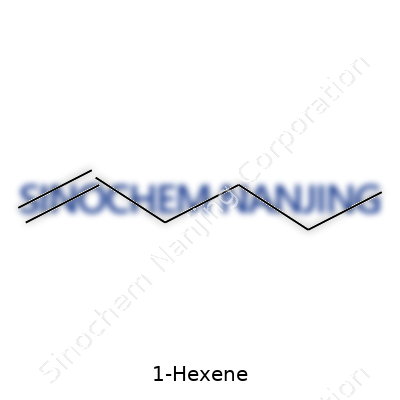
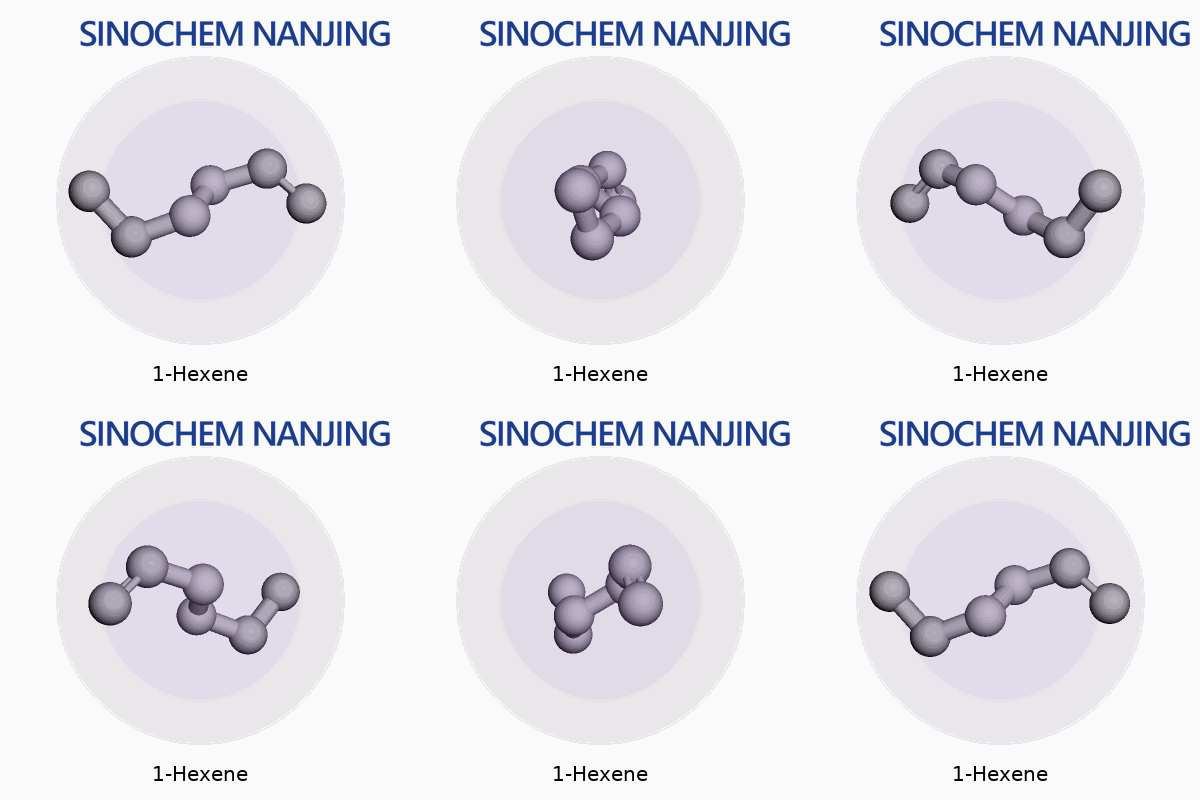
| Names | |
| Preferred IUPAC name | Hex-1-ene |
| Other names |
Hex-1-ene 1-Hexylene Hexene-1 |
| Pronunciation | /ˈwʌnˈhɛksiːn/ |
| Identifiers | |
| CAS Number | 592-41-6 |
| Beilstein Reference | 1718730 |
| ChEBI | CHEBI:35706 |
| ChEMBL | CHEMBL15360 |
| ChemSpider | 8667 |
| DrugBank | DB13880 |
| ECHA InfoCard | 100.003.420 |
| EC Number | 207-070-7 |
| Gmelin Reference | 82152 |
| KEGG | C08361 |
| MeSH | D006544 |
| PubChem CID | 7897 |
| RTECS number | MO4550000 |
| UNII | L5A7R1JZ01 |
| UN number | UN2370 |
| CompTox Dashboard (EPA) | CompTox Dashboard (EPA) of product '1-Hexene': **DTXSID2022847** |
| Properties | |
| Chemical formula | C6H12 |
| Molar mass | 84.16 g/mol |
| Appearance | Colorless liquid |
| Odor | mildly sweet |
| Density | 0.673 g/mL at 25 °C |
| Solubility in water | insoluble |
| log P | 3.13 |
| Vapor pressure | 60.6 mmHg (at 25 °C) |
| Acidity (pKa) | pKa ≈ 44 |
| Basicity (pKb) | 15.68 |
| Magnetic susceptibility (χ) | -13.56×10⁻⁶ |
| Refractive index (nD) | 1.387 |
| Viscosity | 0.307 mPa·s (25 °C) |
| Dipole moment | 0.40 D |
| Thermochemistry | |
| Std molar entropy (S⦵298) | 234.6 J·mol⁻¹·K⁻¹ |
| Std enthalpy of formation (ΔfH⦵298) | -28.4 kJ/mol |
| Std enthalpy of combustion (ΔcH⦵298) | -3916 kJ/mol |
| Pharmacology | |
| ATC code | V06DC02 |
| Hazards | |
| GHS labelling | GHS02, GHS07 |
| Pictograms | GHS02, GHS07 |
| Signal word | Warning |
| Hazard statements | H225, H304, H315, H336, H411 |
| Precautionary statements | P210, P261, P280, P301+P310, P331, P304+P340, P312, P370+P378, P403+P235 |
| NFPA 704 (fire diamond) | 2-2-2-A |
| Flash point | -21 °C |
| Autoignition temperature | 220 °C |
| Explosive limits | 1.1–6.4% |
| Lethal dose or concentration | LD50 (oral, rat): 1790 mg/kg |
| LD50 (median dose) | LD50 (median dose) for 1-Hexene: **>2000 mg/kg (rat, oral)** |
| NIOSH | NIOSH: MK5425000 |
| PEL (Permissible) | 500 ppm |
| REL (Recommended) | neat |
| IDLH (Immediate danger) | 800 ppm |
| Related compounds | |
| Related compounds |
Hexane Hexanol Hexanal Hexylamine Cyclohexene |



