1-Decene: Charting a Course from History to Future Horizons
The Backstory of 1-Decene: From Lab Bench to Industry
Most people outside the chemical industry rarely give a thought to the likes of 1-Decene, but this simple-looking molecule has a surprisingly important role in the modern world. Back in the middle of the twentieth century, as the petrochemical industry took off, researchers homed in on the possibilities packed into simple alkenes like 1-Decene. This ten-carbon straight-chain alpha-olefin caught attention not because it was the flashiest compound, but because it opened doors to some critical industrial advancements. Chemists first produced 1-Decene through laborious fractionation of petroleum and later by cracking higher molecular hydrocarbons, feeding a hungry market for ingredients that could shape synthetic lubricants, surfactants, and plastics. Over the decades, advances in oligomerization of ethylene turned 1-Decene from a specialty compound into a quiet workhorse of modern manufacturing. Every time you notice improved fuel efficiency in your car, or plastics that don’t crack as easily in sunlight, there’s a chance 1-Decene played a part.
Physical Traits and Chemistry Unpacked
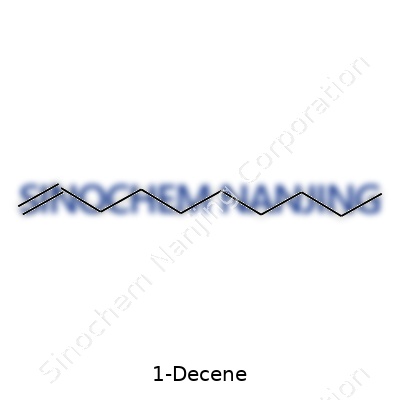
Looking at 1-Decene, you find a colorless liquid at room temperature. Its streamlined linear structure and characteristic terminal double bond set the stage for its versatility. It doesn’t blend with water, which comes across as handy for certain industrial uses, yet it dissolves easily in organic solvents. The boiling point hovers near 170 degrees Celsius, and its vapor pressure makes handling fairly straightforward with the right ventilation. The presence of a double bond at the very end of the chain – what chemists call the alpha position – offers a unique handle for further reactions. It doesn’t just sit still; that bond invites addition reactions and functionalizations, opening up a series of pathways for chemical creativity.
Specifications and Proper Labeling: Setting the Record Straight
Talking about technical standards, 1-Decene gets a lot of scrutiny before reaching the buyer. Purity runs high, often above 95%, because impurities can wreck downstream reactions. Labels spell out CAS numbers so handling doesn't hit any legal speed bumps. Most suppliers give detailed assay information for trace hydrocarbons and residual solvents, helping labs and manufacturers stay consistent. Packaging ranges from industrial drums to tankers, and the chemical gets stored with an eye on controlling exposure to heat and preventing accidental ignition. These details matter, because in the chemical world, a few stray molecules can make all the difference between a process working or failing.
Making 1-Decene: Where Chemistry Meets Ingenuity
Producing 1-Decene starts with some clever chemistry. Long gone are the days when people relied solely on direct distillation of crude fractions. The industry moved to ethylene oligomerization — the process that stitches ethylene molecules together in just the right way. Using catalysts designed for selectivity, chemists can nudge reactions toward producing more decenes instead of longer or shorter chains. In my experience, watching a plant flip the switches to produce hundreds of tons of this stuff is a marvel. It shows just how far we’ve come by merging theoretical chemistry with industrial engineering. The real trick comes in separating 1-Decene from the soup of similar molecules, a process that calls for skillful distillation and constant monitoring.
Chemical Reactions and Ways to Modify
1-Decene struts its stuff not just by being made, but by what it does next. That double bond is like a welcome mat for a slew of reactions, especially hydroformylation and epoxidation. Through hydroformylation, 1-Decene morphs into valuable aldehydes. With some more steps, it becomes alcohols used to make surfactants and plasticizers. That’s just one path; other routes add halogens, oxidize, or cross-link the molecule to produce polymers and resins. One thing stands out: each reaction needs a carefully controlled environment, or you wind up with an unwanted stew instead of a targeted product. There’s a certain satisfaction in watching well-planned chemistry turn a simple liquid into the backbone of detergents or the guts of cutting-edge lubricants.
Other Names and Common Synonyms
Chemists love their naming conventions, and 1-Decene racks up a handful of monikers. You’ll hear it called n-Decene, alpha-decene, and dec-1-ene. These names show up in various technical documents and research papers, mostly to help people steer clear of confusion with other decene isomers. Whatever the name, if you see a formula with ten carbons and a double bond up front, it’s usually 1-Decene.
Keeping Safe and Running Smooth Operations
Handling 1-Decene doesn’t compare to dealing with more hazardous materials, but nobody wants to get careless. Its volatility means workers need proper ventilation, protective gloves, and googles. There’s a fire risk, so plant teams keep water and foam extinguishers close by and maintain strict controls on open flames. Current regulations standardize workplace exposure limits to keep inhalation risks at bay, and training routines drill in steps to take if there’s a spill. I’ve seen how a good safety culture makes all the difference, ensuring this staple of industrial chemistry doesn’t bite back.
Where 1-Decene Gets Put to Work
You might not see 1-Decene on a store shelf, but its fingerprints show up everywhere. Manufacturers turn it into high-performance synthetic lubricants, which keep engines running cleaner and longer. It plays a part in producing linear low-density polyethylene (LLDPE), making everything from food wraps to tubing both flexible and sturdy. Its alcohol derivatives underpin ingredients in detergents, and its intermediate compounds find value in plasticizers for softening plastics. In the world of specialty chemicals, 1-Decene makes its mark wherever durability, strength, or chemical performance matter. My own run-ins with polymer manufacturing convinced me that chemistry’s unsung heroes rarely make headlines, but they keep the modern world humming.
Innovation and R&D: Pushing 1-Decene to New Heights
Behind the scenes, research labs worldwide keep pushing to refine, enhance, and find new uses for 1-Decene. Modern catalyst design still aims to improve selectivity and lower energy demands in production. It’s exciting to watch advances in catalytic processes cut waste, lower emissions, and offer better yields. Biodegradable surfactants built from 1-Decene derivatives offer a green angle that’s essential in a time of mounting environmental pressures. A lot of academic and industry-driven projects target new polymer blends to squeeze extra performance out of old formulas, and 1-Decene usually ranks high in the discussion. From a personal standpoint, seeing how researchers connect global sustainability goals with core petrochemicals reminds me that good chemistry can drive both profit and planet-friendly outcomes.
Toxicity and Keeping Things in Check
No chemical reaches the broad use of 1-Decene without researchers mapping out every possible risk. Scientific studies indicate that 1-Decene has low acute toxicity. Extended workplace studies trace exposure limits to prevent headaches, dizziness, or skin irritation. Long-term animal trials shape our understanding of chronic effects. Regulatory agencies set boundaries for safe emission and waste handling, and industry standards uphold those limits through careful monitoring. Looking at the track record, safety studies and practical experience show that with proper controls, 1-Decene’s risks stay manageable. Mishandling or unchecked releases could spell trouble, so a culture of vigilance and clear training stays non-negotiable.
The Road Ahead: What’s Next for 1-Decene?
Peering into the future, 1-Decene likely won’t fade from importance anytime soon. The push for lightweight, high-performance materials keeps demand strong, especially in automotive, aerospace, and electronics. Environmental regulations nudge chemical companies to keep revising best practices, aiming for greener production lines and cleaner waste streams. With the world focused on sustainability, every molecule counts, and bio-based processes that create alkenes like 1-Decene from renewable feedstocks gain momentum in research circles. For those following these trends, the lesson shines clear: even modest molecules can punch above their weight, shaping entire industries behind the scenes and providing a powerful lever for building tomorrow’s world.
What is 1-Decene used for?
The Many Faces of 1-Decene
1-Decene might sound like something that belongs in a science lab and nowhere else, but this clear, oily liquid crops up in countless places that end up affecting us far more than we realize. From my work in sustainability research, I’ve learned that this compound plays a quiet, crucial role in producing goods that most people use daily.
The Engine Oil Story
One place 1-Decene truly makes a difference is in the world of synthetic lubricants. Car enthusiasts know that the right engine oil boosts performance and keeps engines running smoothly for hundreds of thousands of kilometers. 1-Decene feeds into the manufacturing of polyalphaolefins (PAOs), a key ingredient in high-end synthetic motor oils. These oils beat traditional mineral ones in handling heat, running at extreme temperatures, and resisting breakdown. Without this chemical, road trips would end with a seized engine much more often.
The Plastic Age
Polyethylene changes the way we wrap sandwiches, package products, and keep groceries fresh. Few realize that specialty forms of polyethylene rely on alpha-olefins as building blocks. 1-Decene acts as a co-monomer in this space, giving plastics flexibility and resistance. Years ago, recycling advocates like myself were shocked to learn that these tweaks allow food packaging to last longer and use less material. With global demand for lighter plastics rising, industries have doubled down on these improvements.
Everyday Products Get an Upgrade
Home care aisles hide the chemistry that helps detergents get stains out while staying gentle on your hands. 1-Decene shows up in surfactants, working behind the scenes to lift grease away. It also supports industrial cleaners, making tough jobs possible. In personal care, 1-Decene derivatives help creams feel light and lotions spread evenly.
More Than Meets the Eye
Drilling fluids used by oil and gas companies, electrical insulating fluids for transformers, and even adhesives for those stubborn stickers all trace roots back to 1-Decene. Manufacturers appreciate its reliability—whether they want a liquid that stays stable under high pressure or one that holds up against aggressive chemicals.
Concerns and the Road Ahead
Using a chemical as versatile as 1-Decene forces tough questions for anyone concerned about environmental impact. Most of the world’s supply comes from fossil-fuel sources. This creates challenges for people interested in lowering carbon footprints. As someone always on the lookout for greener solutions, I’ve watched research labs push for renewable feedstocks and closed-loop recycling. Some large firms now explore bio-based olefins through fermentation or plant oils, but the change takes time and serious investment.
Reliable supply matters because 1-Decene's chain runs deep—from auto shops to food packaging lines. Disruptions ripple across industries. Strong safety standards and responsible sourcing promise better working conditions for everyone along the line. Greater transparency and a stronger push for alternative synthesis methods could help limit environmental damage. Until then, it pays to look beneath the label and ask what’s really keeping everyday products running better, longer, and safer.
What are the physical and chemical properties of 1-Decene?
Getting to Know 1-Decene
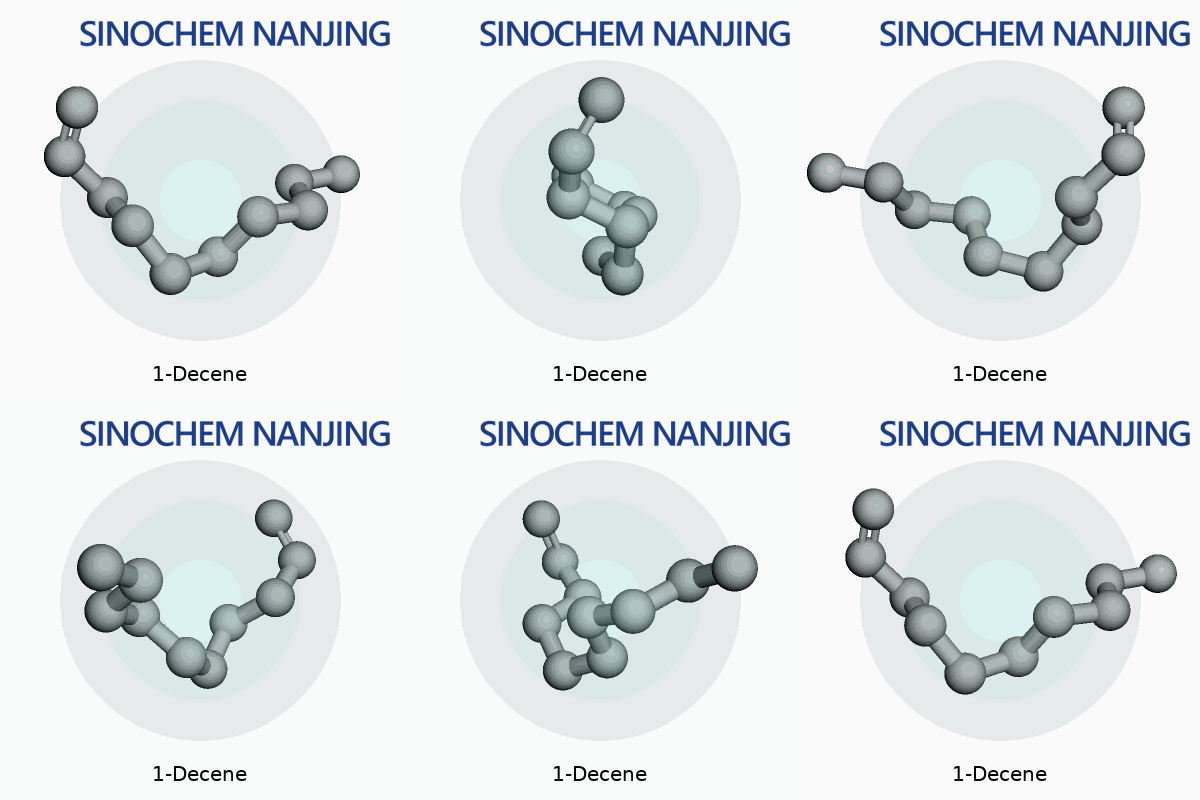
1-Decene spreads out in labs and factories across the world as a clear, colorless liquid. With a molecular formula of C10H20, this chemical comes from the group of alpha-olefins, which includes plenty of other simple hydrocarbons. 1-Decene stands out because of its ten-carbon chain and one double bond right at the end. This setup gives it some neat characteristics, useful from lubricant manufacturing to chemical synthesis.
Physical Traits You Notice Right Away
The liquid doesn’t have a strong smell, but wave your hand over an open container and you’ll catch a faint scent—something between wax and kerosene. It pours about as easily as cooking oil. 1-Decene’s boiling point hits around 172-174°C, while its melting point drops to about -66°C. Such a low freezing point lets it stay liquid in cold environments, where some other chemicals start clumping up. Pour a cup of flour into a beaker of 1-Decene, and it settles at the bottom because the liquid floats (density about 0.74 g/cm3 at room temperature). It’s lighter than water by a good stretch and refuses to mix, no matter how hard you stir.
At many plants, storage gets paired with good ventilation because the vapor pressure of 1-Decene sits higher than you might expect—about 1.3 mmHg at 20°C. Leave an open drum out, and it’ll start to evaporate, especially on a sunny day. But it doesn’t catch fire in a flash. The flash point hovers near 65°C. Folks working in blending rooms know this number because it marks the temperature that can make vapors go up in flames in the wrong conditions. Still, it isn’t as dangerous as lighter hydrocarbons because it needs more heat to catch fire.
Chemical Behavior that Matters
People in industry look to 1-Decene’s double bond—the feature that makes it reactive. Hydrogenation smooths the double bond out, turning 1-Decene into decane, a more stable molecule used in fuels. Run an oligomerization reaction, and the double bond hooks up with others to make longer chains, which matter a lot in synthetic lubricant production. The same carbon-carbon double bond takes part in making polymers and specialty chemicals. In fact, some folks might remember the sharp, sometimes fruit-like smell of the side products after a reaction if the lab ventilation isn’t perfect.
The molecule doesn’t dissolve much in water. Environmental engineers know this low solubility slows down its spread in groundwater spills, which helps in containment but also means cleanup crews can’t just wash it away. 1-Decene doesn’t stick around in the ecosystem; microbes break it down, especially out in the open or on soil rich in bacteria. Regulations push for containment more than panic. Workers keep gloves and goggles handy since the liquid can irritate skin or eyes, although people rarely get lasting harm from brief spills.
Why We Should Pay Attention
Factories rely on 1-Decene because it solves problems—like running gearboxes smoother or helping plastics stay flexible. It brings economical choices over more complex synthetic alternatives. In my own experience, 1-Decene always signaled versatility. Whether working with plasticizers or exploring new surfactant blends, its reactivity felt like a tool people could count on. Environmental safety isn’t a far-off abstract concern; it means constant checks on leaks, strong container seals, and clear instructions for the people who handle it every day.
Investment in tighter storage and simple handling guidelines brings peace of mind to businesses and workers. Switching to newer formulations with better fire and toxicity profiles sets a direction many chemical companies take. Thoughtful production and stewardship make sure industries benefit without losing sight of health and environmental protection—the real bottom line for communities everywhere.
Is 1-Decene hazardous or toxic?
What 1-Decene Is and Where It Shows Up
Many people might see the name 1-decene printed on a label and wonder what they're dealing with. This compound falls under alkenes, a group of hydrocarbons made of carbon and hydrogen. Refineries produce it from petroleum. It slips into all sorts of places: manufacturing plasticizers, lubricants, surfactants, and sometimes even in cutting oils or adhesives. Chemistry books mark it as a colorless, oily liquid with hardly any scent.
Is 1-Decene Dangerous to Touch or Breathe?
Folks who work with chemicals often look for red flags: How badly does it burn the skin? Is the vapor risky? From personal experience in a lab setting, most hydrocarbon-based liquids like 1-decene don’t leap to cause problems the way strong acids or bases do. You might feel mild skin dryness or irritation if it spills on your hands repeatedly, especially with poor ventilation or no gloves. Any organic vapor can irritate eyes and nose if you huff too much. Chronic exposures tell a different story compared to short splashes.
Most occupational studies and safety data sheets rank 1-decene’s acute toxicity low. Swallowing a small accidental dose doesn’t usually trigger major health problems, though, like many hydrocarbons, drinking a mouthful is obviously not smart. Prolonged heavy exposure has shown to bother the lungs and sometimes the liver in rats during lab testing, mostly from breathing high concentrations for days at a time. I’ve seen more workplace complaints about headaches or lightheadedness from being in closed spaces with vapors than from skin burns or rashes.
Long-Term Health and Environmental Impact
It helps to look at long-term effects, since quick spill cleanup mostly brings brief exposures. Reports from chemical agencies and research panels rarely show evidence that 1-decene builds up in the body or the environment. It breaks down by sunlight and microbes pretty quickly. That reduces worries about “forever chemicals” building up in wildlife or tap water.
On the flip side, all volatile organic compounds (VOCs) stack up in the air during production or storage. I’ve seen warehouses cloud up with fumes if ventilation takes a backseat. Too much in the air means workers could complain about nausea, tiredness, or eye irritation. Firefighters also flag chemicals with carbon double bonds (like 1-decene) as flammable. Keep it away from sparks or high heat, and it won’t become an accident.
Managing Risks at Home and Work
Simple rules cut down risk. If handling 1-decene, put on gloves and goggles—no need for hazmat suits, but don’t let it soak your skin. Store it in well-marked, closed bottles away from flames. In a garage or plant, good ventilation clears out any vapors. Spills can get wiped up with absorbent pads, then thrown out as chemical waste. These steps sound routine, but workplace accidents often come from rushing or skipping basics.
Modern safety training lays out those points clearly, and most facilities have quick access to safety data sheets. The folks at NIOSH and OSHA don’t put 1-decene on a “watch out” list, but they remind workers that all organic solvents need respect. For the average homeowner who doesn’t mix lubricants or industrial surfactants, 1-decene’s not lurking in daily life. For workers, protect skin, watch the fumes, and treat it as flammable. With those habits, it doesn't become a menace.
How should 1-Decene be stored and handled?
Understanding 1-Decene Risks
Anyone dealing with 1-Decene ought to respect how easy it is for things to go wrong with this chemical. 1-Decene falls in the category of alkenes, and anyone who’s handled it knows about its reputation for being flammable and having a distinct, sometimes overpowering, odor. A lot of people in industry see 1-Decene as just another raw material for making lubricants, plastics, and surfactants. Yet if a drum is left open or sits near a flame, consequences can be immediate and expensive.
Fire Hazards and Ventilation
Flammability counts as the top concern for anybody working on a loading dock or in a chemical plant. A vapor cloud can catch fire from a static spark, and the flash point for 1-Decene hovers around 63°C (145°F), which means summer heat can be enough to nudge it closer toward the danger zone. Instead of stacking drums in a poorly ventilated corner or near processing equipment, every drum deserves a spot in a well-ventilated, cool area away from any ignition source. That also means keeping electrical equipment and lighting rated for hazardous locations in storage areas.
Protective Gear: No Room for Shortcuts
Nobody should walk into a warehouse with shorts and T-shirts expecting to move 1-Decene around. Safety glasses, gloves made from nitrile or neoprene, and long-sleeved shirts and pants belong on everyone’s gear list. This chemical can cause skin and eye irritation on contact, and vapor inhalation isn’t much better. Spending an extra minute checking your PPE beats losing hours in the health office or calling emergency services because someone thought splashes and vapor weren’t big threats.
Spills and Emergency Planning
It’s easy to get complacent around chemicals you work with every day. Spills happen in crowded warehouses, and 1-Decene turns slick fast. That’s a slip risk, especially if the spill isn’t contained. Absorbent pads, sand, or commercial spill kits need to sit within arm’s reach in any storage location. Workers do well to know the proper steps: ventilate the area, contain with absorbents, collect residue, and clean surfaces with soap and water. Evacuation routes and eyewash stations matter just as much as fire extinguishers, especially if the drum’s been punctured or a container failed. People should know where exits and showers are without asking their supervisor on the spot.
Storage Containers and Incompatibilities
Steel drums with tight closures stand as the best bet for storing bulk 1-Decene. Polyethylene containers offer an option for smaller volumes but every cap and bung should stay checked for corrosion or leaks. Water, acids, and strong oxidizing agents can trigger reactions—nobody wants to see foam or fumes in a storage shed. Keeping incompatible materials separated isn’t just a good idea, it cuts the odds of mixing disasters to nearly zero.
Training and Labeling
Clear labeling and thorough training form the glue that holds everything together. Label every drum with hazard symbols, storage instructions, and emergency contacts. Anyone handling 1-Decene ought to understand the Material Safety Data Sheet, and supervisors should run practice drills at least every few months. Experience counts, but written procedures back it up.
Long-Term Storage
Over months, stored chemicals can degrade or build up pressure inside the container. Make it routine to monitor drums for bulging, leaks, or rust. Stagnant chemicals sometimes develop off-odors or impurities, and duds need to be rotated out and disposed of safely. Keeping an updated log prevents surprise inventory, and nothing beats a well-lit, organized storage area for peace of mind.
What are the common methods of producing 1-Decene?
What Fuels Demand for 1-Decene?
1-Decene keeps showing up in important places. It’s the backbone for making plasticizers, surfactants, and especially those high-performance synthetic lubricants that run everything from car engines to wind turbines. The need for more reliable and efficient chemicals puts pressure on producers to get 1-Decene in a way that’s both cost-effective and scalable. Every new hybrid car or fancy consumer gadget increases the market pull.
Oligomerization: Technology Drives the Show
Oligomerization of ethylene stands out as the most widely adopted way to get 1-Decene today. This method takes simple ethylene molecules and stacks them up—with a bit of precise guidance from catalysts—to make longer chains, including 1-Decene. Shell's “SHOP” process (Shell Higher Olefin Process) dominates because of its efficiency and selectivity. It uses a nickel-based catalyst under controlled pressure and temperature, coaxing out a range of alpha-olefins, with 1-Decene in the mix. Later, producers separate out the batch and recover exactly what they want.
What makes this route interesting is the control possible within the factory. Engineers set up conditions and catalysts to nudge yields in the right direction, hitting that sweet spot needed by lube and detergent chemists. Modern process tweaks even manage side-products—for example, returning some of the leftovers back through the system, so nothing gets wasted.
Cracking: A Legacy Route Still Making an Impact
Producers have also turned to cracking larger petroleum fractions—like waxes or kerosene—to carve out smaller molecules such as 1-Decene. The old-school radical cracking method uses high heat and sometimes steam to break long hydrocarbon chains into bits. This process delivers a mix of olefins, but rarely just 1-Decene, so chemists rely on distillation and selective extraction to purify what’s needed.
Thermal cracking goes back to the rise of large-scale oil refining, and even if it’s less precise than oligomerization, the infrastructure is already in place at refineries worldwide. People working in these plants draw on decades of operational experience to keep yields up and costs under control, even as regulations and energy prices shift.
Environmental Concern Keeps Pushing for Greener Chemistry
With growing attention on sustainability, the industry faces plenty of questions about waste, energy use, and emissions. Every ton of 1-Decene that rolls out uses significant resources and leaves a carbon footprint. Producers now experiment with new catalysts that run at lower temperatures or recycle waste gases. The hope is to someday close the loop—reusing byproducts, capturing CO₂, and squeezing more value from every barrel of feedstock.
Academic labs explore bio-based approaches, using fermentation or plant oils to build alpha-olefins. These remain small in comparison but reflect a wider shift in the mindset: don’t just scale up the old way, rethink the entire process.
Challenges and Pathways Forward
Staying ahead means finding room for improvement in both classic and emerging production lines. Those in the business track byproducts, tailor catalysts, and monitor energy costs. They also collaborate with academic teams chasing breakthrough technology. Each piece plays into how 1-Decene ends up in products that shape daily life. Paying attention to energy use, adapting proven techniques, and investing in research figures as the most sensible path to a more reliable supply chain and a cleaner industry.
| Names | |
| Preferred IUPAC name | dec-1-ene |
| Other names |
n-Decene Decylene 1-Decylene |
| Pronunciation | /ˈwʌn.dɛkiːn/ |
| Identifiers | |
| CAS Number | 872-05-9 |
| Beilstein Reference | 1721117 |
| ChEBI | CHEBI:36408 |
| ChEMBL | CHEMBL15473 |
| ChemSpider | 6536 |
| DrugBank | DB22041 |
| ECHA InfoCard | ECHA InfoCard: 03-2119435724-37-0000 |
| EC Number | 203-893-7 |
| Gmelin Reference | Gmelin Reference: 82 218 |
| KEGG | C08362 |
| MeSH | D003070 |
| PubChem CID | 8217 |
| RTECS number | HD9575000 |
| UNII | 6UK4ZR55M3 |
| UN number | UN2047 |
| CompTox Dashboard (EPA) | `DTXSID2020367` |
| Properties | |
| Chemical formula | C10H20 |
| Molar mass | 140.27 g/mol |
| Appearance | Clear, colorless liquid |
| Odor | sweet odor |
| Density | 0.74 g/mL at 25 °C(lit.) |
| Solubility in water | Insoluble |
| log P | 4.97 |
| Vapor pressure | 0.63 mmHg (25°C) |
| Acidity (pKa) | pKa ≈ 44 |
| Basicity (pKb) | pKb: -9.33 |
| Magnetic susceptibility (χ) | -9.53×10⁻⁶ cm³/mol |
| Refractive index (nD) | 1.4155 |
| Viscosity | 2.62 mPa·s (25 °C) |
| Dipole moment | 0.53 D |
| Thermochemistry | |
| Std molar entropy (S⦵298) | 331.6 J·mol⁻¹·K⁻¹ |
| Std enthalpy of formation (ΔfH⦵298) | -166.1 kJ/mol |
| Std enthalpy of combustion (ΔcH⦵298) | -6147.7 kJ/mol |
| Hazards | |
| GHS labelling | GHS02, GHS07 |
| Pictograms | GHS02, GHS07 |
| Signal word | Warning |
| Hazard statements | H226, H304, H315, H410 |
| Precautionary statements | P210, P233, P240, P241, P242, P243, P280, P303+P361+P353, P370+P378 |
| NFPA 704 (fire diamond) | 1-1-0 |
| Flash point | 170 °F (77 °C) |
| Autoignition temperature | 170 °C |
| Explosive limits | 1-7.2% |
| Lethal dose or concentration | LD50 (oral, rat): 10800 mg/kg |
| LD50 (median dose) | LD50 (median dose) of 1-Decene: Oral, rat: 37300 mg/kg |
| NIOSH | NIOSH: EM4430000 |
| PEL (Permissible) | PEL: 5 ppm (parts per million) |
| REL (Recommended) | 5 ppm |



