The Story of 1-Chloropentane: Chemistry’s Subtle Shaper
Tracing the Path: Historical Development
The world doesn’t buzz about 1-chloropentane. This compound has slipped through decades of chemical history, mostly as a calm presence in research labs and production lines. Chemists learned early in the twentieth century that simple halogenated alkanes offered fresh possibilities for synthesis. 1-Chloropentane didn’t make headlines; it followed quietly behind industrial giants like chloroform and carbon tetrachloride. Still, it has offered scientists a reliable building block when adjusting carbon chains or probing substitutes in reactions. Organic lab manuals from old classrooms list it as a useful example for classic Nucleophilic Substitution reactions. By the end of the twentieth century, laboratories standardized ways to manufacture and handle it. There is rarely a breakthrough blockbuster status for molecules like this—their quiet utility matters, not their fame.
What Exactly Are We Looking At?
1-Chloropentane sits in the family of alkyl halides, with five carbons and a single chlorine stuck to the end. Liquid at room temperature, colorless and with a mild odor, this compound catches attention mostly as a reagent and not much for direct use. Common chemist shorthand for it: CH3(CH2)4Cl. Its key job is introducing a chain or a chlorine atom into a more complex molecule. In the world of the lab bench, 1-chloropentane is far from glamorous, but labs keep bottles of it tucked on shelves, ready for transformations that pull together new medicines, plastics, or test samples.
Understanding Its Physical & Chemical Nature
Spend a little time in a lab holding a vial of 1-chloropentane and it becomes clear: this isn’t water. Nonpolar, oily and faintly sweet-smelling, it doesn’t dissolve much in water but mixes well with organic solvents like ether or benzene. Its boiling point, somewhere around 107 degrees Celsius, falls a bit higher than its lighter cousins with shorter chains. The molecular weight clocks in at about 106.6 g/mol. The key handle chemists grab onto is the reactive carbon-chlorine bond; that site guides most of the chemical action. The chlorine atom makes 1-chloropentane more reactive than plain pentane, opening the door to swaps, substitutions, and various transformations under the right conditions.
Technical Details and Labeling: A Practical View
Chemical suppliers slap a clear label onto every bottle: “Flammable,” “Harmful if inhaled,” “Handle with gloves and eye protection.” Big black numbers spell out its CAS registry identifier, so no confusion crops up during inventory or shipment. The concentration in most labs reaches high purity—think above 98 percent—to avoid uninvited side-products in syntheses. Safety training prefers to drill attention to proper storage: cool, dry, separate from strong oxidizers or heat sources. Labeling focuses more on immediate hazards—the fire risk, irritation from inhalation or skin exposure, and the persistent question, where does the waste go?—than on technical trivia.
How Chemists Bring It To Life: Preparation Methods
Ask an organic chemist for a recipe and the first methods that spring up rely on old-school textbook tricks: react 1-pentanol with thionyl chloride, phosphorus trichloride, or hydrogen chloride gas. These transformations turn the alcohol’s -OH group into a much better leaving group, switching it for chloride. Industrial plants often prefer thionyl chloride, which kicks off the byproducts as gases. This approach helps with purification and keeps the reaction clean. The method remains straightforward, though safety matters, since reagents like thionyl chloride can prove nasty or corrosive if mishandled. The preparation stands as a classic laboratory rite of passage, always demanding respect for both chemistry and safety.
Reactions and Tweaks: Harnessing 1-Chloropentane’s Reactions
1-Chloropentane carries its single chlorine atom like a business card, ready for calling on all kinds of partners. The most familiar dance involves nucleophilic substitution, where a strong nucleophile—maybe an alkoxide or cyanide ion—boots out the chloride, and a fresh group takes its place. Grignard chemists use it to form pentylmagnesium chloride, a starting piston for building bigger, more complicated molecules. Reduction with metals like zinc in acid returns it to good old n-pentane. The reactivity remains plain and instructional. Every year, chemistry undergraduates learn about the SN2 pathway, doing the work right at the bench with compounds like 1-chloropentane. Tweaks and modifications depend on what wants swapping: from amines to ethers to carboxylic acids, this simple chlorinated molecule starts a great many journeys in organic chemistry.
Other Names Across the Globe: Synonyms & Product Names
Chemical catalogs hardly settle on a single name for long. You’ll spot 1-chloropentane, n-pentyl chloride, pentyl chloride, and even amyl chloride all pointing to the same compound. CAS Number 543-59-9 anchors it to a single substance, no matter the wording. Chemists grow used to this, jotting down synonyms and double-checking the structure to sidestep confusion. The varied names reflect its place in historical catalogs, changing as naming standards shift but never straying far from the core structure: a straight five-carbon chain with a chlorine on the end.
How Do We Keep Safe? Safety & Operational Approaches
Experience shows that handling 1-chloropentane pushes people to take old-school lab safety seriously. Avoiding skin contact, wearing tight gloves, and never breathing in vapors stand as basic rules. Most organic chem labs keep it in the flammables cabinet, out of the way of open flames or strong oxidizers. Fume hoods become a friend whenever opening a bottle or setting up a reaction, as its vapors irritate the eyes and lungs. Chemical waste management includes collecting halogenated organics, tagging and storing in special drums, and sending out for hazardous disposal. Many accidents in academic labs stem from simple moments of inattention with solvents like this, not rare exotic toxins. Even so, with the right habits, 1-chloropentane fits safely into the regular routine, never causing more trouble than it’s worth.
Where It Goes: Applications in Labs and Industry
Few products on store shelves trace their origins directly to 1-chloropentane, but it hides as a building block in synthesis of pharmaceuticals, insecticides, plastic additives, and lab reagents. Industrial chemists look to it for creating longer-chain hydrocarbons or branching into new derivatives for experimental materials. It sometimes pops up in the classroom, illustrating reactivity in organic labs or prepping custom molecules for demonstration. Medical researchers have explored derivatives for anesthetic potential, though its relatives attracted more attention for actual drugs. The practical impact is more about making connections—helping link atoms in a chain, transmute one functional group to another, or generate reference compounds for analytical work.
Current Research, Uncertainties, and the Push Forward
Researchers probe all corners of organic chemistry, and 1-chloropentane occasionally enters spotlights reserved for synthesis, catalysis, or reaction mechanism studies. Recent work explores greener and more sustainable approaches to halogenating alcohols, reducing leftover toxic reagents and making processes cleaner. Academic groups dig into catalyst development, trying to nudge reactions toward higher yields or lower temperatures. There’s still a puzzle about lowering waste, slashing byproduct formation, or improving atom economy—this strand of chemistry always pushes for safer and more efficient recipes. Sometimes researchers attach tracking molecules to chloropentanes, chasing them through enzymes and biological samples for metabolic or toxicological studies. Looking back, the compound’s modest profile never dims the fact that subtle changes in reagents can ripple through chemistry as a whole.
Looking at Its Effects: Toxicity Research
1-Chloropentane’s health risks don’t match those of notorious poisons, but toxicology demands respect. Studies show that breathing in high concentrations causes drowsiness, nausea, or irritation; repeated contact dries and inflames skin. Investigations in rodents show some central nervous system depression at large doses, but not the same edge-of-the-cliff danger seen with old-school solvents like benzene or carbon tetrachloride. There’s ongoing scrutiny by occupational health groups, looking for long-term effects or carcinogenic potential, yet broad evidence suggests short-term, low-level exposure in a laboratory context carries more of a routine hazard than an extraordinary threat. The main lesson for anyone working with it: don’t grow careless. Keep ventilation strong, treat every organic as a question mark unless proven otherwise, and favor substitutions when possible, especially outside tightly controlled labs.
Scanning the Horizon: Where Might 1-Chloropentane Fit in the Future?
It’s tempting to see 1-chloropentane as a chemical with its best days behind it, but syntheses rarely go out of style. New discoveries in catalysis, greener solvents, or selective functionalization could push this compound into new niches. As industries rethink traditional chemical routes, environmental policies may steer chemists toward milder, less hazardous transformations, shrinking the use of compounds like 1-chloropentane or replacing them with alternatives. At the same time, in research settings, its role as a fundamental building block seems safe, as long as organic synthesis holds onto the basic doctrine of making bigger and better molecules from simple carbon chains. Practical thinkers must always balance risk, cost, and utility; in that calculation, 1-chloropentane, quiet and flexible, keeps a solid if unassuming place in the chemist’s toolbox.
What is 1-Chloropentane used for?
What is 1-Chloropentane?
1-Chloropentane finds its roots in organic chemistry as a simple alkyl halide. The structure might sound complicated, but all it means is a five-carbon chain with a chlorine atom attached. What matters most—especially if you’re in the world of research or manufacturing—is how it behaves and where it fits in real processes.
Real-World Uses in Industry
Anyone with a background in synthesis or analysis likely remembers this compound as a reagent that helps build more elaborate molecules. Pharmaceutical chemists, for instance, use it as a stepping stone. By reacting 1-chloropentane with certain other chemicals, they build custom organic compounds that could turn into anything from painkillers to heart medications. Without precursors like this, drug discovery would take a hit—new medicines aren’t whipped up from nothing, but crafted brick by brick.
Not everyone thinks about what goes into making simple household items. 1-Chloropentane, though, brings value to people every day. It finds use in agriculture; chemists might turn it into substances that treat seeds or crops, offering protection from pests or boosting growth. It may sound technical, but the downstream effect touches anyone who cares about food supply and cheaper groceries.
Laboratory, Research, and Beyond
1-Chloropentane shows up in chemical laboratories as a key building block. It reacts with other simple molecules to create more complicated structures—think of it as a connector piece in a chemical toolkit. Tinkering in a lab, I’ve seen how a small change at the molecular level can lead to big differences in results. This compound’s reactivity opens doors not only for pure research but for applied work: new plastics, specialty rubbers, or coatings with specific properties sometimes have their origins here.
Teaching labs also use it as a model compound to help students grasp nucleophilic substitution. Anyone who’s spent time in an undergraduate lab can recall the familiar smell and the satisfying clarity it brings to a tricky subject. Hands-on experience with chemicals like 1-chloropentane builds confidence and understanding far more than textbook diagrams ever could.
Safety and Environmental Concerns
Every chemical has a story behind its safety sheet. 1-Chloropentane doesn’t break this rule. It presents risks: inhaling its vapors or handling it without proper gear brings exposure to harmful effects. Early in my chemistry training, we never approached compounds like this without gloves and good ventilation. Safety isn’t an abstract concept in a lab—it’s a ritual that keeps people out of harm’s way and prevents accidents that might send someone to the hospital.
Environmental impact matters. Chlorinated compounds can stick around if they escape into waterways or soil. Researchers keep track of disposal because even a minor spill causes trouble for local plants and animals. It’s not only about following regulations, but about respecting the land and water we share.
How the Industry Can Move Forward
Green chemistry offers hope for safer, cleaner solutions. Scientists encourage substitution with less harmful reagents if possible, or search for ways to recycle byproducts effectively. There’s pride in finding a smarter method that lets industry thrive without making life harder for the next generation. My experience tells me, progress in chemistry doesn’t just come from brand-new molecules, but from learning to care for the ones we use every day.
What is the chemical formula of 1-Chloropentane?
Understanding 1-Chloropentane
1-Chloropentane is an organic compound with the chemical formula C5H11Cl. At first glance, it’s just another entry on a list of chemicals, but this compound pops up in more places than most folks realize. If you’ve ever stepped foot in an organic chemistry classroom, the moment you see those five carbons, eleven hydrogens, and a single chlorine, you know you’re dealing with something built for reactions. Positive identification of a structure like this unlocks the door to a world of synthesis possibilities.
Personal Encounters in the Lab
Back in college, during late-night organic chemistry labs, I watched how a simple molecule like 1-Chloropentane could anchor countless reactions. Sometimes, we needed an alkyl halide for nucleophilic substitution experiments. Pulling out a small bottle labeled C5H11Cl meant we could turn a bland chemical reaction into a hands-on learning experience. Handling that bottle, everyone understood: this molecule is a teaching tool for understanding how organic molecules change and interact.
Practical Importance in Industry
Industry looks at 1-Chloropentane as more than a chemical curiosity. Its ability to act as a starting material for further chemistry gives it a seat at the table in the world of pharmaceuticals, fragrances, and solvents. The chain structure, interrupted by a lone chlorine atom, turns 1-Chloropentane into a great example for those who need to see how structure affects chemical behavior. In pharmaceuticals, designers shape molecules for better performance as drugs, starting with building blocks like this one. Some solvent manufacturers count on 1-Chloropentane because its properties suit tough cleaning or extraction jobs that demand reliability. Having a formula like C5H11Cl lets chemists predict what reactions work and which won’t go anywhere.
Reliability Through Verified Information
Plenty of accidents happen in chemistry labs and industrial sites not because people lack skill, but because they get the basics wrong. Wrong formula, wrong conditions—someone gets hurt or expensive gear gets trashed. For that reason, resources such as peer-reviewed journals, Material Safety Data Sheets (MSDS), and chemical handbooks all focus on precision. You can check the formula C5H11Cl in databases like PubChem, or the NIST Chemistry WebBook, which list not only the formula but also boiling points, molecular weight, and hazard information. These references are meant for keeping workplaces safe and informed, not just for checking a homework answer.
Challenges in Safe Handling
Working with 1-Chloropentane, you smell a sharp, ether-like scent—a real reminder that safety must come first. The compound is flammable, and exposure prompts proper lab habits: gloves, fume hoods, full attention. Mistakes in handling such chemicals lead to serious outcomes, and no amount of theoretical knowledge helps if you skip the goggles. Ongoing chemical literacy programs and easier access to safety training cut down on preventable mistakes. Making sure that every person who picks up a bottle of C5H11Cl knows exactly what it is makes workplaces safer and keeps experiments on track.
Supporting Science and Safety
A compound like 1-Chloropentane, with a simple formula, continues to teach, challenge, and support scientific progress. It proves that even basic molecules shape the way researchers, teachers, students, and workers approach the world of chemistry. And every piece of accurate information, every clear safety instruction, builds real trust in the tools and science we all depend on.
Is 1-Chloropentane hazardous to health?
Understanding 1-Chloropentane
1-Chloropentane doesn’t end up on the average person’s grocery list. It’s a clear liquid, usually found in labs or chemical manufacturing plants. You won’t see it advertised, but it slips quietly into industrial processes. People rarely encounter it directly unless they work around chemicals. My own time in a research lab, years back, taught me early on to respect strange bottles by learning about them, not ignoring the label.
Health Concerns
The big question many ask: is 1-Chloropentane something to worry about? Science points to several reasons for concern, especially around breathing in vapors or getting it on your skin. The chemical produces strong fumes that can irritate nose and throat, and it doesn’t take much. Headaches, dizziness, and even sleepiness show up with repeated exposure. With direct skin contact, you’ll see redness and sometimes blistering.
Long-term risks carry more weight. Studies on animals reveal liver and kidney damage after high exposure. There’s less data for long-term effects on people, but the signs from animals shouldn’t be ignored. Another thing worth noting: some chlorinated compounds act as carcinogens—for example, trichloroethylene has been linked with certain cancers. 1-Chloropentane isn’t in that group, but not every chemical gets studied thoroughly. Anyone using it daily should treat it with caution natural to anything with unclear health records.
Staying Safe
I learned in the lab the value of tight safety habits. With chemicals such as 1-Chloropentane, ventilation matters a lot. Fume hoods, not open windows, are the go-to for keeping the air clear. Protective gloves, goggles, and lab coats make accidental splashes nothing more than a nuisance. Without them, even small mistakes turn risky. I once watched someone spill a drop on bare hands, and it didn’t look pretty—it took days to heal.
Emergency measures play a role, too. Safety showers and eyewash stations are there for a reason. Operating in a place without such stations increases risk much more than most realize.
Protecting Workers and the Public
Chemical safety ties closely to workplace rules. Regulatory agencies like OSHA and NIOSH set limits on how much vapor is acceptable in the air. These aren’t arbitrary—they stem from careful study, mixing lab results with real-world incidents. Regular air monitoring and clear labeling keep workers aware. Training sessions help, especially if new staff rotate in regularly. In my experience, training that lags behind often leads to bad habits and forgotten risks.
Companies handling chemicals shouldn’t cut corners. Spills need fast cleanup. Waste gets sealed up and disposed of through certified channels, not the nearest landfill. That’s not about bureaucracy—it’s about stopping wider exposure, protecting both workers and the surrounding community.
Better Solutions
Some industries experiment with replacements that carry fewer risks. Green chemistry pushes for alternatives that serve the same purpose with less danger. Progress runs uneven, as a single swap out doesn’t always solve every issue. Still, falling back on safer methods—like closed systems that limit hands-on contact—makes sense. More research and stricter safety culture both help keep chemicals from harming people and the planet.
If work takes you near 1-Chloropentane, know what you’re handling. Respect for the chemical—not fear—leads to fewer accidents and healthier people. Inviting regular checkups and safety audits creates an environment where silence about risks doesn’t thrive.
What are the storage requirements for 1-Chloropentane?
Understanding the Risks
Digging into chemical safety at the ground level feels more like rolling up your sleeves in a garage than gazing at a whiteboard full of hazard symbols. 1-Chloropentane, a colorless liquid with a faint, sweet odor, deserves a spot on the list of substances that require a sharp eye and respect for their quirks. This isn’t water in a jug—its flammability jumps off the safety data sheet, and skin contact brings its own risks. Even a whiff in a confined space makes you think twice, as the fumes can hit the lungs and central nervous system hard.
Practical Storage Steps: Lessons from the Field
A few years ago, working with a materials crew, I learned early that tossing chemical drums on a back shelf or in a warm corner of a warehouse is a recipe for trouble. Shady storage spaces don’t cut it with 1-Chloropentane. Unlike dry goods or mild cleaning agents, this chemical calls for a locked, ventilated area. Think of a stubborn uncle—leave him in the heat, and he’s bound to cause a fuss. 1-Chloropentane doesn’t just evaporate quickly; its vapors form heavier-than-air clouds that can crawl across floors and sink into drains where fire lingers.
Fire Risks: Why Metal Cans Work
Get serious about fire protection right from the start. Small containers need to be tough—metal beats plastic, since leaking through porous walls risks disaster. I once saw a laboratory switch from seal-tight glass bottles to lined steel cans after a plastic container warped on a hot day, causing a minor spill and a big panic. The right cans, tightly closed and clearly labeled, stand up to accidental knocks and keep out moisture. Steer clear of ignition sources. Storing near an open socket, a sunlit window, or next to boilers is rolling dice on a fire breaking out.
Ventilation: Fresh Air Saves Lives
Enclosed spaces trap vapors, turning a minor leak into a full-blown hazard. I remember a colleague fainting after entering a poorly-aired store room. The lesson landed: always keep storage spots in areas with positive airflow—either natural through windows or mechanically driven by exhaust fans. Never trust a room without feeling the breeze, especially if more than one can of 1-Chloropentane is open at a time.
Labeling and Segregation: More Than Just Rules
Some ignore labels, calling them a paperwork exercise. My experience suggests otherwise. In a shared storeroom, it only takes one mix-up to pour halogenated solvents into the wrong bin, causing unexpected reactions. Mark containers boldy, use corrosion-resistant ink, and don’t rely on memory. Chemicals with similar-sounding names can sit next to each other on shelves, but their behavior varies wildly. Segregate 1-Chloropentane away from strong oxidizers or acids, since mixing these starts a parade of toxic fumes or worse.
What the Experts Recommend
Agencies like OSHA say 1-Chloropentane belongs in flammable liquid storage cabinets. Temperature should stay around regular room conditions—nothing too hot, nothing too cold. Containers shouldn’t pile up in high-traffic areas. Emergency showers and eyewash stations need to stand nearby, ready for quick use. Spill kits with absorbent pads must be on hand, not locked behind some office door.
Moving Beyond What’s Easy
Too many workplaces cut corners, storing chemicals close for convenience or downplaying label instructions. Safety around 1-Chloropentane boils down to caring more about people than about a few minutes saved on the job. Good habits stick, especially after you see what can go wrong. Training and clear policies beat out handwritten signs and rushed explanations. Storing this liquid safely isn’t just about following rules—it’s about making sure everyone goes home at the end of the shift, healthy and unharmed.
What is the physical appearance of 1-Chloropentane?
Getting a Clear Picture
1-Chloropentane doesn’t draw much attention with its looks, and that’s one reason it’s easy to work with in the lab. If you’ve handled organic solvents before, you might know that a lot of compounds in this family look about the same. 1-Chloropentane is no exception. This compound stands out as a colorless liquid with hardly any distinguishing features apart from its faint, sweet odor that borders on being unpleasant—similar to other alkyl halides. Pouring it from one flask to another feels like handling any light organic solvent, with a viscosity not far from water.
Physical Details Matter
When studying or working with chemicals, it pays to know why the appearance and physical behavior count. Imagine mistaking a colorless solvent for water in a busy lab. 1-Chloropentane’s clear form can be misleading for anyone not paying attention. It has a boiling point sitting at about 107°C, so it evaporates if left open or heated, giving off its telltale chloroalkane aroma. These details go beyond trivia. They guide safe handling and help avoid costly mistakes.
Experience at the Bench
Most times, I've cracked open a freshly delivered bottle of 1-Chloropentane, I noticed the liquid does not stain glass. It glides out of the bottle, forming droplets that merge quickly with other solvents. Compared to heavier oils or colored reagents, it’s much easier to tell if your measuring tools are clean; colorless liquids shine light on good lab practices. With gloves on, I also learned to avoid skin contact—the volatile nature encourages quick evaporation, but that only increases the risk of inhaling vapors if you’re not careful. I keep the fume hood draft strong when 1-Chloropentane is around.
Why Physical Properties Have Bigger Impacts
There’s more at stake here than just identifying a clear liquid. In the wider industry, the physical transparency of 1-Chloropentane makes it favorable for organic synthesis. Chemists prefer clear, non-viscous reagents for consistency and easier phase separation. Impurities often show up as coloration or cloudiness, so clarity signals good quality. Accurate visual checks save hours of troubleshooting later.
The density of 1-Chloropentane sits at about 0.87 g/cm3, lighter than water. If you pour it into a separating funnel along with water, a clear layer forms on top. This detail is a big help for extraction steps, especially when you need to remove the organic phase rapidly and cleanly. A chemist who can easily spot layers and phases spends less time squinting over glassware, which boosts both throughput and safety.
Handling Hazards and Best Practices
Behind the seemingly harmless look of 1-Chloropentane, real risks exist. Its volatility and flammability make it a fire hazard if stored near heat sources. Even trace odor signals the need for proper storage and ventilation. In my experience, containers need tight sealing and storage away from ignition because the invisible vapors can drift and ignite without warning.
Better labeling and education go a long way. Colored markers on glassware or robust digital systems increase safety and confidence. Detailed training sessions—including live handling of colorless solvents under supervision—are more valuable than just reading a safety sheet.
Building Trust and Knowledge
Manufacturers publish purity and quality data as part of their commitment to E-E-A-T principles, giving buyers assurance they’re using what’s on the label. Reliable supply chains trace their sources and provide essential information for safe handling and confident application. Quality control brings peace of mind to everyone, from researchers at the bench to industrial technicians scaling up production.
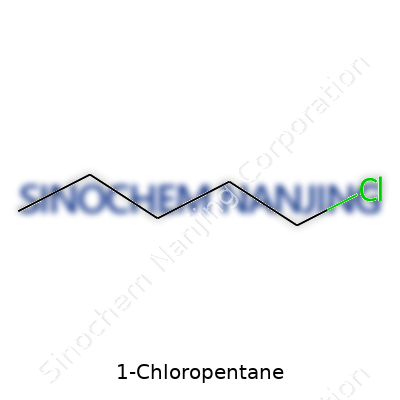
| Names | |
| Preferred IUPAC name | 1-chloropentane |
| Other names |
1-Chloropentane n-Pentyl chloride Pentyl chloride n-Amyl chloride Amyl chloride |
| Pronunciation | /ˈklɔːr.oʊ.pɛn.teɪn/ |
| Identifiers | |
| CAS Number | 543-59-9 |
| Beilstein Reference | 1361214 |
| ChEBI | CHEBI:82608 |
| ChEMBL | CHEMBL14701 |
| ChemSpider | 15844 |
| DrugBank | DB14004 |
| ECHA InfoCard | 100.003.614 |
| EC Number | 203-927-0 |
| Gmelin Reference | 82764 |
| KEGG | C01064 |
| MeSH | D018782 |
| PubChem CID | 12364 |
| RTECS number | RA0350000 |
| UNII | F7V1CQ15M3 |
| UN number | UN1993 |
| CompTox Dashboard (EPA) | DTXSID6020207 |
| Properties | |
| Chemical formula | C5H11Cl |
| Molar mass | 122.6 g/mol |
| Appearance | Clear, colorless liquid |
| Odor | Penetrating odor |
| Density | 0.872 g/mL |
| Solubility in water | Insoluble |
| log P | 2.8 |
| Vapor pressure | 2.5 kPa (at 20 °C) |
| Acidity (pKa) | 16.0 |
| Basicity (pKb) | 'Product 1-Chloropentane has a pKb of approximately -' |
| Magnetic susceptibility (χ) | -7.83 × 10⁻⁶ cm³/mol |
| Refractive index (nD) | 1.404 |
| Viscosity | 0.773 mPa·s (20 °C) |
| Dipole moment | 2.03 D |
| Thermochemistry | |
| Std molar entropy (S⦵298) | 216.4 J·mol⁻¹·K⁻¹ |
| Std enthalpy of formation (ΔfH⦵298) | -171.0 kJ/mol |
| Std enthalpy of combustion (ΔcH⦵298) | -3556.7 kJ/mol |
| Hazards | |
| GHS labelling | GHS02, GHS07 |
| Pictograms | GHS02,GHS07 |
| Signal word | Danger |
| Precautionary statements | P210, P260, P273, P301+P310, P305+P351+P338, P331 |
| NFPA 704 (fire diamond) | 1-1-0 |
| Flash point | 27 °C (closed cup) |
| Autoignition temperature | 220 °C |
| Explosive limits | 1.2–7.2% (in air) |
| Lethal dose or concentration | LD50 oral rat 4060 mg/kg |
| LD50 (median dose) | LD50 (median dose): Oral-rat LD50: 3,027 mg/kg |
| NIOSH | RN0410000 |
| PEL (Permissible) | Not established. |
| REL (Recommended) | REL (Recommended): NIOSH REL: 100 ppm (500 mg/m³) TWA |
| IDLH (Immediate danger) | 500 ppm |
| Related compounds | |
| Related compounds |
n-Pentyl chloride 1-Bromopentane 1-Iodopentane 1-Fluoropentane Pentane 1-Chlorobutane |



