1-Bromopentane: A Deep Dive into a Key Organic Compound
Historical Development
Chemistry does not often deliver flashy stories, but some compounds quietly shape labs and industries. 1-Bromopentane came into play during a period when synthetic organic chemistry surged in the late nineteenth and early twentieth centuries. Early researchers recognized the synthesis and alkylation potential of halogenated compounds, with bromides offering better reactivity compared to their chlorinated cousins. Traditional labs used 1-bromopentane for building larger molecules and creating organometallic reagents, and it carved out a unique role as a gateway intermediate for more complex structures. Generations of chemists relied on it for both educational reactions and industrial-scale alkylations, keeping it relevant across decades.
Product Overview
1-Bromopentane—known by its CAS number 110-53-2—belongs to the class of alkyl halides. This compound lies right in the middle of the chain-length sweet spot, being long enough for interesting physical attributes and short enough to offer brisk, manageable reactivity. Its straightforward five-carbon skeleton and terminal bromine make it more than just a formula written on the board; it represents real-world utility in chemical manufacture, research, and training future chemists how to handle halogenated organics.
Physical & Chemical Properties
Pour 1-bromopentane and you'll see a colorless liquid with a not-too-intense, sweet odor. Its boiling point, lodged around 129°C, sets it apart from lighter alkyl bromides like 1-bromopropane, which boils much lower. The density reflects its bromine content, tipping the scale at about 1.22 g/cm³. Water and this compound do not mix, and it floats right between the organic and aqueous phases when poured into a separatory funnel. Chemists notice how it dissolves well in most non-polar solvents and stays chemically stable under ordinary lab storage conditions. Structurally, with a simple Br atom at the terminal carbon, its reactivity centers on classic nucleophilic substitutions and coupling reactions, offering broad scope for derivatization.
Technical Specifications & Labeling
Every drum or bottle containing 1-bromopentane needs more than just a name. Suppliers attach detailed labels stating purity, usually 98% or higher for lab use, and note any stabilizer content to fend off unwanted reactions. Lot number, storage requirements, date of manufacture, and specific hazard pictograms fill out the rest of the label. Importantly, buyers look for any sign of yellow discoloration or cloudiness as a warning for degradation. Reliable suppliers support all this transparency with certificates of analysis, providing GC or NMR data. Strict inventory and transport controls keep it safe from misuse or lapses in tracking, especially since regulatory frameworks treat many alkyl halides with heightened scrutiny.
Preparation Method
Classic organic synthesis textbooks walk through the making of 1-bromopentane step by step, often starting from the corresponding alcohol, 1-pentanol, and treating it with hydrobromic acid or a phosphorus tribromide/bromine combo. The process typically happens under reflux, sometimes with a phase separator, yielding the pure alkyl bromide in respectable yields. For industrial scale, the reaction uses larger vessels, controlled feeds of pentanol, and careful temperature regulation to maximize output and minimize byproducts like dibromides or rearranged alkenes. After the reaction, chemists separate the bromopentane, wash it with water or brine, dry over anhydrous calcium chloride, and purify by distillation, always mindful of the compound’s volatility and the health risks associated with hydrogen bromide vapor.
Chemical Reactions & Modifications
This compound has an open field for transformation. Nucleophiles like amines, cyanides, or alkoxides quickly snap up the bromide in an SN2 reaction, pushing aside the leaving group to form a new carbon-nitrogen, carbon-cyano, or carbon-oxygen bond. Magnesium and lithium covet the bromine in dry ether to create powerful organometallic intermediates—Grignard and organolithium reagents—that chemists exploit for carbon chain extension and countless coupling strategies. Reducing agents can strip away the bromine, leaving behind pentane. Oxidative or photolytic conditions rarely visit this compound in routine labs but provide more exotic routes for modification in polymer and material science work.
Synonyms & Product Names
Anyone stepping through catalogs or reference lists comes across 1-bromopentane under names like pentyl bromide, n-pentyl bromide, n-C5H11Br, or even primary pentyl bromide. Regulatory systems and shipping manifests still mostly stick with the original IUPAC naming. Some older literature refers to it as amyl bromide, although that term often confuses it with branched or mixed isomers. Recognizing these synonyms helps to dodge errors in ordering or inventory, keeping research and production running without hiccups.
Safety & Operational Standards
Labs working with 1-bromopentane respect the risks that come with organohalides. Short-term inhalation or skin contact brings irritation and possible nervous system effects. Protective gloves, splash goggles, and work under a fume hood form the baseline for lab safety. Accidental spills need swift response and absorbent material that blocks the vapor; no one wants bromine-rich air circulating among staff. For larger operations, regular air quality checks and exposure monitoring happen every shift. Storage requires sealed, non-reactive containers—glass or compatible plastics—far from strong bases or oxidizers. Emergency protocols and periodic hazard training round out a safety profile built on both regulation and long-term experience.
Application Area
The real world values 1-bromopentane for what it can become. Labs use it to create longer hydrocarbon chains for specialty chemicals, flavors, fragrances, and surfactants. Pharmaceutical chemists reach for it early in drug synthesis pathways, where it acts as an alkylating agent to stitch together new biologically active molecules. In the world of material science, compounds built from this bromide find service in plasticizers and advanced polymer synthesis. Even analytical labs use it as a reference compound or internal standard. Flexibility carries the compound across many sectors, where each use case tweaks reactivity or purity requirements to fit a particular job.
Research & Development
Ongoing research around 1-bromopentane tracks two main directions. The first involves greener, safer synthesis—developing catalytic or phase-transfer methods that sidestep hazardous waste and lower energy consumption. Researchers trial continuous flow or microwave-assisted synthesis to boost yields and limit risk. The second direction dives deep into reactivity, finding clever ways to use this compound for cross-coupling or to create novel heterocycles, surfactant backbones, or sensor molecules. Academic groups and industrial R&D teams publish improvements in selectivity, scalability, and downstream modification, each hoping to unlock more value from a well-known structural template.
Toxicity Research
Hazards from alkyl bromides spark significant attention in toxicology. Research documents that 1-bromopentane behaves like other short-chain alkyl halides, causing central nervous system depression and, at high doses, damage to liver and kidneys in laboratory animals. Chronic exposure leads to cumulative toxicity risk, making air monitoring and proper ventilation essential. The compound does not persist long in the environment—hydrolysis and biodegradation usually break it down—though concerns linger about acute aquatic toxicity, especially to small water organisms. These findings drive regulations on permissible workplace limits and shipment controls. Translating animal toxicity data into workplace best practices keeps incidents rare and secures long-term occupational safety.
Future Prospects
Chemical manufacturing always demands a sharper focus on both efficiency and sustainability. For 1-bromopentane, trends point toward lower-emission syntheses, bio-based feedstocks, and smart recycling of bromide wastes. Researchers aim for catalyst development that eliminates byproduct formation and allows for precise control over the desired reaction. Larger industrial users invest in process intensification—including continuous flow chemistry—which supports scalable, cost-effective, and green production lines. Academic labs investigate how slight tweaks to the carbon chain or substituent might deliver new reactivity or open up fresh application fields. As demand grows in complex molecule synthesis, the need for well-characterized, reliable starting materials like 1-bromopentane only gets stronger. Progress in safe handling, efficient preparation, and smart application promises to keep this compound a fixture in the years ahead, both as a tool for discovery and a staple for industry.
What is 1-Bromopentane used for?
Building Blocks Matter
Chemistry feeds the world more than most realize. Out in the world of laboratories and factories, 1-bromopentane holds a practical, yet quiet role. This colorless liquid, made up of five carbon atoms linked to a bromine atom, might not spark recognition, but plenty happens because of it. I remember seeing bottles of 1-bromopentane racked behind safety glass in the university lab, smelling the faint scent that hints toward its potency. The first thing that crosses a chemist’s mind isn’t the bottle—it’s the invisible chain starting from it.
Let’s Get Into Its Real Jobs
Many of today’s specialty drugs and well-known chemicals start with smaller, simple molecules. 1-bromopentane is one of these workhorses. It acts as an “alkylating agent”—a chemical that attaches carbon chains where they’re needed. Drug makers reach for it to build complex scaffolds in medicines, inserting pentyl groups into larger molecules. Synthetic chemists like working with it because it reacts cleanly and predictably.
The story doesn’t stop with pharmaceuticals. Pesticide manufacturers also rely on this chemical as a starter piece in the synthesis of new crop protection agents. Often, it plays a part that’s hidden after the end product is finished—the chemical transformed, but the pathway made possible by 1-bromopentane. Its predictable reactions help industries create custom chemicals. Factories use it to introduce a five-carbon chain into other compounds, producing surfactants and plasticizers used in lubricants, cleaning agents, and some materials found in everyday life.
Benefits and Risks Side by Side
In chemical manufacturing, efficiency means everything. Fewer steps, higher yields, and safer processing make the difference between sensible production and waste. 1-bromopentane offers this efficiency thanks to its reliable structure. Yet, those of us who’ve worked with such reagents know the hazards too. Once, while helping prepare a reaction using 1-bromopentane, the fume hood’s exhaust fan broke down for a few minutes. The sharp headache that followed assured me of its potency—this isn’t something to pour in an open space. Short-term exposure can irritate skin and eyes. Long-term exposure can damage the nervous system or liver. Reliable chemical handling procedures, protective gear, and controlled environments stay non-negotiable.
Oversight often lags behind chemistry’s fast pace. Regulations in some developing regions let some slip through the cracks, allowing misuse or unsafe disposal. In the US and EU, waste from 1-bromopentane gets designated as hazardous, so it gets collected and broken down instead of leaking into waterways. Keeping this discipline global will keep both people and ecosystems from paying the price down the line.
Looking Forward: Greener Pathways
Chemistry’s always adapting. Interest in using renewable feedstocks for organobromine compounds grows every year. Researchers are investigating catalytic processes that trim waste and provide safer, less toxic alternatives. Until large-scale replacements reach the market, people handling 1-bromopentane stick with careful habits and strict safety measures. Training new chemists right, investing in green chemistry, and making sure manufacturers follow up-to-date regulations all help shrink the risks tied to this useful but dangerous chemical.
Every new medicine or material reaching a shelf carries an invisible trail, and sometimes that trail leads back to a modest, clear bottle labeled “1-bromopentane.” The world needs skilled people and smart rules to keep those pathways safe.
What is the molecular formula of 1-Bromopentane?
Chemical Details That Shape Everyday Life
1-Bromopentane brings together five carbon atoms, eleven hydrogens, and a single bromine. Its molecular formula reads C5H11Br. That simple text string holds more than meets the eye. Years back, I worked in a teaching lab where students got their hands messy with organic reactions. One day, a student asked why we care about the formula beyond test answers. These small details tell stories about how chemicals interact, break down, or show up in medicine, energy, and the plastics in daily life.
Understanding Why Formulas Matter
Textbooks hand out formulas as facts, expecting rote memorization. Anyone who’s spent a late night before a chemistry exam knows that pain. The thing is, those numbers and letters predict how a molecule will behave. Swap a hydrogen for a bromine and you end up with a completely different chemical identity. That single halogen gives 1-bromopentane more weight and reactivity than plain pentane, making it a useful building block in labs and factories.
Real-World Impact in Industry and Research
C5H11Br isn’t just a set of pretty symbols. This compound’s structure lets it join with other molecules to form new materials or help in making pharmaceuticals. I once saw a plant manager explain to a group of trainees how a single miscalculation in a formula led to a full day of downtime and thousands lost. Precision turns into a big deal at a scale like that, both for cost and safety. Brominated alkanes such as 1-bromopentane show up in labs for creating longer carbon chains, often ending up as parts of flavors, dyes, or specialty oils.
Respecting Safety and the Environment
It’s easy to overlook safety. Compounds carrying bromine can turn dangerous if not handled correctly. A friend who used to work in chemical waste management told me stories of how poor labeling and confusion over formulas caused workers to mix incompatible chemicals. Even experienced hands can fall victim to momentary lapses. Any time a human health risk exists, care with identification and handling beats shortcuts.
Solutions and Responsible Use
We can push for safer labs and workplaces by sticking to clear communication and solid training. One smart move is using electronic inventory and tracking tools, which cut down on labeling errors. Another involves regular refresher sessions about chemical formulas and safe handling practices, switching from textbook recitation to hands-on, real-world examples. Regulators have started requiring better reporting on potentially hazardous compounds, and that puts more eyes on exact identification. That benefits not just the people directly handling chemicals, but whole communities downstream.
Sticking to facts, respecting detail, and making safety practical creates a culture where accidental exposure or misuse gets rare. The true formula for safety and progress stretches far beyond C5H11Br, yet it always begins with knowing precisely what’s in the bottle.
How should 1-Bromopentane be stored safely?
Understanding What You’re Dealing With
1-Bromopentane is a colorless liquid used in labs and industry for making other chemicals. It smells a bit sweet, kind of like gasoline with a hint of almond, so you know you’re around it even if you can’t see it. Exposure to its vapors or spills can cause eye, skin, and lung irritation. Knowing these risks matters, since small mistakes can deliver big headaches or worse.
Why Storage Details Matter
Some chemicals don’t get on well with sunlight, sparks, or humidity. 1-Bromopentane sits in that crowd. Left on a crowded shelf without thought, a leaky lid or scrap of spark can start something nobody wants. Over the years working in labs and with students, I’ve seen more than one accident traced to a lazy storage plan.
The Smart Way to Store 1-Bromopentane
- Keep It Cool and Dry Heat makes 1-Bromopentane build up pressure fast inside its container. It helps to keep it somewhere below 25°C, away from radiators or sunny windows. Humidity can trigger reactions with the container or even corrode metal shelving, so dry air trumps muggy corners every time.
- Lock Up and Label Well You want a sealed, tough container with a solid lid. No glass with old corks, and no containers that show rust or wear. Every bottle needs a legible label facing out. Everyone sharing the space can spot what’s inside, batch numbers, and hazards without guesswork.
- Ventilated Storage Spots Make a Difference Store in a fume hood, ventilated cabinet, or chemical storage room that pushes air outdoors. Vapors hang low, and without proper air flow, even a tiny spill can stick around and bite later.
- Don’t Mix With Incompatibles 1-Bromopentane plays rough with strong oxidizers like peroxide and nitric acid. Store away from acids, alkalis, and metals that can corrode. Grouping chemicals by hazard class really cuts down the odds of a dangerous reaction.
- No Food or Drinks Near Work Areas Cross-contamination seems like a problem for sloppy operators, but I’ve seen seasoned techs sip tea beside a bench. Lock down food policy so everything stays outside the chemical zones.
- Keep Spill Kits and Eye Wash Nearby No one plans for spills, but they still happen. Stock kits for both small and large leaks—absorbent pads, neutralizing binders, nitrile gloves, goggles. An eye wash station in arm’s reach is not overkill.
Facts That Back This Up
Organizations like OSHA, NIOSH, and the European Chemicals Agency publish clear warnings and storage criteria for alkyl halides like 1-Bromopentane. Major chemical companies also print handling guides that all name cool, dry, ventilated storage as best practice. They track incidents and update rules to close gaps the hard way—after incidents, not before.
Solutions: Training and Routine Checks
All workers, interns or veterans, need real training that lets them recognize risky setups. You catch rusted containers, missing labels, or broken vents during weekly inspections. Logs of these checks reduce shortcut-taking, and they show if gear quietly fails. No fancy tech or software required—just real eyes and a willingness to act before a small mistake turns serious.
Caring about storage turns into a habit, rooted in lived experience. Safety rules not only protect workers, but keep labs open and supplies unspoiled. Taking a bit of time for good storage pays off every year with fewer close calls, clean workspaces, and time saved cleaning up messes that didn’t need to happen.
What are the potential health hazards of 1-Bromopentane?
Understanding 1-Bromopentane in Everyday Life
Most folks never think about 1-bromopentane. It sounds like the kind of thing you read on the back of a chemical drum, not something that pops up in your daily routine. Yet, it’s out there, mainly in labs or places that handle chemicals for making medicines or specialty products. Clear and a little bit sweet-smelling, this liquid hardly feels dangerous at first glance. Still, the health hazards deserve a real look.
What Science Says About Exposure
Breathing in 1-bromopentane can irritate your nose and throat. Over time or in high doses, it causes headaches, dizziness, and drowsiness. Some people get skin rashes or even blisters if it spills on their hands. I remember working in a lab as a student. Even trained staff counted on chemical-resistant gloves and good ventilation, but every so often, someone would have a minor spill. The lesson stuck with me: skin contact isn’t just uncomfortable, repeated exposure may lead to worse problems like dermatitis or long-term nerve damage.
Research suggests long-term exposure can have more lasting effects. Studies on brominated chemicals show most stick around in the environment and the body a bit longer than you’d hope. In animals, high doses sometimes damaged the liver and affected the nerves. For people, there’s less concrete data, but nobody wants to take chances with solvents that have links to neurological issues or organ damage.
Risks for Workers and The Public
Most people outside the chemical business have only tiny odds of running into 1-bromopentane. Still, workers in labs, factories, or recycling centers deal with it directly. I've seen safety teams drill everyone on fume hoods and emergency wash stations, because once someone inhales or spills these kinds of chemicals, quick action counts. Folks cleaning out old industrial sites—sometimes with no clear idea what’s inside old containers—face even higher risks.
Sometimes, chemicals leak or spill during transport, hitting air or groundwater. Local news stories have covered mysterious odors from industrial parks; many times, investigators later point to halogenated organics like this. Even small leaks add up, especially near neighborhoods. Long-term contamination doesn’t just affect workers but whole communities.
How to Manage The Hazards
It pays to respect any chemical, but those using 1-bromopentane should really lean into safe practices. That means gloves, goggles, and using it only with ventilation designed for volatile organics. Dumping chemicals down the drain or tossing them in regular garbage simply spreads the risk. Companies should train staff, refresh spill drills, and always label storage areas clearly. Many problems start when things get sloppy after years of routine.
Proper disposal helps way more than people think. Specialized waste outfits handle old solvents safely. Policymakers also play a role, setting exposure limits, funding ground and water testing, and pushing for safer alternatives where possible. Regulatory agencies lay out benchmarks, but oversight matters. Neighbors and advocacy groups call out problems, and that pressure makes a difference in real cleanup.
Final Thoughts on Smart Handling
Chemicals like 1-bromopentane don’t need to be household names to matter. Most risks drop with the right storage and handling. Science keeps sharpening our understanding, but the basics—gloves, vents, responsible disposal, and sharp eyes—do much of the heavy lifting. In the long run, taking care with solvents makes workplaces safer and neighborhoods cleaner.
What is the purity specification for 1-Bromopentane available for purchase?
What Purity Means in Chemical Supply
You shop for chemicals. You want to know just what’s in each bottle. That story rings especially true for organic reagents like 1-bromopentane. Most suppliers offer it at a stated purity, usually ranging from 98% up to 99%. In lab practice, this percentage directly shapes your results. It’s not an abstract number tucked into a spec sheet—it’s about clean chemistry and results you trust.
Labs lean on these purity ratings because unwanted impurities mess with yields, create unknown byproducts, and skew analytics. An extra 1% impurity could include unreacted pentanol, leftover solvents, or even bits of other alkyl halides. If your reaction has a mind of its own, it might be thanks to what got bottled along with the main ingredient. Even trace impurities can block synthesis steps or play tricks during NMR or GC-MS analysis. This gets especially relevant when you’re making something new, scaling up, or working under regulatory guidelines where proof of purity and documentation back up every step.
Industry Practice and Current Specs
I’ve checked catalogs from chemical giants and niche suppliers alike. The majority of commercial 1-bromopentane comes labeled at 98% or 99% purity. Big research brands publish full analytical data: GC traces, specific gravity, and sometimes water content by Karl Fischer titration. Even at “99%,” 1-bromopentane can carry up to 1% of some cocktail of pentene or other halide byproducts. For those working on pharmaceutical syntheses or needing better guarantees, some suppliers do offer HPLC or GC-certified lots at higher cost.
What does this mean for the bench chemist or engineer? Order the standard 98% and you’re looking at general research work, preliminary studies, or basic process trials. For QC testing or GMP-regulated labs, you probably reach for documentation that spells out every contaminant over 0.1%. In my own work in academic labs, we often ordered standard 98% grade and ran a quick double-check analysis before any sensitive reaction. If anything felt wrong—odor, color, or an old “best before” date—we’d distill it ourselves. That extra step never feels wasted, especially after a botched reaction that traced back to a bad batch.
Concerns and Moving Forward
A lot rides on trust in the supply chain. Subpar lots can slip through, or travel poorly thanks to hot shipping warehouses. Regulators in the U.S. and EU push for better traceability. Documentation now comes stacked with batch analytics, certificate of analysis (CoA), and traceable source info. In my experience, the best labs keep careful digital logs tied to each chemical bottle—including not just the stated purity, but results from their own spot-checks. This approach catches surprises before they spiral into wasted runs or mysterious contaminants in the data.
Some buyers still chase the cheapest offer online and skip these checks. In regulated spaces like pharma, that’s a non-starter. For those environments, either find a supplier that stands up to scrutiny, or put systems in place for regular in-house testing—NMR, GC, or titration. For the rest of us, don’t ignore red flags: a batch that smells off, looks cloudy, or turns your results sideways rarely gets fixed by crossing your fingers.
Smart Purchasing Keeps Chemistry Honest
With chemicals like 1-bromopentane, the thumb rule stays simple: specs from 98% to 99% meet most research or industrial needs, but only buy from sources that provide complete paperwork and batch proof. One bad bottle can set you back more than the few extra dollars spent on guaranteed purity.
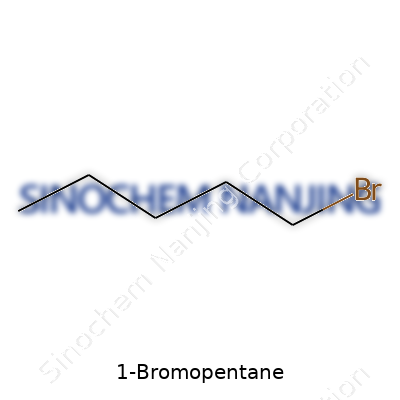
| Names | |
| Preferred IUPAC name | 1-bromopentane |
| Other names |
n-Pentyl bromide Pentyl bromide Pentane, 1-bromo- 1-Pentyl bromide |
| Pronunciation | /ˌwaɪˈbrəʊməʊˈpɛnteɪn/ |
| Identifiers | |
| CAS Number | 110-53-2 |
| Beilstein Reference | 1208736 |
| ChEBI | CHEBI:81335 |
| ChEMBL | CHEMBL141240 |
| ChemSpider | 10959 |
| DrugBank | DB02395 |
| ECHA InfoCard | ECHA InfoCard: 100.003.957 |
| EC Number | 203-912-4 |
| Gmelin Reference | 60753 |
| KEGG | C08330 |
| MeSH | D001938 |
| PubChem CID | 8027 |
| RTECS number | EJ8750000 |
| UNII | N8JH4DV8VS |
| UN number | UN1266 |
| Properties | |
| Chemical formula | C5H11Br |
| Molar mass | 137.04 g/mol |
| Appearance | A colorless to pale yellow liquid |
| Odor | pleasant |
| Density | 1.216 g/mL at 25 °C |
| Solubility in water | Insoluble |
| log P | 2.9 |
| Vapor pressure | 1 mmHg (at 46°C) |
| Acidity (pKa) | 16.0 |
| Basicity (pKb) | 'Basicity (pKb)' of 1-Bromopentane is '–3.03' |
| Magnetic susceptibility (χ) | -66.2·10⁻⁶ cm³/mol |
| Refractive index (nD) | 1.436 |
| Viscosity | 1.161 mPa·s (20 °C) |
| Dipole moment | 2.00 D |
| Thermochemistry | |
| Std molar entropy (S⦵298) | 216.0 J·mol⁻¹·K⁻¹ |
| Std enthalpy of formation (ΔfH⦵298) | –84.0 kJ·mol⁻¹ |
| Std enthalpy of combustion (ΔcH⦵298) | -3526 kJ/mol |
| Hazards | |
| GHS labelling | GHS02, GHS07 |
| Pictograms | GHS02,GHS07 |
| Signal word | Warning |
| Hazard statements | H226, H315, H319, H335 |
| Precautionary statements | P210, P261, P280, P301+P312, P303+P361+P353, P305+P351+P338, P312 |
| NFPA 704 (fire diamond) | 1-1-0 |
| Flash point | 42 °C |
| Autoignition temperature | 220 °C |
| Lethal dose or concentration | LD₅₀ (oral, rat): 2,250 mg/kg |
| LD50 (median dose) | LD50 (median dose): Oral rat LD50: 2,660 mg/kg |
| NIOSH | RX9625000 |
| PEL (Permissible) | Not established |
| REL (Recommended) | 1 – RECOMMENDED |
| IDLH (Immediate danger) | 500 ppm |
| Related compounds | |
| Related compounds |
1-Chloropentane 1-Iodopentane 1-Fluoropentane Pentanol Pentene |



