1-Bromohexane: From Early Beginnings to Today’s Uses
Historical Development
Talking about 1-Bromohexane always takes me back to the roots of organic chemistry. Chemists in the 19th century started pushing the limits of what they could extract or synthesize from the endless world of hydrocarbons. Men like August Wilhelm von Hofmann laid down the basics of making alkyl halides by halogenating alcohols. Over the decades, improvements in purification and separation set the stage for folks in both industry and research to put 1-Bromohexane to work. The chemical didn’t stay a curiosity for long—pharmaceutical giants needed it for molecular building. Materials scientists saw the value for specialty polymers. Academic labs started reaching for it because of its versatility in substitution reactions and chain extension. Every improvement in technique—from vacuum distillation to better temperature control—helped make 1-Bromohexane far more accessible than in those old glass flasks.
Product Overview
A bottle of 1-Bromohexane carries the essence of a six-carbon linear alkyl chain capped by a single bromine atom. The molecular formula is C6H13Br. It's not just a raw chemical—many view it as a reliable building block, especially for those seeking to introduce a hexyl group or a bromine handle into more complex molecules. Its utility hasn’t faded with time: anyone working on synthesizing pharmaceuticals, surfactants, or complex organic intermediates will likely have encountered it on the shelf. By reliably delivering both an alkyl and a halogen group, it’s become a staple that folks often reach for when looking to carry out one-pot syntheses or couple reactions.
Physical and Chemical Properties
Experience tells me there’s no mistaking 1-Bromohexane in the lab. It pours as a clear, colorless, oily liquid with that faint, sharp smell you associate with many simple bromoalkanes. The boiling point sits around 155°C and at room temperature, its density hovers close to 1.17 g/cm3. Solubility leans strongly toward organic solvents—hexane, toluene, ether—but it wants nothing to do with water. This chemical has a moderate vapor pressure, which warns folks to keep it capped, as the fumes are no joke for the unprepared. If you ever watch it under UV light, you’ll notice it’s stable—no decomposition to bother you during reactions—making it an easy candidate for those seeking predictable outcomes in their experiments.
Technical Specifications and Labeling
Manufacturers rarely take chances with specifications these days. A typical container will spell out purity, usually at 98% or above for research-grade product. Impurity profiles might list minor traces of 1-chlorohexane, hexanol, or hexene, usually below 1%. Safety warnings get printed in clear font: “Flammable liquid,” “Harmful if swallowed or inhaled,” and “Causes skin and eye irritation.” Most come with a CAS number—111-25-1—which provides a quick check for anyone needing to verify the identity. Labels highlight the batch number and expiry, just as they should, to ensure traceability. Material safety data sheets go further, listing everything from the UN transport code down to guidelines for storage below 30°C, well-ventilated, and away from oxidizing agents.
Preparation Method
The roots of classic organic synthesis run deep here. Traditional prep routes start with 1-hexanol, which reacts with a strong brominating agent. Phosphorus tribromide, hydrobromic acid, or even bromine in presence of phosphorus can do the trick. In the lab, I’ve run these transformations by mixing the alcohol and carefully controlling the addition of the brominating agent, keeping everything ice-cold, and watching for the phase separation that gives away the alkyl bromide layer. Newer approaches, mindful of waste and hazards, explore greener routes, especially those involving catalytic bromination or phase-transfer catalysts to cut down on harsh acid use and streamline purification.
Chemical Reactions and Modifications
1-Bromohexane stands out as an open invitation for substitution and elimination. The bromide group practically begs for nucleophiles. I’ve watched this compound react to give amines, ethers, and thiols simply by mixing with the right partners under suitable conditions. It also takes well to metallic sodium for Wurtz reactions, allowing chemists to stitch hydrocarbon chains together into higher alkanes. Elimination runs with strong bases create hexenes—useful for downstream chemistry. In the hands of inventive researchers, modifications extend to Suzuki couplings after converting the bromide to a boronic ester or to Grignard reagents, broadening the synthetic potential by a mile.
Synonyms and Product Names
A quick scan of catalogs reveals a tangle of names, often reflecting old conventions. You’ll find it under n-Hexyl bromide, 1-bromo-n-hexane, and sometimes just Hexyl bromide, though the last can confuse newcomers with isomeric forms. Retailers may throw in the CAS number for clarity. Some safety sheets go with the systematic approach—1-bromhexan for European data. These names spill over into pharma inventories, chemical reaction textbooks, and even regulatory reports.
Safety and Operational Standards
Anyone who’s worked a shift in a chem lab knows that healthy skepticism saves skin and lungs. 1-Bromohexane won’t ignite spontaneously, but it catches easily enough that open flames and hot plates always spell trouble. Good ventilation cuts down on inhalation nonsense—fume hoods and PPE are standard procedure. Breathing vapors isn’t just uncomfortable; chronic exposure may affect the nervous system. Most guidelines stress quick removal from exposure, skin rinsing, and medical attention if accidental ingestion happens. Waste disposal rules treat the compound with respect—never down the drain and always marked as halogenated solvent for chemical waste pickup. Long-term storage boxes call for tight seals, fire protection, and clear hazard signs in line with industry-wide standards.
Application Area
1-Bromohexane rarely gathers dust on a chemical stockroom’s shelf. It jumps between roles in pharma, agrochemicals, surface coatings, and oil recovery. I’ve seen it used to make surfactants that stabilize everything from lotions to pesticide sprays. It’s needed for advanced polymers and block copolymers where long alkyl chains bring flexibility and hydrophobicity. Drug discovery chemists pick it for chain elongation and to make active intermediates needed for further elaboration. Folks in academic research return to it again and again as a dependable alkyl source in structure-activity projects on new compounds.
Research and Development
Every time synthetic chemists look at a tough target molecule, reagents like 1-Bromohexane show their worth. R&D teams continue testing new catalytic systems for better coupling, cleaner substitutions, and more eco-friendly conditions. There’s work underway to substitute hazardous brominating agents with safer, recyclable ones. Material scientists push the boundaries by designing functionalized hexyl derivatives, aiming for smarter surfaces or new drug candidates. Across many fields, the push is for efficiency, atom economy, and greener production—every improvement trickles down, cutting costs and hazards for students and professionals alike.
Toxicity Research
Toxicologists flagged 1-Bromohexane as more than just an irritant decades ago. Animal studies note impacts on nervous function at high exposures. Extended inhalation, as reported in some industry cases, brings risk of headaches, dizziness, or numbness. The compound moves easily through skin, making gloves and lab coats a must. Regulatory updates track chronic effects, especially for workers in large-scale production. Most labs stress glove selection, restrict skin contact, and maintain strict limits on volatility in indoor air. Data continues to evolve, but the trend is clear—reducing exposure protects both short-term well-being and long-term health.
Future Prospects
The days ahead look set to amplify 1-Bromohexane’s reach, especially as demand grows for specialty polymers, bioactive molecules, and sustainable materials. Advances in catalytic methods might make bromination faster and less polluting, trimming waste streams and costs. As chemists tap biobased routes to produce alcohol precursors, making the final steps to 1-Bromohexane cleaner and safer grows likely. Ongoing work in analytical detection and exposure reduction aims to protect those working with the compound at every step. While no single chemical holds the key to all of industry’s challenges, the reliable handling and ever-adapting uses of 1-Bromohexane prove that even classic compounds have plenty of runway left for new ideas and safer practices.
What is 1-Bromohexane used for?
A Look at a Common Yet Overlooked Chemical
If you ever opened a college-level organic chemistry textbook, you probably saw 1-bromohexane tucked somewhere among dozens of other halogenated compounds. It’s not flashy, but it finds its way into a surprising number of experiments and real-world products. My own brush with this liquid came during undergrad labs, pipetting its clear, distinct-smelling form to help build more complex organic molecules. Many students started learning about nucleophilic substitution reactions using it. There’s a reason it turns up over and over.
So what sets 1-bromohexane apart? Its structure is simple: six carbon atoms line up with a bromine atom attached at the end. That bromine atom isn’t just along for the ride. Swapping it out unlocks a world of possibilities.
Making Ingredients for Life’s Materials
Industries use 1-bromohexane to stick new groups onto carbon chains—this can lead to substances with all sorts of uses. Manufacturers count on this trick to make molecules for flavors, perfumes, surfactants, and more. In a factory, it's easy to imagine pipes moving the reactive liquid into mixing tanks, transforming it step by step into something you might find in detergent or hair products.
My experience tells me most people never realize that the fragrances in household sprays or shampoos might owe their existence to a chemical cousin of 1-bromohexane. Its ability to act as a starting material, thanks to the reactive bromine, gives chemists reliability. They lean on that, especially when purity and predictability matter.
The Researcher’s Sidekick
In university labs, 1-bromohexane serves another purpose—a teaching tool. Under controlled settings, its reactivity makes it a favorite to demonstrate how carbon-halogen bonds break and form. Professors hand out this compound to show substitution and elimination reactions in action. These demonstrations matter. A safe, predictable reaction helps students build confidence before they move on to more complicated challenges.
Researchers turn to it for another reason: it helps form longer carbon chains or introduce functional groups without much fuss. Its single bromine doesn’t get in the way of forming new bonds, so if someone wants to add a six-carbon tail to a molecule, it’s usually the first choice. That kind of utility saves both time and money.
Worries and Safer Handling
Like every halogenated hydrocarbon, 1-bromohexane comes with its own list of safety concerns. Its fumes need to stay out of enclosed spaces because regular exposure can bring headaches, dizziness, or much worse if you’re not careful. During my time in the lab, one rule always stood out: use it under a fume hood and keep those gloves on. The bromine-carrying molecules often find their way into biological systems—not something you want to happen by accident.
Chemical companies spend a great deal of effort finding greener solvents and safer alternatives when possible. Some labs now pick less hazardous alkylating agents, or they choose reaction conditions that cut down on environmental or health risks. There’s momentum in the field for improving both worker safety and reducing pollution. It’s not perfect yet, but every new project pushes the line a little further.
Looking Ahead
The story of 1-bromohexane isn’t just a tale of molecules—it’s a daily example of how science connects with living, breathing work. Its uses in making products and teaching students link chemistry’s theory to practical life. If there’s one takeaway from time spent handling 1-bromohexane, it’s that chemicals we rarely notice often help build the everyday world in ways nobody expects.
What is the molecular formula of 1-Bromohexane?
What’s In a Formula?
Most people glance at chemical names and see little more than intimidating jargon. The reality feels much simpler. Take 1-Bromohexane as an example. Its molecular formula—C6H13Br—tells a story that links high school labs to special chemical applications in research and industry. Having spent a couple of weekends watching students fumble with glassware while trying to make simple alkyl halides, I’ve noticed that formulas like this one serve as passports. They reveal what’s possible on the bench, how substances behave, and even give a few clues about risk and reward for those who handle them.
Why Details Matter in Chemistry
Every atom in a formula counts. With 1-Bromohexane, six carbons join in a continuous chain. Thirteen hydrogens wrap around that chain, and a single bromine atom waits off to one side, bound to the first carbon. This looks dry on paper, but the arrangement opens the door for chemical creativity. Add one halogen atom in the right spot, and suddenly you have a compound that reacts differently, dissolves in some solvents but not others, and can even act as a stepping stone for more complicated molecules.
Sitting in a lab, I’ve witnessed how important this arrangement can be. Organic synthesis often relies on reliable building blocks that can react in expected ways. The bromo group provides a useful “handle” for swapping in new pieces—a fact that organic chemists learn early. If the bromine gets misplaced or another carbon sneaks in, the properties shift, sometimes wrecking months of work.
Practical Uses and Principles
One thing I like to point out: 1-Bromohexane isn’t just theory. Companies use it as an intermediate, a kind of chemical relay baton. Swap out that bromine for something bigger—an amine, an alcohol—and you begin to see a pathway to pharmaceuticals, agricultural chemicals, or specialty plastics. In teaching labs, students chase after the same reaction, learning hard lessons in precision and patience.
Knowing the exact formula helps keep experiments safe. Brominated compounds raise flags for toxicity and persistence in the environment. Regulations exist for good reason. I remember a colleague mentioning that even a small spill prompted fumigation and air-checks: the molecular weights and atom counts feed right into workplace safety calculations and disposal decisions.
Toward Informed Use and Safer Practice
Knowledge matters. The more comfortable people become with molecular formulas and what they signify, the more equipped they are to act responsibly in the lab and the environment. With growing concern about chemical runoff and long-lived pollutants, paying attention to the precise atoms and bonds in a molecule like 1-Bromohexane moves from academic formality to a core aspect of safeguarding public health.
Educators can take a lead here. Clear, realistic discussions rooted in real-world lab experience build better chemists and safer workplaces. Students who can explain molecular formulas without shying away from specifics know what they’re handling and why it matters. In my experience, giving context—pointing out why the formula isn’t arbitrary—fosters both curiosity and respect for chemistry’s overlooked details.
Is 1-Bromohexane hazardous to health?
Understanding the Risks
Most people outside a chemistry lab probably never hear about 1-Bromohexane. For folks who do, knowing what this chemical can do to your body matters. Anyone who works with it or comes across it in an industrial setting needs to pay attention. This colorless liquid, known for its role in organic synthesis, brings a bundle of health risks that shouldn’t get ignored.
Direct Health Effects
A 1-Bromohexane bottle looks harmless, but fumes linger and skin absorbs much more than people expect. Breathing in even small amounts scratches at your throat and nose, leading to coughing, headaches, or lightheadedness. Splash a bit on your skin, and redness or burning can develop. I still remember seeing a college classmate handle a bromide compound too casually, ending up with red patches on his hands after lab. Direct contact isn’t just uncomfortable—it can mean long-term skin issues. Eyes and mucous membranes react strongly to this stuff too.
Worker safety studies show repeated exposure to chemicals like 1-Bromohexane can affect your nervous system. Studies published in journals like Regulatory Toxicology and Pharmacology note that folks handling similar haloalkanes showed symptoms like tremors, confusion, or dizziness. These are not one-off reactions—chronic exposure carries real neurological risk.
Routes of Exposure
Breathing vapors and touching liquid aren’t the only problems. 1-Bromohexane doesn’t just stay in one place—it floats. Spills on lab benches, poorly ventilated rooms, and leaks during transport push this chemical into the air. In manufacturing, accidental releases and improper storage can lead to problems outside the workplace, sometimes affecting communities nearby.
Keeping chemicals out of your system starts with awareness. Many folks rely on gloves, goggles, and proper hoods to stay safe, but mistakes still happen. Chemical engineering magazines have run pieces over the years about accidents caused by complacency—nothing breaks safety protocols like routine and overconfidence.
Looking at the Bigger Picture
Cancer risk gets mentioned with many organobromine compounds. The EPA and IARC have called for more research on 1-Bromohexane’s long-term risks, but animal studies already show some cause for concern. In these studies, chronic exposure has led to outcomes like organ damage and neurological changes, which line up with reports from workers around the world.
It’s tough to avoid 1-Bromohexane if you’re in certain industries. Best practice means strict ventilation, airtight storage, and regular air quality checks. Anyone working with this chemical benefits from routine training that keeps safety protocols fresh in their minds. For wider communities, environmental monitoring near production sites gives some peace of mind that emissions haven’t spread.
Better Solutions in Reach
Education still stands out as the cheapest, fastest way to save lives. In my experience, even seasoned lab workers develop safer habits after monthly reminders or seeing a near-miss firsthand. Management can push for closed-system manufacturing, which traps fumes and reduces accidents. Companies that invest in alternative chemicals for synthesis can dodge trouble altogether if safer compounds do the job.
Controlling exposure goes beyond labs. Emergency planners who map out spill response and teach medical providers what to do if people get exposed stand out in keeping damage minimal. People living near industrial plants deserve open communication about any risks and steps taken to limit them.
Staying healthy comes down to staying alert—nobody wants a careless slip to turn a handy ingredient into a health hazard.
How should 1-Bromohexane be stored?
Understanding What’s at Stake
Working in a chemical lab, I’ve handled enough halogenated solvents to respect the way their fumes hit the air, and 1-Bromohexane pulls no punches in that department. It’s a colorless liquid, but don’t let that fool you. Its vapor carries some real bite and a whiff too many leaves you dizzy or lightheaded. The challenge with this stuff isn’t just keeping it sealed—it’s knowing what can go wrong if you ignore the basics.
Finding the Right Spot
Experience taught me fast: never leave volatile liquids on a shelf next to sunlight or a radiator. 1-Bromohexane feels at home in a cool, dry spot, far away from any heat source. Temperatures across much of the United States swing a lot with the seasons. I’ve seen labs that tuck bottles away in the corner only to find them sweating in the summer. The sweet spot is below 25°C, ideally closer to 15°C if you’ve got controlled storage. Keeping it away from temperature spikes means fewer chances for vapor leaks—that saves money and headaches.
Choosing the Container
Safety isn’t just about location, it’s about what holds the chemical. I always reach for amber glass bottles with tight-sealing caps. Light helps break down bromoalkanes—ultraviolet exposure means impurities or even dangerous byproducts over time, which no one wants. Clear bottles don’t cut it. Polyethylene and mild steel react badly with 1-Bromohexane, too. In a bind, stainless steel can stand up, but glass almost always wins. Write the date and contents on the label in big, legible print.
Ventilation and Fume Risk
Fume hoods aren’t just furniture—they’re a shield. 1-Bromohexane evaporates faster than you’d expect if the stopper slips. Breathing in those vapors makes people nauseous or worse. I keep the bottle in a secondary container even inside the cabinet. If a bottle leaks, the tray catches it. Every now and then I check the seal for cracks—cheap insurance against broken sleep over a botched bottle.
Keeping Away Trouble
Sodium, potassium, and strong oxidizers cause all sorts of trouble when paired with 1-Bromohexane. That’s not just something you read in a safety sheet—one tiny splash and you’re in the kind of mess that clears out a room. Separate cabinets work better than sticky notes or tape lines. Never trust your memory with chemical pairs.
Emergency Prep Pays Off
No one likes to think about spills, but being caught off guard is worse. Absorbent pads, a bucket of neutralizer, and personal protective equipment belong close enough to grab without searching. I test the eyewash station monthly and remind the new folks how to work the shower in a hurry. Even after years of smooth shifts, I’ve seen accidents get out of hand in seconds. Planning saves more than just time.
Building Good Habits
Taking a moment to double-check the storage setup brings real peace of mind. 1-Bromohexane isn’t just another bottle in the lab—it’s a reminder that a good safety plan comes from respect for the risks and caring for the people working around you. Good habits keep the chemical where it belongs, and that keeps everyone moving forward.
What are the physical properties of 1-Bromohexane?
Not Just a Name in the Chemistry Book
1-Bromohexane might sound like a mouthful, but anyone who’s worked in a lab or with organic synthesis has run into chemicals like this. Its simple formula, C6H13Br, means it’s a six-carbon chain with a bromine slapped on one end. The way it behaves — not just on paper but in day-to-day handling — depends on a bunch of physical properties that set the tone for everything from storage to reactions, to just keeping things safe.
The Look and Feel
The substance comes as a clear, colorless liquid with a faintly sweet, not-too-pleasant odor. No flashy colors or warning signs when you pour it, yet you don’t want to get too casual. Getting it on your skin or breathing in the vapor never ends well – gloves and a fume hood aren’t luxuries. This is just everyday respect for safety in chemistry.
Why Boiling and Melting Matter
1-Bromohexane boils at about 155°C (311°F). That means in a lab with any moderate heating, there’s a real possibility for vapors to form. Too much heat, the stuff starts acting up as a vapor, so controlling temps during reactions becomes less about theory and more about staying smart. As for the melting point, you’re looking at around -87°C. Freezing this compound in normal conditions isn’t an issue most face, but it hints at how stable it stays as a liquid.
Density Tells a Bigger Story
Pour 1-Bromohexane into water and it sinks — density clocks in at around 1.18 g/cm³, heavier than water. There’s a neat trick here: if a spill lands in a sink or a beaker of water, it doesn’t sit on top. It goes under. So, clean-up changes, which matters for any busy workspace. Imagine missing a spill because it blended or hid at the bottom of a wash bottle. No one wants that kind of surprise on cleanup day.
Solubility Issues in the Real World
1-Bromohexane doesn’t mix well with water. In fact, it barely dissolves — about 0.35 g/L. But bring in organic solvents like diethyl ether, ethanol, or chloroform, and it blends with no fuss. Anyone doing extractions quickly learns what this means. Water-based clean-ups won’t cut it. Solvent choices and waste disposal pile up fast — you can’t just rinse a flask in the sink and be done.
Flash Point and Fire Risk
Flash points always get attention for a reason. For 1-Bromohexane, the flash point is about 49°C (120°F), so a warm room or a bit of stray heat can mean trouble. Even if you’re not setting out to start fires, in a busy space full of glassware and heating mantles, unexpected accidents find their way in. Minimum distraction, maximum focus — that’s the only way through.
Making Safety and Storage Work Together
Chemicals like 1-Bromohexane need respect. Good ventilation, tightly capped bottles, solid labeling, and away from ignition sources — that’s the recipe for keeping people and projects on track. Every property — from density to solubility — shapes how you treat a bottle on the shelf or in a reaction. Respecting the numbers saves time, money, and keeps the peace in any lab.
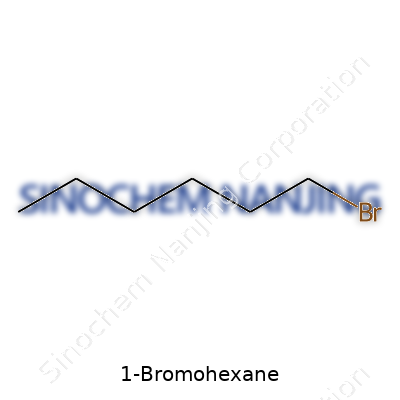
| Names | |
| Preferred IUPAC name | 1-Bromohexane |
| Other names |
Hexyl bromide n-Hexyl bromide n-Bromohexane |
| Pronunciation | /waɪˈbrəʊ.moʊˌhɛk.seɪn/ |
| Identifiers | |
| CAS Number | 111-25-1 |
| Beilstein Reference | 3580706 |
| ChEBI | CHEBI:81233 |
| ChEMBL | CHEMBL26190 |
| ChemSpider | 6372 |
| DrugBank | DB03858 |
| ECHA InfoCard | InChIKey=IGNKYZTEVKODSL-UHFFFAOYSA-N |
| EC Number | 214-185-2 |
| Gmelin Reference | 7848 |
| KEGG | C06535 |
| MeSH | D001917 |
| PubChem CID | 8127 |
| RTECS number | NX8575000 |
| UNII | 0786J16IWD |
| UN number | UN2342 |
| Properties | |
| Chemical formula | C6H13Br |
| Molar mass | 193.13 g/mol |
| Appearance | Colorless to pale yellow liquid |
| Odor | pleasant odor |
| Density | 1.027 g/mL at 25 °C(lit.) |
| Solubility in water | insoluble |
| log P | 3.47 |
| Vapor pressure | 1.53 mmHg (25°C) |
| Acidity (pKa) | 16.0 |
| Basicity (pKb) | 15.29 |
| Magnetic susceptibility (χ) | -74.0e-6 cm³/mol |
| Refractive index (nD) | nD 1.445 |
| Viscosity | 2.04 mPa·s (25 °C) |
| Dipole moment | 2.00 D |
| Thermochemistry | |
| Std molar entropy (S⦵298) | 354.5 J·mol⁻¹·K⁻¹ |
| Std enthalpy of formation (ΔfH⦵298) | -51.7 kJ/mol |
| Std enthalpy of combustion (ΔcH⦵298) | -3897.5 kJ·mol⁻¹ |
| Hazards | |
| GHS labelling | GHS02, GHS07 |
| Pictograms | GHS02,GHS07 |
| Signal word | Warning |
| Hazard statements | H226, H315, H319, H335 |
| Precautionary statements | Precautionary statements: P210, P261, P280, P301+P312, P305+P351+P338, P332+P313 |
| NFPA 704 (fire diamond) | 1-2-0 |
| Flash point | 55 °C |
| Autoignition temperature | 170 °C |
| Explosive limits | Explosive limits: 1.1–7.4% |
| Lethal dose or concentration | LD50 (oral, rat): 2900 mg/kg |
| LD50 (median dose) | LD50 (median dose) of 1-Bromohexane: **2.03 g/kg (rat, oral)** |
| NIOSH | BX8575000 |
| PEL (Permissible) | Not established |
| REL (Recommended) | 1 ppm |
| IDLH (Immediate danger) | Not established |
| Related compounds | |
| Related compounds |
1-Chlorohexane 1-Iodohexane 1-Bromoheptane 1-Bromopentane |



