Understanding 1,4-Diethylbenzene—Context, Challenges, and Opportunities
Historical Development of 1,4-Diethylbenzene
The story of 1,4-Diethylbenzene dates back to the boom of the petrochemical era, a time when chemists pushed hard to transform simple hydrocarbons into building blocks for new industries. 1,4-Diethylbenzene, also known to some as para-diethylbenzene, emerged as one of those practical developments right out of the early days of benzene alkylation. As refining techniques advanced and catalytic chemistry began to steer large-scale production methods, facilities across Europe and America started seeing derivatives such as diethylbenzene pop up in their process flows. From solvents to intermediates, para-diethylbenzene started showing up in reaction schemes and journals, slowly making its name in both academic and industrial settings. There’s something telling about how a compound moves from lab notes in organic chemistry to large reactors and storage tanks: not every molecule grabs attention or leaves an imprint, but diethylbenzene earned its place by being effective and adaptable in practical chemical processes.
Product Overview—Physical and Chemical Realities
1,4-Diethylbenzene presents as a clear, colorless liquid, and it doesn’t put on any airs—think of it as one of those no-nonsense chemicals that just gets the job done. Its odor is often described as sweet and aromatic, a gentle warning that you’re dealing with a true aromatic hydrocarbon. This compound’s structure brings together two ethyl groups on a benzene ring, but parked right across from each other, creating that stable para arrangement chemists appreciate for predictability. What makes this molecule stand out isn’t some fancy trick or magical performance, but its ability to blend into applications that value both solvency and stability. It resists breaking down under routine lab and plant conditions, doesn’t corrode equipment, and keeps its cool unless the temperature gauge rises well above 150 degrees Celsius. The boiling point hovers in the range of 183–184 °C, and it’s less dense than water, meaning it’s not going to sink and vanish in an accidental spill—something process engineers learn never to ignore.
Technical Specifications and Labeling Practices
Nobody likes confusion in the warehouse or lab, so clear labeling matters when it comes to chemicals like 1,4-Diethylbenzene. CAS number 105-05-5 helps pin it down for regulators and buyers alike, but a label alone doesn’t shape behavior. Purity often exceeds 98 percent in commercial grades, with moisture and impurity levels kept far lower than one would see sixty years ago. Regulations in major markets require hazard pictograms, risk statements, and substance classification info. It’s important to educate every handler about its flammability and environmental impact—the global push for transparency and safety owes a lot to painful lessons from the past. While technical specs might bore some folks, missing information can invite accidents, so every bottle or drum of diethylbenzene puts these hard-won lessons right on display.
How 1,4-Diethylbenzene Is Made
People in chemical manufacturing always keep an eye on raw materials and costs, so the synthesis of 1,4-Diethylbenzene usually starts from benzene—a major petrochemical feedstock. The most common route involves alkylating benzene with ethylene in the presence of an acid catalyst. In older setups, you’d find aluminum chloride, but as environmental controls got tighter, new catalysts like zeolites have stepped in, making operations cleaner and helping curb waste. Temperature and pressure have to stay in a tight range, or else side reactions crop up and muddy the batch. Getting a good selectivity for the para isomer takes careful control of process variables, and a shortcut approach can saddle a plant with unwanted ortho or meta compounds. I’ve seen the headaches that come from dealing with impure mixes or production hiccups—problems tend to snowball if bad habits go unchecked in the plant or lab.
Chemical Modifications and Reactivity
Chemists love the benzene core for its stability, but adding ethyl groups does allow some creative chemistry. 1,4-Diethylbenzene stands up to moderate heat and acids, but strong oxidizers will eventually chew through it, generating acetophenone or even carboxylic acids depending on how tough a reaction you throw at it. Hydrogenation changes its aromatic ring to a cyclohexane ring, useful for specialty intermediates. People sometimes use selective halogenation to introduce other substituents or prepare more functionalized derivatives for resin and polymer work. These modifications keep para-diethylbenzene circulating not only in bulk production, but in small-batch specialty shops that tailor molecules for research or niche applications. Thinking about all the trial runs and scale-ups, it’s clear that the chemistry isn’t just about what happens in the flask, but the road testing that comes in full-scale production.
Aliases and Industry Names
Synonyms rarely spark controversy, but keeping them straight saves a lot of hassle. 1,4-Diethylbenzene goes by para-diethylbenzene, p-diethylbenzene, or the less formal “PDEB” in trade contexts. Some older catalogs call it p-DEB. None of these names change the underlying identity, but they’re each a reminder of how the language of chemistry stays alive through worker habits, regional terminology, and regulatory requirements. I’ve had more than a few conversations get tangled up by mixing up synonyms, so cross-checking those names is part of the drill for anyone who orders, ships, or tracks chemicals across borders.
Staying Safe—Operational Standards in Practice
Safety standards around 1,4-Diethylbenzene reflect a mix of hard lessons and practical wisdom. Its flammability means you don’t leave containers open near hot work, and proper venting counts for a lot more than some realize. Eye and skin protection is standard, and even the most seasoned staff don’t skip that part. Exposure limits differ between countries, but proper ventilation and spill containment win out over the details of any rulebook. Environmental concerns also matter here, with strict controls on emissions. Training doesn’t substitute for common sense, but regular reviews and clear signage cut down on slip-ups that gum up production or put people at unnecessary risk. From spill drills to fire safety, the operational backbone of any facility carrying diethylbenzene rests on a culture of attention—rules mean little if people don’t own and understand them.
Application Areas—From Industry to Everyday Life
The practical use of 1,4-Diethylbenzene reaches into different industries. One key role lies in the manufacture of resins and polymers, where para-diethylbenzene acts as a precursor in making specific high-performance plastics and advanced composites. It also finds its way into the production of ion-exchange resins, used in water softeners and purification systems that households and businesses rely on all over the world. That clean water running from the tap owes something to compounds first handled with gloves and goggles in a chemical plant. In the lab, it serves as a solvent and a calibrant for analytic methods, thanks to its predictable behavior. The fragrance and specialty chemical sectors also dip into the diethylbenzene well, transforming it into tailored molecules for consumer goods and industrial formulations. No matter the end use, consistent quality and thoughtful handling remain in demand.
Research and Development—Pushing Know-How Forward
Ongoing research into 1,4-Diethylbenzene focuses on greener production methods, better catalysts, and resource-efficient recycling. There’s demand for less waste, both in spent chemicals and energy, so process engineers lean on new reactor designs and continuous flow systems. Studies look for ways to use bio-based feedstocks instead of petrochemicals, but challenges keep that from becoming the norm. I have seen chemists push up against the restraints of current catalyst technology, knowing that even incremental improvements bring the double reward of lower cost and less environmental impact. Analytical chemists tinker with improved detection and quantification methods to support tighter regulatory limits and quality assurance. Research groups in universities and industry labs don’t operate in isolation—they rely on open dialogue, data sharing, and the slow build of experience across projects.
Toxicity Research—Understanding the Risks
The push to study toxicity stems from a recognition that ignoring health impacts never ends well. 1,4-Diethylbenzene passes through the human body just like other volatile hydrocarbons—primarily by inhalation or skin contact. Studies in animals point towards low acute toxicity, but repeated or chronic exposure raises legitimate concerns about liver and central nervous system effects. Dusting off old incident reports serves as a reminder to respect the cumulative impact of repeated low-level exposures. Regulations in Europe, North America, and Asia aim to set exposure limits that keep workers out of harm's way, but policing those rules requires more than paperwork. Advances in monitoring, personal protective equipment, and ventilation tech mean that current-day operations offer more safety than plants even thirty years ago. Feedback from toxicology studies helps manufacturers reformulate or redesign processes, trimming exposures before they become headline concerns.
Future Prospects—How 1,4-Diethylbenzene May Shape Industry
The road ahead for 1,4-Diethylbenzene bends with the priorities of the industries it supports. More people care about what ends up in the air and water, so scrutiny of production emissions and downstream contamination keeps rising. Demand for energy-efficient, waste-minimized production methods keeps researchers busy. Regulatory bodies lean harder on proof before market approval, so new applications for diethylbenzene must clear a higher bar in terms of both performance and safety. Integrated chemical production hubs, digital process controls, and stronger global standards will shape how this hydrocarbon gets made and used. While I expect demand to climb in specialty applications and advanced materials, the path forward depends on how well industry adapts to new environmental and consumer expectations. Real progress will demand a joint effort—policy, technical innovation, and a willingness to learn from past missteps, all grounded in a commitment to health, safety, and practical utility.
What are the main uses of 1,4-Diethylbenzene?
Chemical Building Block and Its Daily Influence
1,4-Diethylbenzene doesn’t grab headlines like plastics or renewable energy breakthroughs, but its role in chemicals and industry runs deep. As someone who has spent years working with chemical safety data and supporting manufacturing teams, I’ve seen how small molecules drive surprising amounts of progress in the background. This compound, for instance, helps kick-start and streamline processes that touch daily life, from cleaner engines to stronger plastics.
Making Other Chemicals Possible
At its core, 1,4-Diethylbenzene acts as a core raw material for bigger, more complex molecules. It stands out as a feedstock to make chemicals like p-xylene and specialty intermediates used in resins. This route matters for anyone following the polymer supply chain. Factories often break it down, rearrange it, or blend it into other reactions, letting them produce everything from polyester to insulation materials. In short, without it, many common consumer goods would be costlier or harder to make.
Growth in the packaging and automotive world relies on dependable intermediates. For example, p-xylene, an important cousin, leads straight to terephthalic acid—the stuff forming PET plastics. Look around, and you’ll spot PET in water bottles, fruit containers, and soft drink packaging. Industry needs 1,4-Diethylbenzene for its role in this lineage, supporting stable jobs and supply chains worldwide.
Boosting Cleaner Energy and Fuels
Fuel refiners value this compound for its part in creating cleaner-burning gasoline. In catalytic reforming, 1,4-Diethylbenzene contributes to octane improvement, reshaping fuel molecules so engines run smoother and cleaner. Growing environmental standards don’t look likely to loosen, so demand for additives and building blocks like this keeps ticking up.
Solvents and Electronics: Less Visible, Still Crucial
People outside the lab might not realize how often fine chemicals need strong, stable solvents. 1,4-Diethylbenzene shows up here too. It dissolves specialty additives, dyes, and complicated molecules. Labs and electronic manufacturers favor its stability at higher temperatures. If you ever handled electronics assembly, you know how picky parts can be about impurities; using reliable solvents keeps short circuits and product failures at bay.
Safety and Environmental Facts Matter
Chemicals stir up heated opinions because many folks remember disasters or health warnings. As a writer who’s worked with safety data, I know that proper handling always deserves attention. Manufacturers store and transport 1,4-Diethylbenzene in controlled environments. Workers wear protective gear, and long-term environmental monitoring watches for spills or emissions. The compound doesn’t break down rapidly in nature, making responsible use and disposal especially important. Smart companies invest in leak-proof storage and trained emergency teams to prevent and contain any incidents.
Finding Balance: Sustainable Chemistry’s Next Step
Chemistry faces a crossroads, with demand for durable plastics and better fuels fighting against waste and pollution problems. Scaling up green technology—think recycling PET or using renewable feedstocks—provides a smarter path forward. Some university labs are already researching plant-based routes to chemicals like 1,4-Diethylbenzene, using bio-based materials to lower reliance on crude oil. Consumer demand for sustainable packaging will likely keep pushing industry in this direction. Watching research turn into reality can give hope: progress often starts in quiet, overlooked corners of science, not just splashy headlines.
What is the chemical formula and structure of 1,4-Diethylbenzene?
Understanding 1,4-Diethylbenzene
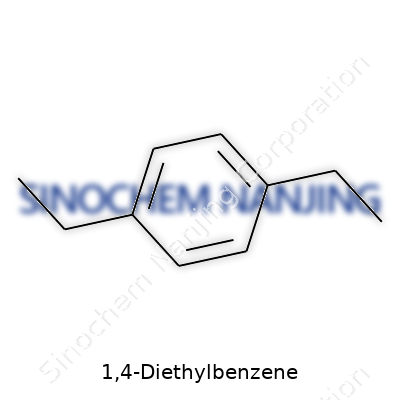
Many folks working in chemistry labs or exploring the world of aromatic hydrocarbons eventually bump into compounds like 1,4-diethylbenzene. Think of this molecule as a classic benzene ring that picks up two ethyl groups in its para positions—meaning the attachments sit directly across from each other.
Chemical Formula
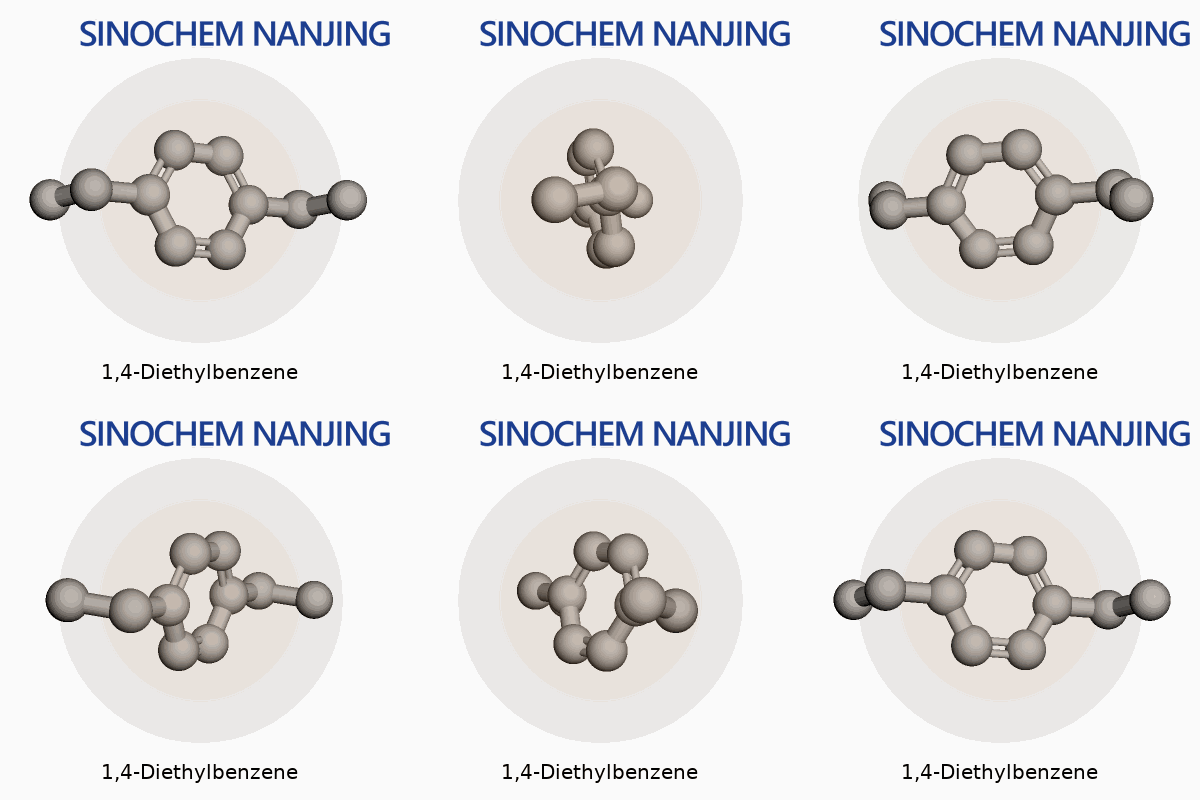
The formula of 1,4-diethylbenzene stands as C10H14. If you built a model, you’d use a benzene ring as the backbone—six carbon atoms in a tight, flat circle with alternating double bonds, classic for aromatics. The “1,4” in the name marks the position for the ethyl side chains sticking out from the ring, spaced evenly apart.
Structural Details
Chemists usually sketch the structure as a hexagon for the benzene base, then tack on two —CH2CH3 groups at carbon positions one and four. Both ethyl chains break up the molecule’s symmetry just enough to make it useful in several chemical pathways. The ring’s electrons move in a delocalized cloud, giving the compound some stability and resistance to direct attack from many simple chemicals.
Why the Structure Matters
This specific spot for those ethyl groups changes how 1,4-diethylbenzene behaves. Compared to its cousins (with those same ethyls but in other positions), this para substitution delivers different boiling and melting points. For example, the bulkiness across the ring encourages a bit more separation between molecules, which alters how tightly they pack together in a solid or liquid form.
Plenty of major industries lean on benzene derivatives just like this. Its structure lines up closely with some plasticizers and advanced polymers. Crews using high-octane fuels look out for aromatics such as this, too, since their stability gives fuels a higher resistance to knocking. Those applied uses trace right back to a solid grasp of the molecular framework.
Safety and Environmental Considerations
Anyone handling this compound ought to pay attention to its aromatic core. Similar to its relatives, 1,4-diethylbenzene can pose risks for both workers and the environment, especially if spills enter rivers or groundwater. Responsible facilities enforce proper storage, using sealed containers and adequate ventilation. Gloves and goggles keep skin and eyes safe, since exposure over time links back to health concerns.
Companies can reduce risk by substituting safer chemicals when possible, choosing more robust containment options, or recycling used solvents. On the regulatory front, stricter limits and improved emissions tracking push everyone toward safer operations.
Looking Forward
This isn't just book chemistry; getting the structure and formula of 1,4-diethylbenzene right helps prevent accidents and opens pathways for smarter product design. That eye for detail—from boardroom to bench—connects with environmental safety and better end results for research, manufacturing, and workers on the floor.
Is 1,4-Diethylbenzene hazardous or toxic?
Getting to Know 1,4-Diethylbenzene
Many folks come across strange names like 1,4-diethylbenzene in safety sheets, chemical supply lists, or online forums. This compound often pops up in labs or manufacturing plants, given its role as an industrial solvent and an intermediate for other chemicals. Anyone working in environments like these naturally worries about the health and safety factors at play.
What Science Tells Us About Risks
Let's cut through the confusion. The Material Safety Data Sheet (MSDS) tags 1,4-diethylbenzene as a flammable liquid and vapor, which means fire precautions are non-negotiable. Breathing in the vapor in a closed space could make you lightheaded, dizzy, or give you a headache, kind of like what you’d expect after a few breaths near gasoline. You don’t want to swallow any, and you certainly don’t want it irritating your skin or eyes.
Its bigger, well-known cousin, benzene, raises alarms for causing cancer and damaging bone marrow. That history creates a lot of distrust. 1,4-diethylbenzene carries some of the same dangers as other substituted benzenes, but let's not exaggerate. According to research published in Chemosphere and data from the European Chemicals Agency, it doesn’t climb into the league of "extremely toxic" or "known carcinogen." Still, it resists easy breakdown in the environment, sticking around in soil and water. That persistence means the stuff can build up, not just disappear after a spill.
Personal Experience with Chemical Hazards
Working around chemicals for years shows one clear thing: just because a chemical doesn’t cause instant harm doesn’t mean it’s harmless. Many times, people in labs or plants get careless around compounds that don’t have a scary label. I’ve seen coworkers forgo gloves or overlook goggles just because a chemical “isn’t benzene.” Cue skin rashes, watery eyes, and in rare cases, longer-term health effects. Risk comes from long-term exposure as much as high-concentration accidents.
Why Persistent Pollutants Matter
Take a chemical like 1,4-diethylbenzene that barely budges from soil—even after months. Toss a spill near a riverbank, and fish or birds might end up exposed to it for much longer than you’d imagine. Animals don’t choose protective equipment. Low doses, over time, put those populations at risk, changing behavior or reproduction patterns. These effects often go unseen until the damage adds up.
Building Safer Habits, Not Just Reacting to Danger
Education and routine make a huge difference. Workers armed with the right information tend to take small but critical steps, like wearing gloves and keeping ventilation running. Posting reminders about chemical hazards actually changes how a shift runs; it keeps people alert, even if management isn’t watching. Passing on real safety stories—where someone fell sick or a careless move caused an accident—hits closer to home than technical warnings.
Smart Solutions
Companies do best when they don’t just comply, but look for less risky substitutes or update their engineering controls. Chemistry departments that test and share water and air results with the public send the message that they have nothing to hide. This builds trust, slows down misinformation, and fosters neighborhoods that watch out for their health.
It’s always tempting to shrug and file away chemicals like 1,4-diethylbenzene as “not quite dangerous.” Truth is, experience shows that downplaying these risks only increases accidents. Treat every chemical with as much respect as the worst on the list—because in the long run, the only thing more costly than safety is losing it.
How should 1,4-Diethylbenzene be stored and handled?
Understanding the Material
1,4-Diethylbenzene turns up in labs, factories, and industrial settings where chemicals like this help drive synthesis or production. Most folks outside specialty chemical fields don’t cross paths with it, but for those who do, the health and safety stakes get real. This liquid hydrocarbon gives off a pretty strong smell and vapor, so keeping it handled right matters as much as the work it helps support.
Real-World Risks and Lessons from Experience
I’ve worked in spaces where the whiff of solvents lingers longer than you’d like, and one lesson you learn fast is: fumes stick with you, sometimes in your lungs, sometimes in your clothes. 1,4-Diethylbenzene brings similar worries. Its low flash point means fire doesn’t need much of an invitation, and vapor can turn risky in unventilated spots. Toxicologists warn that breathing too much can hit your nervous system and irritate your airways. Touching it might not burn on contact, but skin can soak it up over time.
Practical Storage Strategies
For storage, keep drums or containers in cool, dry areas far from any heat or direct sunlight. I always check container seals; a cracked cap or rusted drum makes all sorts of headaches in months to come. A well-marked, secure chemical cabinet keeps unauthorized hands away—insurance won’t cover curiosity.
Shelving should offer good support and not crowd the area. Chemicals like this tempt folks to shove extra drums into corners, but cramped quarters just raise the risk of spill or leak. Grounding metal containers cuts down the static sparks nobody sees coming, and bunded pallets or trays catch the odd drip.
Handling Decisions on the Job
Daily handling calls for gloves and goggles—simple, non-negotiable stuff you’d expect in any responsible shop. Proper ventilation isn’t just a tick-box on a safety checklist; exhaust fans make the difference between a headache-free afternoon and a call to the site medic. No eating, no smoking, and definitely no open flames. Even a stray spark from a faulty tool can trigger a fire.
Spills, though rare with the right diligence, demand attention. Absorbent pads, sand, or specialty spill kits grab liquids quickly. Folks I respect never skimp on cleanup gear because accidents don’t schedule themselves. Waste gets labeled and locked away for a licensed hauler. Pouring leftovers down the drain just pushes the problem downstream.
Why It Matters
The cost of cutting corners hits everyone—staff, neighbors, even the company’s bottom line. Reports of chemical fires or exposures fill headlines for a reason. Smart storage and handling aren't about stacking rules; they protect the people who show up and do the work, day after day. Every plant manager knows those stories where missed steps cost real lives. Even one mishap changes everything.
Ongoing Training and Culture
Refresher sessions pay off, especially for new hires or when updating storage protocols. A workplace that rewards flagging small issues before they turn into big ones runs smoother. Trusted staff step up to train the next crew, so hard-won lessons keep traveling forward. That matters as much as any lock on a door or label on a drum.
Where can I purchase 1,4-Diethylbenzene?
Understanding Why Sourcing Matters
Stories about chemicals like 1,4-Diethylbenzene don’t get splashy headlines. Most people won’t bump into it outside of a lab or plant setting. For those running a research project, managing an industrial process, or trying to turn theory into practice, finding a reliable supplier matters more than most buzz topics.
I remember working in an analytical lab early in my career, watching waste time spiral because a shipment of a specialty compound got stuck at customs. Productivity suffered, deadlines drifted, stress piled up. A strange compound like 1,4-Diethylbenzene proves just how important it is to get sourcing decisions right from the start.
1,4-Diethylbenzene Supply Chain in 2024
Producers treat 1,4-Diethylbenzene as a niche item. Used as an intermediate for other chemicals or for high-purity research, it doesn’t show up lining the shelves at hardware stores or hobby supply shops. Instead, one finds it sold through established chemical suppliers. Sigma-Aldrich, TCI, Toronto Research Chemicals, Alfa Aesar, and Fisher Scientific have it listed in their catalogs, but you’ll have to request a quote. Some suppliers operate globally, others serve specific regions.
Larger orders bring more options. If you’re working with a ton-scale process at an industrial site, you’ll find bulk chemical houses in the US, Europe, and China that can handle shipment. For smaller amounts, the big scientific distributors are often the safest bet, despite higher costs. These sellers lay out specifications, purity levels, and testing reports on their product pages—a step that builds trust, especially for buyers who care about trace impurities.
Safety, Legality, and Vetting Vendors
Buying chemicals isn’t like picking up a can of paint. Regulators watch closely. You’ll need to show business credentials or proof of research use for orders. Failing to double-check compliance can cause headaches, delays, or worse. In the United States, federal and state laws may limit certain shipments. Countries like Germany or Japan sometimes apply stricter rules. One bad vendor can leave you stuck waiting months, or scrambling for alternatives.
From experience, it pays to stick with sources that offer full documentation: material safety data sheets, certificates of analysis, shipping records. Strong paperwork streamlines customs clearance and helps people in the lab focus on the science, not the paperwork.
Avoiding Pitfalls: Counterfeits and Unsafe Sellers
Low-cost offers on open marketplaces or unfamiliar online stores often come with risk. During my time in quality control, I saw cheap samples fail purity tests and delay projects. Legitimate suppliers like MilliporeSigma, Alfa Aesar, and Fisher Scientific invest in safe packaging and delivery. That investment protects both the end-user and the wider public.
If a supplier refuses to answer questions about analytic methods, or dodges requests for documentation, walk away. Trusted sellers welcome dialogue—they want buyers informed, safe, and set up for success. Searching for “1,4-Diethylbenzene for sale” online floods you with results, but only companies with a history of positive reviews and regulatory compliance deliver peace of mind.
Better Sourcing, Fewer Headaches
Anyone working with specialty chemicals bets part of their project’s outcome on their supplier. Experience has taught me to put transparency and reliability above price every time because a single setback can cost more than any upfront savings. If you need high-quality 1,4-Diethylbenzene, reach for reputable distributors who back up every order with data, service, and experience.
| Names | |
| Preferred IUPAC name | 1,4-Diethylbenzene |
| Other names |
p-Diethylbenzene p-Ethyldiethylbenzene 1,4-Diethylbenzeen para-Diethylbenzene |
| Pronunciation | /ˌwaɪˌfɔːr.daɪˈɛθ.əl.bɛnˌziːn/ |
| Identifiers | |
| CAS Number | 105-05-5 |
| Beilstein Reference | 1718734 |
| ChEBI | CHEBI:140309 |
| ChEMBL | CHEMBL204761 |
| ChemSpider | 8073 |
| DrugBank | DB13631 |
| ECHA InfoCard | ECHA InfoCard: 100.012.578 |
| EC Number | 202-050-9 |
| Gmelin Reference | 841 |
| KEGG | C06504 |
| MeSH | D017929 |
| PubChem CID | 8674 |
| RTECS number | ZE2625000 |
| UNII | H7P6Y97R8T |
| UN number | UN1177 |
| CompTox Dashboard (EPA) | DTXSID0033739 |
| Properties | |
| Chemical formula | C10H14 |
| Molar mass | 162.26 g/mol |
| Appearance | Colorless liquid |
| Odor | aromatic |
| Density | 0.867 g/mL |
| Solubility in water | Insoluble |
| log P | 3.6 |
| Vapor pressure | 0.24 mmHg (25°C) |
| Acidity (pKa) | 40.37 |
| Basicity (pKb) | 12.41 |
| Magnetic susceptibility (χ) | -68.5e-6 cm³/mol |
| Refractive index (nD) | 1.489 |
| Viscosity | 1.105 mPa·s (25 °C) |
| Dipole moment | 0.0 D |
| Thermochemistry | |
| Std molar entropy (S⦵298) | 198.5 J·mol⁻¹·K⁻¹ |
| Std enthalpy of formation (ΔfH⦵298) | -50.6 kJ/mol |
| Std enthalpy of combustion (ΔcH⦵298) | -3727.8 kJ/mol |
| Pharmacology | |
| ATC code | C07BA04 |
| Hazards | |
| GHS labelling | GHS02, GHS07 |
| Pictograms | GHS02,GHS07 |
| Signal word | Warning |
| Precautionary statements | P210, P233, P240, P241, P242, P243, P261, P264, P271, P280, P301+P310, P303+P361+P353, P304+P340, P305+P351+P338, P312, P337+P313, P362+P364, P370+P378, P403+P233, P403+P235, P405, P501 |
| NFPA 704 (fire diamond) | 1-2-0 |
| Flash point | 64 °C |
| Autoignition temperature | 435 °C |
| Explosive limits | Explosive limits: 0.9–6.4% |
| Lethal dose or concentration | Lethal dose or concentration of 1,4-Diethylbenzene: "LD50 (oral, rat): 2300 mg/kg |
| LD50 (median dose) | Rat oral LD50 3200 mg/kg |
| NIOSH | DD3325000 |
| PEL (Permissible) | PEL (Permissible Exposure Limit) for 1,4-Diethylbenzene: Not established |
| REL (Recommended) | 5 ppm |
| IDLH (Immediate danger) | IDLH: 900 ppm |
| Related compounds | |
| Related compounds |
1,2-Diethylbenzene 1,3-Diethylbenzene Ethylbenzene |



