Looking at 1,4-Dichlorobutane: Chemistry, Safety, and the Road Ahead
Historical Development
Chlorinated aliphatics started popping up in labs over a century ago, mostly by sheer experimental curiosity rather than deliberate design. 1,4-Dichlorobutane came from that era of trial and error, as chemists explored what could happen if they added chlorine atoms to long-chain hydrocarbons. Its use didn’t stay confined to glassware or blackboards for long. Over the decades, the molecule found its way into industrial processes, appreciated by chemists for its simplicity: two chlorines, four carbons, not too reactive but not totally inert. This unassuming compound crept into manufacturing thanks to its pivotal role in creating more valuable intermediates, showing how even apparently niche molecules can shape entire industries.
Product Overview
At a glance, 1,4-Dichlorobutane fits the textbook idea of a building block molecule. Major chemical suppliers treat it like a staple—one that feeds directly into the production of specialty chemicals, polymers, and pharmaceuticals. Once you spend time in the lab or study the flowcharts used in process engineering, you begin to realize how many downstream products trace back to this colorless liquid. It does not grab headlines, but its impact echoes across supply chains, particularly in regions investing in plastics and elastomer manufacturing.
Physical & Chemical Properties
The molecule boils just below 160°C and brings a modest molecular weight, making it manageable for both storage and processing. Immersed in a room, one would notice a faint, sweet odor—not nearly as biting as some other chlorinated organics. The two terminal chlorine atoms allow for straightforward transformation, yet 1,4-Dichlorobutane holds together well enough under standard lab temperatures. Its density sits a bit above that of water, and it does not dissolve particularly well in water, but holds steady in organic solvents. These traits give anyone handling it predictable behavior, which matters a lot once you scale up from bench to plant.
Technical Specifications & Labeling
Receiving a drum of 1,4-Dichlorobutane means dealing with specific labeling and containment standards. Companies must meet food and pharmaceutical regulatory guidelines if the end-product veers toward medicine or consumer goods. Most drums ship with UN hazard symbols highlighting its irritation potential and flammability under the right conditions. Industrial users generally require documentation for impurity content, moisture level, and precise boiling point to ensure downstream reactions do not misfire.
Preparation Method
Industry usually takes the well-trodden route: reacting 1,4-butanediol or tetrahydrofuran with hydrochloric acid or phosphorus pentachloride, kicking off a substitution that swaps hydroxyl groups for chlorine atoms. Tweaking temperature, solvent, and reactant ratios influences yield and by-product composition. Researchers sometimes search for cleaner, more efficient synthesis routes, especially given pressure to avoid hazardous by-products or high-energy processes, but the classic halogenation approach persists in large-scale plants.
Chemical Reactions & Modifications
Ask a synthetic organic chemist about 1,4-Dichlorobutane, and the answer comes quick: the compound serves as an all-purpose linker. Both chloro groups act as reactive sites, making it easy to anchor the molecule into longer chains, rings, and network structures. It shines in Williamson ether synthesis or when producing macrocycles like crown ethers. In specialty polymer production, using it to cross-link chains creates flexible, durable materials. Recent literature points toward unique cyclization reactions, leading to heterocycles used in research settings. Because of its structure, 1,4-Dichlorobutane enables both step-growth polymerizations and tailored modifications, meeting demand in custom synthesis.
Synonyms & Product Names
In catalogs and scientific papers, chemists recognize the compound under several guises. “Tetramethylene dichloride” and “1,4-Butylene dichloride” are common mentions, with naming conventions varying by region and even end application. While chemistry veterans don’t stumble over its name, newcomers often notice the frequency of synonyms and trade names attached to a single substance. This issue pops up across many chlorinated hydrocarbons, not just here, sometimes complicating efforts to track safety records or environmental impacts.
Safety & Operational Standards
No matter how unassuming it looks in a flask, 1,4-Dichlorobutane poses tangible risks. Short-term contact can bring eye and skin irritation. Inhalation, even at modest vapor levels, can cause respiratory discomfort. Long-term exposure history, as gathered by workplace safety boards, points to the need for containment, proper ventilation, and regular monitoring. I’ve watched experienced staff double-check gloves and goggles, leaning on training that never assumes a substance is “safe enough.” Governments require detailed storage and transport records for all chlorinated solvents, and plant safety audits treat even minor leaks seriously, partly because the compound contributes to volatile organic emissions.
Application Area
Traditional uses cluster around its role as an intermediate. Specialty elastomers, ion-exchange resins, and pharmaceuticals all originate from functionalizing 1,4-Dichlorobutane. It finds a spot in the synthesis of polyadipate-based plastics and as a precursor to quaternary ammonium compounds, which themselves power water treatment and phase-transfer catalysis. In the lab, I watched researchers use the molecule to craft custom macrocycles; its ability to form cyclic structures grants researchers a way to access new, often unexplored compounds. Industrial chemists turn to it when they need a tough, flexible starting material or a reliable cross-linking agent. The breadth here testifies to its solid reputation rather than any one spectacular feature.
Research & Development
Academic labs poke at the boundaries of what 1,4-Dichlorobutane can do, especially as newer catalytic systems enter the scene. Studies now look at mild, selective chlorination techniques, aiming for greener or safer alternatives. There’s fresh energy in efforts to combine it with biobased reagents, tapping into global demand for products sourced from renewable resources. Chemists publish regular reports on improved yields and reduced side-products, often leveraging advances in continuous flow chemistry. These efforts don’t just promise cleaner processes but also higher productivity, which matters for countries battling with both cost and environmental limits.
Toxicity Research
Early assumptions about chlorinated aliphatics have had to shift recently. Testing shows that while 1,4-Dichlorobutane does not seem acutely toxic at low concentrations, concerns linger about chronic exposure and breakdown products. Some metabolites possess marked toxicity, driving many industries and government agencies to demand lower permissible workplace exposure limits. Researchers track environmental persistence, knowing that what doesn’t break down quickly may wind up accumulating over time. Analytical chemistry teams keep refining tests to measure trace residues, protecting both workers and the public. My own experiences echo these concerns, having seen safety officers take a low-tolerance stance on spills and mislabeling.
Future Prospects
As the push for sustainable chemistry grows louder, 1,4-Dichlorobutane faces pressure to adapt or find greener alternatives. The drive isn’t just political or regulatory; many young chemists have shifted their mindset, looking for molecules that leave lighter environmental footprints or lend themselves to processes with less waste. Investment in cleaner production routes—using renewable feedstocks, switching to milder reagents, recycling by-products—could shift the molecule’s environmental profile for the better. Given its entrenched role, though, 1,4-Dichlorobutane is not going away soon. Being so widely used ensures that efforts to improve its safety and sustainability will echo throughout the industries that depend on it.
What is 1,4-Dichlorobutane used for?
The Building Block Most Folks Never Hear About
Few people think about the chemicals powering daily life. 1,4-Dichlorobutane doesn’t make headlines, but if you’ve ever used plastics, medicines, or even cleaning sprays, this compound probably played a part somewhere along the line. I’ve noticed that most discussions about chemicals like this get bogged down in jargon, forgetting the practical ways they touch regular life. Let’s talk about what this chemical does, where it shows up, and why we ought to care.
Key Roles in Industry
Most of what 1,4-Dichlorobutane accomplishes comes down to being a middleman. Factories use it as a starting point for making other chemicals, especially in pharmaceuticals and plastics. Folks working in manufacturing use it to create nylon, specifically nylon 4,6. This isn’t the kind of nylon in your yoga pants; nylon 4,6 holds up in high-heat or rough conditions, so think of car engine parts or some electronics. Without 1,4-Dichlorobutane, those tough, heat-resistant plastics cost more or need different recipes that don’t always work as well.
Beyond plastics, it also steps in to make some drugs. Pharmaceutical companies get creative with molecules, and they rely on 1,4-Dichlorobutane to build more complex substances. For anyone who relies on certain medications, a chemical that helps bring costs down or improves efficiency deserves attention.
Making Other Chemicals Happen
Most people I talk with don’t realize just how much chemistry happens behind the scenes. 1,4-Dichlorobutane reacts well with many other substances, which makes it useful for making specialty chemicals. It pops up in research labs testing new compounds. Cleaning product giants sometimes use related chemicals to help dissolve or clean, though safety rules put tight controls on this kind of use. In the end, most of what 1,4-Dichlorobutane does stays behind factory walls, even though the effects trickle down to all of us.
What About Safety?
Experience shows that benefits and risks always run side by side with industrial chemicals. 1,4-Dichlorobutane doesn’t end up in finished goods you touch, but workers in plants handle it directly. The compound carries real risks: inhaling or touching it can irritate eyes, skin, and lungs. Regulators like the EPA and OSHA set strict exposure rules. From my own visits to manufacturing plants, good safety gear and correct procedures make a world of difference, but nothing replaces plain respect for how powerful a chemical can be in the wrong hands.
Push for Better Alternatives
Green chemistry tries to cut out dangerous chemicals and waste wherever possible. For 1,4-Dichlorobutane, that means inventing new ways to build the same products using safer ingredients or lower-impact processes. Researchers in universities and companies across the world look for bio-based feedstocks, hoping to make plastics and drugs with less toxic byproducts. Anyone who’s worked in sustainable materials sees how tough—but not impossible—it can be to swap out these basic chemical building blocks.
Real Talk: Why We Should Pay Attention
To me, it’s always important to step back and ask why any material commands space in our economy. 1,4-Dichlorobutane earns its keep by making things we all use run smoother, last longer, or come at a price regular folks can afford. Its story reminds us that progress in industry often means managing trade-offs between utility and safety, always with an eye on finding cleaner, smarter options for the future.
What are the handling and storage recommendations for 1,4-Dichlorobutane?
Understanding the Risks of 1,4-Dichlorobutane
1,4-Dichlorobutane shows up in many labs and industrial settings. On paper, it's just another organic solvent, but folks working with it know it carries plenty of risk. The chemical stings if it touches skin, raises a fuss in your lungs, and spreads fumes you probably don’t want to breathe. Some studies point to its possible links to cancer with regular exposure. So smart storage and handling can avoid painful accidents, protect employees, and keep those OSHA citations at bay.
Keeping It Secure: Storage Rules That Matter
Dedicated flammables cabinets belong at the top of the list. This stuff will catch fire if it finds too much heat or a stray spark. If you’ve ever seen the mess left by a lid left loose on a solvent drum, you know leaks are a headache. Only use containers rated for organic solvents with a solid seal—think metal cans or tightly sealed glass bottles. Skipping plastic grocery jugs or worn-down lids spells disaster.
A cool, well-ventilated storage spot makes a big difference. Direct sun or a spot near a steam line will spike the temperature and build up pressure inside containers. These drums or bottles need space on low shelves, away from acids or strong bases—mixing those up creates a real chemical circus.
Proper labeling goes beyond just a name on a tag. Add hazard diamonds, the chemical’s full name, and a quick rundown of possible dangers. No one wants to panic because the faded label left them guessing.
Workers can’t just toss this stuff in back rooms or under benches. I’ve learned the hard way: set aside a clean, organized section and keep an updated log. Track every bottle that comes in or out. That detail matters the next time someone needs to run an inventory or answer an auditor’s questions.
Handling With Care: Smart Steps Every Time
Gloves, goggles, and lab coats seem basic, but PPE saves skin and eyes from nasty burns. Splash goggles work best—regular glasses miss side spills.
I’ve seen many skip fume hoods if they’re in a hurry. Those hoods cut down inhalation risk. If the hood’s broken, hold off on any open work. Shortcuts bring real trouble.
Spill kits should sit where everyone can see them—granules for absorbing, neutralizers, and thick gloves. Quick clean-up beats lingering fumes or ruined floors.
Remind everyone about hand washing after tasks, even if gloves look clean. It’s easy to rub eyes without thinking, and that grab for eye wash is the last thing anyone wants.
Transport rules need respect, too. Any time you move bottles around a building or between sites, a secondary container helps. Picture a sealed, chemical-resistant tub. This habit cuts the chance of leaks in hallways and elevators.
Why Procedures Stick: Health and Compliance
Handling rules aren’t just red tape. My own mistakes—like topping a half-empty jug, then returning weeks later to find fumes and crust—proved how fast things go south. Safe storage keeps workers from harm and keeps company costs down by avoiding fines, medical leave, or ruined equipment.
Training works best face-to-face, not just through an online checklist. Demonstrate how to seal a drum, show what labels look like, and walk through those “what-if” emergencies. This way, everyone remembers that smart handling cuts risk, supports a safer workplace, and keeps the boss and regulators happy.
What are the health and safety hazards of 1,4-Dichlorobutane?
The Everyday Truth About 1,4-Dichlorobutane
Anyone who’s spent time in a lab or around industrial chemicals has probably squinted at a jug labeled “1,4-Dichlorobutane.” It pops up in chemical syntheses, especially in making some plastics, rubber, and solvents. Most people never see or touch it directly, but that doesn’t mean it stays tucked away from our lives. The main headache isn’t its usefulness. Handling and storing this stuff without proper attention can send workers or even nearby communities down a risky road.
Even after years around industrial chemicals, 1,4-Dichlorobutane gives me pause. This is a clear liquid with a faint, sweet smell that can trick people into thinking it’s harmless. Honestly, that is where the trouble starts. Even in ventilated areas, fumes stick around. Get it on your hands, or worse, breathe it in, and symptoms hit hard. Headaches show up. Dizziness cuts through attention spans. Some folks end up nauseated or short of breath, long after they leave the job site.
Short-Term and Long-Term Hazards
Skin contact with 1,4-Dichlorobutane leads to redness and irritation. It doesn’t take much—just a sprinkle, and rashes develop fast. Eyes sting and water, sometimes causing more lasting damage. Breathing vapors causes more than temporary discomfort. High exposure can knock someone out or mess with the nervous system. That’s no small thing; forgetfulness and mood changes stick around long after the exposure stops.
Over longer periods, the bigger worry is cancer. The government’s National Toxicology Program calls it a possible carcinogen. Long-term and repeated exposure in animals has shown kidney and liver damage, cancerous changes, and trouble with reproduction. Regulatory agencies—OSHA, NIOSH, and EPA—put it on restricted lists, so even factories in less-regulated countries take note. Regular blood and urine checks catch signs of exposure, but not every company follows through as closely as they should.
Making Work Safer—And Smarter
Basic safety goes a long way. In my old lab, training didn't stop with a warning. Supervisors kept an eye on gloves, goggles, and face shields. No one dumped leftovers down the drain. Every spill, no matter how small, got contained with sand and cleaned right away. Ventilation stayed running even on weekends to keep fumes out, not just diluted. Sometimes, people get lazy, thinking a little exposure today doesn’t matter. Looking at the facts and hearing stories about folks who lost kidney function after years in the field puts that kind of thinking to rest fast.
Better solutions mean more than just personal gear. Automation and closed systems cut down on direct exposure. Digital leak detectors and regular air monitoring add another layer of certainty. Companies that put health over profit install these upgrades before getting stung by regulatory fines or lawsuits. Mistakes from the past show that investments in safety pay off in workers’ well-being and a smoother workplace. No manager wants to lead a team where someone collapses on the floor because they underestimated a colorless liquid.
Looking Ahead
New chemicals get tested with stricter standards these days, but 1,4-Dichlorobutane is old enough that its risks must be managed basically forever. Reading about the health troubles in communities near chemical plants serves as a constant reminder—prevention works better than cleaning up after a crisis. Old habits hang on in the chemical trade. Shifting the culture from quick fixes to long-term safety takes real effort from everyone, not just the safety officers. As I’ve seen, asking questions, staying informed, and refusing shortcuts makes the difference between a close call and a clean bill of health.
What is the chemical formula and structure of 1,4-Dichlorobutane?
Chemical Formula and Structure
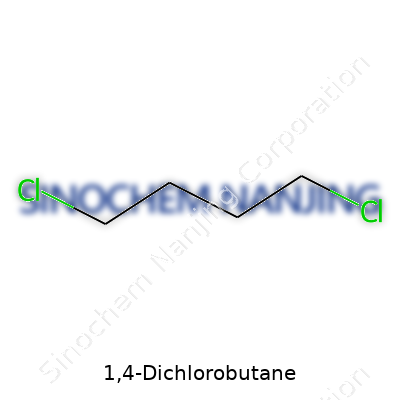
Let’s break down 1,4-dichlorobutane. The name tells a lot. It's a four-carbon alkane chain—basically a straight line of four carbon atoms. Each end holds a chlorine atom, stuck to the first and fourth carbons. Its chemical formula reads as C4H8Cl2. If you sketch it, the chain runs Cl–CH2–CH2–CH2–CH2–Cl. No loops or branches, just a clear, simple string.
What always interests me about these small organic chemicals is the way their atoms arrange and react. Those chlorine atoms create strong dipoles, which shift how the molecule interacts with its surroundings. The backbone holds together through covalent bonds, easy to remember from high school chemistry class, and those two chlorines often end up making the compound reactive in ways simple butanes never manage.
Why This Compound Draws Attention
1,4-dichlorobutane pops up in industry for more than just academic reasons. It’s a key piece for making materials such as nylon-6,6 and other specialty polymers. Having both chlorines at the ends turns it into a versatile building block for bigger molecules. That reactivity isn’t just good for chemistry labs—it means less waste and more efficient manufacturing, since the molecule gives two functional groups for the price of one small carbon chain.
I’ve watched chemists use 1,4-dichlorobutane to join other units in longer chains or rings. The symmetry—having chlorine on both ends—lets it act kind of like a chemical zipper. Make the wrong substitution and the whole reaction stalls. The importance of the precise position of those chlorines taught me that in chemistry, a small change in structure makes a huge difference in the end product.
Safety Concerns and Environmental Impact
A lot of organic chlorides have a reputation that sticks. 1,4-dichlorobutane shares some of those concerns. It’s not something you want on your skin or in your lungs—chlorinated solvents find their way into cells pretty quickly. Regulatory guidelines recommend protective gloves, goggles, and proper ventilation during handling. That’s not just bureaucratic red tape: the compound’s volatility and absorption properties create real risks for workers. Companies who ignore those basics invite headaches, both legal and literal.
Disposal always comes up. It pays to remember that chlorinated organics can linger in the environment and that they sometimes break down into toxic byproducts. My experience in industrial labs drove home how crucial it is to capture and treat waste streams that contain compounds like this one. High-temperature incineration or careful chemical neutralization can keep chlorinated compounds from leaching into soil and water supplies.
Steps Toward Safer and Cleaner Chemistry
More groups are looking for alternatives to heavily chlorinated compounds in production. Sometimes bio-based or less toxic chemicals provide the same versatility. Where 1,4-dichlorobutane still brings unique value, it pays to invest in sealed systems and capture technology. Automated monitoring in plants can catch leaks before they go unnoticed. Green chemistry pushes researchers to design safer replacement molecules or break down waste more efficiently.
Despite its challenges, 1,4-dichlorobutane retains a place in chemical manufacturing for a reason: its structure and reactivity can’t always be duplicated. But the push for better safety and environmental practices is catching up, reshaping the way labs and factories deal with small but powerful compounds like this one.
How should spills or exposure to 1,4-Dichlorobutane be managed?
Recognizing Real Risks in Everyday Workplaces
In a lab or industrial plant, few chemicals raise eyebrows until something spills. 1,4-Dichlorobutane might not ring many alarm bells at first glance, but the health hazards stack up if you don’t take spills or exposure seriously. Some colleagues I’ve known in chemical production treat spills like an everyday clean-up. That attitude invites trouble. Exposure through inhalation or skin contact can lead to respiratory or eye irritation. After a long workday, nobody should take the risk of headaches, nausea, or worse just because of a careless approach to handling.
OSHA points out that chemicals like 1,4-Dichlorobutane have immediate health effects. Even if the symptoms feel mild at first, chronic contact builds up risk. A story circulated in our plant years ago about a technician who brushed a spill aside with his sleeve—no gloves, no goggles. That moment left him out for days with burns and breathing trouble. If people don’t learn directly from the material safety data sheet (MSDS), they learn the hard way.
Quick Action: Spills Demand Respect and Speed
No fancy protocols fix carelessness. Grab protective gear before anything else. Nitrile gloves and goggles or a face shield block much of the risk. Don’t trust your sense of smell—1,4-Dichlorobutane can do its damage before your nose even alerts you. Ventilation flips the situation around. Open the windows and power up fans. Letting vapors linger raises exposure limits and stresses the lungs.
Contain the spill with inert absorbent material like vermiculite or sand. Forget mops or rags—these only spread the problem. Bag up the material, label it as hazardous, and send it for proper disposal. Those steps may feel obvious, but people cut corners to save a few minutes, risking everyone’s health. From my own experience, calling your environmental health and safety (EHS) rep as soon as possible stops panic and confusion. They’re not just rule enforcers; they problem-solve actively and bring experience that trumps guesses from the rest of us.
Setting Up Clear Emergency Procedures
Every workplace needs more than a dusty binder of procedures on a forgotten shelf. Run drills and keep those practices fresh. In my time as a safety lead, I saw fewer incidents when people walked through spill clean-up steps live instead of just reading an SOP. It builds muscle memory and confidence. Post up emergency numbers in plain sight. Keep spill kits well-stocked and easy to find, not buried in supply closets. Training isn’t just for new hires—seasoned technicians overlook basics if reminders fade.
The right safety culture grows from accessible information and open talk about mistakes, not just policies. In my career, I found that crews learned best from well-told stories about real mishaps, not dry lectures. Employees grasped the risks and respected the chemicals more. They also learned that asking questions brings more credit than acting like they know it all.
Building Long-Term Improvements
Relying on basic personal protective equipment only gets you through the day. Improving storage, using proper ventilation systems, labeling chemicals correctly, and keeping equipment in good condition matters for every shift. Raise near-miss reports—listen to people and fix hazards before an actual spill lands someone in the ER. Federal guidelines back up every thoughtful action taken to improve chemical management. Companies carry responsibility for the wellness of their teams, not just for checking boxes on a compliance form. In my own experience, respect for these steps turned ordinary jobs into safer careers.
| Names | |
| Preferred IUPAC name | 1,4-dichlorobutane |
| Other names |
1,4-Butanedichloride 1,4-Dichlorobutan Tetramethylene dichloride |
| Pronunciation | /waɪˈfɔːr daɪˌklɔːrəˈbjuːˌteɪn/ |
| Identifiers | |
| CAS Number | 110-56-5 |
| Beilstein Reference | 1209240 |
| ChEBI | CHEBI:16207 |
| ChEMBL | CHEMBL44329 |
| ChemSpider | 8279 |
| DrugBank | DB02157 |
| ECHA InfoCard | 03e68659759b-44bb-a955-6f189b9dc5bb |
| EC Number | 203-444-5 |
| Gmelin Reference | 7870 |
| KEGG | C01738 |
| MeSH | D002639 |
| PubChem CID | 8056 |
| RTECS number | EK9625000 |
| UNII | 8B1X6N61HF |
| UN number | UN2529 |
| Properties | |
| Chemical formula | C4H8Cl2 |
| Molar mass | 109.03 g/mol |
| Appearance | Colorless liquid |
| Odor | Sweet odor |
| Density | 1.18 g/mL at 25 °C |
| Solubility in water | 5.25 g/L (at 20 °C) |
| log P | 2.18 |
| Vapor pressure | 2.6 mmHg (25°C) |
| Acidity (pKa) | 14.5 |
| Magnetic susceptibility (χ) | -7.82 × 10⁻⁶ cm³/mol |
| Refractive index (nD) | 1.4540 |
| Viscosity | 1.96 mPa·s (20 °C) |
| Dipole moment | 2.19 D |
| Thermochemistry | |
| Std molar entropy (S⦵298) | 222.6 J·mol⁻¹·K⁻¹ |
| Std enthalpy of formation (ΔfH⦵298) | -204.5 kJ/mol |
| Std enthalpy of combustion (ΔcH⦵298) | -2510.7 kJ/mol |
| Pharmacology | |
| ATC code | '' |
| Hazards | |
| GHS labelling | GHS02, GHS07 |
| Pictograms | GHS02, GHS07 |
| Signal word | Warning |
| Hazard statements | H302 + H312 + H332: Harmful if swallowed, in contact with skin or if inhaled. |
| Precautionary statements | P210, P260, P280, P301+P312, P305+P351+P338, P308+P313, P337+P313 |
| NFPA 704 (fire diamond) | 2-2-0 |
| Flash point | 62 °C (closed cup) |
| Autoignition temperature | 402 °C |
| Lethal dose or concentration | LD50 oral rat 570 mg/kg |
| LD50 (median dose) | LD50 (median dose): 570 mg/kg (rat, oral) |
| NIOSH | RN0293000 |
| PEL (Permissible) | PEL (Permissible Exposure Limit) of 1,4-Dichlorobutane: Not established |
| REL (Recommended) | 5 ppm (18 mg/m³) |
| IDLH (Immediate danger) | **75 ppm** |
| Related compounds | |
| Related compounds |
1,2-Dichlorobutane 1,3-Dichloropropane 1,4-Butanediol Tetrahydrofuran 1-Chlorobutane 1,4-Dibromobutane |



