1,4-Benzenediol: Chemistry, Legacy, and What Comes Next
Historical Development
1,4-Benzenediol, more widely known as hydroquinone, carries with it a chemical history rooted in nineteenth-century France. In 1820, the French chemist Pelletier stumbled upon this modest white solid in the bark of a tree during his search for plant pigments. Nearly two decades later, the German scientist Wöhler mapped out its structure and properties with the early tools of chemistry. Laboratories of that era tended to use hydroquinone not just as a scientific curiosity, but as a practical agent in areas ranging from photography to dye-making. This chemical quickly gained a reputation, both as an antioxidant and a reducing agent. Over time, advances in synthetic organic chemistry improved ways to extract and purify it, making it widely available for the boom in industrial applications that followed the industrial revolution. The whole trajectory of 1,4-Benzenediol serves as a reminder of how seemingly simple molecules can shape so much of the modern world, even if they often operate behind the scenes.
Product Overview
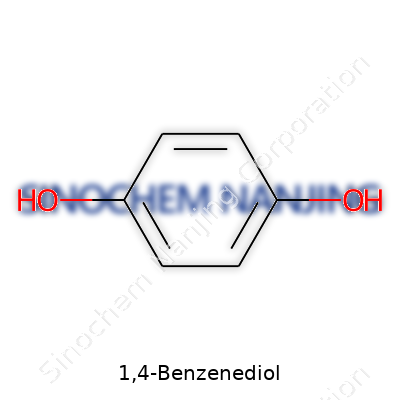
Looking at a bag of 1,4-Benzenediol, one sees a fine crystalline solid, unmistakably white. The proper chemical name reveals something about the structure: benzene’s six-ring carbon backbone, tethered to two hydroxy groups at exactly opposing ends. This arrangement grants it a mix of stability and reactivity. In manufacturing, companies often sell it in bulk, free-flowing crystalline or powder form, tailored for sectors like cosmetics or polymer production. Hydroquinone may not attract the attention of splashier compounds, but in the right hands, it delivers real value through its redox chemistry—be it keeping color photographs from fading, brightening human skin, or extending the shelf life of certain materials.
Physical and Chemical Properties
With a melting point around 170 degrees Celsius, hydroquinone stands up well under heat until it transitions into clear liquid. In a beaker, it dissolves easily in hot water and many polar solvents such as ethanol. Its solubility makes it useful as both an intermediate and a functional end product. The twin hydroxy groups account for its strong reducing power, as seen by its ability to reduce metal ions or interact with peroxides. Chemically, it walks a fine line: stable enough to handle everyday light and air, reactive enough to participate in polymerization reactions or to halt oxidative degradation in oils. Left exposed too long, though, it browns on contact with air, holding clues to the very oxidation reactions it’s so skilled at interrupting.
Technical Specifications & Labeling
Manufacturers and labs turn to pure hydroquinone, generally upwards of 99 percent purity, for precise applications. Labels on commercial containers must echo its safety risks, like skin sensitivity and inhalation dangers. Most chemical suppliers state the purity, origin, batch date, and storage recommendations. For some applications in food packaging or pharmaceuticals, additional testing for contaminants and residual solvents will get listed. Genuine transparency in documentation and traceability speaks to the gravity of responsible distribution, especially as more countries enforce tight regulations governing chemical safety.
Preparation Method
Chemists have learned several routes to produce 1,4-Benzenediol. Historically, oxidation of aniline or benzene derivatives gave modest yields, but modern industry relies on the hydroxylation of phenol, using oxidizing agents like hydrogen peroxide. This process works efficiently and with less environmental baggage than older methods. Electrochemical reduction or catalytic hydrogenation provides other ways to convert related compounds into hydroquinone. Academic researchers sometimes explore greener, bio-based synthesis using engineered enzymes to coax nature into producing it, but these are not yet standard in large-scale operations.
Chemical Reactions & Modifications
In the laboratory, hydroquinone stands out for its reversible redox chemistry. Its most famous reaction may be with silver ions in photographic developer solutions, where it swings between reduced and oxidized forms to bring images to life. Chemists substitute or modify hydroquinone’s hydroxy groups to build pharmaceuticals or specialty polymers. Methylation yields derivatives like methylhydroquinone, while halogenation makes it suitable for other specialty uses. The formation of quinones through controlled oxidation offers a gateway to biologically active compounds used in medicine and agriculture. Working with hydroquinone has shown me just how versatile a single molecule can be in the synthetic toolkit.
Synonyms & Product Names
Most people in the trade know this compound as hydroquinone. Over the years, labels have also carried para-dihydroxybenzene, quinol, p-benzenediol, and 1,4-dihydroxybenzene. In cosmetics, the term hydroquinone dominates ingredient lists. Being aware of these names can prevent costly confusion when ordering or discussing formulation changes across international teams or different regulatory systems.
Safety & Operational Standards
Handling hydroquinone asks for care and respect. It can cause skin and respiratory irritation, and in the long run, repeated exposure may increase the risk of more serious effects. Good lab and factory practice will always call for gloves, goggles, and splash guards. Ventilation stands out as a must, since dust and fumes threaten lungs. Many countries, guided by research into toxicity and long-term effects, restrict how it can be sold, stored, and used, particularly in consumer goods. Cosmetic formulations in some regions cap the allowed concentration or ban its use in non-prescription products entirely. My experience in lab environments underscores how easily cross-contamination or carelessness can lead to exposure, another reason to push for constant vigilance and good training. Workers and end users both deserve this level of respect.
Application Area
Hydroquinone's reach cuts across multiple sectors—photography, polymers, cosmetics, agriculture, and pharmaceuticals, to name a few. In skin creams, hydroquinone remains a gold standard for managing hyperpigmentation, though regulators and doctors argue over safe dosages and long-term effects. In industrial settings, it acts as a stabilizer for certain chemicals stored for long periods, staving off unwanted reactions. Polymers rely on it to prevent premature hardening during synthesis. In photographic development, it persisted for decades as a frontline reducer, creating clear, crisp images before digital cameras took over. That versatility makes it a commodity that’s tough to replace all at once, despite renewed scrutiny over health concerns.
Research & Development
Researchers keep probing the boundary between hydroquinone’s affordability and its safety. Alternatives to hydroquinone in cosmetics—like arbutin or kojic acid—attract plenty of attention, though nothing quite matches its speed and efficacy in lightening skin. In industry, green chemistry teams experiment with routes that curb greenhouse gas emissions and lessen toxic waste during synthesis. Molecular biologists explore using genetically engineered microbes to make hydroquinone from agricultural waste, bypassing traditional refinery setups. New research into antioxidant blends, incorporating hydroquinone analogs, targets everything from food preservation to advanced battery technology. These research efforts intrigue me, not only for their ambition but because they acknowledge the legacy—and the limits—of conventional chemistry.
Toxicity Research
Over the decades, scientists and regulators have grappled with the question: just how safe is hydroquinone? Early studies flagged hazards ranging from skin sensitization to carcinogenicity in animal models. Studies in humans suggest it can disrupt melanocyte function, which is exactly what skin-lightening products intend—but at higher concentrations or with chronic misuse, this effect can scar or damage skin. Inhalation remains a major concern for workers in chemical plants, where even short-term exposure above threshold limits triggers headaches, nausea, or respiratory distress. Scientists have called for more transparency from product manufacturers, urging wider publication of long-term safety data. Medical professionals continually debate whether the risks outweigh the benefits, particularly for vulnerable populations who might overuse lightening creams out of social or economic pressure.
Future Prospects
Hydroquinone stands at a crossroads. The next decade will likely bring renewed restrictions, especially in cosmetics, as alternatives gain traction and authorities take a harder stance on safety. Green chemistry promises less polluting preparation methods, which could allow industrial uses to continue with a cleaner bill of health. Researchers worldwide sift through molecular cousins of hydroquinone, hoping to match or beat its function without the same toxic legacy. In medicine and materials science, its ability to shuttle electrons remains invaluable—offering lifelines to critical processes in batteries, solar cells, and drug manufacturing. But as awareness spreads, the industry owes it to society to invest in safer substitutes and transparency, ensuring we keep reaping the rewards of hydroquinone’s chemistry without piling new risks onto future generations.
What is 1,4-Benzenediol used for?
Real-Life Utility of 1,4-Benzenediol
Anyone who has worked with film photography will recognize 1,4-benzenediol under another name: hydroquinone. In the darkroom, this chemical acts as a cornerstone, making images come to life on paper. I remember the particular scent in those small developing rooms from college—dark except for the red safety light—where hydroquinone took the latent, invisible prints and built them into something you can hold. It’s this kind of transformation that highlights its practical value, both for artists and for industries shaping our everyday products.
Industrial Applications
Hydroquinone doesn’t only help create photographs. In factories, it serves as a crucial ingredient for manufacturing antioxidants. It stops products from spoiling. In rubber production, it prevents premature hardening. Everyday tires carry a link back to this chemical. Paints also rely on hydroquinone for stability, which keeps colors true and surfaces smooth after years of exposure. The textile world taps its properties when dyeing fabrics. Those bright prints on your summer shirts hold up through repeated washings largely because of this color stabilizer.
Touching Daily Routines
Hydroquinone also finds its way into personal care routines. People trying to treat dark spots or patchy skin may use creams with hydroquinone on their shelves. It works as a skin-lightening agent by interfering with pigment production. This function brings up real debates about beauty standards, access, and safety. Doctors warn against long-term and unsupervised use. Prolonged or excessive use may cause harmful effects such as skin irritation, and some studies have linked large doses to greater health risks like ochronosis, especially where regulations lag or cruelty-free standards fall short. For this reason, countries such as the European Union strictly control or ban its sale in cosmetics. In the United States, hydroquinone is available in certain concentrations over the counter, but even here, health agencies keep a close watch on how it gets used.
Questions of Safety and Regulation
Curiosity about what goes into our daily products grows stronger every year. Consumers want to know not only what works, but what brings the least risk. Hydroquinone’s potential for toxicity means that workers in factories, as well as folks at home, need clear guidance. Wearing gloves and working in well-ventilated spaces can make a difference. Labels and instructions need to be written clearly, with no fine print hiding side effects or risks. Honest information empowers people to make healthier choices. In my years of talking with medical professionals, one thing rings true: education works best in reducing accidental exposures or misuse.
Seeking Responsible Solutions
One path forward invites greater transparency and innovation. Researchers around the world keep looking for alternatives with fewer risks for people and the environment. As new options emerge, industries begin to test safer chemicals in rubber, films, or skincare. In the meantime, tackling problems that come with hydroquinone calls for collaboration. Companies can offer better training, governments can set thoughtful guidelines, and consumers have a role in staying informed.
Building Smarter Conversations
Whether caring for photographs in a darkroom, choosing a skincare cream, or considering a fresh coat of paint at home, the impact of chemicals like 1,4-benzenediol extends further than most realize. By valuing straightforward information and questioning sales pitches, everyone shares responsibility for safer, better choices in the products we trust and use.
Is 1,4-Benzenediol safe to handle?
What’s in Everyday Products Isn’t Always a Friend
Many people know 1,4-Benzenediol by a different name: hydroquinone. It shows up in more places than most expect—a crucial part of photography labs, some wood treatments, certain hair dyes, and even skin-lightening creams. Science treats hydroquinone as a workhorse, but that doesn’t mean anyone should take it lightly. Over the years I’ve handled a fair share of chemicals, and one lesson sticks out: respect for the risks is non-negotiable, no matter how routine a substance may seem.
Risks in Plain Sight
Hydroquinone can irritate the skin, eyes, and respiratory system. I spent a summer helping refurbish camera gear; I watched more than one person reach for it without gloves and later regret it. A splash or bit of dust feels like a bee sting. Prolonged skin contact brings out reddening and itch; vapor can set off coughing. If a product warns you to wear gloves or a mask, there’s a good reason rooted in both science and thousands of workers’ lived experience.
Regulators have started to take hydroquinone seriously. Agencies like the U.S. Occupational Safety and Health Administration (OSHA) and the European Chemicals Agency list specific exposure limits. California keeps it on its Proposition 65 warning list. Decades of research show that hydroquinone, absorbed through the skin in significant amounts or breathed in as dust, can cause more than temporary trouble. Repeated, high exposure links to potential blood disorders and, in some animal studies, even cancer risks. That’s hardly a trivial consideration.
The Role of Evidence and Experience
I’ve had friends who worked in printing presses or beauty salons where hydroquinone got everyday use. They’d talk about headaches or rashes after a long shift. None of them expected long-term problems, but studies from peer-reviewed journals keep warning about unprotected use. Some creams with hydroquinone get banned or restricted in countries like Australia and Japan for a reason—regulation rarely comes from a hunch.
People working with this compound every day understand its reach. Home users tend to overlook it, trusting over-the-counter brands. The World Health Organization spells out the risks in black and white—potential toxicity and allergic reactions aren’t just lab stuff, they show up in emergency rooms, too.
Practical Choices for Staying Safe
Disposable gloves and goggles aren’t optional with hydroquinone. Ventilation beats a stuffy workspace, as airborne dust or vapors travel quickly. Skin creams with hydroquinone needpatch-testing before broad use. Store it locked away from kids and pets, because accidental poisoning does show up in poison control hotlines.
Disposal deserves extra attention. Pouring hydroquinone down the drain or tossing it in household trash can pollute water and soil. Hazardous waste depots know how to manage it; I’ve driven leftovers more than fifteen miles to one, and the feeling of doing the right thing outweighs the hassle.
Knowledge Shapes Decisions
Respecting chemicals like 1,4-Benzenediol isn’t about fearing science but honoring common sense and proven evidence. Take personal protective gear seriously. Don’t take shortcuts. Anyone—at home or work—owes it to themselves and their colleagues to read labels, check up-to-date safety recommendations, and listen to regulators. That’s experience and research talking, not just another scary label. Safety with hydroquinone doesn’t come from paranoia, but from practical steps rooted in collective expertise and a realistic look at the risks.
What are the physical properties of 1,4-Benzenediol?
What Stands Out About 1,4-Benzenediol?
1,4-Benzenediol, also known as hydroquinone, shows up across a surprising number of fields. Day-to-day, you might see it mentioned in skincare or photography. Before diving into uses, it's smart to understand how it actually behaves as a substance.
Looks, Feel, and Solubility
This compound shows up as white, needle-shaped crystals. Toss a small pile on your palm, you’ll notice the fine, slightly gritty texture. Exposing it to the air for long periods leads to it turning brown, mainly because it reacts with oxygen. You don’t need any complex chemical kit to spot that change—just some patience and a pair of eyes.
Water welcomes 1,4-Benzenediol pretty well. At room temperature, over five grams dissolve in just 100 mL of water. That points to more than average solubility for an aromatic chemical—not always the case for similar molecules. It also mixes with alcohol and ether, which helps folks blending it for industrial purposes or laboratory work.
Melting, Boiling, and Volatility
Heating a sample of those crystals reveals more. They begin to melt at roughly 172°C, a point where you see them liquefy into a clear pool. For people handling or processing the chemical, that melting point tells them how much heat the equipment needs to get it moving into another phase. Boiling isn’t practical for day-to-day lab routines because it breaks down before it ever reaches full vapor, sparing workers from dealing with vapor-pressure headaches but also locking out some purification methods.
Stability and Storage
Air, light, and moisture attack this compound, slowly turning it darker over time. Even the container you keep it in matters, and most folks who work with it avoid storing it in clear glass on a sunny shelf. Sealing it in a dry, dark, airtight jar keeps it from picking up unnecessary brown stains. The fact that it reacts so easily to air offers a clear lesson—stores, labs, and manufacturers need a plan for managing both risks and product quality.
Risks and Real-World Tips
At room temperature, 1,4-Benzenediol doesn’t jump off the bench as a fire hazard. Still, in dust form and with enough heat, it can burn. You’ll pick up a faint scent if you lean in close; most describe it as slightly medicinal. That sensory cue is one small way to check for leaks or spills, especially in tight lab spaces.
The fine crystals get airborne pretty easily, so wearing gloves and dust masks makes sense even in a small workspace. If you touch it, you may notice your skin dry out in a matter of minutes. In that way, the physical character of the chemical lines up perfectly with the common advice: treat it with care, give it a clean space, and don’t skip basic protection.
Down to the Essentials
Getting familiar with how 1,4-Benzenediol looks, behaves, and even how it feels matters if you handle it. Safety teams, skincare chemists, and industrial engineers all lean on these physical facts to decide storage, usage, and protection standards. That’s more than trivia—it shapes how people keep both products and themselves safe in environments that count.
How should 1,4-Benzenediol be stored?
Looking at Real Risks, Not Just Rules
Plenty of folks remember high school labs with little jars of white powder, and only later realize chemicals like 1,4-Benzenediol (often called hydroquinone) aren’t just harmless props. This stuff gets used in everything from cosmetics to photographic developers. Yet, just because you see it in everyday products doesn’t make it safe to toss in a cabinet and forget about.
The Mess From Light, Air, and Heat
I’ve seen firsthand how a neglected chemical shelf turns into a collection of leaky bottles with labels long faded by sunlight. 1,4-Benzenediol puts on an even bigger show if left in the wrong spot. This compound reacts to light and air, turning brown and eventually breaking down. It can produce irritating fumes and even set off fires if things get warm enough.
The science backs this up. Hydroquinone sits in a group of chemicals that break down and oxidize quickly. Air exposure is a problem, but exposure to light makes everything worse. The chemistry isn’t just academic—people have had skin burns and breathing trouble from mishandled hydroquinone. Add heat, and you’re risking dangerous vapors and pressure building up inside containers.
How I Stash It—And Why
Years ago at a printmaking studio, I learned to keep hydroquinone powdered form away from any sunny shelves. Even a bit of daylight would yellow the powder overnight. Today, common sense says airtight glass jars work best. Stash them in a metal cabinet with no windows, and keep the room cool—think basement temperature, not office temperature.
Most safety sheets echo what careful chemists have done for decades: glass or HDPE containers with tight lids. Vapor-resistant seals keep out moisture and air. Some big labs flush storage bottles with nitrogen to chase out oxygen, but not everyone has gas cylinders on hand. For most, making sure the cap’s on tight and the storage area stays under 25°C solves most problems.
Physical safety comes next. No one wants to reach into a cabinet and get a skinful of chemicals. Hydroquinone stains fingers brown in seconds and can cause nasty rashes. Lab folk always wear gloves—usually nitrile—and safety goggles, even if it’s just for refilling a tiny bottle.
Legal Stuff and House Rules
Ignore state or national regs at your own risk. I once visited a print shop where a fire marshal fined the owner over expired chemicals left out in the open. In many places, keeping certain quantities of hydroquinone without ventilation or fireproof storage can attract similar trouble. Label everything clearly. Outdated or mystery powders shouldn’t linger—dispose according to hazardous waste rules.
Tackling Storage Problems at Home and Work
Not everyone can build a pro lab in their basement. Still, a thick-walled cabinet with a lock stops curious kids and pets. Avoid plastic containers that crack or leak—cheap plastics might dissolve after a month or two. For cosmetic mixes, buy only as much as you need each time, use it quickly, and avoid bulk storage. Salons and artists often team up with local hazardous waste programs for disposal, easing the burden on single users.
Hydroquinone’s power and danger live side by side. Storing it safely is about more than following rules—it’s about protecting your eyes, skin, air, and the people who share your space.
What are the potential health hazards of 1,4-Benzenediol?
What Is 1,4-Benzenediol?
1,4-Benzenediol, often called hydroquinone, shows up in skin-lightening products, photo development processes, and some industrial applications. Products containing this compound usually claim to reduce skin pigmentation or remove uneven spots. Its presence isn’t limited to specialty items—some everyday cosmetics feature it as an active ingredient.
Exposure Affects the Skin and Body
Direct skin contact often leads to irritation. People using creams with this ingredient sometimes notice redness, burning, or inflammation. Longer use or higher concentration can cause a type of skin discoloration that looks grayish or bluish—this condition, called ochronosis, rarely reverses even after stopping the product.
I’ve seen folks turn to hydroquinone products with high hopes, only to face unexpected reactions. It doesn’t help that some users don’t realize they are allergic until after repeated exposure. Allergic reactions often go beyond mild rash. They might involve swelling, blisters, or more intense discomfort. Reports from dermatologists around the world suggest that these reactions surface more often in people with sensitive skin or a history of allergies.
Inhaling or Swallowing Raises New Issues
Most people think only of topical exposure, but handling hydroquinone powder or inhaling its dust carries health concerns. Industrial workers in photo labs or manufacturing plants risk occupational exposure. Inhaling the substance can trigger headaches or dizziness. If swallowed, it can damage organs over time, affecting the liver and kidneys. Cases reported in toxicology journals describe nausea, vomiting, and abdominal pain after accidental ingestion.
Looking at Long-Term Effects
Hydroquinone’s links to cancer pop up in animal studies but not clearly in humans. The U.S. Food and Drug Administration took notice after research in rats showed tumor formation following prolonged, high-dose intake. Regulatory agencies in Europe and several Asian countries now restrict or ban over-the-counter sales for this reason. The U.S. still allows limited concentrations in consumer products but continues to review safety data. It’s easy to overlook these risks when grabbing an over-the-counter tube, especially given slick marketing or online endorsements.
Solutions: Smarter Choices and Safer Practices
Staying informed makes a real difference. People should check ingredient labels, especially if they—like me—have experienced skin sensitivity in the past. Dermatologists encourage patch-testing small amounts before committing to any treatment. Proper glove use helps in workplaces handling concentrated forms, and exhaust fans or protective masks cut down on inhalation risks.
For those looking to lighten skin, alternatives like azelaic acid or vitamin C serums offer milder actions with fewer risks. Regulation can’t cover every risky product sold online, so spreading awareness matters just as much as government rules. If you have questions, a healthcare provider or board-certified dermatologist will offer insight tailored to your body’s needs. Listening to your body and seeking professional advice often heads off trouble before it starts.
Resources and Help
Health agencies such as the American Academy of Dermatology and the World Health Organization publish up-to-date safety guidance. Checking in with reputable sources keeps people one step ahead of health problems linked to 1,4-benzenediol. Safe habits, clear information, and ongoing oversight—these can protect people from the hazards tied to this common but controversial chemical.
| Names | |
| Preferred IUPAC name | benzene-1,4-diol |
| Pronunciation | /waɪt ˈbɛn.zə.niː.daɪ.ɒl/ |
| Identifiers | |
| CAS Number | 123-31-9 |
| Beilstein Reference | 1208630 |
| ChEBI | CHEBI:17594 |
| ChEMBL | CHEMBL1649 |
| ChemSpider | 504 |
| DrugBank | DB01901 |
| ECHA InfoCard | 03c601076854b83de60001fc |
| EC Number | 1.10.3.2 |
| Gmelin Reference | 50296 |
| KEGG | C00186 |
| MeSH | D001835 |
| PubChem CID | 785 |
| RTECS number | MX3500000 |
| UNII | XR6QJ0GV3D |
| UN number | UN2020 |
| Properties | |
| Chemical formula | C6H6O2 |
| Molar mass | 110.11 g/mol |
| Appearance | White crystalline solid |
| Odor | Odorless |
| Density | 1.3 g/cm3 |
| Solubility in water | Soluble in water |
| log P | 0.59 |
| Vapor pressure | 0.00016 mmHg (25 °C) |
| Acidity (pKa) | 10.0 |
| Basicity (pKb) | 10.04 |
| Magnetic susceptibility (χ) | -46.0·10⁻⁶ cm³/mol |
| Refractive index (nD) | 1.639 |
| Viscosity | 132 cP (25°C) |
| Dipole moment | 1.61 D |
| Thermochemistry | |
| Std molar entropy (S⦵298) | \(110.7 \, \mathrm{J \, mol^{-1} \, K^{-1}}\) |
| Std enthalpy of formation (ΔfH⦵298) | -146.0 kJ/mol |
| Std enthalpy of combustion (ΔcH⦵298) | –2852 kJ·mol⁻¹ |
| Pharmacology | |
| ATC code | D11AX01 |
| Hazards | |
| Main hazards | Harmful if swallowed, causes skin irritation, causes serious eye irritation, may cause respiratory irritation |
| GHS labelling | GHS02, GHS05, GHS06 |
| Pictograms | GHS07, GHS05 |
| Signal word | Danger |
| Hazard statements | H302, H315, H319, H372, H410 |
| Precautionary statements | P210, P260, P280, P301+P312, P305+P351+P338, P330, P501 |
| NFPA 704 (fire diamond) | 2-1-0 |
| Flash point | 165 °C |
| Autoignition temperature | 533 °C |
| Explosive limits | 7-18% |
| Lethal dose or concentration | LD50 oral rat 320 mg/kg |
| LD50 (median dose) | LD50 (median dose): Oral (rat) 320 mg/kg |
| NIOSH | SN35000 |
| PEL (Permissible) | PEL (Permissible Exposure Limit) for 1,4-Benzenediol: 2 mg/m³ |
| REL (Recommended) | 0.0005 |
| IDLH (Immediate danger) | 100 ppm |



