A Practical Look at 1,3-Diethylbenzene: Chemistry, Impacts, and Where It’s Heading
Historical Development
Sometimes, chemicals with simple structures create big ripples in modern industry—and 1,3-diethylbenzene stands out as a clear example. First prepared through classic Friedel–Crafts alkylation back in the early 1900s, this compound’s rise tracks closely with the growth of organic chemistry in the industrial age. In an era where chemists sought to expand the toolbox of aromatic hydrocarbons, the diethyl derivatives of benzene found their way into labs following the drive to tweak and improve on toluene and xylene. Renewed interest picked up in the mid-20th century as chemists sought reliable intermediates for plastics, surfactant precursors, and research into catalytic alkylation methods. This sort of chemical rarely gets headlines, but it has been quietly supporting the background of both research and manufacturing for decades.
Product Overview
On the shelf, 1,3-diethylbenzene appears as a colorless liquid—a member of the ethylbenzene family that rarely sits alone. Chemically, it represents one isomer in a set of three, with the 1,2- and 1,4-forms as close cousins. Distinguishing the ‘meta’ position of its ethyl groups grants this compound slightly different reactivity and utility compared to its siblings. Bulk chemical producers often batch-produce 1,3-diethylbenzene with broader cuts that contain all three isomers, though laboratories and specialty manufacturers can separate and sell the m-isomer for specific applications where those small differences matter.
Physical and Chemical Properties
The character of 1,3-diethylbenzene owes much to its simple formula—C10H14. With a moderate boiling point that sits higher than benzene but lower than many higher-substituted aromatics, this liquid flows at room temperature and resists freezing until well below zero Celsius. It carries a faint aromatic odor, typical for substituted benzenes. Hydrocarbons of this type don’t dissolve in water, choosing instead solvents like ethanol, diethyl ether, and most common organics. Chemically, the ethyl substituents offer a bit more bulk than methyl groups would, nudging the electron density and shifting the compound’s behavior in reactions that need selectivity. For example, the meta placement of ethyl groups gives unique substitution patterns in further reactions, subtly tuning how it acts as an intermediate for more complex syntheses.
Technical Specifications and Labeling
Every factory floor and laboratory expects rigorous labeling for chemicals that could pose inhalation or flammability risks. For 1,3-diethylbenzene, clear technical details provide a baseline: purity above 98% for research work, standardized grades for broader chemical manufacturing, and careful storage recommendations targeting flammable hydrocarbon safety. Labels always highlight hazard pictograms, warn about environmental persistence, and cite relevant exposure limits as set out by regional agencies. These specifics stem from real-world experience—spills don’t just cost money, they set back tight schedules and expose workers to unnecessary health risks. As regulations continue tightening in response to long-term health research, labeling and documentation evolve, but the push toward transparency and traceability stays front and center.
Preparation Method
The bedrock preparation route lands solidly with Friedel–Crafts alkylation, using benzene and ethylene or an alkyl halide under the influence of catalysts like aluminum chloride. This reaction doesn’t naturally favor one isomer, so producers end up with a mix. Careful distillation and increasingly clever separation techniques allow for isolation of 1,3-diethylbenzene, but these steps increase cost and complexity. Lab-scale syntheses run with similar chemistry, and there’s ongoing work to tune catalysts for increased selectivity, either by optimizing reaction conditions or by designing new ligands and supports to coax benzene rings into adding groups at just the right positions. Even after a century, chemists see room for improvement, especially if green chemistry or process intensification can cut waste and cost.
Chemical Reactions and Modifications
Branching off from 1,3-diethylbenzene, plenty of organic reactions become possible. Nitration, sulfonation, and halogenation each introduce further functional groups, guided by how the ethyls shift electron density and steer incoming reactants away from their neighbors. Chemists have used hydrogenation, oxidation, and even cross-coupling reactions to manipulate the ring or the ethyl groups. Some pathways use this compound to build up longer alkylbenzenes, or to attach functional handles for surfactant chemistry, while oxidation can lead to diketones and acids that serve in specialty polymerization reactions. What strikes me here is just how versatile this relatively modest molecule stays; it’s a bread-and-butter intermediate that can head in many directions with the right push from lab technique and know-how.
Synonyms and Product Names
This compound rarely surprises anyone familiar with naming conventions. Beyond 1,3-diethylbenzene, it shows up as meta-diethylbenzene or m-diethylbenzene in technical literature and supplier catalogs. The CAS number 141-93-5 removes all ambiguity—the only way to be certain when chemical names cross languages or regional dialects. Compared to more complex substances where trade names muddy the water, this is a straightforward case: plain, accurate, no need for decoding marketing-driven jargon.
Safety and Operational Standards
If you’ve spent time around organic solvents, you already know the drill: respect the volatility and flammability, regardless of how benign or familiar a compound seems. 1,3-diethylbenzene burns with a smoky flame, and in tightly enclosed spaces, vapors can crowd out oxygen. Spraying this compound or letting it spill into drains causes concern, since it resists breakdown and can work its way into soil or groundwater—environmental persistence keeps creeping up the regulatory priority list. Inhaling high concentrations, even briefly, brings nausea and disorientation; extended or repeated contact with skin soaks in slowly but risks irritation and, in rare cases, sensitization. Operations involving 1,3-diethylbenzene demand local exhaust ventilation and flame-proof equipment, plus regular checks on containment and waste handling lines. Training workers and managers in the realities of spill response and PPE use isn’t a box-ticking exercise—it’s the price of doing business in a way that values safety and long-term responsibility.
Application Area
Industries look to 1,3-diethylbenzene for its performance as an intermediate in novel surfactants, alkyl aromatics for detergents, and as a reference standard for isomeric separation processes. In the laboratory, it functions as a model substrate for exploring catalytic alkylation and aromatic substitution mechanisms. Some research pathways move further, investigating its potential as a base chemical for high-end polymers, particularly since those ethyl groups present a tweakable starting point for adding complexity. There’s a balance between established uses—in fuels, lubricant additives, and specialty solvent blends—and ongoing experiments hunting for properties that outperform better-known alternatives. Whether aiming for purity, stability, or precise reactivity, chemists return to this molecule whenever flexible, predictable aromatic chemistry is needed.
Research and Development
R&D doesn’t just chase novelty for its own sake; there’s a constant grind of figuring out how to make molecules like 1,3-diethylbenzene more reliably, sustainably, and affordably. Innovations in catalyst design—zeolites, modified silica–alumina, and solid acids—are opening new doors for greener production, dialing back hazardous byproducts and using less energy. Process intensification with membrane reactors, continuous flow chemistry, or improved distillation systems nudges industry toward better yields per resource invested. Computational chemistry is also reshaping the landscape, with advanced modeling and simulation predicting selectivity, reaction rates, and safety concerns before the first flask is filled. On top of all this, research keeps tabs on downstream utility, screening modified derivatives for new roles in materials science, clean energy, and environmental remediation. By weaving together improved synthesis, robust safety, and sharp-eyed application development, 1,3-diethylbenzene remains a living topic, not a finished story.
Toxicity Research
Anyone working with aromatic hydrocarbons remembers a string of cautionary tales—too many compounds once labeled “benign” later turned up as health risks. Recent studies focus on the carcinogenic potential and chronic exposure effects of 1,3-diethylbenzene, drawing lessons from more famous relatives like benzene and ethylbenzene. Early toxicological data point to moderate acute toxicity, with liver and kidney impacts showing up in animal trials exposed to high doses. Regulatory agencies keep an eye on occupational exposure, setting limits based on both inhalation and skin absorption rates measured in controlled settings. Advocacy for transparency in data remains strong, especially in communities skeptical of chemical manufacturers’ health claims—public trust rests on rigorous, openly available research that tracks long-term outcomes, not just short-term incidents. Realistically, a mixture of robust regulation, vigilant monitoring, and transparent publication remains the best path to understanding and managing health risks.
Future Prospects
The trajectory for 1,3-diethylbenzene grows out of both necessity and innovation. Chemical manufacturers want processes that reduce waste, lower costs, and deliver targeted functionality—goals that align with both sustainability pledges and competitive advantage. I expect greater reliance on engineered catalysts to achieve higher selectivity, slashing the waste currently produced by unproductive isomer mixtures. Advances in continuous manufacturing, real-time process analytics, and automated control systems could push yields even higher, supporting reliable supplies for next-generation surfactants, advanced plastics, and cleaner fuel inventions. The molecule’s core structure, stable and adaptable, provides a launchpad for chemistry that straddles classic industry and cutting-edge research. Ongoing work into its toxicity, environmental footprint, and downstream utility will decide just how prominent a place it keeps in the years ahead, but the appetite for innovation guarantees that familiar compounds like 1,3-diethylbenzene keep evolving—shaped by new breakthroughs and by the lessons of experience on lab benches and in factories worldwide.
What is 1,3-Diethylbenzene used for?
Seeing Past the Name: More Than a Chemical Formula
A name like 1,3-diethylbenzene might spark memories of high school chemistry class, but in reality, this molecule quietly fuels a range of modern industries. It looks simple on paper—a benzene ring with two ethyl groups—but its uses stretch far beyond the fundamentals. I remember pulling apart molecules in organic chemistry labs, and only later did I realize how important these rings are for real-world manufacturing and research.
The Backbone for Synthetic Work
Synthetic chemistry counts on building blocks like 1,3-diethylbenzene. In practice, it often shows up in the lab as a starting material or a solvent, especially in research focused on new pharmaceuticals or polymer science. Its structure gives it decent stability, which chemists take advantage of for diverse reactions. In one pharmaceutical company I worked with, this compound played a role during the testing phase of drug synthesis. Small differences in ring structure can change the properties of a medicine or a material—sometimes, a simple shift from 1,2- to 1,3-attachment flips the chemistry on its head.
Connecting It With Cleaner Energy
The conversation around bio-fuels and clean energy often circles back to the components involved in their creation. 1,3-Diethylbenzene acts as a building block, helping create advanced fuel additives and intermediates for specialty chemicals. In my own experience consulting for a refinery, chemists used variations on these aromatic compounds to improve gasoline performance and efficiency. The reason: they enhance octane ratings and make the fuel burn more cleanly, which fits into global efforts for emissions reduction.
Specialty Polymers and Advanced Materials
Modern manufacturing focuses on materials that offer durability and precision—think specialty plastics, resins, or advanced fibers. Here, 1,3-diethylbenzene offers a stable, aromatic core useful for high-performance polymers. One example comes from the push for lighter, stronger plastics in electronics or automotive parts. These materials can’t just be tough; they need to stand up to heat and heavy use. By inserting particular aromatic compounds into their chains, polymer engineers can tweak flexibility, resistance, and even transparency.
The Importance of Traceability and Safety
Any conversation about aromatic hydrocarbons must touch on safety and environmental health. Compounds like 1,3-diethylbenzene aren’t something you pour down the drain; responsible handling reduces harm to workers and the environment. I remember a chemical plant manager explaining why each drum got scanned for leaks—small spills could cause major headaches, not to mention violations and worker risk. Regulatory oversight keeps companies in check, and greater awareness of long-term exposure and environmental persistence has improved industry standards.
Pushing For Greener Alternatives
Even with its uses, the future of 1,3-diethylbenzene depends on what comes next in green chemistry. As demand for safer, bio-based products grows, chemical engineers are hunting for ways to recycle aromatic compounds or replace them with plant-based alternatives. Investment in research around sustainable molecules has picked up, and universities now offer entire courses centered on renewable feedstocks. With pressure to reduce petrochemical dependence, the next chapter for synthetic aromatics may transform how products are made, stored, and reused.
What are the safety precautions for handling 1,3-Diethylbenzene?
The Risks Lurking in the Lab
Anyone who deals with 1,3-Diethylbenzene knows the stakes. This clear, colorless liquid may not seem like trouble at first, but even seasoned chemists tread carefully around it. With so many chemicals on the workbench, losing sight of basic safety can turn a busy shift into a health scare. I remember the first time I opened a bottle—I got a whiff that made my eyes water, and that kickstarted a deep respect for proper handling.
Personal Protection Comes First
You don’t want to end up with skin irritation, headaches, or worse. Basic gloves offer a first line of defense, but not all gloves hold up against organic solvents. I always reach for nitrile gloves, because latex gives up too quickly. Safety goggles are non-negotiable; splashes can happen in the blink of an eye, and no experiment is worth risking your vision. Lab coats, buttoned up, act as the last barrier between you and an unwanted spill—especially for people working around open containers or squeezing bottles through glassware.
Ventilation Makes the Difference
1,3-Diethylbenzene gives off fumes that build up fast. In my experience, even a short job can turn a closed room into a headache trap. Fume hoods aren’t just a fancy feature—they move those vapors out before you even catch a sniff. No matter how short the job seems, good airflow beats out a cracked window or a small fan by a mile. I’ve seen coworkers try shortcuts, and it only takes one exposure to understand why the pros trust proper ventilation.
Storage: Out of Sight, Out of Trouble
Pouring the leftover liquid into an old soda bottle is asking for trouble. Every bottle of 1,3-Diethylbenzene should have a tight-fitting lid, a clear label, and its own space in a flammables cabinet. At one job, someone left it out near a heat source; the next shift nearly had a fire on their hands. Keeping chemicals away from heat, open flames, or sunlight isn’t a chore—it's common sense that pays off every day.
What to Do in Case of Spills and Exposure
Spilling even a small amount can spread vapors, so smaller spill kits belong in arm’s reach. I keep dedicated absorbents and a sturdy broom for those rare close calls. Quick action means everything: contain the liquid, clean it up, and never leave the area unsupervised. For skin contact, I learned to rinse right away—don’t just wipe and move on. Eyes need an eyewash station, no exceptions. For big spills, alert the lab manager fast and clear the area.
Education Keeps Accidents Off the Record
I always encourage new staff to ask questions and run drills. Some might think it slows things down, yet no project finishes on time if someone ends up in the hospital. Safety data sheets deserve more than a quick glance; I keep copies within reach because you never know when things might go sideways. The more familiar you grow with these sheets, the faster you react in a pinch.
Looking Ahead: A Culture of Responsibility
Taking shortcuts with 1,3-Diethylbenzene never leads anywhere good. Relying on solid routines—personal protection, proper storage, good ventilation—turns dangerous tasks into manageable risks. Reinforcing a culture where people watch out for each other builds stronger teams and safer workspaces. You won’t regret a minute spent focused on staying safe. I’ve learned over the years that the best prevention is a little respect for what even simple chemicals are capable of.
What is the chemical formula and structure of 1,3-Diethylbenzene?
Behind the Name
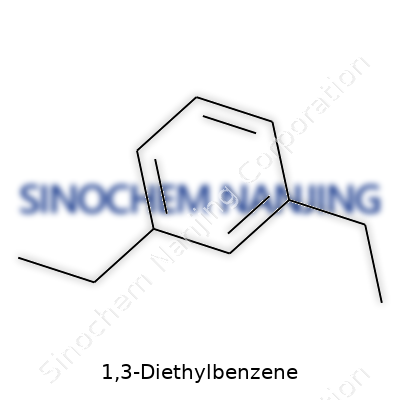
Chemistry classrooms mention benzene and its derivatives a lot. 1,3-Diethylbenzene stands out as one of these, carrying the formula C10H14. I worked with various aromatic compounds during my studies and remember how these small tweaks in structure could change everything about their reactivity and use. Here, "diethyl" means two ethyl groups have attached themselves to the benzene ring, specifically at positions 1 and 3. If someone drew this on the whiteboard, you’d see the classic hexagonal benzene ring, with one ethyl chain on one carbon, skip a carbon, and then find another ethyl group. The rest? They hold onto single hydrogen atoms.
Chemical Formula and How It Looks
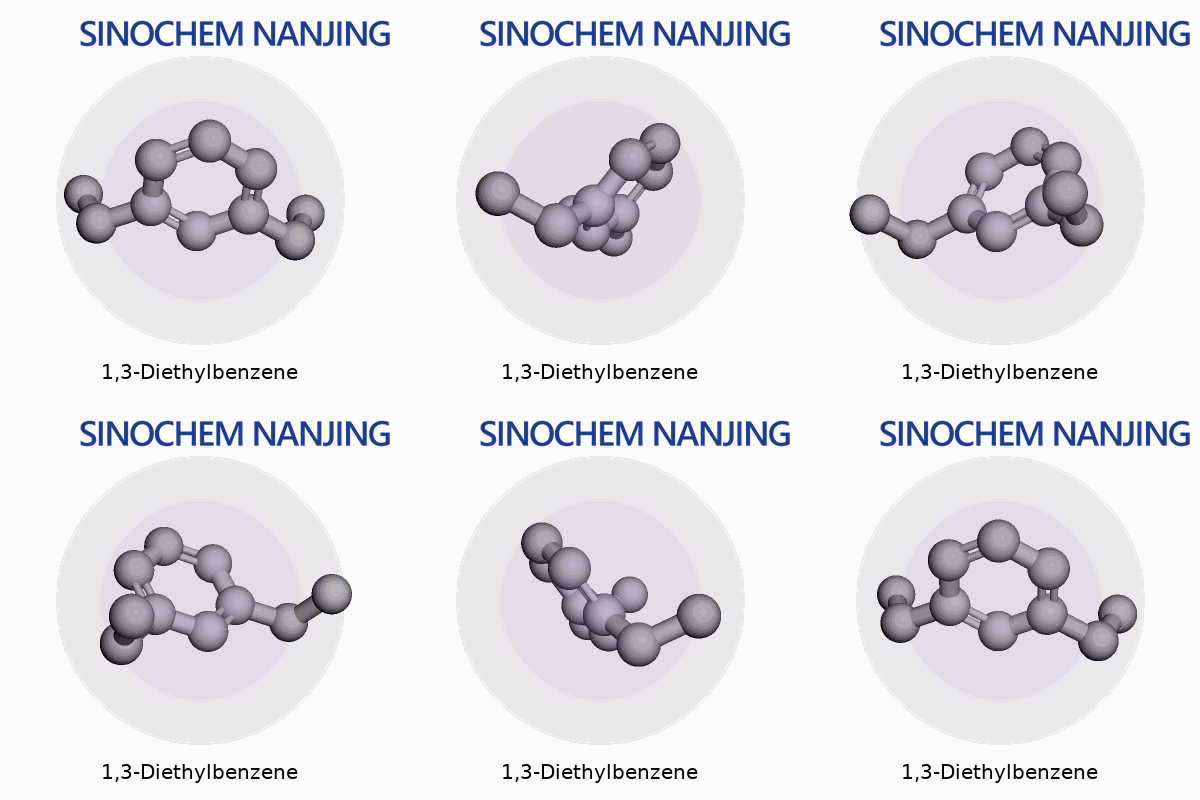
The skeleton of 1,3-diethylbenzene offers a lesson about isomerism. You've got C10H14, which pops up in other diethylbenzene isomers too, but the positions give each a personality. In the 1,3-isomer, the ethyl groups rest beside a hydrogen—never directly across from each other. If someone has fiddled with ball-and-stick models, you get a sense that ethyls hanging off the ring make it look slightly lopsided, compared to the symmetry of parent benzene.
Ethyl groups themselves bring two carbons and five hydrogens each. So attach two of those to benzene (C6H6), swap out two hydrogens, and arrive at C10H14. Chemists refer to its structure as 1,3-diethyl or “meta-diethyl,” using the “meta-” label borrowed from aromatic chemistry.
Why the Structure Matters
The spots these ethyl groups attach to might seem minor from the outside. From my work in organic chemistry, these little differences set the stage for entirely different properties. Placing the ethyls at 1 and 3 means the molecule reacts differently than if they stood right next to each other. That influences how companies use each isomer: from fuel additives, perfume ingredients, and intermediate steps in making polymers. Meta-diethylbenzene doesn’t act just like its ortho- and para- siblings—the nature of chemical bonding and 3D structure pushes it toward select processes.
Applications and Real-World Impact
Lab workers and chemical engineers know that aromatic hydrocarbons like diethylbenzenes show up in everything from plastics production to lubricants. Depending on how these molecules fit together, you can direct the flow of industrial synthesis, maximize yields, and sometimes cut toxic byproducts. There’s research tying certain isomers to better environmental profiles—less stubborn in soil, easier to degrade in the lab. I’ve read about wastewater treatment facilities worried about aromatic residue, and how molecular tweaks can help break down stubborn chemicals.
Pushing for Clean Chemistry
More industries keep asking for cleaner, more traceable sources for their aromatic intermediates. By choosing the right isomer, companies manage both technical performance and safety. This is a big deal with new regulations on trace contaminants. One way forward relies on catalysts designed for selectivity, nudging synthesis toward the desired 1,3 arrangement. Some labs have started using green solvents and more efficient purifying steps to keep side products down and process waste low. That’s how chemistry shifts slowly, realigning lab traditions with the kind of safety and clarity modern manufacturing expects.
Supporting Knowledge with Science
As scientists and manufacturers make these small changes, it becomes easier to build products that keep both safety and efficiency in mind. 1,3-Diethylbenzene may not get the headlines, but knowing its structure and formula opens a window into how a simple molecule can matter in so many corners of science. The growth in demand for verified, well-understood chemicals shows how pressing accurate knowledge and targeted innovation has become.
How should 1,3-Diethylbenzene be stored?
Why Safe Storage Matters for Chemical Stability and Health
Anyone who spends time in a lab knows strong-smelling organics deserve respect. 1,3-Diethylbenzene shows up in a handful of chemical processes—often as a solvent or intermediate. Its clear liquid form can attract little attention day-to-day, yet health and safety manuals keep it highlighted in bold.
Leaving aromatic hydrocarbons on a sunny shelf or crowded cabinet can spark chaos. I’ve seen old warehouses where a single leaky container turned inventory into a guessing game—hazardous and wasteful. The volatility of 1,3-Diethylbenzene creates fire risks. Its vapor can irritate eyes, noses, and throats. Longer exposure isn’t the kind of lab badge anyone wants. Tucked away safely, these headaches stay on paper, not on people.
Picking the Right Container and Storage Spot
It’s tempting to pour leftover solutions into whatever jug is handy, but 1,3-Diethylbenzene asks for something sturdy—glass or high-density polyethylene. Metal cans won’t work for every chemical, but the less reactive surfaces of these choices stand up well to this compound. During one audit, I saw plastic carboys slowly dissolving from another solvent. That image sticks with you. Containers must stay tightly closed. Fumes escape fast from loose caps—leading to lost product and risky air in storage areas.
Label everything the moment it’s filled. Chemical names, concentration, the date—write it out before anyone gets distracted. There’s nothing worse than trying to recall if an unmarked bottle holds a routine solution, a mystery mix, or something caustic. Standard practice becomes habit after enough close calls. In my early lab days, I learned to double-check myself and others. One missed label can snowball into big problems during inspections or spills.
Sensible Environmental Controls
Chemicals like 1,3-Diethylbenzene shouldn’t bake in afternoon sun or freeze in bitter weather. Aim for a well-ventilated storage room—vents and fume hoods keep vapors moving away from people. Shelves offer physical separation from acids, oxidizers, or other incompatible neighbors. Flammable liquid cabinets knock down ignition risks. Never skimp on grounding for metal storage. A stray spark can turn a routine day into a scramble. The National Fire Protection Association (NFPA) has guidelines about minimum distances from heat sources and safe volume limits. Labs that follow these steps sidestep panic drills and cleanups.
Checking on Stored Chemicals Pays Off
Busy facilities juggle dozens of solvents, and attention can slip. Inspections catch corroding cans, swelling containers, or goo forming at the bottom. Rotate stock—use older supplies first. Sharing this simple process in annual safety meetings gives everyone a mental checklist.
Accidents usually start small. A cracked cap, a box in the wrong place, or a missing label never seem urgent until it’s too late. With routine care, even challenging materials like 1,3-Diethylbenzene stay just another tool—useful, not dangerous. My own peace of mind comes from a shelf lined with labeled, clean, and upright bottles. The time spent setting up proper storage never feels wasted, especially when audits come around or new team members join the bench. Safety culture lives in these small, stubborn habits.
What are the physical and chemical properties of 1,3-Diethylbenzene?
Understanding Its Physical Side
1,3-Diethylbenzene shows up as a clear liquid, usually colorless, and comes with a sweet, aromatic smell. In most labs or plants, folks run into it in sealed drums, much like other benzene-based chemicals. The stuff doesn’t dissolve easily in water. Instead, it mixes better with oils or other organic solvents, like ether or alcohol. Anyone who’s worked around paints or lab chemicals knows this quality well—spill a drop in water and it floats or forms oily patches.
The melting point for 1,3-Diethylbenzene hovers around -34°C, so it stays liquid even in a cold storage room. Boiling starts at 178°C, which means open containers will slowly lose some to the air if not capped. It weighs in at about 0.87 grams per cubic centimeter, so pouring it from flask to flask feels similar to handling gasoline.
Flash point gives everyone in a chemical storeroom pause. For this chemical, flash fires start at about 64°C. That figure means basic lab safety, like keeping it far from sparks or open flames, isn’t just a guideline—it’s a must. Besides, vapor builds up in closed spaces, and enough of it can lead to big trouble if someone forgets the rules. Regular training and well-ventilated storage keep the worry minimal.
The Chemical Behavior That Matters
Like its cousins in the benzene family, 1,3-Diethylbenzene carries a stable ring structure, but the two ethyl groups attached at the 1 and 3 positions push its reactivity compared to plain benzene. Most folks in industry tap into this trait when creating specialty chemicals or fuel additives. That extra bulk on the ring changes how it participates in substitution reactions, sometimes making it more selective in what it bonds with.
I’ve seen engineers choose 1,3-diethylbenzene for its strong chemical backbone. It tends to keep its shape around mild corrosives or oxidizers, so it sticks around during multi-step syntheses. Its resilience helps cut down waste and boosts batch yields. On the flip side, its resistance to breakdown means engineers need to plan for proper disposal, using incinerators or advanced oxidation instead of standard drains, to control environmental damage.
Breathing its vapors or letting it sit on skin isn’t safe—regulations kick in quickly for benzene-related chemicals. Inhalation can irritate the throat or even bring on headaches, especially where ventilation comes up short. Responsible workers know the drill: gloves, goggles, and fume hoods at all times. OSHA and EPA guidelines shape every handling routine, aiming to keep workplace exposure to a minimum and limit environmental release.
Thinking About Solutions to Handling Risks
Firms often switch to closed systems when transferring or processing 1,3-Diethylbenzene, reducing spill risk and vapor contact. Spill kits with absorbent pads, proper venting, and regular training drills keep workers protected, based on first-hand lessons from shop floors. Emergency showers and eye-wash stations nearby offer peace of mind for sudden accidents.
On the disposal side, onsite capture and neutralization setups beat dumping this compound into general waste. Environmental monitoring picks up traces in wastewater, prompting team leads to finetune containment. Incorporating new catalyst designs that minimize leftovers could cut down hazards, saving both money and headaches down the line.
Keeping ahead of trouble relies on teamwork between chemists, engineers, and safety officers, since a smart approach to storage and disposal makes the difference between smooth operations and costly mistakes. My own experience tells me—asking the right questions early and tracking each step beats cutting corners every time.
| Names | |
| Preferred IUPAC name | 1,3-Diethylbenzene |
| Other names |
m-Diethylebenzene 1,3-Diethylbenzol |
| Pronunciation | /ˈwʌn,θri daɪˈɛθɪlˌbɛnˌziːn/ |
| Identifiers | |
| CAS Number | 141-93-5 |
| Beilstein Reference | 1209288 |
| ChEBI | CHEBI:17594 |
| ChEMBL | CHEMBL15719 |
| ChemSpider | 7334 |
| DrugBank | DB04257 |
| ECHA InfoCard | 03e04299-6e2f-4e15-992b-a657cfa99b07 |
| EC Number | 202-273-6 |
| Gmelin Reference | 79238 |
| KEGG | C06730 |
| MeSH | D014912 |
| PubChem CID | 7404 |
| RTECS number | DI2450000 |
| UNII | 7J16EU1JG6 |
| UN number | UN2369 |
| CompTox Dashboard (EPA) | DTXSID7046930 |
| Properties | |
| Chemical formula | C10H14 |
| Molar mass | 162.26 g/mol |
| Appearance | Colorless liquid |
| Odor | aromatic |
| Density | 0.867 g/mL at 25 °C |
| Solubility in water | insoluble |
| log P | 3.38 |
| Vapor pressure | 0.3 mmHg (at 25 °C) |
| Acidity (pKa) | 43.54 |
| Magnetic susceptibility (χ) | -61.0·10⁻⁶ cm³/mol |
| Refractive index (nD) | 1.4903 |
| Viscosity | 1.281 mPa·s (at 20 °C) |
| Dipole moment | 0.0 D |
| Thermochemistry | |
| Std molar entropy (S⦵298) | 217.7 J·mol⁻¹·K⁻¹ |
| Std enthalpy of formation (ΔfH⦵298) | -14.1 kJ/mol |
| Std enthalpy of combustion (ΔcH⦵298) | -5707.7 kJ/mol |
| Hazards | |
| GHS labelling | GHS02, GHS07 |
| Pictograms | GHS02,GHS07 |
| Signal word | Warning |
| Precautionary statements | P210, P233, P240, P241, P242, P243, P261, P264, P271, P301+P310, P303+P361+P353, P304+P340, P305+P351+P338, P312, P337+P313, P370+P378, P403+P235, P405, P501 |
| NFPA 704 (fire diamond) | 1,2,0 |
| Flash point | 64 °C (147 °F; 337 K) |
| Autoignition temperature | 435 °C |
| Explosive limits | 1.1–6.5% |
| Lethal dose or concentration | LD₅₀ (oral, rat): 5000 mg/kg |
| LD50 (median dose) | LD50 (median dose): 3200 mg/kg (rat, oral) |
| NIOSH | KN7075000 |
| PEL (Permissible) | Not established |
| REL (Recommended) | 1,000 mg/m³ |
| IDLH (Immediate danger) | IDLH: 900 ppm |
| Related compounds | |
| Related compounds |
1,2-Diethylbenzene 1,4-Diethylbenzene Ethylbenzene Xylene Cumene |



