1,3-Cyclohexadiene: Shaping Chemistry From Foundation to Frontier
Historical Development
Chemists have always chased after molecules that open doors to new discoveries, and 1,3-cyclohexadiene certainly has a strong place in this story. The earliest syntheses date back to the late nineteenth century, as researchers rummaged through the world of six-membered rings, searching for connections between aromatic chemistry and the realm of cycloalkenes. Diels and Alder relied on this molecule for their revolutionary cycloaddition work in the 1920s, which would eventually change how the whole world thinks about ring systems and chemical synthesis. Techniques for making and isolating cyclohexadiene improved through the next few decades, driven by its reputation as a versatile diene. People in both academic labs and industry figured out early on that this molecule was an important stepping stone to a range of chemicals, especially as petrochemical processing took off in the twentieth century.
Product Overview
For folks just getting their hands wet in synthetic labs, 1,3-cyclohexadiene sometimes seems unimpressive—just another colorless mobile liquid with a slightly musky smell. But anybody who has used it in a real experiment recognizes its value as a building block and as a stand-in for more reactive or unstable dienes. Beyond bench-scale reactions, its use stretches into industrial syntheses for pharmaceuticals, agrochemicals, and specialty plastics. Its role as a diene in Diels–Alder reactions is widely recognized, and chemists cherish it for its predictable behavior and reliability across a range of tough conditions.
Physical and Chemical Properties
People who work with 1,3-cyclohexadiene notice that it boils at around 80°C, putting it in that convenient sweet spot for distillation without needing fancy equipment. Its six-membered ring, loaded with two double bonds, shows a chemistry distinct from both benzene and other cyclic alkenes. The presence of conjugation gives it some aromatic-like stabilization, but not enough to make it as sleepy as benzene. That half-aromatic energy makes it just reactive enough to play well in cycloadditions, or get snagged in an oxidative process. Its density sits a little below water, so in most cases, it forms a neat layer when mixed. Not many solvents dissolve it as easily as toluene or dichloromethane, but it holds up well with classic organic solvents.
Technical Specifications and Labeling
If you spend enough time ordering chemicals, you learn quickly that technical specifications matter. Suppliers generally state a purity above 95%, though you can sometimes dig up higher grades marketed for sensitive research, where even trace peroxides or extra double bond isomers can throw off an experiment. Folks in chemical purchasing have to keep an eye out for color stability and polymerization inhibitors—ironically, very pure cyclohexadiene will polymerize in storage if left unmonitored or exposed to air. The shipping labels include the usual hazard warnings about flammability and volatility, lined up with local and international transport rules.
Preparation Method
Making 1,3-cyclohexadiene in the lab brings out the history of organic synthesis. Traditional methods often start from benzene, which, after careful hydrogenation, yields cyclohexene. From there, clever dehydrogenation with catalysts like palladium or high-temperature copper acts as a bridge to knock out more hydrogen, giving the conjugated diene. Labs sometimes reach for the Birch reduction—a method using sodium in liquid ammonia—if they want partial reduction, though that often lands closer to 1,4-cyclohexadiene. Industrial processes prefer high-throughput, catalytic setups, often reusing hydrogen streams and leveraging heat for efficiency. Waste minimization starts with catalyst recycling, a topic chemists care more about now, given the pressures for greener processes.
Chemical Reactions and Modifications
Cyclohexadiene stands out because it's as much a starting material as it is an intermediate in more ambitious syntheses. Diels–Alder reactions with electron-deficient dienophiles regularly fork out on undergraduate problem sets, but on a factory scale, these reactions lay down the backbones for lubricant additives or synthetic perfumes. With both double bonds exposed, the molecule willingly undergoes hydrogenation, halogenation, and oxidation. Adding hydrogen nudges it toward cyclohexene and ultimately to cyclohexane, making it an option for fine-tuning the hydrogen profile of more complex systems. It reacts with peracids to form epoxides, and with proper tweaking, can give brominated or chlorinated intermediates useful in polymer chemistry. Its double bonds make selective modifications possible—something that isn’t always true for fully aromatic systems like benzene.
Synonyms and Product Names
People sometimes call it 1,3-CHD, but you’ll also see hexadiene-1,3-cyclo or even just cyclohexadiene depending on the catalog. Regulatory agencies and older literature use other names such as 1,3-cyclohexadiene or cyclohex-1,3-diene, just to keep students on their toes. Looking back at collected samples in research notebooks, the name matters less than the structure—a lesson every experienced chemist learns after tracking down a mislabeled vial and realizing the importance of systematic nomenclature.
Safety and Operational Standards
In any real lab, safety is more than classroom rules. Cyclohexadiene lights up quickly and can form explosive peroxides if neglected on a shelf. Its volatility means even a small spill can stink up the place or tip off anyone who’s ever handled unsaturated hydrocarbons. Good labs use grounded storage, flame-resistant refrigerators, and keep stocks small. Skin contact can cause irritation, so nitrile gloves—never bare hands—are the way to go. Eye protection isn’t optional. Fume hoods pull away any stray fumes, and waste-handling procedures get reviewed often to avoid accidental mixing with incompatible chemicals. According to international standards, this compound sits in the flammable and irritant category, and disposal practices have gotten stricter as people focus more on long-term environmental impact.
Application Area
The practical applications reach farther than most folks realize. Organic synthesis almost always hovers close. Its greatest claim to fame probably remains its role in the Diels–Alder reaction, but it also shows up in developing vitamin precursors, specialty coatings, and fine chemicals. Rubber chemistry benefits from its diene character, as some cyclopolymerizations depend on the unique behavior of six-membered ring dienes. Some fragrance companies derive certain musky notes from it or intermediates created from its reactions. In the pharmaceutical world, researchers use it to build scaffolds that later become more complex drug molecules. Academic research turns to cyclohexadiene for studying electron transfer, photochemistry, and as a prototype for exploring the border between aromatic and non-aromatic ring systems.
Research and Development
People in R&D watch this molecule for several reasons. Cyclohexadiene teaches lessons about conjugation, aromatic transition states, and even bond migration. Teams are pushing greener synthesis strategies—finding catalysts that run at lower temperatures or operate without precious metals. Others explore using cyclohexadiene as a precursor in sustainable polymer development, examining how its structure could lay down everything from biodegradable plastics to specialty elastomers. In academic circles, it keeps showing up in foundational studies of pericyclic reactions and quantum chemical modeling, standing as a reproducible subject for theoretical versus bench-top results. The consistency offered by reliable synthesis methods means it remains a model system for testing new catalytic transformations or new types of selective functionalization.
Toxicity Research
Health studies have taken a closer look at 1,3-cyclohexadiene as new data on volatile organic compounds come to light. Direct contact can irritate skin and eyes, and breathing in fumes has the same risks found with similar unsaturated hydrocarbons—light-headedness, headaches, and respiratory irritation. Long-term exposure raises questions, especially for workers handling tons per year. Most reports stop short of linking it directly to more serious chronic effects, but a cautious approach remains in place. Growing awareness around chemical exposure now prompts ongoing toxicological studies, and regulatory agencies continue to refine workplace guidelines to keep risks to a minimum. People working with it on a daily basis, especially in less-ventilated industrial settings, benefit from improvements in engineering controls and stricter limits on time-weighted average exposures.
Future Prospects
Chemists looking ahead see 1,3-cyclohexadiene not just as a museum piece, but as an engine for innovation. Interest grows in tailoring its chemistry for next-generation polymers with less environmental footprint, leveraging its double bonds for coupling reactions under milder, more sustainable conditions. As new catalytic systems emerge, especially those based on earth-abundant metals or organocatalysts, its classic behavior could play into new synthetic cycles. The continued drive toward green chemistry puts pressure on both academic and industrial communities to cut down on waste, reduce use of toxic auxiliaries, and boost atom economy—where 1,3-cyclohexadiene provides measurable progress. In the classroom and in industry, people learn from its solid track record, reliable reactions, and ongoing adaptability. Policy changes, technological advances, and plain old chemical curiosity will keep this versatile ring spinning for decades, whether building molecules, teaching concepts, or setting new standards in chemical safety and sustainability.
What is the chemical formula of 1,3-Cyclohexadiene?
A Simple Formula Packs a Punch: C6H8
The chemical formula for 1,3-Cyclohexadiene is C6H8. This formula means the molecule holds six carbon atoms and eight hydrogen atoms. It may sound like just another hydrocarbon, but subtle changes in ring structure and bond placement can send molecules down drastically different chemical roads. With 1,3-Cyclohexadiene, I see a perfect example of how molecular structure shapes everything in organic chemistry.
What Makes 1,3-Cyclohexadiene Stand Out?
1,3-Cyclohexadiene belongs to a family called conjugated dienes, molecules featuring double bonds separated by a single carbon bond within a six-membered ring. The precise arrangement of those double bonds — sitting at carbon positions 1 and 3 — gives the molecule unique reactivity. In undergraduate labs, I learned to appreciate how those double bonds jumpstart chemical reactions. They draw interest from researchers looking for simple feedstocks that can transform into complex products in just a few steps.
Unlike plain cyclohexene or benzene, cyclohexadienes open the door to Diels-Alder reactions. These use the energy stored in conjugated bonds to make rings that often end up in pharmaceuticals, fragrances, and advanced materials. It’s not only about building on an old formula. It’s more about using molecular logic to push chemistry forward.
Why Should Anyone Care?
Raw chemical formulas don’t usually get people talking, but knowing why 1,3-Cyclohexadiene matters can open bigger doors. The world relies on chemistry to solve big problems — from making medicines cheaper, to finding less wasteful manufacturing paths. Industrial companies value this molecule for making everything from nylon to adhesives. Researchers dig into its chemistry when looking for new catalysts or improved drug candidates.
A spill of C6H8, though, would remind anyone that safety comes first. Its double bonds make it more reactive and sometimes harder to handle compared to saturated hydrocarbons. The flammability and potential for forming peroxides calls for tight storage and handling practices. Working in labs, I’ve learned to respect small molecules as much as large machinery.
Better Chemistry Means Safer, More Efficient Use
Companies push to make bulk chemical production cleaner and safer by continually tightening how they manage molecules like 1,3-Cyclohexadiene. Closed systems, specialized containers, and tight temperature control help cut risks. Young chemists gain better tools and training to spot hazards, prevent pollution, and avoid major accidents. Stronger environmental rules also hold producers to clear standards for venting or disposing of volatile compounds.
There’s always room for advances. Developing catalysts that use conjugated dienes more selectively can cut down on unwanted byproducts, reduce waste, and lower energy demands. At the same time, switching to green solvents and finding new uses for byproducts can squeeze more value from every barrel of raw chemical stock.
Keeping an Eye on the Future
A chemical formula might look plain on paper, but each one hides a story of challenges and potential. People who work with 1,3-Cyclohexadiene look past the numbers. They balance safety, creativity, and sustainability each day. Getting that formula right underpins progress not just in labs or factories, but across entire industries that shape modern life.
What are the major applications of 1,3-Cyclohexadiene?
Key Ingredient for Making Rubber and Plastics
At first glance, 1,3-cyclohexadiene looks like just another chemical, but it’s got a pretty big role in industrial chemistry. Factories use it to make all kinds of synthetic rubber. Think about the tires under your car, latex gloves in your doctor’s office, even the soles on your shoes — chances are, this compound touched each step somewhere along the supply chain. The secret features of 1,3-cyclohexadiene include the double bonds in its ring structure. Chemists can turn these double bonds into other groups, basically reshaping the molecule as they need. That makes it valuable for large-scale production of polymers. I’ve met people who work on the line at polymer plants, and for them, this chemical’s efficiency can mean the difference between a good day at work or potential downtime.
Fuel Additives and Cleaner Engines
Gasoline manufacturers have spent decades trying to clean up fuel and cut pollution. 1,3-cyclohexadiene finds a spot here too. After going through hydrogenation, it turns into cyclohexane. Cyclohexane is an important blending agent for high-octane fuel. Engines running on these blends tend to burn fuel more efficiently, which cuts down on emissions. Cleaner air might sound abstract, but anyone who grew up near urban highways knows the sharp sting of thick exhaust. Research at both public and private labs shows that switching to better fuel bases, including those involving this compound, already helps keep city air clearer than it would be otherwise.
Building Blocks for Medicine and Fragrances
Chemists usually see chemicals as building blocks — and this one’s like Swiss Army knife for organic synthesis. Pharmaceutical companies rely on it to whip up complex drug molecules. Because of its structure, new rings and chains can sprout off with the right reactions. This trick helps chemists create antibiotics, antivirals, and other medicines that save lives every day. Perfume companies also use derivatives from the same molecule to craft unique scents. One time I helped analyze synthetic routes for a research group, and the sheer number of fragrance variants that start with this ring structure still surprises me. It’s behind citrusy, woody, and even musky scents that fill everyday products.
New Materials and Academic Research
Every university chemistry lab has a shelf covered in bottles and flasks, and 1,3-cyclohexadiene appears pretty often. Students and researchers use it to teach the basics of chemical reactions — things like Diels–Alder chemistry, which is one of the cornerstones for learning how molecules fit together. These reactions help students see in real time how complex structures grow out of simple rings. Materials science teams build on this basic chemistry to dream up specialty coatings, adhesives, and advanced materials that keep evolving each year.
Room to Grow: Safer Handling and Greener Production
Every chemical comes with headaches. 1,3-cyclohexadiene isn’t the friendliest — it can catch fire and needs careful storage. Reports by the European Chemicals Agency and the US National Institutes of Health point out the importance of strict handling protocols. Industry insiders have started to switch to greener production pathways, cutting down on waste. One sustainable approach relies on renewable feedstocks instead of petroleum, lowering the environmental footprint. Groups like the American Chemical Society keep pushing for these practices, making them a growing part of the field’s future.
Is 1,3-Cyclohexadiene hazardous or toxic?
A Closer Look at the Chemical
1,3-Cyclohexadiene lands on the workbench with a clear, strong smell, a lot like turpentine. I remember handling it in undergraduate labs, and safety rules around it felt stricter than with most other chemicals. The main reason comes down to its chemistry. As a volatile hydrocarbon, even a small spill can fill a lab with a strong, sharp, almost medicinal odor. At room temperature, it turns into a vapor quickly, so it’s easy to inhale if air circulation isn’t up to scratch.
Research on 1,3-cyclohexadiene reveals that it can irritate the eyes, skin, and respiratory tract. Exposure at modest levels can cause dizziness, headache, or even nausea. Anyone with experience in synthetic chemistry knows that headaches sometimes feel like part of the job—usually that means something irritating is in the air. I used to believe irritation was just a minor nuisance, but repeated exposure leads to longer recovery times and more mistakes. Simple measures like gloves and goggles don’t always cut it if the chemical gets airborne.
Long-Term Concerns and Toxicity
Short-term reactions don’t always tell the whole story. Long-term animal studies on cyclohexadienes show possible liver and kidney impacts, and in some cases developmental toxicity. Chronic inhalation exposure could affect nervous system function—rodent studies show behavioral changes after sustained exposure. In the workplace, cumulative low-level contact often creeps in, and its smell blends into the background.
According to the US National Library of Medicine, 1,3-cyclohexadiene poses a moderate hazard. The European Chemicals Agency classifies it as harmful if swallowed, irritating to skin, and possibly harmful by inhalation. There’s scarce evidence of cancer risk directly from 1,3-cyclohexadiene, but it shares chemical neighbors that have caused problems over decades of industrial use. The structure itself gives rise to reactive intermediates under certain conditions. Peroxide formation, especially when stored in the presence of air or light, turns a useful reagent into a fire and explosion hazard. I’ve seen containers in the back of storerooms labeled “potential peroxide former—check before use,” a sign of chemical neglect that could cause real harm.
Real-World Practices and Safer Habits
Industrial plants with decades of experience never treat this stuff casually. I’ve seen standard operating procedures that strictly enforce handling in fume hoods, daily checks for leaks, and special fire suppression near chemical storage. Accidents happen despite planning, but diligent air monitoring lowers the risk of chronic exposure. Even in small research facilities, teams substitute less hazardous analogs wherever possible, but sometimes chemistry doesn’t allow a shortcut.
The world outside the lab includes logistics crews, cleaners, delivery workers, and firefighters who may not recognize the dangers on first encounter. Each group depends on clear labeling and updated safety data. I’ve responded to fire alarms in buildings where “it’s just solvent vapor” turned out to be a hazardous spill. Rapid communication and training saved that day from becoming a newspaper headline.
Steps Forward: How to Lower Risks
Risk drops significantly with simple steps—ventilation, protective clothing, and regular training. I’ve seen success stories where teaching just-in-time response skills turned a nervous new lab assistant into the fastest person at spotting unsafe handling. Industry can invest in continuous monitoring technology and predictive maintenance to stop dangers early. For those new to the world of industrial chemicals, take every warning on the label seriously. It takes only a few seconds for something invisible to become unforgettable.
How should 1,3-Cyclohexadiene be stored?
Understanding the Real Risk
1,3-Cyclohexadiene isn’t something you find in a home garage or on the shelf at a local grocery store. This colorless liquid pops up in labs, chemical plants, some research facilities. Like many unsaturated hydrocarbons, one wrong step can invite a fire or spoil a whole batch. Its flash point sits around -26°C, making it as flammable as gasoline, so any spark or simple carelessness around open flames can trigger trouble most folks might not even expect. Even without an immediate sparkle, long-term exposure to air sets off slow polymerization—which just means you can end up with gunky, dangerous side products.
Why Temperature and Air Matter
Letting any chemical bake in sunlight or smother above room temperature can worsen its instability. My own time working in a biotech startup showed me how a forgotten liter of chemical, left near a sunny window, could send lab safety officers scrambling. Stashing 1,3-Cyclohexadiene at a max of 8°C in a well-ventilated chemical refrigerator helps keep those wild reactions at bay. Don’t forget—refrigerators meant for chemicals aren’t the ones that also store lunch. The vapors this stuff throws off, even with the lid on, create an accident waiting to happen if you treat kitchen fridges like lab ones.
The Role of Antioxidants
Oxygen pumps up the risk for peroxides and makes 1,3-Cyclohexadiene prone to surprise reactions. One solution comes from adding a stabilizer such as butylated hydroxytoluene (BHT). Commercial suppliers often ship it out this way, but it’s on the person at the point of use to double-check: is it stabilized, or not? Without a stabilizer, storing it under an inert gas like nitrogen or argon keeps oxygen out. People sometimes see this step skipped to save time, but skimming on this precaution opens the door to dangerous pressure build-up.
Container Choices and Labeling
Glass bottles with tight-fitting, screw-on lids win out for storage. Personal experience taught me that a mix-up in lid choice once led to a tightly sealed plastic jug bulging from inside pressure. Metal trays or containers kick off the slow corrosion and kick up the risk of off-gassing or contamination. Labels should go on thick and clear, listing the date it first arrived and any stabilizers added. Too many labs let faded, unlabeled bottles pile up, turning cleanup into a guessing game nobody wins.
Ventilation and Spill Control
A cramped or stuffy store room causes problems in any building, but venting fumes away from storage areas stays critical here. Strong fume hoods and spill-control kits don’t just tick boxes for regulators—they give staff a fighting chance in emergencies. From my own workshops, regular drills set muscle memory so quick action beats panic. Anyone who uses 1,3-Cyclohexadiene should also stash absorbent material and PPE nearby, from gloves to goggles to splash aprons.
Training Drives Safe Practice
Ignoring chemical safety and banking on luck keeps no one safe. Building habits through regular hands-on training works better than dense manuals. Safety data sheets need to stay accessible, and every team member should actually read them before unlocking the storage cabinet. Getting these details right guards against both small incidents and larger disasters—lessons best learned without scars or lost time.
What are the physical properties of 1,3-Cyclohexadiene?
The Look and Feel
1,3-Cyclohexadiene flows clear as water, with no color in sight. This liquid sends off a slightly sweet, faintly gasoline-like smell when you pop open a new bottle. You’ll spot it boiling at about 80 degrees Celsius under normal pressure, which means you don’t need to blast the heat to see it vaporize. Pour it in a glass, and it spreads out. Its density sits at roughly 0.86 grams per cubic centimeter—a hair lighter than water and right in the range you’d expect for a hydrocarbon with this structure. It won’t freeze unless you chill it down past minus 44 degrees Celsius, so there isn’t much risk of it turning solid in the usual lab freezer.
Stability and Sensitivity
This compound doesn’t like fire or sparks. Its flash point slips below room temperature, landing around minus 7 degrees Celsius, which sets off alarms for anyone handling it without proper ventilation or flame protection. Vapors climb up quickly when you leave the bottle open, making a flammable cloud that can catch with very little ignition. Lab mishaps often start with ignoring those invisible vapors.
Solubility and Mixing
Water won’t welcome 1,3-Cyclohexadiene into its club—these molecules drift away instead of blending. Solvents like diethyl ether or hexane let it dissolve with ease, fitting right in with other non-polar organics. The non-polar nature keeps 1,3-Cyclohexadiene out of many common aqueous mixes, so spills or mishaps often mean reaching for organic absorbents, not just a mop and bucket.
Reactivity and What That Means in Practice
Double bonds sit across the ring, making this molecule a target for reactions like Diels-Alder cycloadditions and polymerizations. In the field, you often spot it getting pulled into new arrangements under the right heat or with the right partners. Leaving the bottle open for air or letting light pour in for too long leads to slow transformations as oxygen steps in, especially given the molecule’s eagerness to interact owing to those unsaturated points.
Health and Safety Concerns
Nobody wants 1,3-Cyclohexadiene near their lungs for long. Its vapors can bring on headaches and drowsiness if you breathe too much. Skin contact dries things out, sometimes with redness or itching after a spill. Years in the lab teach the importance of gloves, fume hoods, and keeping it capped tight. Workplace safety sheets hammer the point home: don’t mess around with ignition sources, keep ventilation top-notch, and never leave storage near oxidizers.
Room for Improvement
Industries working with large amounts still lean on proper storage and responsible transport. Adding clear hazard communication to every step, extending training for new lab folks, and using better containers that monitor vapor buildup could all limit the risk. With energy systems moving toward greener alternatives, looking for ways to reduce reliance on such volatile compounds, or designing safer derivatives, could make labs and production lines safer for the long haul.
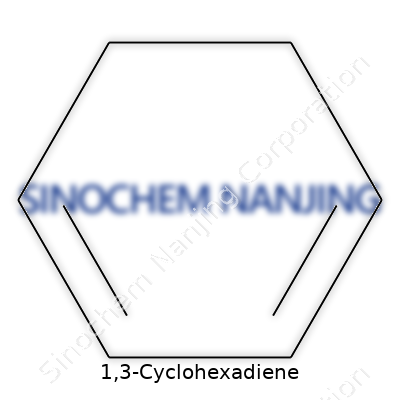
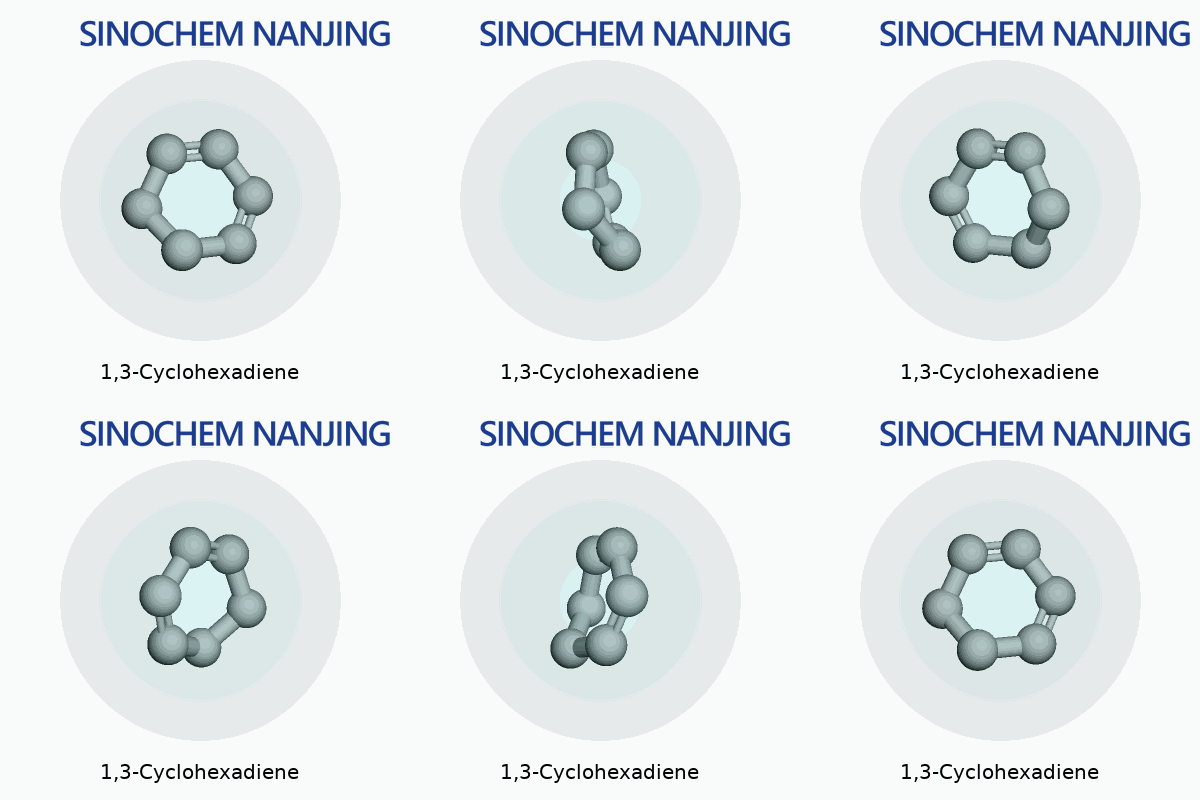
| Names | |
| Preferred IUPAC name | 1,3-cyclohexadiene |
| Other names |
1,3-Hexadiene, cyclic 1,3-Dicyclohexadiene Cyclohexa-1,3-diene |
| Pronunciation | /ˌwʌn,ˌθri.saɪ.kloʊˈhɛk.səˌdaɪˌiːn/ |
| Identifiers | |
| CAS Number | 592-57-4 |
| Beilstein Reference | 1209240 |
| ChEBI | CHEBI:36170 |
| ChEMBL | CHEMBL11648 |
| ChemSpider | 12398 |
| DrugBank | DB02184 |
| ECHA InfoCard | 100.037.777 |
| EC Number | 1.3.99.1 |
| Gmelin Reference | 828 |
| KEGG | C00881 |
| MeSH | D003442 |
| PubChem CID | 1011 |
| RTECS number | GW3150000 |
| UNII | Z9V0B44M4T |
| UN number | UN2256 |
| CompTox Dashboard (EPA) | `DTXSID7020233` |
| Properties | |
| Chemical formula | C6H8 |
| Molar mass | 80.13 g/mol |
| Appearance | Colorless to pale yellow liquid |
| Odor | aromatic |
| Density | 0.866 g/mL at 25 °C (lit.) |
| Solubility in water | insoluble |
| log P | 1.85 |
| Vapor pressure | 3.7 kPa (20 °C) |
| Acidity (pKa) | pKa = 25.4 |
| Basicity (pKb) | pKb = 10.48 |
| Magnetic susceptibility (χ) | -55.3e-6 cm³/mol |
| Refractive index (nD) | 1.475 |
| Viscosity | 1.04 mPa·s (20 °C) |
| Dipole moment | 0.41 D |
| Thermochemistry | |
| Std molar entropy (S⦵298) | 250.0 J⋅mol⁻¹⋅K⁻¹ |
| Std enthalpy of formation (ΔfH⦵298) | +110.6 kJ/mol |
| Std enthalpy of combustion (ΔcH⦵298) | -3267 kJ/mol |
| Pharmacology | |
| ATC code | 'V04CX36' |
| Hazards | |
| GHS labelling | GHS02, GHS07 |
| Pictograms | GHS02, GHS07 |
| Signal word | Danger |
| Hazard statements | H226, H304, H315, H319, H335 |
| Precautionary statements | P210, P233, P240, P241, P242, P243, P261, P280, P303+P361+P353, P304+P340, P312, P370+P378, P403+P235, P501 |
| NFPA 704 (fire diamond) | 2-3-1 |
| Flash point | -12 °C |
| Autoignition temperature | 440 °C |
| Explosive limits | 2.4–11.8% |
| Lethal dose or concentration | LD50 oral rat 5820 mg/kg |
| LD50 (median dose) | LD50 (median dose): 1270 mg/kg (oral, rat) |
| NIOSH | RN14000 |
| PEL (Permissible) | PEL (Permissible Exposure Limit) of 1,3-Cyclohexadiene: 200 ppm (TWA) |
| REL (Recommended) | '200 mg/m3' |
| IDLH (Immediate danger) | IDLH: 400 ppm |
| Related compounds | |
| Related compounds |
1,2-Dihydrobenzene Cyclohexene Cyclohexane 1,4-Cyclohexadiene |



