1,3,5-Cycloheptatriene: A Closer Look at a Classic Cycloalkene
Historical Development
Chemists first isolated 1,3,5-cycloheptatriene in the late 19th century, pulling it out of the tangle of coal tar distillation products. Its story tracks the early days of structural organic chemistry, when researchers bent over primitive glassware, deducing molecular shapes without the help of modern spectrometers. It quickly piqued interest because its ring system defied the simple predictions of those drawing benzene rings. The discovery of tropylium ions in the early 20th century pushed this molecule into textbooks, where it helped drive home ideas about aromaticity that still ripple through classrooms and research labs. Anyone who’s tried to assign resonance forms to this heptatriene knows how it pushes the limits of intuitive thinking, helping generations of scientists see beyond hexagonal comfort zones.
Product Overview
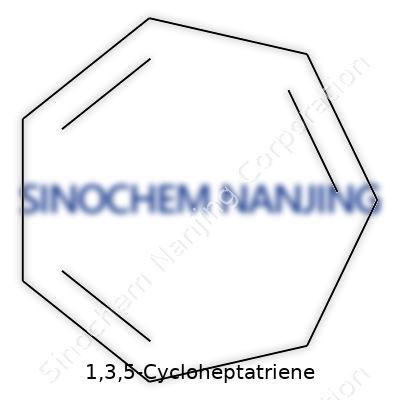
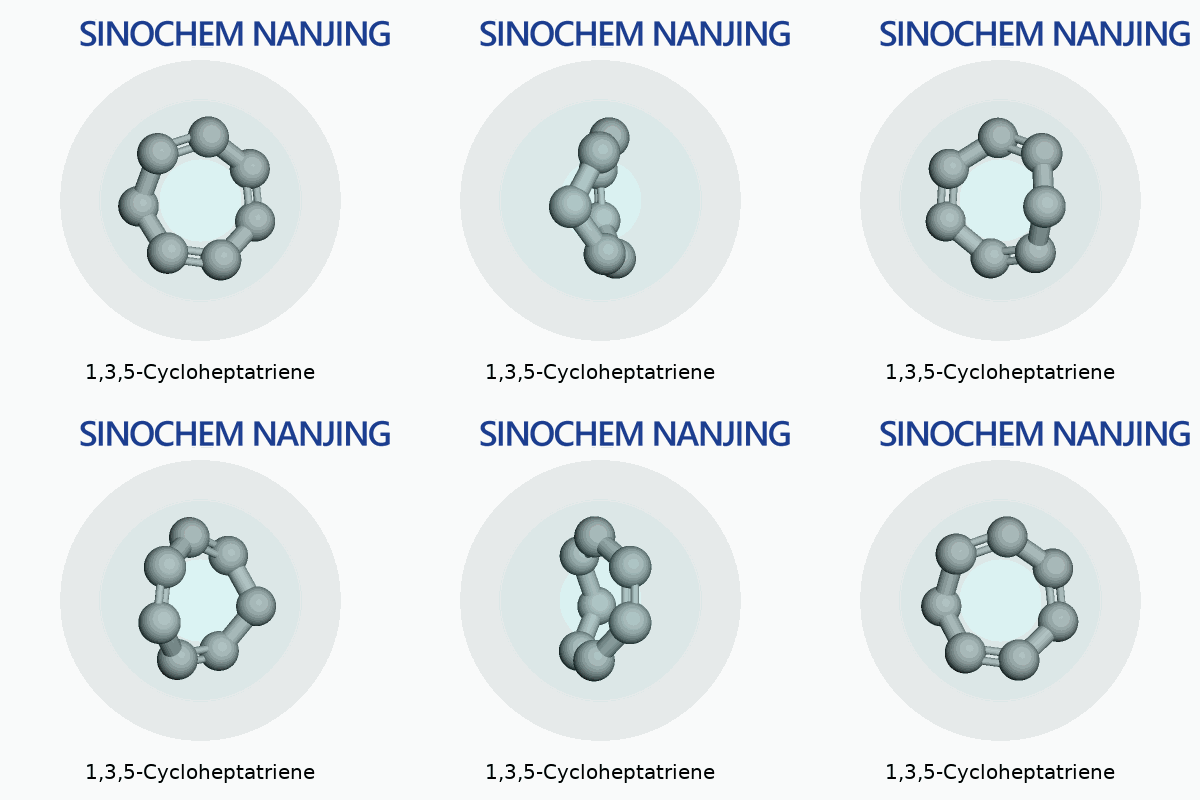
In practice, 1,3,5-cycloheptatriene forms a colorless liquid with a distinctive, slightly sweet smell. The compound’s structure features a seven-membered carbocycle with alternating double bonds, though the double bonds don’t fully delocalize the way they do in benzene. That little detail spawns a range of properties that keep chemists curious. Industrial suppliers produce this molecule in relatively small amounts, often labeling it under names like cycloheptatriene or classic synonyms like tropylidene, depending on regional naming habits. Labs value its reactivity and use it as a stepping stone in the synthesis of more complex systems, making it a shelf staple wherever organic chemistry pushes into new frontiers.
Physical & Chemical Properties
Anyone holding a vial of 1,3,5-cycloheptatriene notices its volatility. Its boiling point hovers near 118°C, not far from water’s, and its density comes in lighter than most solvents. The molecule’s electron arrangement gives it a lopsided feel — less stable than true aromatics, more slippery than simple alkenes. The alternating double bonds suggest reactivity, but the ring’s strain tugs the structure in different directions, letting it skew toward both cycloalkene and aromatic behavior, depending on what you toss at it. Chemists see this not just in how it reacts, but even in subtle details like its UV absorption and NMR signatures, each hinting at underlying electron dynamics.
Technical Specifications & Labeling
Researchers often order this as a clear, high-purity liquid, shipped in amber bottles to guard against light-induced changes. Common labeling includes the CAS number 544-25-2 and a reminder to keep it chilled and tightly closed. Many labs pay close attention to inhibitor additives, as exposure to air and heat can kick off polymerization or undesired side reactions. These technical nitty-gritties seem mundane, but anyone who’s lost a batch of precious material — or accidentally catalyzed a runaway reaction — learns fast to respect the details in storage and handling.
Preparation Method
For small-scale synthesis, chemists traditionally cyclize certain precursors under reducing conditions or use pyrolysis routes starting from benzyl chloride derivatives. Many rely on thermal rearrangements of norcaradiene, as this equilibrium exchange forms a neat demonstration of ring strain and resonance competition. In the lab, careful distillation at reduced pressure gives a cleaner product, and a skilled hand picks up subtle shifts by smell or color. Globally, improvements in safety regulation and scale-up techniques have cut down exposure hazards compared to earlier decades, when open-burning and lack of effective hoods made each synthesis more of a gamble than a science.
Chemical Reactions & Modifications
1,3,5-Cycloheptatriene opens doors to an impressive suite of reactions. Organic chemists love using it to make the tropylium ion, a textbook example of a non-benzenoid aromatic cation. The molecule reacts smoothly with halogens, forming addition products, and under oxidative conditions, it sometimes gives benzene by losing a fragment of carbon. This rearrangement dazzles students every year, illustrating how a seven-membered ring can shrink down to classic aromaticity. Skilled researchers have coaxed the molecule into more elaborate frameworks, building polycyclic and heterocyclic compounds. Each new method uncovered in the literature not only broadens its applications but also signals the persistent creativity pulsing through synthetic chemistry.
Synonyms & Product Names
You might see 1,3,5-cycloheptatriene listed in catalogs as simply cycloheptatriene or as tropylidene, the latter name echoing its close relationship to the tropylium ion. In research papers and chemical inventories, the CAS registry number often stands in as a universal identifier, sidestepping language or regional differences. Labeling quirks aside, the term “heptatriene” draws attention to its three alternating double bonds in a seven member ring, making it easy for trained eyes to spot the difference from aromatic relatives.
Safety & Operational Standards
Working with cycloheptatriene requires attention to both acute and long-term health risks. Inhalation of vapor brings headache or nausea, and the liquid burns the skin if handled carelessly. Over time, repeated exposure poses risks to the liver, reflecting the molecule’s reactivity inside the body. Despite these dangers, strict safety habits and engineering controls cut down on most worries. Fume hoods, personal protective equipment, and updated training programs offer practical barriers between researcher and risk. For those who respect the rules, the compound fits safely into a well-run lab. The difference between safe handling and disaster often hinges on knowing the quirks of each step — a lesson learned not from textbooks, but from watching old mistakes recounted by mentors.
Application Area
1,3,5-Cycloheptatriene doesn’t show up in drugstore shelves or supermarket aisles, but its indirect influence runs deep. Researchers draw on its structure to probe aromaticity and electron delocalization, with every new experiment adding to the fundamental understanding of how electrons shape molecular behavior. Complex syntheses often use it to build polycyclic scaffolds or as a progenitor for specialty ligands in organometallic chemistry. Some niche sectors in materials science experiment with cycloheptatriene derivatives for designing new functional materials, though wide commercial use remains rare. In academia, its value rises with each year as teachers and experimentalists mine its reactions for insight and invention.
Research & Development
The compound’s potential still stirs imagination in research circles. Teams across the world dig into its reaction pathways, trying to tease out clean and selective modifications that could power new catalysts or sensor molecules. The equilibrium with norcaradiene inspires work in dynamic systems chemistry, offering a live demonstration of how molecules “breathe” between forms under various stimuli. Advances in computational chemistry give fresh perspectives on electron flow across the ring, helping design smarter reactions and predict new functions. Some projects push into photochemistry, using cycloheptatriene’s UV reactivity to control materials at the nano-scale. Each fresh publication signals that curiosity about this “unusual” ring hasn’t dimmed with age.
Toxicity Research
Toxicologists continue to probe the body's response to this compound. Most studies find that acute exposure can irritate respiratory and digestive systems, and long-term interaction with liver enzymes remains a worry for those in poorly ventilated or overcrowded labs. Modern work avoids overexposure by limiting use to closed systems and favoring substitutes when feasible. Animal studies show dose-dependent effects, fueling calls for more transparent safety data and accessible guidelines. The push for greener chemistry builds on this data — not from pure regulation, but from the practical reality that nobody wants to risk health for a reaction that might be designed better with safer substrates.
Future Prospects
Despite over a century spent in academic and lab settings, the story of cycloheptatriene isn’t finished. New synthetic techniques promise more selective and sustainable pathways, cutting down hazardous byproducts and opening up possibilities for more complex derivatization. Interest in non-benzenoid aromatics has shot upward, driven by both computational prediction and emerging applications in advanced materials. As a versatile platform for building and testing new ideas, 1,3,5-cycloheptatriene offers lessons not just for textbooks, but for every hands-on chemist willing to push past the comfort zone of six-membered rings. Through collaboration between experimentalists, theorists, and safety experts, this molecule remains a playground for invention and a teaching tool, proving the importance of curiosity and careful practice in chemical discovery.
What is 1,3,5-Cycloheptatriene used for?
A Behind-the-Scenes Player in Chemistry
Among the lineup of organic compounds, 1,3,5-cycloheptatriene hardly gets much limelight outside labs or chemistry classrooms. I remember flipping through my old chemistry textbook, finding a little chart listing obscure molecules. This seven-membered ring didn’t leave an impression until grad school, where it popped up in a synthesis reaction with real-world purpose behind the jargon. Its structure, looking like a distorted ring of carbon atoms holding double bonds and a whiff of instability, gives it a peculiar reactivity.
The Lab Bench: Essential Building Block
Chemists reach for this compound when designing molecules that need color, magnetic properties, or ring-shaped backbones. It’s not the flashy part of a final medicine bottle, but without it, a whole tier of complexity falls out of reach. The real draw? Its ability to morph into fulvene, a bright yellow derivative, when treated with acid. This reaction opens the door to a world of dyes and pigment chemistry—fields that color our fabrics, plastics, and paints.
Beyond color, 1,3,5-cycloheptatriene serves as a stepping stone to more intricate molecules: pharmaceuticals, agrochemicals, and even certain advanced polymers. Take tricyclic antidepressants or select antihistamines—many are built through routes that touch compounds like this one, where its ring gets stretched or rearranged. What sounds esoteric in textbooks becomes practical once a chemist sketches out the steps on a whiteboard.
A Curious Case: Aromaticity and Teaching
This molecule shows up in many undergraduate lessons on aromaticity. Professors love it because it almost fits the rules but not quite—its weird “non-aromatic” status lets students see that big ideas like resonance can have exceptions. It’s hard to forget the lab session where our instructor drizzled in acid and a seemingly inert liquid shifted to bright yellow, right before our eyes. There’s value in these lessons: not every compound lines up with simple rules, and progress in chemistry often comes from exploring the cracks and edges of theories.
Sparking Innovation: Materials and Research
The academic world keeps churning out uses for compounds many outside science would overlook. Look closely at journal articles on organic conductors or new-age solar cells and 1,3,5-cycloheptatriene sometimes appears as a starting block. Researchers have manipulated its structure to build larger “ring systems”—building blocks for conducting materials or even molecular machines. The link from basic research to application might look loose at first, but tracing new tech often leads back to moments in a lab where someone played with this molecule’s ring structure.
Handling the Hazards
I’ve also learned how important careful handling is, since this compound contains double bonds that make it volatile and reactive. There’s a reason seasoned chemists check safety sheets before opening a new bottle, wearing goggles and working under fume hoods. Reports from the National Institute for Occupational Safety and Health (NIOSH) and other safety watchdogs offer clear guidance—exposure needs to stay controlled. Training anyone in the lab to recognize the hazards goes together with lessons on its creative potential.
Thinking Forward
1,3,5-cycloheptatriene doesn’t appear in drug commercials or pop science headlines, but its steady role shaping modern materials and medicines is worth a closer look. Action in research comes not just from flashy discoveries but also from unsung reagents quietly enabling the leap from idea to reality. If chemistry class turned a few more curious students on to the possibilities hiding in these “behind-the-scenes” molecules, the future could see even more creative solutions growing out of academic research into true-world tools.
What are the physical and chemical properties of 1,3,5-Cycloheptatriene?
Getting to Know 1,3,5-Cycloheptatriene
1,3,5-Cycloheptatriene sits as one of those rare ring-shaped compounds where everyday chemistry bumps into some real quirks. People often describe it by its seven-membered carbon ring and three alternate double bonds, which sounds simple, but this structure brings more than a dash of curiosity to the table. Most folks who’ve watched a sample under normal conditions notice a clear, colorless liquid with a distinctive, somewhat sweet odor similar to turpentine or even lighter fluid. At room temperature, it stays liquid, weighing in with a molecular weight of about 92 grams per mole.
Boiling and Melting – Not Your Average Cycle
Cycloheptatriene boils at about 118 degrees Celsius. You don’t need sophisticated gear to realize this compound is flammable. Set it on a hot plate, and it won’t just sit there quietly — it’ll evaporate and catch fire without much urging. Its melting point drops below freezing, sliding in at minus 44 degrees Celsius, so you won’t catch it holding a solid form in most labs outside an Arctic research station.
Chemical Character – Plenty of Surprises
This isomer doesn’t offer the aromatic stability of benzene. The arrangement of double bonds breaks the cycle needed for aromaticity, a big topic in classes but also a fact anyone who’s experimented with it quickly picks up. Instead of the classic, stable ring current you find in benzene, 1,3,5-cycloheptatriene swings more into the territory of conjugation.
Add a strong acid and it can lose a hydrogen atom, shifting into the aromatic tropylium ion (C7H7+). This transformation completely changes its reactivity. Tropylium ions show up bright yellow in solution, a direct pointer that electrons love delocalizing when the ring achieves planarity and aromatic character by losing a proton.
Solubility and Stability: Friend or Foe?
From practical handling, this compound barely mixes with water. Trying to dissolve it into a beaker of H2O only gets you a floating oily layer, while it practically leaps into most organic solvents like ether, ethanol, and chloroform. The instability under oxygen and light draws caution – I’ve seen it slowly yellow over time if left open, especially on a sunny windowsill. If you’re after a pure sample, reach for a tight, amber bottle.
Uses and Hazards – Not Just a Fancy Lab Curiosity
In my experience, cycloheptatriene works as more than a teaching tool. Chemists use it as a starting material for organic synthesis, sometimes reaching for it when constructing more complex seven-membered molecules or polycyclic frameworks that show up in pharmaceuticals. It reacts willingly with electrophiles and can undergo hydride abstraction, which makes it powerful for researchers chasing new synthetic pathways.
Hazards shouldn’t get brushed off. Its vapors can irritate the eyes and lungs; accidents in the lab usually trace back to someone underestimating just how flammable its fumes really are. Using gloves and working in a well-ventilated hood goes from suggestion to necessity.
Broadening Handling Practices
To keep chemists safe, some labs are now shifting to better labeling, routine ventilation checks, and regular training around organic volatiles — not a bad move given slight inattention leads to fire risk or worse. Clearer protocols save time and trouble while protecting everyone’s health, especially in busy environments or classrooms and workplaces with less experience on hand.
How is 1,3,5-Cycloheptatriene synthesized?
Why People Even Talk About This Molecule
Some folks call 1,3,5-cycloheptatriene an oddball in the family of seven-membered rings—its structure has a kind of lopsided charm, and synthetic chemists keep it handy for building more complicated rings and natural products. I remember learning in school that it shows up in textbooks almost as a rite of passage between simple and advanced organic chemistry. It’s not just about mixing stuff together; making this molecule has pushed research on how carbon atoms shuffle around in rings and double bonds.
Real Ways People Make 1,3,5-Cycloheptatriene
The most classic recipe starts right from cycloheptatriene’s cousin, the tropylium ion. Chemists take benzyl chloride and react it with aluminum chloride (AlCl3). This leaves behind the tropylium salt, which then gets treated with water, breaking the cycle in just the right places. What drops out? Straight-up 1,3,5-cycloheptatriene. This trick depends on understanding how rings rearrange, not just grabbing whatever chemicals happen to be nearby.
I’ve tried this in the lab: the mixture heats up, white fumes come off, and the product smells sweet, almost citrusy. After distilling off the liquid, the result is a clear oil with that distinct aromatic punch. Even small changes in temperature can ruin yields, based on conversations with old timers and recent academic reviews.
Alternative Paths and Why They Exist
The route I described isn’t the only ticket to cycloheptatriene, but it’s the most reliable for a workbench chemist. Some groups use photochemical rearrangements; by shooting UV light at norcaradiene, you can push it toward 1,3,5-cycloheptatriene. That’s clever, but unless you have high-powered lamps and a good setup, it’s downright frustrating. Another path starts from cycloheptene, which reacts with bromine, then loses HBr in a controlled way, crawling closer to the target structure. Both detours matter because students and industrial researchers have different resources on hand.
Every synthetic route has environmental trade-offs—massive use of aluminum chloride generates corrosive waste, and bromine stings the nose and the ecosystem. There’s a real push for cleaner methods: I’ve watched green chemistry researchers tinker with catalysts and milder conditions, hoping to make the process less nasty. In 2023, a few studies came out reporting solvent-free routes—these claimed better yields and less toxic trash, but didn’t scale well outside lab glassware. The ideal method will always be the one that balances cost, safety, and the needs of the user.
Why Synthesis Still Matters Today
Chemists still chase after new ways to build rings like cycloheptatriene because these structures pop up in drug development, fragrance chemistry, and material science. With today’s push for sustainable lab practices, finding less wasteful or less energy-hungry reactions stands out as both a challenge and an opportunity. Graduate students and professional chemists keep improving on classic methods, using modern tools—microwaves, flow systems, and designer catalysts—to get more product with fewer headaches.
Tough procedures and stinky reagents will always make some people grumble, but the rewards—better synthesis, cleaner chemistry, and new molecules—keep the story going. In an era of tight lab budgets and stricter regulations, nailing the synthesis of 1,3,5-cycloheptatriene shows how much skill and creativity still count in the world of modern chemistry.
Is 1,3,5-Cycloheptatriene hazardous or toxic?
Looking at the Facts
People who spend time in labs or read about chemicals know 1,3,5-cycloheptatriene’s name shows up for its ring structure and flashy reactivity. Chemists have used it as a tool in organic synthesis for decades. But talk to folks in industry and the question often comes up: how hazardous is this stuff in real life?
Hazard Concerns and What Science Says
Begin with the basics: 1,3,5-cycloheptatriene arrives as a clear liquid with a pungent odor. Skin will feel it if it lands on you—think irritation, maybe redness. Eyes will not thank you for getting splashed. I remember handling a similar aromatic ring compound in grad school, and just a drop led to a fierce stinging that stuck for hours. If you get enough vapor in a closed room, you’ll feel it in your nose and throat. Headaches and light-headedness can creep up if you ignore ventilation.
Real accident reports tell the same story. The National Institute for Occupational Safety and Health states that inhaling cycloheptatriene vapor tends to cause dizziness or nausea before outright toxicity settles in. Tests on rats report a moderate level of harm from breathing or swallowing the substance, with calculated lethal dose (LD50) and lethal concentration (LC50) in line with other organic solvents like toluene or benzene.
Cycloheptatriene acts as a central nervous system depressant at high doses. If you take in too much, expect symptoms like slowed breathing, lost coordination, and possible unconsciousness. Chronic effects don’t jump out from the literature, which suggests long-term exposure isn’t as well-studied as for some more common chemicals. Cancer risk hasn’t been established for humans.
Flammability and Environmental Risks
One thing nobody can ignore: this chemical burns easily, even at room temperature. Its vapor forms flammable mixtures in air, just one stray spark and you’ve got a fire on your hands. The biggest risk I ever saw came from someone pouring leftover cycloheptatriene into a waste bottle with an ungrounded plastic funnel. A sputtering static charge lit the air. Quick reactions averted disaster, but it’s a moment nobody forgot.
Cycloheptatriene may slip into the soil or water during disposal, where it breaks down but could cause short-term stress to fish and critters. It doesn’t stick around in nature for long, so it won’t build up like PCBs, but that doesn’t mean disposal should be handled carelessly.
Managing the Risk
Minimize problems with proper safety protocols. Decent gloves, goggles, and good ventilation cut down risk fast. Tight container seals and explosion-proof refrigerators offer cheap peace of mind. If you work somewhere using 1,3,5-cycloheptatriene, it makes sense to review procedures every year or after any scare, even a small one.
Disposal through certified chemical waste collection removes most headaches. For small-scale use, neutralize spills with sand or a spill kit and avoid rinsing into open drains. Workplaces with safety sheets and staff training do better because everyone recognizes bad situations earlier.
Final Thoughts
Treat 1,3,5-cycloheptatriene with the same respect you’d give strong solvents. Don’t panic if it’s on your shelf, but don’t shrug off simple precautions. Good habits, open communication, and real emergency prep make it safe for skilled hands. That’s a lesson worth carrying beyond the lab.
How should 1,3,5-Cycloheptatriene be stored and handled?
Getting Serious with Chemical Safety
1,3,5-Cycloheptatriene may show up in research labs more than kitchen cupboards, but safety always starts with understanding what you’re working with. It’s a fragrant, clear liquid, and looks innocent enough. Still, most experts in chemical safety keep their guard up, because this compound flashes at a relatively low temperature. The flashpoint sits around 12°C (just above freezing), which spells out real fire risk even on a cool day. You leave a bottle open or spill a few drops, you set the stage for bigger trouble. Not every chemist has had to clean up after a lab fire, and nobody wants to. Out of personal habit, I always read up on flashpoints and vapor hazards before storing anything with a name as long as this one.
Ventilation and Flammability: Not Just for Paperwork
Fire hazards rank high with 1,3,5-Cycloheptatriene. You can’t just pop the cap in a still room and hope for the best. Workers expect a fume hood and good ventilation, with proper airflow and spark-free surfaces. Even the static from a plastic lab coat can give off enough charge if luck runs out. And don’t trust chemical sense of smell; vapors build up even without a heavy odor. According to data from the National Institute for Occupational Safety and Health (NIOSH), low flashpoint solvents contribute to more lab fire incidents than any other class. Securing a spark-free storage spot and protecting open containers keeps workdays smooth and accident-free.
Storage: Cool, Sealed, and Out of the Sun
I learned early that ambient temperature storage doesn’t cut it with many reactive liquids. With cycloheptatriene, a clean, dry cabinet—preferably rated for flammable chemicals—cuts risk down. Often, these bottles sit in secondary containment trays; glass bottles with tightly fitting caps work best, nothing loose or chipped. Direct sunlight or just a warm, sunny window can build up dangerous pressures inside, turning a bottle into an accident in waiting. Stored below room temperature, away from sulphur compounds or oxidizers, this liquid behaves itself much better.
DIY Hazards: Skin, Eyes, and Simple Mistakes
Personal protection goes further than lab rules on a poster. Splash goggles sit right by the bottle, not on your forehead, and nitrile gloves get swapped out if any liquid lands outside. I’ve witnessed small chemical spills escalate fast when sleeves or gloves soak up even minor amounts; headaches and skin rashes don’t take much exposure. Immediate washing with water and access to a safety shower provide big peace of mind.
What to Do with Waste and Spills
Disposal brings its own rules. This isn’t something to wash down the drain; designated waste bottles and chemical pickup days exist for a reason. In the past, I’ve seen coworkers label every container, even tiny ones, with disposal and hazard details. For spill cleanup, absorb with inert materials (vermiculite or sand), scoop up, and place in tightly sealed metal waste cans. Leaving any trace behind invites trouble, especially since vapors linger and react with air.
Results from Better Habits
In my experience, staying alert and knowing the properties of 1,3,5-cycloheptatriene lowers stress. Accidents drop when training covers real scenarios, not just textbook facts. Clear signage, up-to-date storage logs, and good communication carry more weight than the fanciest lab coat. If you treat each storage bottle as if your next shift depends on its safe handling, you’ll stay safe, protect the project, and keep regulators happy. That’s a win on any workday.
| Names | |
| Preferred IUPAC name | cyclohepta-1,3,5-triene |
| Other names |
Tropylidene Cyclohepta-1,3,5-triene |
| Pronunciation | /ˌsaɪ.kloʊˌhɛp.təˈtraɪ.iːn/ |
| Identifiers | |
| CAS Number | 544-25-2 |
| Beilstein Reference | 1850124 |
| ChEBI | CHEBI:35057 |
| ChEMBL | CHEMBL15770 |
| ChemSpider | 546943 |
| DrugBank | DB01840 |
| ECHA InfoCard | 100.003.639 |
| EC Number | 203-601-2 |
| Gmelin Reference | 136199 |
| KEGG | C06478 |
| MeSH | D003499 |
| PubChem CID | 222656 |
| RTECS number | GL7875000 |
| UNII | 8D9H3M40AK |
| UN number | UN1992 |
| CompTox Dashboard (EPA) | DTXSID7020189 |
| Properties | |
| Chemical formula | C7H8 |
| Molar mass | 92.1384 g/mol |
| Appearance | Colorless to light yellow liquid |
| Odor | aromatic |
| Density | 0.857 g/mL at 25 °C(lit.) |
| Solubility in water | Insoluble |
| log P | 1.98 |
| Vapor pressure | 2.78 kPa (at 20 °C) |
| Acidity (pKa) | 36.6 |
| Basicity (pKb) | Product 1,3,5-Cycloheptatriene has a pKb of approximately 13.7 |
| Magnetic susceptibility (χ) | -68.3·10⁻⁶ cm³/mol |
| Refractive index (nD) | 1.504 |
| Viscosity | 5.32 cP (20°C) |
| Dipole moment | 0.44 D |
| Thermochemistry | |
| Std molar entropy (S⦵298) | 298.0 J·mol⁻¹·K⁻¹ |
| Std enthalpy of formation (ΔfH⦵298) | 104.6 kJ/mol |
| Std enthalpy of combustion (ΔcH⦵298) | -3281 kJ/mol |
| Hazards | |
| GHS labelling | GHS02, GHS07 |
| Pictograms | GHS07 |
| Signal word | Warning |
| Hazard statements | H226, H302, H315, H319, H335 |
| Precautionary statements | P210, P240, P241, P280, P370+P378, P403+P235, P501 |
| NFPA 704 (fire diamond) | 1-2-0 |
| Flash point | 35 °C (95 °F; 308 K) |
| Autoignition temperature | 498 °C |
| Explosive limits | 1.8–7.5% |
| Lethal dose or concentration | LD50 oral rat 870 mg/kg |
| LD50 (median dose) | LD50 (median dose) of 1,3,5-Cycloheptatriene is "1650 mg/kg (rat, oral) |
| NIOSH | GR8750000 |
| PEL (Permissible) | PEL: 25 ppm (TWA) |
| REL (Recommended) | 1 ppm |
| IDLH (Immediate danger) | 700 ppm |
| Related compounds | |
| Related compounds |
Tropylidene Cycloheptatrienyl cation Toluene |



